How can a just green transition be addressed?
Recent research shows that two main approaches dominate when it comes to addressing the just green transition; one focusing on social justice on the labour market and one focusing on social justice to advance the climate agenda (Cedergren et al. 2022). Below are some examples of initiatives to put a just green transition on the agenda.
In the international context, the OECD suggests a comprehensive approach. The ILO Guidelines for a Just Transition (ILO 2015) include nine policy areas that should be addressed to achieve a just green transition: macroeconomic and growth policies, industrial and sectoral policies, enterprise policies, skills development, occupational safety and health, social protection, active labour market policies, rights, social dialogue and tripartism.
Both the EU and ILO recognise the potential and benefits of green collective bargaining in tackling the just transition, including green clauses for skills development and sustainable environmental management (European Economic and Social Committee, 2023; ILO, 2023).
The United Nations Development Programme (UNDP) uses the concept of the just green transition as a means of delivering on the Paris Agreement. That includes providing a framework for countries on Show to tackle the just green transition, covering the key elements of increasing awareness of the principles of a just green transition, strengthening the ability to engage in just transition processes and increasing the capacity to implement just transition practices (UNDP, 2022).
The Intergovernmental Panel on Climate Change (IPCC) also recognises just transition as a key element (IPCC, 2022). The UNDP reports that 38% of the 170 countries that submitted their National Determined Contributions (NDC) to the Paris Agreement referred to a just transition in their plans (UNDP, 2022). However, there is always a risk that social aspects of the green transition may be overshadowed by economic and technical imperatives, as was shown in a recent study of Just Green Transition Plans in Sweden (Moodie et al. 2021).
The European Commission has suggested strengthened social dialogue to manage a just transition (European Commission, 2023) and there are several examples of how the green transition and a just green transition have made their way into policies in relation to education and training. The European Commission refers to the green transition and digitalisation as twin transitions. That is also reflected in the New Skills Agenda, the five-year plan presented in 2020. The agenda aims to strengthen sustainable competitiveness as set out in the European Green Deal, ensure social fairness, increase resilience and put an emphasis on skills for the green and digital economy.
Cedefop is the European Union’s centre for the development of vocational training. Beyond technical skills needed for the green transition, it recognises that the greening of jobs will cut across occupations and sectors. Vocational education and training (VET), including both short-term tracks and solutions and long-term development responding to skills needs at all levels, will be needed with the aim of employability and leaving no one behind. Cedefop (2022) defines skills for the green economy as “the knowledge, abilities, values and attitudes needed to live, work and act in economies and societies seeking to reduce the impact of human activity on the environment”.
In the Nordic context, the Nordic model – with the key elements of responsible macroeconomic policies, collective bargaining and universal welfare systems – has played a crucial role in previous socio-economic transitions. Long-term public investment in education has contributed towards the preparedness of the Nordic Region for crises and structural changes. Mobilising qualifications through continuous and coordinated facilitation and access to upskilling and reskilling of the labour force is a critical factor for the future of work in the Nordics (Alsos and Dølvik, 2021).
The Nordic trade union movement has also engaged in collaboration on a just green transition. In the project “The Road Towards a Carbon-Free Society – A Nordic-German Trade Union Cooperation on Just Transition”, trade unions from Denmark, Finland, Iceland, Norway and Sweden drew up a joint report on a just green transition through the Council of Nordic Trade Unions (NFS) in collaboration with the Friedrich-Ebert Stiftung (FES) and the German Trade Union Confederation (DGB).
At the national level, all Nordic countries are engaged in tackling not only the green transition but also the just green transition. The impact of the green transition on the labour market and jobs – as well as the concept of a just green transition – is generally taken into consideration in the climate councils’ work and reports. For example, in Finland the Climate Change Panel is conducting an ongoing study on the just green transition and in Norway, the 2050 Climate Change Committee has deemed a just green transition to be one of 10 priority areas.
Learning about the impacts
Learning about the impacts of the green transition on the labour market is essential in order to provide adequate support measures, such as education and training and this is also a focus for e.g. OECD. In Norway the government has launched several initiatives, such as “Better growth, lower emissions” – the Norwegian Government’s strategy for green competitiveness, which provides a framework for value creation and high employment through the transition to a low-emission society with inputs from various stakeholders. The Norwegian committee on skills needs (Kompetansebehovsutvalget), whose latest report focuses on skills development and labour needs within the context of the green transition and social justice. Furthermore, the annual Norwegian YS Arbeidslivsbarometer focused in its latest report on motivation and challenges of upskilling on the labour market, including in relation to the green transition (2023).
Other examples are the Skills assessment for the future needs of businesses in Iceland, conducted by the Icelandic Association of Industries, and a report on the possible effects of automation of jobs by the Committee on the 4th Industrial Revolution and Statistics Iceland.
The Swedish Trade Union ILO describes which sectors, jobs and professions are impacted most by the green transition in Färdplan Sysselsättning. It estimates, for example, that while four industry sectors stand for half of the CO2 emissions in Sweden, they only represent 2% of the workforce. It also estimates that 100 000-250 000 new jobs will be created as a result of the green transition and that more jobs will go greener. However, it acknowledges that future scenarios are difficult to estimate, not least since they are also dependent on strategic political choices.
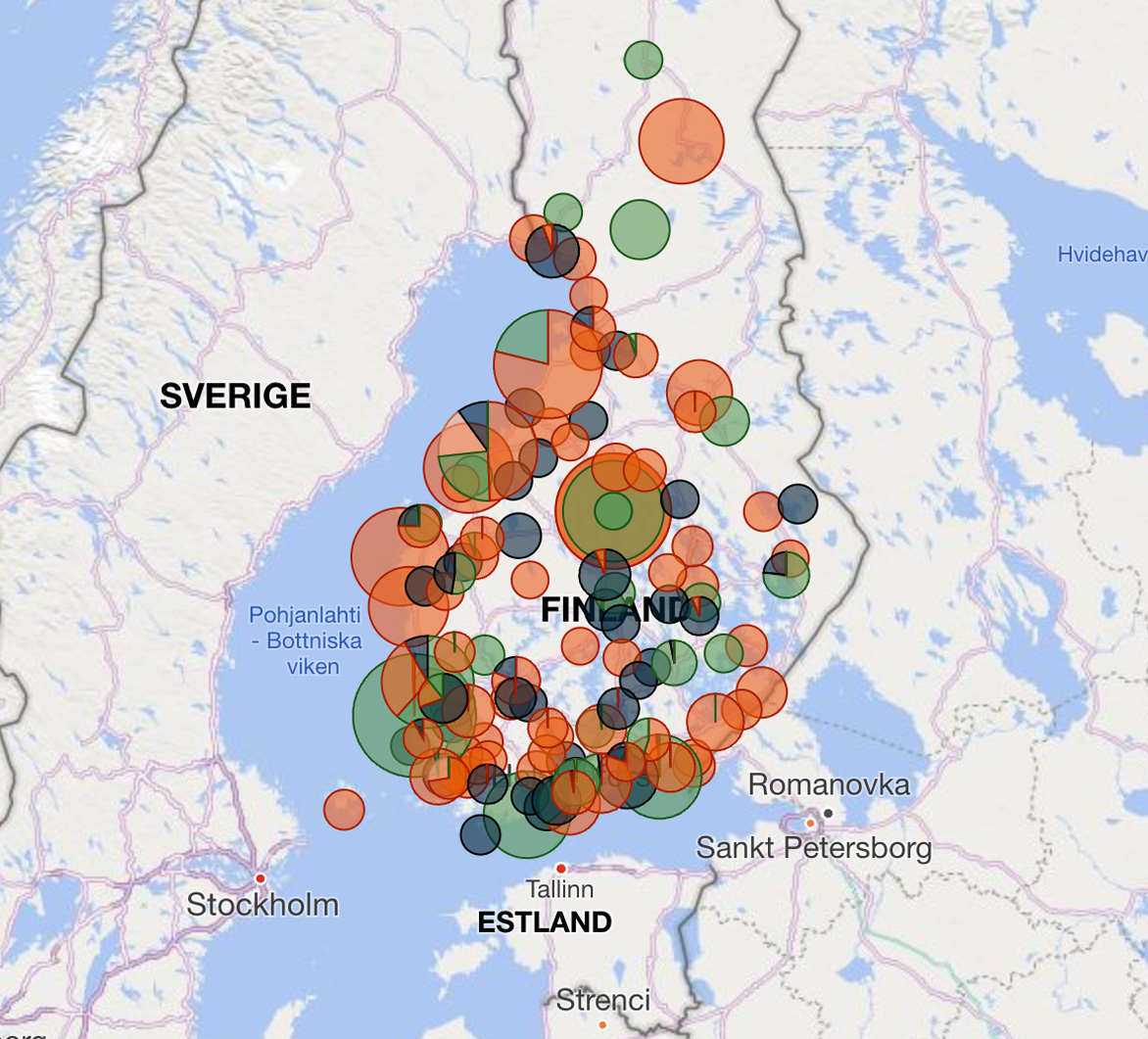
In Finland, the Confederation of Finnish Industries has developed a digital tool to display estimations in real-time of future skills needs relating to green investments.
To showcase green investments in Finland, the Finnish Confederation of Industries has developed a GIS tool and dashboard displaying more than 260 new green investments and the expected number of jobs associated with them.
https://ek.fi/en/green-investments-in-finland/
https://ek.fi/en/green-investments-in-finland/
Collaboration to enhance a just green transition
In the Nordic countries, examples can be found of joint platforms for addressing matters of sustainable development and climate change, involving representatives from the tripartite actors, as well as other actors.
One example is the National Council on Sustainable Development in Iceland, which was formed in 2022 and includes representatives from the business sector and unions, ministers, the parliament, municipalities and NGOs. The Council forms part of the cooperation platform Sustainable Iceland, which also includes specialists from the relevant ministries and Statistics Iceland and is tasked with boosting cooperation and multi-sectoral involvement “to ensure that a just transition in all areas of society is a guiding principle in all policy making and actions” (Prime minister´s office, n.d.). The Icelandic Macroeconomic Council, a cooperation between the leaders of government and social partners, also addresses matters related to the just transition.
The climate partnership in Norway, and the Norwegian Green Alliance with the EU, established in 2023, is set to enhance cooperation on the green transition between Norway and the EU, further supporting job creation in the renewables sector in Norway.
Another example from Norway is the Council of Just Transition (Rådet for rettferdig omstilling i arbeidslivet) in Norway. Set up by the Minister of Climate and Environment in 2022, the council engages in tripartite dialogue at the national level, and also encourages bipartite discussion on matters related to the green transition between trade unions and employers' organisations.
In Finland, the Climate Policy Roundtable is an advisory body led by the Prime Minister and includes representatives from the social partners, i.e. the government, industry organisations and trade unions, as well as from other stakeholders and interest organisations, such as those representing youth and the environment. The council meets five to seven times per year to discuss climate policy plans such as the EU Fit for 55 package, the new Climate Act that entered into force in 2022 and other sectoral climate change plans. There is a particular focus on a just green transition, i.e. on ensuring that the transition to a carbon-neutral society is made in a way that is socially and regionally just.
To extend knowledge in this field, it is also common to look to best practices in other parts of Europe and the world. A report by the Central Organisation of Finnish Trade Unions (SAK) titled A Fair Climate Policy for Workers – Implementing a just transition in various European countries and Canada is an example of that approach.
The Danish Citizens Assembly on the Climate Arena, which has resulted in 119 recommendations to policymakers (see fact box), is an example of engaging with a larger community.
The Danish Citizens` Assembly on the Climate Arena is a representative group of 99 citizens that have been appointed by the Danish Ministry for Climate, Energy and Utilities to provide input on the national climate action plans. The 119 recommendations in the first two reports related to leadership and citizen participation, the roadmap and financing of the reduction of CO2 emissions, as well as the transport, agriculture, energy and construction sectors.
Towards an agenda for a just green transition in the Nordic Region
Apart from the international conventions and resolutions engaging with a just green transition, there are also examples of initiatives, agendas and roadmaps from around the Nordic countries that could be learnt from. Strengthening social dialogue and including issues related to the environment and climate mitigation measures in collective bargaining could be another way forward (see fact box).
The Danish Trade Union Confederation (FH), for example, has proposed a climate action plan called “Green Transition Together”, which it also calls a master plan as it targets all major sectors and includes the three major principles of solving challenges faced by society, creating more good jobs and ensuring social justice. The confederation has also developed 10 priorities under the heading “A Fair Europe for Workers”. One of those priorities is a just green transition, with an emphasis on vocational education and training, as well as health and safety.
In Iceland, the Icelandic Confederation of Labour (ASI) identified 9 priorities and 10 tasks for "The future of the labour market 2022-24", including pushing for investment and governmental levers to support a just transition and the creation of diverse and good green jobs, as well as making the public and society aware of a just transition and its importance (ASI, 2022).
In the interest of achieving the goal of a carbon-neutral Finland by 2035, the Finnish government launched "13 sector-specific low-carbon roadmaps" developed in cooperation with operators in each sector, with the aim of identifying the scale, costs and conditions of the climate measures needed, including changes for employees, such as future skills and competence needs.
Fossil Free Sweden is another example which was initiated and is supported by the government. It involves more than 500 actors from industry, government and civil society who are engaged in working with 22 roadmaps for various industry sectors.
GREEN COLLECTIVE BARGAINING
Green collective bargaining means including environment and climate mitigation measures in the collective bargaining processes and agreements. One of the key areas is usually that of information and consultation processes aimed at reducing environmental harm or CO2 emissions. While some agreements include clear goals as well as specific details of how to attain them, agreements setting out only vague intentions are also common.
Areas typically covered in the agreements may include green representatives or committees in the workplace, support for the use of climate-friendly transport and green procurement and waste management at the workplace or in the industry. It is generally important that the parties are strongly committed and that the agreements are adapted to the respective national and local institutional contexts (Bjergene & Hagen, 2020).
The ILO Guidelines for a Just Transition promote the inclusion of environmental provisions in collective bargaining (ILO 2015, 2023c). In 2023 the European Economic and Social Committee issued an opinion on green collective bargaining as a means of supporting environmental protection and combating climate change. It suggested including clauses such as protection of workers from the effects of climate change and impacts of the green transformation on companies’ activities in terms of work structure, changing occupations and skills.
Collective bargaining is an essential part of the Nordic labour market model and includes national-level and local-level/workplace bargaining. By international comparison, the Nordic Region has a high ratio of employees covered by collective agreements. Differences between the Nordic countries with regard to collective bargaining relate mainly to institutional factors, such as level of trade union membership, how employers are organised and the scope of the collective agreements.
Final remarks
The green transition is underway in the Nordic Region, and ensuring that the transition is just enjoys strong support in the Nordic countries. Hopefully this report can inspire the tripartite discussions on the next steps towards a embracing the just green transition on the labour market in the Nordic Region.