Photo: Robert Bednarczyk / Norden.org
Gender and youth engagement in sustainable development
Patterns of engagement in nonprofit organisations
Focus group learnings
On 13 August 2023, a workshop was held with the involvement of 21 young participants (four of whom identified themselves as male) during ReGeneration Week in Mariehamn, Åland, to discuss issues of inclusion in youth organisations that focus on climate change. The participants came from ten different countries, namely Denmark, Estonia, Finland, Germany, Hungary, Iceland, Latvia, Lithuania, Poland and Sweden. A large majority identified themselves as belonging to their country’s majority culture (two identified themselves as belonging to a minority culture and one as foreign-born). While there was a relatively even spread across places of upbringing (from rural areas to capital areas), a relatively small proportion (5) had parents with an academic background and most (16) identified their parents as working class.
The discussion in the focus group revolved around three main questions: 1) The participants’ own motives for getting involved in the climate movement, 2) Why others with a similar background do not get involved and 3) What steps the movement can take to recruit and include people from groups that are not already committed. There was consensus in the group that diversity is a prerequisite for solving the challenge of climate change, for example through wider representation in teams. Part of the problem lies in the fact that many people do not have their voices heard; that mainly concerns categories other than gender, although there is also underrepresentation of men, which is deeply rooted in masculinity.
The traditional masculinity culture is a big challenge globally and works against empathy and caring values. It is anti-emotion and anti-environment and all about sustaining an unsustainable lifestyle, using big petrol-driven cars, eating meat etc. We need to show alternatives for men and encourage emotions!
While the participants’ own motives for getting involved could be anything from the nature of their upbringing (mindful parents, closeness to nature etc.), university studies or new like-minded acquaintances through to growing anger towards “the system” (injustice, lack of equality, climate change) and a desire to change society (frustration/hope), various types of barriers were also addressed. To a large extent, involvement is related to social class and regionality. Educational background plays an important role, but so too does having the financial means to spend the time required to be involved in a movement. (At the same time, it was emphasised that there are many privileged students who are not prepared to change their lifestyle.) Cultural exchange and meeting people with different experiences and ideas can inspire change. That is less easy to achieve in rural areas or in smaller towns. Some argued that while farmers may be experiencing the consequences of climate change, they tend to complain about policymakers failing to see their problems and needs, rather than get involved in the climate movement themselves.
Survey results
The issues raised in the focus group were further investigated through a survey in spring 2024, with 218 respondents from the five Nordic countries, all of whom were involved in various youth organisations.
Denmark n=49, Finland n=35, Iceland n=17, Norway n=53, Sweden n=62, other n=2.
The UN definition of young people is 15-24 years, while for statistical purposes it is common to define young adults as those aged between 18 and 34. In 2024, people belonging to Generation Z are approximately 12-27 years old (cf. Tyson et al., 2021).
Likewise, there was a relatively even distribution of places of upbringing among the respondents; 23% had grown up in a rural area, 28% in a small town (below 15,000 inhabitants), 29% in a relatively large town (over 15,000 inhabitants) and 19% in a capital area. By contrast, a large majority (79%) identified themselves as belonging to their country’s majority culture, a significantly smaller proportion (15%) as belonging to a minority culture and even fewer (6%) as foreign-born. Interestingly, the distribution between those three categories was very similar to that of the focus group. It is striking that the proportion of foreign-born people in particular is far below the average for the population in the Nordic countries.
The latest data for the Nordic countries on the proportion of foreign-born individuals is 14% in Denmark, 8% in Finland, 20% in Iceland, 17% in Norway and 20% in Sweden. SeeState of the Nordic Region 2024 from Nordregio. https://nordregio.org/publications/state-of-the-nordic-region-2024/
While there was very even distribution among the respondents between those whose parents had an academic educational background (49%) and those whose parents were identified as working class (51%), the respondents themselves can very much be described as highly educated (82% were attending or had attended an academic education, while 18% were attending or had attended a vocational secondary school). Among those in higher education, the largest proportion were studying social sciences and humanities (43%), followed by science, technology, engineering and mathematics (STEM, 20%) and business, economics and law (19%).
Other fields were medicine, psychology and nursing (8%), teacher training (5%) and arts and crafts (5%).
When the respondents were asked to choose three out of ten societal issues that were most important to them, the ranking was as follows:
- Climate and environment (58%)
- School and education (53%)
- Healthcare and social care (44%)
- Economic equality (38%)
- Gender equality and LGBTI (36%)
- Migration and integration (17%)
- Lower taxes and freer markets (16%)
- Fighting racism (15%)
- Security and military defence (14%)
- Police and law enforcement (8%)
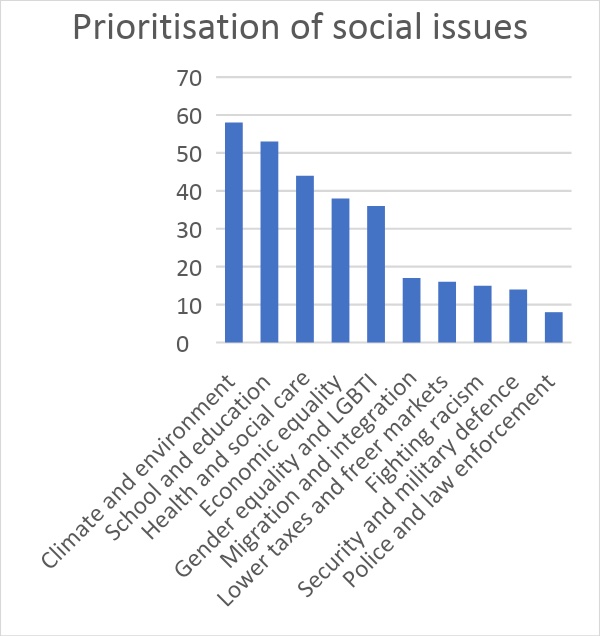
Broken down by gender, 63% of female respondents ranked climate and the environment among their top three issues, compared to 54% of males and 43% of those who identified themselves as non-binary. That can be compared with figures from Sweden. In its generational report, the Youth Barometer presented sex-disaggregated results based on its survey question about which social issues young people (n=16,295, age 15-24 years) prioritised. While environmental and climate issues were considered the second most important issue overall, after healthcare and social care, the difference between female and male respondents was among the largest (both environmental and climate issues and healthcare and social care at 19%, after gender equality at 40%, which females accorded a higher priority to and energy policy at 21%, which males accorded a higher priority to) (Hoffman & Åkerström, 2023).
It is possible that the 218 results from this report’s survey mainly say something about who responds to such a survey, but they may also reflect the representation of different groups in society among those involved in the organisations. It should be emphasised that the organisations in the survey were not limited solely to environmental organisations, but also included sports, outdoor, cultural and student associations, organisations for the promotion of women’s, LGBTI and disability rights, as well as political and religious youth associations and more. It would undeniably be interesting to follow up the findings of this survey with more thorough studies of young people’s involvement in such nonprofit organisations in terms of categories such as gender, class, migration background and cultural affiliation.
The respondents’ motives for getting involved in their organisation and staying involved differ. For some respondents, the reason for staying involved differed from what got them involved in the first place. For some, getting involved happened by chance and they continued on that path because it felt meaningful or stimulating, while others joined – some at a very young age – because their parents, older siblings or friends were involved.
It was somewhat of a spontaneous decision. I was invited to a general meeting to fill a spot. During the voting for new board members, the only person to run for treasurer was not voted in, so the position was not filled. After a lot of thought, I decided “why not” and went up and gave an improvised speech. In no way do I regret my decision and I think it’s one of the best things that has happened to me.
There are those who became involved out of concern about climate change or because of injustice and discrimination that they had either suffered themselves or seen in society, with the desire to contribute to social or political change being the motive for starting out on that path.
Because I come from a rural area and from a family of farmers and factory workers, I have always known that the only way you can make a change is to organise and do it yourself. Our local village suffered cuts in finances when I was young and at one point my local school was shut down. Seeing my parents engage in the battle to keep the school made me realise the importance of organising and working politically to change society. Growing up in a working-class home, alongside many immigrant friends, also made me aware of how unfair the world truly is, even in one of the richest countries in the world … In recent years, I have also discovered that I am of forest Finn descent and this heritage has fuelled me to keep fighting for equal rights and against environmental change.
Others saw the commitment as a way to gain experience and learn new skills, a way to put their education into practice or to make contacts and acquire credentials for their CV. In some cases, involvement is for reasons of personal development, making new friends or having the opportunity to practice music, sports or other interests, as well as a way to contribute to making other people’s lives better and more meaningful.
There were of course multiple reasons for joining. One of the main ones was the craving for a feeling of doing SOMETHING in the “service” of people. I also wanted to educate myself by joining my organisation: by being involved weekly in topics that I wanted to educate myself in, I would surely have growth in understanding.
Learnings from organisations working on sustainability
In parallel with the focus group and the survey, six interviews were conducted with representatives of youth-oriented organisations active in the green transition across the Nordic region. Unlike long-established, nature-oriented organisations – such as the scout movement or associations for nature conservation – these were formed after the turn of the millennium, most of them during the last decade. They all differ in various respects, both in terms of type of organisation and way of working, ranging from large membership organisations to networks, committees and nonprofit enterprises. Hopefully, those differences can help to clarify different ways of tackling challenges related to gender and engagement. The findings of those interviews are presented below. First a description is given of the structure, activities and outcomes of their work, followed by their approaches to inclusion and recruitment of volunteers or members in a separate chapter.
Frej (DK)
Frej (Tænketanken Frej), is a nonprofit association that was established in 2016 with the aim of helping to make Denmark a more ecologically sustainable food nation by engaging young people (“generation sustainability”) in dialogue with food producers. Frej has its roots in a student association at the University of Copenhagen, which organised debates on food policy topics across various fields of study and fought to replace the silo thinking of individual studies with broader collaboration. Today, Frej consists of more than 40 volunteers and a secretariat of 18 employees, a board of directors, an advisory board and a partnership network consisting of more than 60 partners for sustainable action. Among those partners are large companies, smaller businesses and producer organisations, as well as nonprofit organisations devoted to climate, environmental and animal welfare issues.
A large part of the organisation’s work involves engaging young people. The employees at the secretariat provide a framework for those concerned to develop and run various projects. That may involve organising events such as panel debates and workshops, participating in democracy festivals (folkemøde), running a podcast or producing other awareness-raising materials in the form of videos or texts for the organisation’s website (Vidensunivers). The organisation is also strongly engaged in social media, especially Instagram. Its marketing to attract more young people is aimed at people who are thought likely to take an interest, for example those who have just moved to a bigger city or have just started their university studies. Most of the volunteers are women, well-educated and city dwellers; those studying natural sciences or economics, for example, are a minority. It has been a deliberate priority to target the young “generation sustainability”, rather than trying to convince those who do not already have an interest.
The best ambassadors are the volunteers themselves; peer-to-peer communication is the most effective. Volunteers are passionate and that is the most persuasive.
One important activity that Frej organises is that of networking meetings with stakeholders. Companies and associations in the food sector meet with volunteers to discuss sustainability issues. The meetings take place every Monday evening and are of great value to stakeholders as they allow them to hear the opinions of young people. Moreover, young people gain access to potential future employers. It has proven to be a forum where different actors in the sector can meet, even though they may otherwise be on opposite sides (as in the legal case between Danish Crown and Danish Vegetarian Association).
An example of the outcomes of such meetings is the pamphlet produced by Frej with recommendations on how the food industry can become more sustainable. An event to hand out the pamphlet was held at Christiansborg (the building in Copenhagen housing Denmark’s Parliament, the Prime Minister’s office and the Supreme Court), with participation of the responsible minister and separate meetings arranged with other politicians.
A challenge faced by Frej is that the farmers who are the primary food producers operate out in the countryside, while the volunteers are in cities like Copenhagen and Aarhus, which is also where the organisation’s activities take place. It is not always easy to get the farmers involved and the potential influence that the organisation has is through networking. However, just as the volunteers are the best ambassadors among young people, the farmers know which other farmers might be interested.
The Finnish Agenda 2030 Youth Group (FI)
The Agenda 2030 youth group was launched in 2017 by Finland’s National Commission for Sustainable Development under the leadership of the Prime Minister. The purpose of the initiative is to increase youth participation in the national planning and implementation of Agenda 2030, as well as to offer a platform for young people who are interested in sustainable development.
Young people aged 15-28 can apply to the group. The mandate lasts two years. The youth group is composed of 20 people and the aim is for members to be from different backgrounds and from all over Finland in order to achieve broad geographical representation. A criterion for participation is to have a network by already being active in other organisations. The application process is run by the Finnish National Youth Council, Allianssi. The members have two main tasks, namely 1) acting as advocates for the Sustainable Development Goals (SDG) in their own regions, organisations or workplaces and 2) participating in national planning and implementation of the SDGs. The members receive invitations to various stakeholder meetings in the ministries and other organisations to participate in workshops, discussions and other events on sustainable development. Furthermore, the youth group has a small budget, enabling it to organise activities such as study visits and workshops.
Regarding geographical spread among the participants, it has proven easier to recruit from Helsinki, Turku and southern Finland. Marketing of the recruitment of new members is mainly performed through the communication channels of Allianssi and the various social media channels of the group and its members. Most members are women and are often university students, typically majoring in the social sciences; fewer are studying technical subjects and few are in vocational education. Some have a background in teacher training and nursing training, but there are few if any in upper secondary and vocational education. That last point has been a topic of discussion and the youth group has identified the need to promote the group to students studying in vocational schools. The group has been promoted to vocational schools and universities of applied sciences to some extent, but it is acknowledged that more needs to be done.
Environmental policy and international relations are areas of interest that have engaged some participants. Several members are interested in climate and global justice. Besides getting the voices of young people heard, for some members being a member of the group has turned out to be beneficial when searching for internships and work. Indeed, active participation in the group provides valuable experience, allowing individuals to expand their skill set and knowledge of sustainable development. For those young people who must earn a living during their studies, it can be more challenging to find time to perform volunteer work. Increasingly inflexible arrangements requiring students to complete their studies faster can also hinder students from becoming involved in mechanisms and activities that promote youth participation.
The Icelandic Young Environmentalist Association (IS)
The Icelandic Young Environmentalist Association (Ungir umhverfissinnar) is a non-governmental organisation founded in 2013 as a forum for young people in Iceland to influence the way society interacts with nature. As of April 2024, the association has over 1,500 members, of whom around 50 are particularly active. There is a central board composed of eight people on which the four thematic committees for the organisation’s work are represented: education and awareness raising, climate, nature conservation and the circular economy.
The organisation clearly states that natural science findings on the environment and climate form the basis for the policies it pursues. However, it also highlights experiences of injustice, i.e. that climate change affects different groups in society differently due to social structures. In addition, those who get involved may have a sense of guilt or responsibility for the issues concerned. Internally, social dimensions are often discussed, as they form the basis for participants’ commitment, but it is not always easy to reach out to the public on those grounds. The media focus is primarily on the need to reduce emissions, even though there is awareness in the organisation of both the negative impact and social benefits for various groups in relation to climate policy. There is now high awareness of the climate issue in the population, but a lesser inclination for behavioural changes. In the public debate there is much focus on the economy, such as in relation to inflation and energy issues. The latter topic could be linked up with the climate, but that is rarely done and even then it is mainly discussed in relation to technology.
Women are more active than men in the organisation and there are a small number of non-binary people. There is a mix of different educational backgrounds, including both natural scientists and social scientists, with that background often determining the nature of the participants’ engagement. For example, natural scientists are often responsible for content, while social scientists and people with a creative focus are responsible for design. Many have come from an interdisciplinary environmental programme at the University of Iceland.
Alongside the gender patterns in engagement, the organisation also perceives regional challenges in relation to membership recruitment.
We see a gap between urban and rural areas. It has become more difficult in general to get people involved and it is especially difficult in rural areas. Online meetings are one possible approach, but it is a difficult balance as it is not always easy to run projects that way. During the pandemic, more people could be reached in the countryside and also abroad. We managed to increase the number of members thanks to online meetings, but the number of people active in running projects did not increase.
In 2023, the organisation adopted a new policy, both for internal work and the thematic areas. In the process of developing that policy, larger meetings were organised in four parts of Iceland – the capital area, north, south and east – linked to each topic and with thorough discussion of how the organisation should work on inclusion and diversity. Under the new policy, the organisation commits itself to creating a safe place for everyone to express their opinion in line with the policy against discrimination based on various grounds. It is up to the organisation’s confidants and the board to address any issues should they arise. If deemed necessary, the confidants may seek professional advice or support outside the association. The organisation also has a strategy to develop collaboration with experts, teachers and curriculum coordinators, with a focus on the primary and secondary level in the school system.
Spire (NO)
Spire was formed in 2004 as a youth organisation for the Development Fund (Utvecklingsfondet), a Norwegian NGO active in the field of development aid in the last 40 years. A group of committed young people came together with the aim of creating a youth organisation focused on the connection between the environment and development. Spire currently has over 1,300 members, mainly aged between 18 and 30. There is a central board consisting of nine people on which four thematic committees are represented: climate and environment, food security, sustainable urban development and international trade.
Focusing on those four topics, the organisation’s goal is to change the social structures that maintain unfair distribution and mismanagement of rights and resources, as poverty can be both a cause of and a result of environmental degradation. Spire works on information campaigns and political influence to create change together with young people in the Global South. Most of the activity revolves around creating greater awareness and increased knowledge among people in Norway about North/South issues, with special attention to how Norwegian policies are affecting the whole world.
Of particular interest to this study is the campaign that Spire developed and worked on in 2017-2018 about how Norway can become a clear and strong voice on the connection between climate and gender equality. The idea was raised during a collaboration with partners in Malawi, where for some time work had been carried out on gender aspects of climate change, for example concerning the vulnerability of women and girls, as well as efforts for the empowerment of women and girls to change the situation. The proposal was made to conduct a campaign to learn more about the issues and to carry out political influence work in Norway. Initially, the proposal met with some resistance.
When we worked on the campaign, some were downright negative, afraid that it would take focus away from “more central” issues (both in environmental and women’s organisations). Others thought it was important but that it was an issue for someone else, while still others thought it was exciting with a new way of looking at it, since they hadn’t thought of it that way (traditional focus on rich/poor, North/South).
The campaign was carried out, with its activities including an exhibition illustrated by Jenny Jordahl that told the stories of three Malawian women and their climate struggle in their local communities. It was shown at Youngstorget, a square in central Oslo where political demonstrations are often held, as well as in front of Parliament. A policy brief was drawn up regarding the contradictory nature of Norway’s self-image as a model for gender equality policy and, at the same time, a major oil exporter that thereby contributes to climate change, which particularly affects women and girls in the Global South. Spire contacted other organisations, including those within the women’s and environmental movements, with the aim of creating a petition to influence Norwegian government policy. Eighteen organisations backed the petition, which was handed to the environment minister and the minister of development in the then conservative government. In addition, gender and climate were made a slogan on International Women’s Day, 8 March 2018, with the demonstrations attracting many new participants, including environmental organisations.
When Spire started its campaign, the links between gender and climate were not an issue in the public debate, but that is no longer the case. While specific measures may still be somewhat lacking, the campaign on gender and climate is among those that Spire has received the most requests for and awareness has been raised of the links between the two.
Many of the people active in Spire are young women in their twenties studying social sciences, but there are some differences with respect to the various topics: it is mostly women who are engaged in the climate field, while the picture is more mixed in urban development. On the topic of food, there are not only social scientists, but also some participants who are more practically oriented. The patterns depend to some extent on the issues concerned. Within development aid, there is also a greater mix of activists from different countries compared to in purely environmental organisations.
Future Minds (SE)
Future Minds has been run since 2019 as a nonprofit public association, with its origin in the “We Change” project, which started out at Fryshuset in Stockholm in 2011 as a platform where schools, authorities, municipalities, companies and other social actors could meet young people to discuss sustainable development. One factor behind its establishment was growing climate anxiety among young people and the concept that a good way to respond to that could be to give teachers support and tools for their work with young people, especially in secondary schools. Today, Future Minds has developed into a national collaboration scheme for 18 upper secondary schools throughout Sweden. The association provides interactive educational materials about sustainable development and then hosts hackathons together with students to develop innovative solutions to local sustainability challenges. One aim is to democratise knowledge about sustainable development and, above all, to empower young people to create solutions and be the change.
The secondary schools that are part of the collaboration are spread from Malmö in the south to Piteå in the north, with even distribution between municipal schools and independent schools, as well as between larger and smaller schools. However, theoretical university preparatory programmes are over-represented compared to practical, vocational programmes. Natural and social science programmes dominate, but there is growing interest among schools with economy programmes focusing on entrepreneurship and also among schools with technical programmes to some extent. Practical programmes, in fields such as childcare or construction, are less represented, with electricity and energy forming an exception to a minor extent (perhaps thanks to the focus of the public debate on green jobs). Sometimes the interest differs depending on how much teacher training programmes were focused on sustainable development, especially earlier, because often the whole collaboration is initiated by teachers getting in touch, even if it is the headteachers who ultimately decide.
Considering the gendered patterns of involvement in sustainability issues, which is also noticeable among those who work with Future Minds, various methods are used to increase interest among not only women and girls. For example, the hackathons that are organised in participating schools seem to attract more boys and young men.
The polarisation in society is reflected in the young. The ability to source critical views or evaluation of information is not always that developed – there is a tendency that is not so much about the substantive issues (the climate, for example) and can be described as being “tired of woke”.Those who are committed (to sustainability) are a small clique, as well as those who are extreme in the other direction. That is visible not least in the school elections in connection with the parliamentary elections. But there is a large mass in the middle who are just trying to survive the teenage years and figure out what they want to do with their lives. How do we reach them?
The hackathons and other school activities are based on the involvement of young people, who are the ones who need to be seen and noticed. A needs inventory was made among students and teachers, focusing on what creates engagement. It pointed to a number of factors, including being able to perform real tasks for a real recipient, as opposed to school tasks for the teacher. Other aspects can be to have one’s voice heard, for example by exchanging letters with politicians and other decision-makers. Future Minds is therefore trying to level up cooperation with schools to also include the host municipalities and local companies through a network of partnerships, so that potential future employers can provide various cases (sustainability challenges) for the students from the participating schools to work on.
ReGeneration 2030 (AX)
ReGeneration 2030 was founded in 2017 as an initiative of the Nordic Council of Ministers. As of 2020 it is an independent, youth-led organisation consisting of young people from the Nordic and Baltic countries, as well as Germany and Poland, aged approximately 15-30. It is not a membership organisation in the traditional sense, but rather a foundation registered on Åland and an open network that volunteers can join for free. The activities are led by a team consisting of a board of seven people and a secretariat of four people. Most identify as she or they. There is broad representation from different countries.
The organisation started top-down to get young people more involved in sustainability issues, with a particular focus on the 2030 Agenda and SDG 12 on sustainable production and consumption. Since then, a new strategy has been developed, as over time there has been a shift towards a more pronounced focus on system change. It also attracts more people who are committed in a different way, who perhaps see themselves more as activists demonstrating rather than working on policy issues in an organisation. There are fewer differences between different countries in this regard, although there may be experiences from different school systems and economic systems.
The main activity involves organising ReGeneration Week, a youth summit for sustainability that has been held annually in August since 2020. An important element of the summit, appreciated by all parties involved, is the intergenerational dialogue, where politicians and decision-makers are invited to engage in dialogue with young people. In addition to the summit, the secretariat has designed an online education programme for climate awareness and activism among young people. The team at the secretariat also participates in other relevant youth conferences to advocate for climate and sustainability and is engaged in maintaining and expanding the network.
As in many sustainability organisations, the trend is mainly for young women to be involved; a minority of those involved are men or non-binary. That tendency has been much discussed and is largely related to norms and structures in society at large that the organisation wants but struggles to influence.
We can work on representation outwards, try to get even gender distribution, at least one guy on the board. If guys see it, maybe more people will think it’s not so silly. But you don’t want to give that space just for the sake of it – give a bigger platform than is deserved. In various movements guys tend to end up in positions of power, which may happen subconsciously. The boys do not hesitate to contribute their opinions even if they are new, while girls have a greater tendency to end up in the background – which means that boys and men, despite being a minority, can be heard a lot and have power. Maybe not so much in our organisation, but in the environmental movement in general.
The majority of those who participate in the activities are 18 years of age or older; they have completed secondary school and are continuing their education, mainly in subjects related to sustainability issues and especially within the social sciences. The organisation endeavours to cater to that. As a result, ReGeneration Week is organised before the start of the school and university semester and participants can apply for travel grants and free accommodation.
The systems perspective will characterise operations going forward to a greater extent, with prioritisation of capacity building, skills development around theory of change, climate justice etc. While there is considerable consensus with respect to gender equality, there may be differing views when it comes to other aspects of social justice, such as the Global North-South dimension (cf. Braff & Nelson, 2022).