What did we find?
Remote work is here to stay… but not for everyone and not all the time
Our findings suggest that higher levels of remote work are likely to be maintained in the long-term in all Nordic countries, at least to some degree. Importantly however, there is little evidence to support a large-scale shift towards a “remote first” mindset among Nordic workers or workplaces. This means that, for the majority of workers and workplaces, the most likely scenario will be some form of hybrid arrangement. The effectiveness of these arrangements in promoting wellbeing and quality of life for workers, as well as the extent to which collaboration and innovation thrive under hybrid conditions, will both be key factors in determining whether remote work remains more common in the long term.
Increased remote work will have implications for planning in Nordic cities, regions, and rural areas
From a spatial perspective, the patterns of migration, mobility and multilocality observed in the Nordic countries during the pandemic support the idea that increased remote work will have implications for planning in Nordic cities, regions, and rural areas. Daily commuting became less common during the pandemic and internal migration patterns suggest that this has been accompanied by a willingness to travel further (see map). Some rural municipalities also appear to have become more attractive. This is evidenced by the slowing, or even reversal, of trends towards population decline and also by increased demand for and use of second homes. If these trends continue, they could present substantial opportunities for positive development in some rural areas as well as for smaller cities in proximity to larger urban centres. On the other hand, changes in the use of office spaces and new living preferences present new planning challenges also in urban centres. Planning systems should be scrutinized to address new potentials and challenges in different types of places.
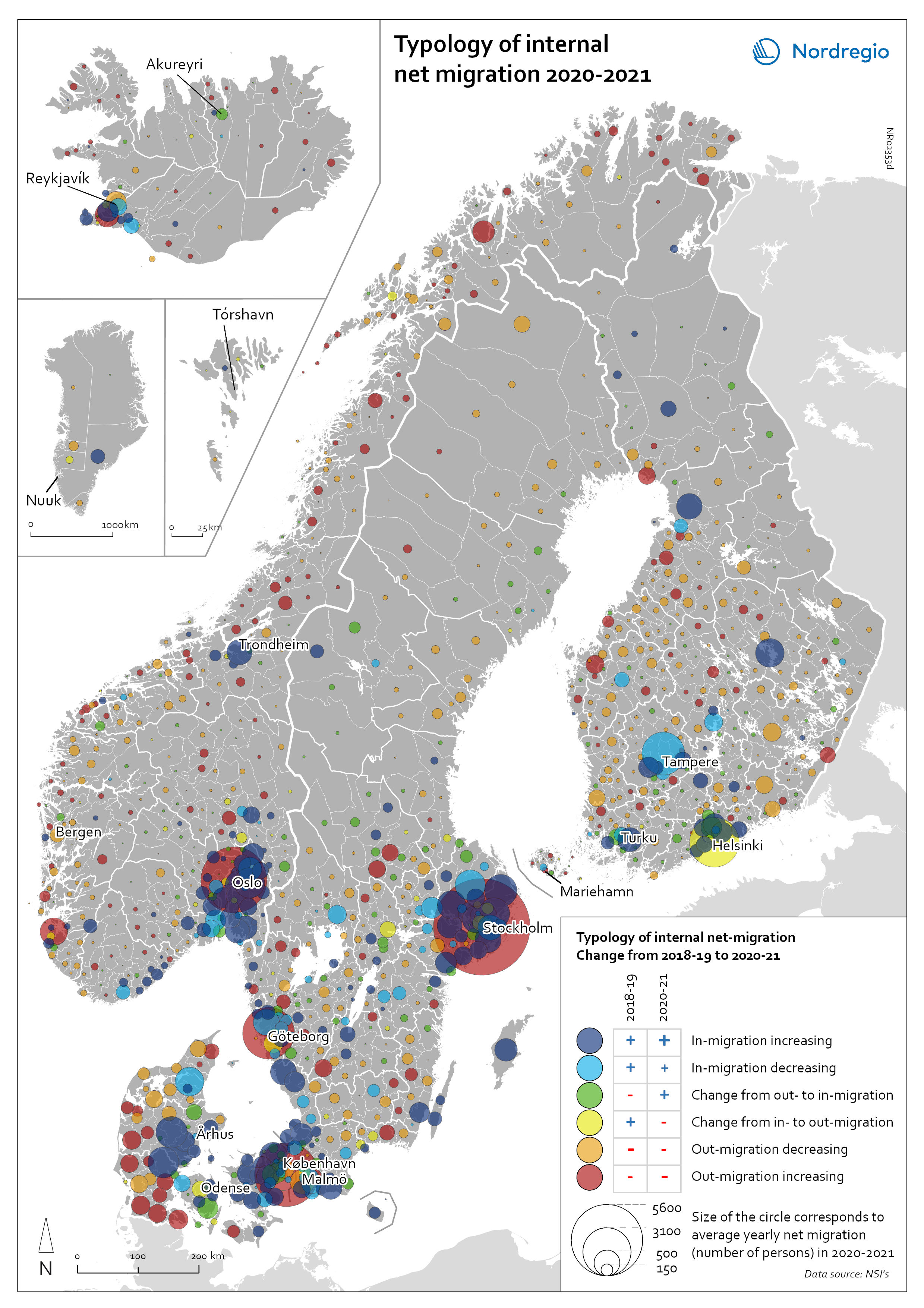
Typology of internal net migration 2020-2021.
Reliable data to inform understandings of the spatial implications of increased remote work is limited
Understanding the degree to which the spatial trends observed during the pandemic have been driven by increased remote work is somewhat of a challenge. Register data on, for example, internal migration flows, is highly reliable and freely available. Unfortunately, however, it sheds little light on what motivates migration or the degree to which opportunities for increased remote work has been a driver. Understanding changes in the temporary population (as tourists and second home users) is even more challenging. So-called activity data can provide useful insights, particularly when combined with other types of data and local knowledge. This data is generally owned by private companies however and can be expensive to obtain and challenging to work with.
Experiences have been similar in all Nordic countries, but different policy responses have emerged
Although the experience of remote work during the pandemic has been relatively similar in all Nordic countries, the future direction varies somewhat in light of the pre-existing policy context in each country. In Iceland, the pandemic has given momentum to the existing regional policy priority of encouraging state jobs without specified placement. Similarly, in Finland, increased remote work fits well with the pre-pandemic focus on combating depopulation and ageing in rural municipalities through increased multilocality. In Sweden, Norway, and Denmark, the links between regional policy and remote work are less clear. At the same time, the preconditions for increased remote work are evident in all countries and the potential regional development benefits align well with broader regional policy goals.
The long-term sustainability implications of increased remote work are far from clear
From a social sustainability perspective, it is important to acknowledge that most workers do not have the possibility to work remotely and, even for those who do, the advantages and disadvantages will differ between groups. Economic sustainability is also an important consideration, particularly in the case where a person’s life and work are split between two or more municipalities. From an environmental perspective, it is important not to assume that remote work is inherently coupled with favourable environmental outcomes. While it may reduce the need for travel, the lifestyle choices remote work enables may be accompanied by negative environmental impacts such as increased resource use and travelling longer distances through less environmentally friendly means.