Myth #1: Cycling conditions are already good enough in the Nordic Region for those willing to cycle, so we should prioritise other issues.
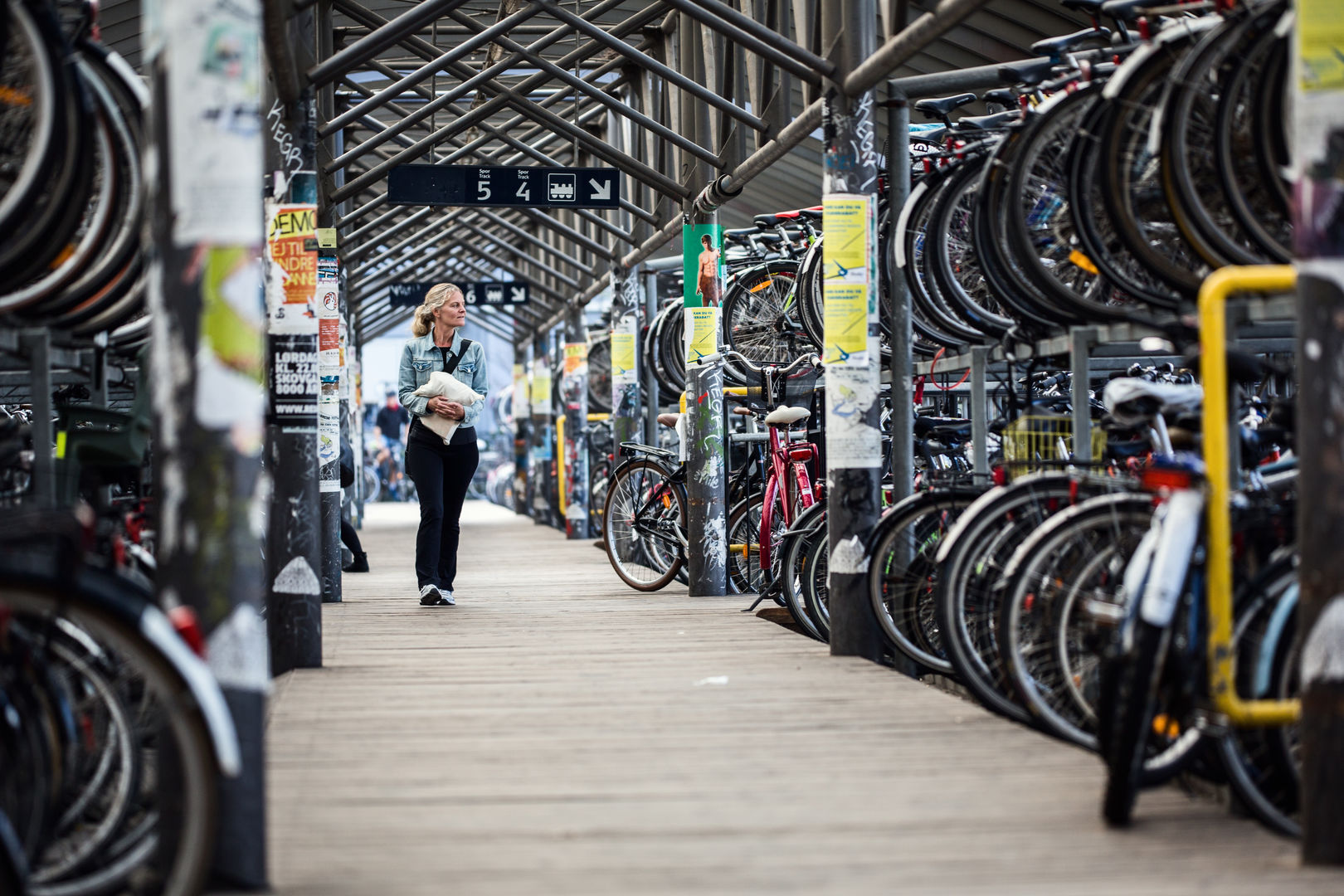
The bicycle parking at Copenhagen Central Station. Photo: DSB
In recent years, cities like Copenhagen and Stockholm have experienced an increase in the number of cyclists due to municipal investments in cycling infrastructure. However, even among major cities, the share of trips made by bicycle remains relatively low. Fewer than 10% of trips in Helsinki, Oslo, and Reykjavík are made by bicycle, and even in Stockholm, the city reports that under 12% of trips are made by bicycle, compared to 22% made by car. Large discrepancies exist between major cities and other parts of the countries; even within Denmark, cycling accounts for about 12.1% of number of trips made compared to Copenhagen’s 21%.
Good cycling conditions—such as separated, well-maintained lanes throughout the region, covered and secured parking facilities, and slow speed limits for road traffic—have the potential to benefit everyone in society, even those who do not cycle. For example, studies around the world have shown that high-quality cycling infrastructure raises property values and municipal revenues. Additionally, providing access to commercial centres by bicycle can also result in higher retail sales (specifically in dense urban contexts) given that pedestrians and cyclists tend to spend more per month than drivers.
Rohrer, L., Lidmo, J., & Beidenhauser, C. (2023). Nordic cycling policy: National objectives, mechanisms, and actors in Denmark, Finland, Norway, and Sweden. Nordregio Working Paper 2023:8. http://doi.org/10.6027/WP2023:81403-2511; City of Reykjavík. (2023). Hlutfall virkra ferðamáta hjá fullorðnum fer vaxandi [The proportion of active modes of transport among adults is increasing.] Accessible at: https://reykjavik.is/frettir/hlutfall-virkra-ferdamata-hja-fullordnum-fer-vaxandi
Good cycling conditions—such as separated, well-maintained lanes throughout the region, covered and secured parking facilities, and slow speed limits for road traffic—have the potential to benefit everyone in society, even those who do not cycle. For example, studies around the world have shown that high-quality cycling infrastructure raises property values and municipal revenues. Additionally, providing access to commercial centres by bicycle can also result in higher retail sales (specifically in dense urban contexts) given that pedestrians and cyclists tend to spend more per month than drivers.
Institute for Transportation & Development Policy. (2022). Making the Economic Case for Cycling. Accessible at: https://itdp.org/wp-content/uploads/2022/06/Making-the-Economic-Case-for-Cycling_6-13-22.pdf
The benefits of cycling cannot be unlocked unless cycling is integrated into transport polices at local, regional, and national levels. It is also important to define governance mechanisms to better coordinate the implementation, monitoring, and maintenance of infrastructure. Governments need to identify how improvements in cycling conditions—from implementing more infrastructure and incentivising citizens to replace car trips with cycling trips—can holistically improve their transport system. By doing so, governments will also be able to calculate how improvements in cycling can positively contribute to the achievement of wider societal goals such as on climate and health.
Policy/planning implications:
Update and align national, regional, and local cycling strategies.
According to a 2023 ECF report, Denmark, Norway, and Sweden have outdated national cycling strategies that urgently need updating.
Exchange cycling practices among Nordic neighbours.
Due to similar cultures and institutional frameworks, Nordic cities and regions can benefit immensely by sharing knowledge and learning from each other’s successes and failures. For example, where some Nordic cities excel at collecting cycling data, others currently lack the tools to do so; where one region struggles to maintain cycling levels during winter, another has found solutions to keep citizens pedalling year-round. Tools and methods can also be swapped across Nordic municipalities and regions so that different areas can make a short-term trial or pilot study to better understand how a solution might be adapted in a new context.
There are also opportunities to harmonise mobility efforts across the Nordic Region to strengthen cross-border communication and integration. This can only be achieved through well-established, cross-Nordic collaboration. A dynamic network of Nordic cities and regions can become a key source of inspiration, ideas, and practical solutions. This is how the cycling agenda can be elevated throughout the entire Nordic Region.
According to a 2023 ECF report, Denmark, Norway, and Sweden have outdated national cycling strategies that urgently need updating.
Küster, F. & Schusta, B. (2023). The state of national cycling strategies in Europe (2023). European Cyclists’ Federation. Accessible at: https://ecf.com/system/files/The-State-of-National-Cycling-Strategies-2023_ECF.pdf
Exchange cycling practices among Nordic neighbours.
Due to similar cultures and institutional frameworks, Nordic cities and regions can benefit immensely by sharing knowledge and learning from each other’s successes and failures. For example, where some Nordic cities excel at collecting cycling data, others currently lack the tools to do so; where one region struggles to maintain cycling levels during winter, another has found solutions to keep citizens pedalling year-round. Tools and methods can also be swapped across Nordic municipalities and regions so that different areas can make a short-term trial or pilot study to better understand how a solution might be adapted in a new context.
There are also opportunities to harmonise mobility efforts across the Nordic Region to strengthen cross-border communication and integration. This can only be achieved through well-established, cross-Nordic collaboration. A dynamic network of Nordic cities and regions can become a key source of inspiration, ideas, and practical solutions. This is how the cycling agenda can be elevated throughout the entire Nordic Region.
Good practice examples:
For example, Surbrunnsgatan in central Stockholm; City of Stockholm. (n.d.). Surbrunnsgatan blir Stockholms första cykelgata [Surbrunnsgatan becomes Stockholm’s first bicycle street]. Accessible at: https://vaxer.stockholm/projekt/vasastan/surbrunnsgatan-blir-stockholms-forsta-cykelgata/
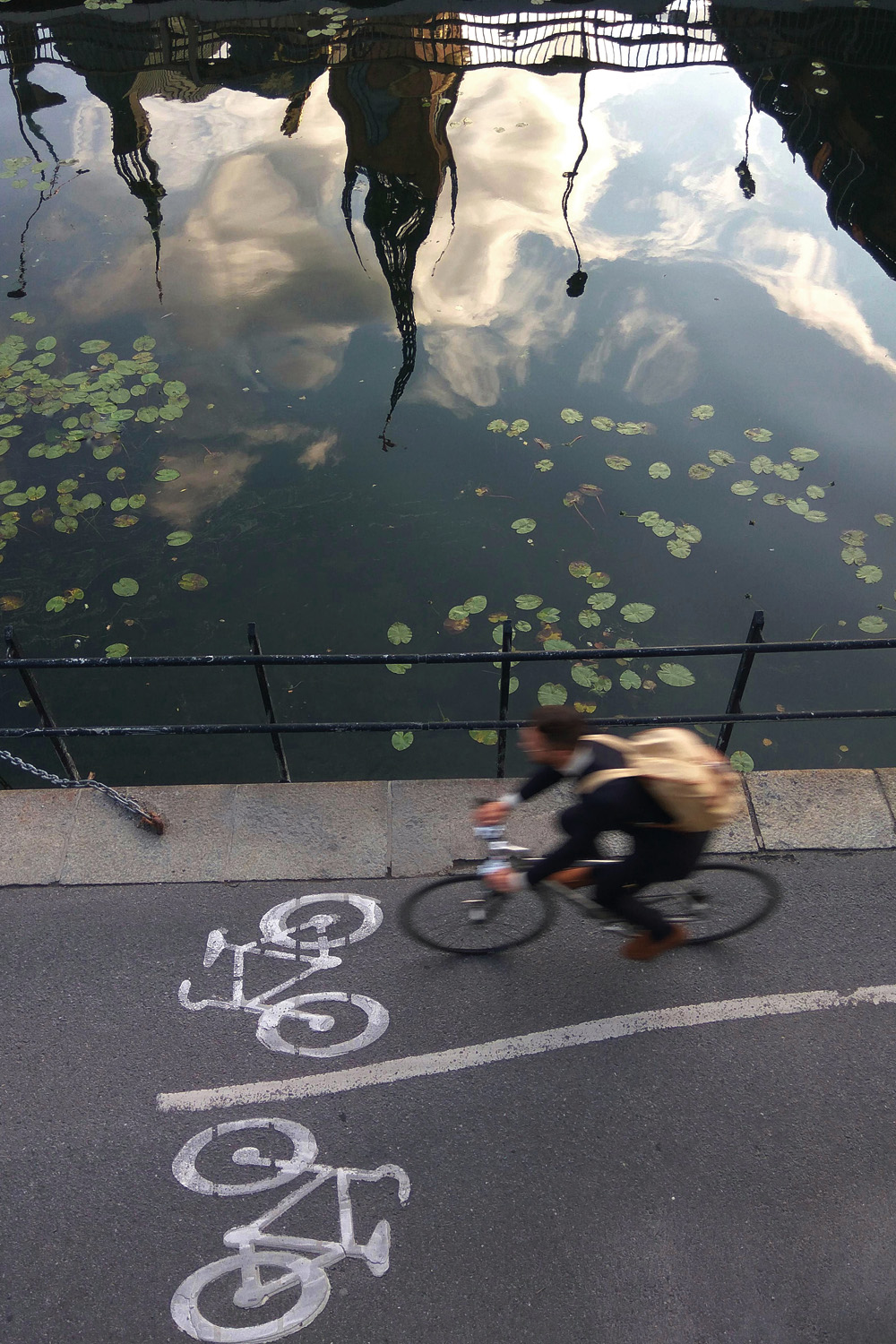
Man riding bicycle alonge the canal next to Riddarholmen Church in Stockholm, Sweden. Photo: iStock