
Myth #2: Cycling infrastructure is too expensive for local and regional budgets to invest in.
Reality: Cycling is a no-regret investment, providing returns for the economy and society.
Isoisänsilta bridge in Helsinki, Finland. Photo: Shutterstock
Cycling is undoubtedly a financially efficient and cost-saving means of transport for private citizens and for the public. It also generates substantial economic growth for businesses and a society’s economy. A study on the economic benefits of installing cycling infrastructure in key city arteries in Helsinki found that every euro invested in high-quality cycling infrastructure yields an eight euro benefit for society.
[1] City of Helsinki. (2014). Pyöräilyn hyödyt ja kustannukset Helsingissä [Costs and benefits of cycling in Helsinki]. Accessible at: https://www.hel.fi/hel2/ksv/julkaisut/los_2014-5.pdf
WHO. (n.d.). Health economic assessment tool (HEAT) for walking and cycling. https://www.who.int/europe/tools-and-toolkits/health-economic-assessment-tool-for-walking-and-cycling
Rich, J., Fjendbo Jensen, A., Pilegaard, N., & Hallberg, M. (2021). The cost-benefit of bicycle infrastructure with e-bikes and cycle superhighways. Case Studies on Transport Policy, 9, 2:608-615. https://doi.org/10.1016/j.cstp.2021.02.015
City of Oslo. (2024). Oslos sykkelsatsing har bidratt til mer og tryggere sykling [Oslo's cycling initiative has contributed to more and safer cycling]. City Council's Department for Environment and Transport. Accessible at: https://aktuelt.oslo.kommune.no/oslos-sykkelsatsing-har-bidratt-til-mer-og-tryggere-sykling
Several countries outside the Nordic Region also provide examples of positive returns on cycling investment. A 2022 cost-benefit analysis of cycling in Belgium revealed the net benefits of riding a bike are equal to 98 eurocent per kilometre; riding an e-bike yields 22 eurocent per kilometre.
Transport and Mobility Leuven. (2024). The cycling economy in Belgium. Accessible at: https://www.tmleuven.be/en/project/The-cycling-economy-in-Belgium#:~:text=In%202022%2C%20the%20cycling%20economy,in%20general%20in%20recent%20years
Haubold, H. (2022). Celebrating World Health Day: What are the health benefits of cycling? European Cyclists’ Federation. Accessible at: https://www.ecf.com/en/news/celebrating-world-health-day-what-are-the-health-benefits-of-cycling/
To ensure financial investments are made, cities and regions need to present the clear benefits of cycling by collecting and analysing qualitative and quantitative data. However, traffic and cycling planners in the Nordic Region lament the quality of GIS data, complications with travel surveys, lack of available technology for collecting data, and complications around privacy, standardisation, data categorisation, and resources.
Policy/planning implications:
Invest in high-quality cycling infrastructure to generate economic and health benefits.
Investing in cycling is an investment in society. The widespread benefits are well-researched and documented. According to ECF’s annual analysis of national cycling strategies in Europe, central government investments in cycling are less than €20 per capita in Norway, and less than €10 per capita in Denmark, Finland, Sweden, and Iceland.
Invest in measures to collect cycling data.
Collecting quality cycling data on critical indicators can provide important evidence for making a funding case. Such efforts can also inform planners’ decision-making around design, infrastructure, and maintenance. Data is at the heart of cycling promotion. In the Nordics, many cities and regions are collecting data on a wide range of indicators, including number of cyclists, travel times, modal share, perceived and actual traffic safety, number of trips and locations using public bike share systems, bicycle parking, perceptions and satisfaction of cyclists, cycling demographics, cycling speeds, overall travel habits.
Investing in cycling is an investment in society. The widespread benefits are well-researched and documented. According to ECF’s annual analysis of national cycling strategies in Europe, central government investments in cycling are less than €20 per capita in Norway, and less than €10 per capita in Denmark, Finland, Sweden, and Iceland.
Küster, F. & Schusta, B. (2023). The state of national cycling strategies in Europe. European Cyclists’ Federation. Accessible at: https://www.ecf.com/media/resources/2023/The-State-of-National-Cycling-Strategies-2023_ECF.pdf
Invest in measures to collect cycling data.
Collecting quality cycling data on critical indicators can provide important evidence for making a funding case. Such efforts can also inform planners’ decision-making around design, infrastructure, and maintenance. Data is at the heart of cycling promotion. In the Nordics, many cities and regions are collecting data on a wide range of indicators, including number of cyclists, travel times, modal share, perceived and actual traffic safety, number of trips and locations using public bike share systems, bicycle parking, perceptions and satisfaction of cyclists, cycling demographics, cycling speeds, overall travel habits.
Good practice examples:
City of Copenhagen. (2022). Cykelregnskab 2022 [Bicycle Account 2022]. (p.12). Accessible at: https://kk.sites.itera.dk/apps/kk_pub2/index.asp?mode=detalje&id=2419
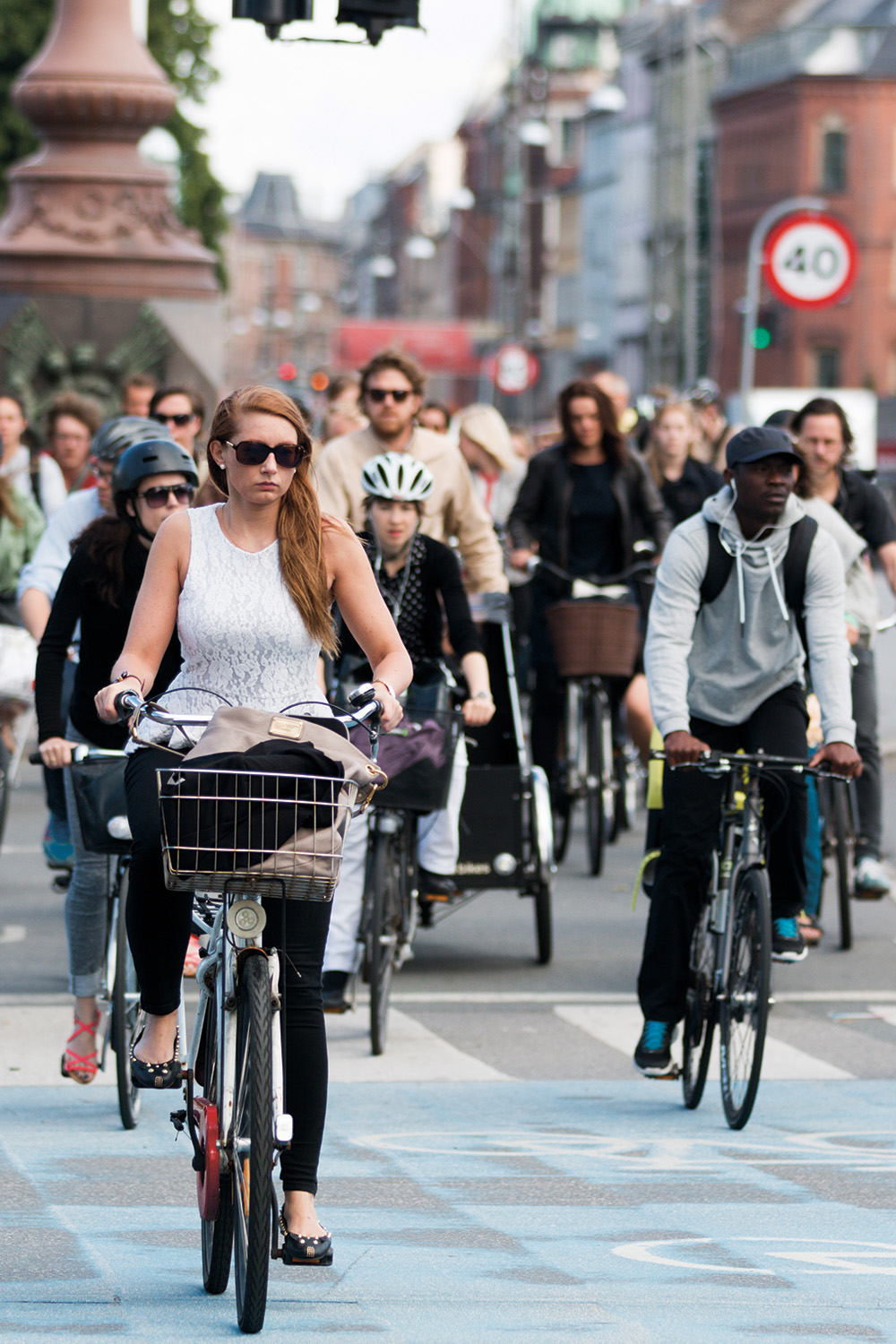
Rush hour in Copenhagen, Denmark.
Photo: iStock
Photo: iStock