Myth #4: Cycling is useful for recreation and leisure, but not as a mode of transportation.
Reality: Cycling plays an important role in holistic mobility systems and is recognised by the European Union as a sustainable form of transport.
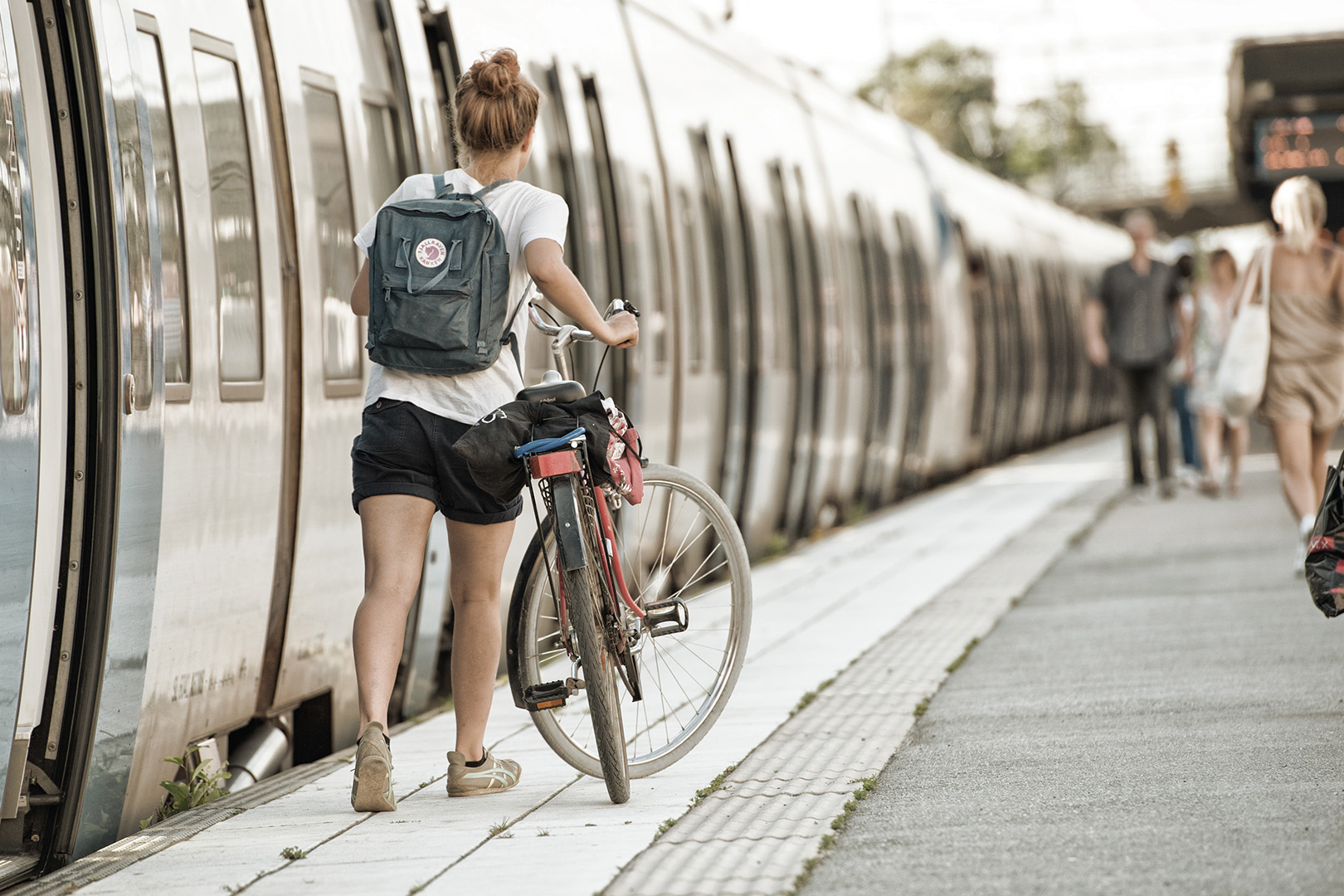
Young woman waiting with bicycle to board a regional train in Stockholm, Sweden. Photo: iStock
In April 2024, the EU adopted a European Declaration on Cycling, “recognising cycling as one of the most sustainable, accessible and inclusive, low-cost, and healthy forms of transport and recreation.”
Cycling can be furthered as a legitimate form of transport by integrating it with other modes of transport. Doing so is part of enabling inhabitants to make sustainable choices. A multimodal transport system can provide smooth and efficient linkages for people, improve health by enabling more active travel, reduce pollution, and reduce emissions because it encourages less driving. It also increases the democratisation of transport by dedicating more space to the public and less space towards private automobiles. Furthermore, multi-modal transport systems can improve transport safety and lead to fewer road deaths (which is a national transportation goal in all Nordic countries). When cycling, walking, and public transport authorities work together, resources can be used more effectively to achieve common goals.
The European Cyclists’ Federation notes that about 90% of people walk to get to public transport, and enabling more people to access public transport stations via bicycle can increase the catchment area for ridership. However, many barriers currently exist for enabling strong multi-modal transport in the Nordic countries, such as lack of commitment among public transport companies, poor quality of—or lack of safety for—bicycle storage at transport hubs, or lack of year-round city bike share systems that can adequately support residents’ transitions from bicycle to train or tram. Combatting these concerns requires cooperation among sustainable transport actors. Furthermore, it is important for cycling to work with, rather than to compete against, other sustainable modes of transport to achieve large-scale sustainability objectives. When cities aim to increase the number of trips made by bicycle, this aim requires disincentivising private transport and incentivising all modes of sustainable transport together, including but not limited to the bicycle.
International Association of Public Transport (UITP), Pathways to a multimodal lifestyle: Reinforcing public transport with active and micromobility, 2023, https://www.uitp.org/publications/pathways-to-a-multimodal-lifestyle-reinforcing-public-transport-with-active-and-micromobility/
The European Cyclists’ Federation notes that about 90% of people walk to get to public transport, and enabling more people to access public transport stations via bicycle can increase the catchment area for ridership. However, many barriers currently exist for enabling strong multi-modal transport in the Nordic countries, such as lack of commitment among public transport companies, poor quality of—or lack of safety for—bicycle storage at transport hubs, or lack of year-round city bike share systems that can adequately support residents’ transitions from bicycle to train or tram. Combatting these concerns requires cooperation among sustainable transport actors. Furthermore, it is important for cycling to work with, rather than to compete against, other sustainable modes of transport to achieve large-scale sustainability objectives. When cities aim to increase the number of trips made by bicycle, this aim requires disincentivising private transport and incentivising all modes of sustainable transport together, including but not limited to the bicycle.
Policy/planning implications:
Recognise cycling as a complete mode of transport in national, regional, and local mobility systems.
This means providing cycling with financing and political priority comparable to other modes of transport, and to incorporate cycling infrastructure as a necessary element in all major on-surface transportation projects. It also means each level of government should identify which commitments within the European Declaration on Cycling can be implemented in the short and long term.
National authorities could also integrate cycling more intimately and seriously into their transport policies. Furthermore, small-scale initiatives can help to rebalance the road hierarchy; for example, by recalibrating traffic lights to grant cyclists and pedestrians a head start at traffic crossings.
Collaborate among regional and local authorities to enable multi-modal transport.
This is a crucial measure needed to create the necessary linkages for people to combine bike and public transport trips. It requires authorities to take into consideration how land is used to ensure a high frequency of service. By incorporating sufficient and secure bike parking and bike share schemes, public transport hubs can better support residents who wish to combine modes of travel for work or leisure. Clearly designated cycle routes are also important to guide cyclists to and from public transport hubs. Integrating public transport with bike share systems through a common regional mobility platform is another way to show the legitimacy of the bicycle as part of urban and regional mobility systems.
Good practice examples:
Mäkinen, S. & Granberg, M. (2023). The best journeys are made together [presentation]. Helsinki Region Transport.
City of Reykjavík. (2024). State and six municipalities agree on updated Transportation Charter. Accessible at: https://reykjavik.is/en/news/state-and-six-municipalities-agree-updated-transportation-charter
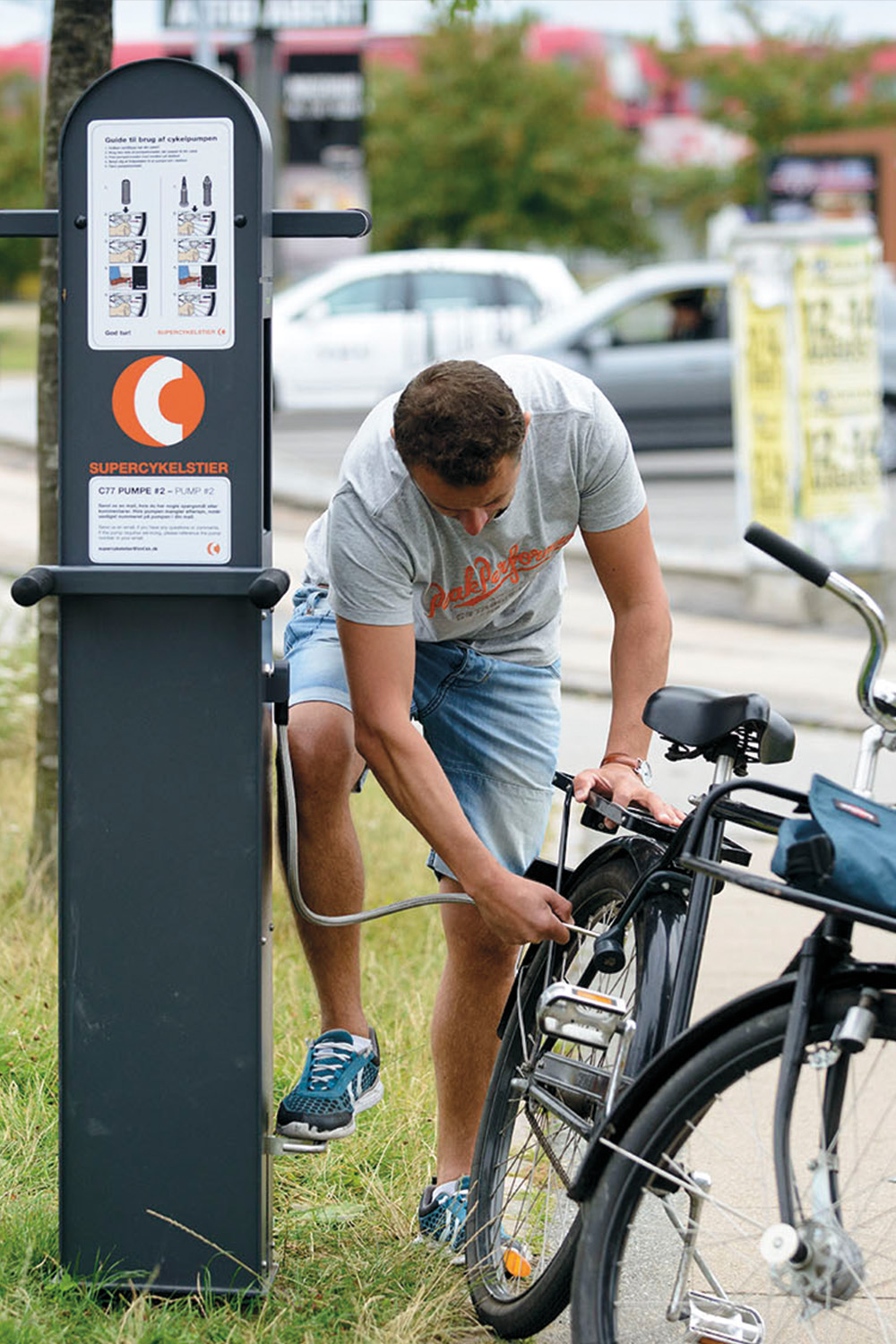
On the Cycle Superhighways in the Greater Copenhagen Area, pumps are installed in case your bicycle needs air.
Photo: Supercykelstisamarbejdet, hovedstadsregionen
Photo: Supercykelstisamarbejdet, hovedstadsregionen