Myth #5: Cycling is an exclusive mode of transport.
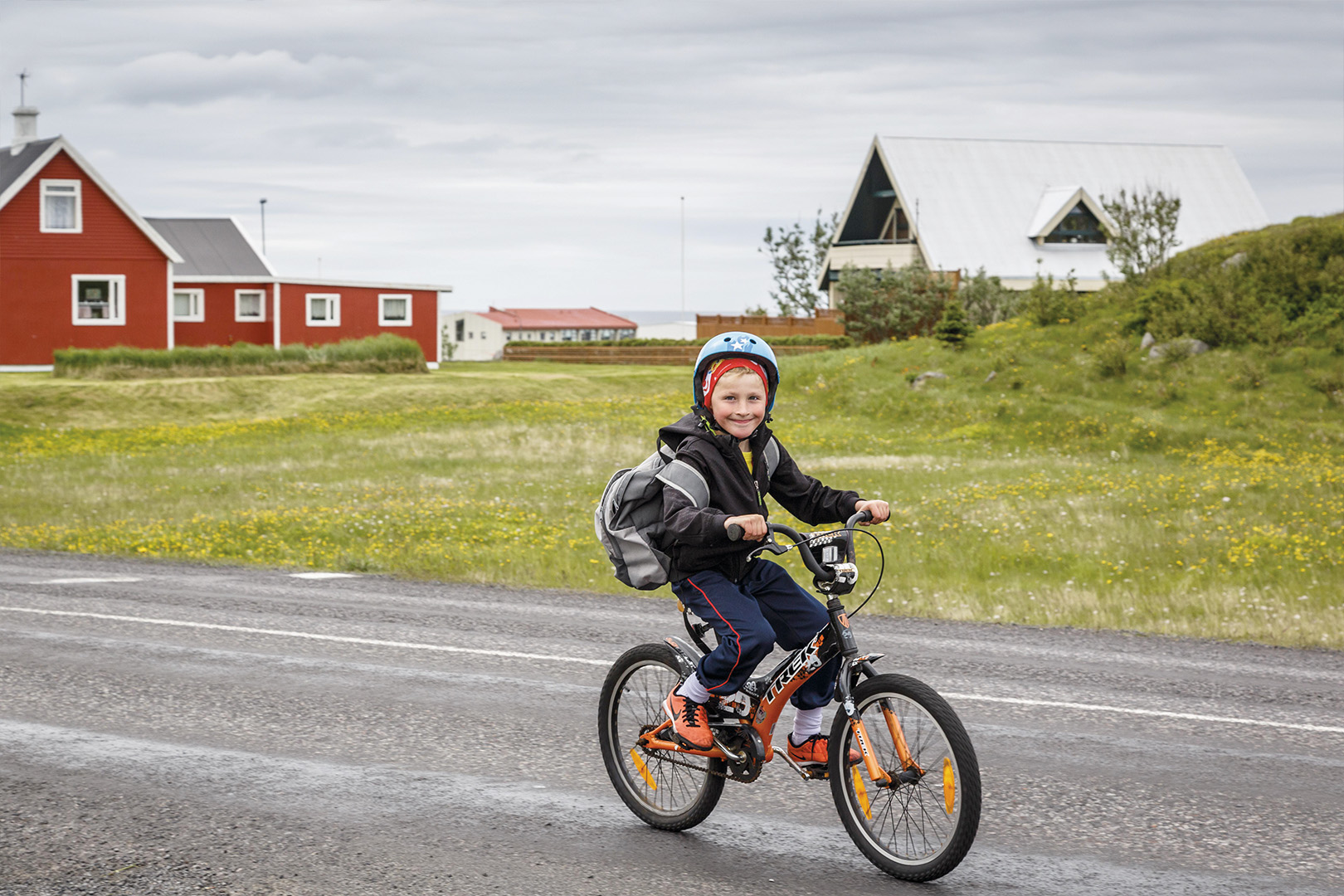
Boy on his way to school in Reykjavik, Iceland. Photo: Yadid Levy / norden.org
In some Nordic cities and regions, efforts to become more cycling friendly are met with opposition by organisations and individuals who see cycling as exclusive—especially to people living with disabilities or who have lower levels of fitness or agility. However, when compared to other forms of mobility, cycling has the potential to offer a high degree of mobility justice due to its affordability and accessibility to people of different ages, genders, and socioeconomic status. From the user’s perspective, purchasing a bicycle is at least 98% cheaper than buying a car in the EU (in 2023), and it does not require high additional costs to store and fuel.
See https://www.statista.com/statistics/1426435/bicycle-ownership-in-households-in-the-nordics-by-country/#:~:text=As%20of%202022%2C%20three%2Dquarters,of%20households%20owned%20a%20bicycle ; https://www.stjornarradid.is/library/01--Frettatengt---myndir-og-skrar/IRN/Ferdavenjukonnun-2022/4033670_Heild_allt_landid_210423.pdf
When compared to car transport, cycling provides more democratic use of public resources. For example, in Denmark, the average number of passengers per car is about 1.3, making car lanes and large parking lots an inefficient use of space per person.
See Tables 11b and 11c in Christiansen, H. & Baescu, O. (2022). The Danish National Travel Survey: Annual Statistical Report for Denmark for 2021. DTU Orbit. Department of Technology,
Management, and Economics. Accessed 5 June 2023 from https://orbit.dtu.dk/en/publications/the-danish-national-travel-survey-annual-statistical-report-for-d
Hosseini, K. & Stefaneic, A. (2023). A wolf in sheep's clothing: Exposing the structural violence of private electric automobility. Energy Research & Social Science 99, 103052. https://doi.org/10.1016/j.erss.2023.103052
There are many emerging solutions for meeting the needs and preferences of different groups to cycle, thereby enabling higher degrees of mobility justice (see Box 1). For example, electric bikes (e-bikes) provide all riders with the ability to travel at the same speed efficiently—either alone or with additional cargo. For those who are new to, or less comfortable with, cycling, they offer a smoother transition for taking up this mode of transport. E-bikes can also enable longer commutes, thereby granting people living further from the city centre with higher degrees of accessibility among the city or region. For those commuting on the cycle superhighways of Denmark’s Capital Region, 20% are doing so with an e-bike, while traffic analysts from Oslo report that 39% of all bike trips in Oslo are made with an e-bike. But there is more that can be done to capitalise on these efforts within the Nordic countries.
Policy/planning implications:
Integrate universal design principles into city planning.
Principles of universal design
Include e-bikes in bike-sharing systems.
As of 2022, just under 53% of employed persons in Denmark live within a 10-km distance from their workplaces, and 70% of all employed persons live within a 20-km distance from their workplaces.
Support cycling for children, families, and elderly residents.
Supporting cycling for children is a natural on-ramp to more cycling in the future. Not only can it help to improve their own health and urban mobility, but it may also reduce the number of children who need to be driven to school and other activities, which is a common argument from parents for why they require a car. When evaluated from a social justice perspective, cycling can level the playing field and provide more equal accessibility and mobility for those who cannot or do not want to drive or do not have the means to rent/own a car. One tangible way to do this is to assess the quality of walking, cycling, and public transport networks and bicycle parking facilities in and around schools and elderly care facilities. Building cycling awareness and training within schools is another way for children to learn safe cycling techniques and encourage cycling to school. Additionally, cargo bikes could be introduced into local or regional bike share systems.
Consider subsidy schemes for residents who need customised cycling solutions.
National governments may also consider providing subsidy schemes for people with disabilities for accessing specialised bicycles. In Sweden, residents can claim an allowance for purchasing a bicycle that requires customised adjustments due to a disability. In some cases, residents with certain disabilities may not even be aware of the options that exist and assume that cycling is not an option; therefore, targeted campaigns to build awareness are also important initiatives.
Principles of universal design
Include e-bikes in bike-sharing systems.
As of 2022, just under 53% of employed persons in Denmark live within a 10-km distance from their workplaces, and 70% of all employed persons live within a 20-km distance from their workplaces.
Statistics Denmark. (2022). Home to work commuting. Accessible at: https://www.dst.dk/en/Statistik/emner/arbejde-og-indkomst/beskaeftigelse-og-arbejdsloeshed/erhvervspendling
Stockholms stad. (2022). Cykelstaden: En del av framkomlighetsstragin. Accessible at https://cykla.stockholm/siteassets/cykla-i-stockholm/dokument/cykelplan-for-stockholms-stad.pdf
Support cycling for children, families, and elderly residents.
Supporting cycling for children is a natural on-ramp to more cycling in the future. Not only can it help to improve their own health and urban mobility, but it may also reduce the number of children who need to be driven to school and other activities, which is a common argument from parents for why they require a car. When evaluated from a social justice perspective, cycling can level the playing field and provide more equal accessibility and mobility for those who cannot or do not want to drive or do not have the means to rent/own a car. One tangible way to do this is to assess the quality of walking, cycling, and public transport networks and bicycle parking facilities in and around schools and elderly care facilities. Building cycling awareness and training within schools is another way for children to learn safe cycling techniques and encourage cycling to school. Additionally, cargo bikes could be introduced into local or regional bike share systems.
Consider subsidy schemes for residents who need customised cycling solutions.
National governments may also consider providing subsidy schemes for people with disabilities for accessing specialised bicycles. In Sweden, residents can claim an allowance for purchasing a bicycle that requires customised adjustments due to a disability. In some cases, residents with certain disabilities may not even be aware of the options that exist and assume that cycling is not an option; therefore, targeted campaigns to build awareness are also important initiatives.
Mobility justice is about reducing harmful consequences of mobility systems to ensure that people can self-determine their movements so they can live meaningful lives without fears or barriers. Sheller, M. (2018). Theorising mobility justice. Tempo Soc., 30, 2:17-34. https://doi.org/10.11606/0103-2070.ts.2018.142763  |
Good practice examples:
manual provides an example of how the city folds equitability into technical requirements to accommodate street users of all kinds to comfortably access urban infrastructure. The design manual provides a list of questions to consider when it comes to universal mobility, such as “which groups of road-users should be prioritised in terms of space and ease of movement?” and “are there users that utilise the street that require particular facilitation.”
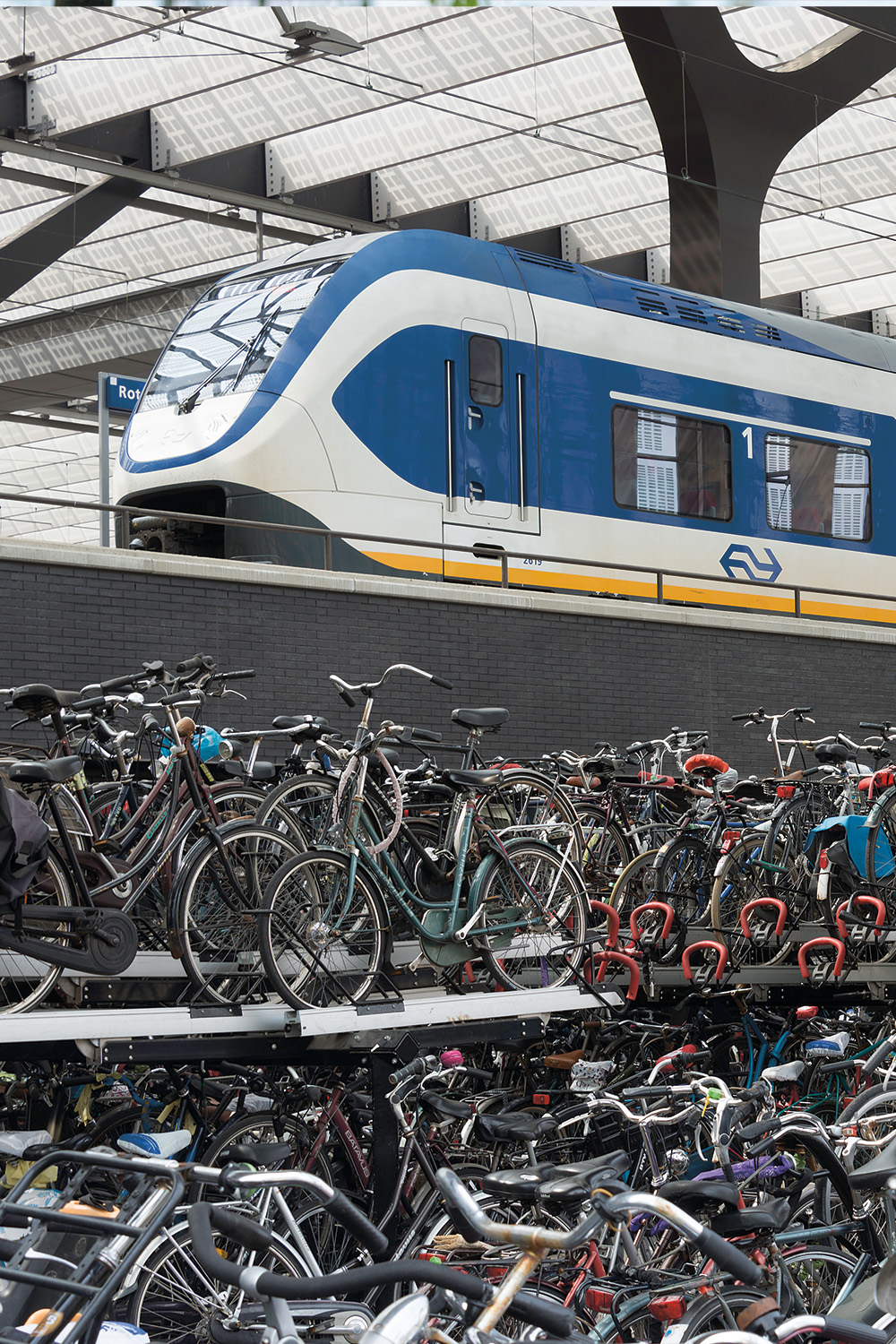
Bicycle storage for thousand of bikes at
Rotterdam Central Station in the Netherlands. Photo: iStock
Rotterdam Central Station in the Netherlands. Photo: iStock