About the project
This policy brief has been developed under the project “Smart Adaptation to Rural Realities: Approaches and Practices in Nordic Municipalities and Regions” (2023-2025). The primary aim of the project is to identify and describe smart adaptation and its governance implications in the Nordic region. Additionally, the project seeks to facilitate the sharing of knowledge on potential smart adaptation strategies among Nordic municipalities, regions, and at the national level.
The research activities included a review of Nordic and European literature on shrinkage and smart adaptation, published in journals and by research institutions, public authorities, and associations. A background study was also conducted on Nordic regional and rural development policies, as well as national support initiatives addressing population decline. Ten country-specific workshops were organised (2023-2024) with municipal representatives, regional and national public officials and experts, and local politicians from Sweden, Finland, Norway, Iceland, and Denmark. Additionally, an onsite physical Nordic workshop was organised with participants from all country networks, discussing challenges associated with population shrinkage, local and regional development potentials beyond population growth, and suggesting adaptation pathways for managing population decline at various levels.
The workshop participants were selected based on those municipalities with the highest population decline (1990–2022), focusing on the ten municipalities per country with the largest percentage loss. Regions were chosen according to their composition of shrinking municipalities. While most of the selected municipalities experienced consistent decline, additional municipalities were selected with minor shrinkage. Some also had small population growth over the selected years. The selection was designed to reflect a variety of experiences and perspectives on demographic challenges. Diversity in terms of geography, size, and demographics was prioritised, though the outcome leans towards municipalities that are smaller in population but cover larger geographical areas.
Acknowledgements
The results and policy action points in this policy brief were developed based on the contributions of the workshop participants, under the auspices of Nordregio. We would like to thank the representatives of municipalities, regions, national level authorities and ministries as well as policy experts who actively participated in workshops and provided their insights and knowledge throughout the project.
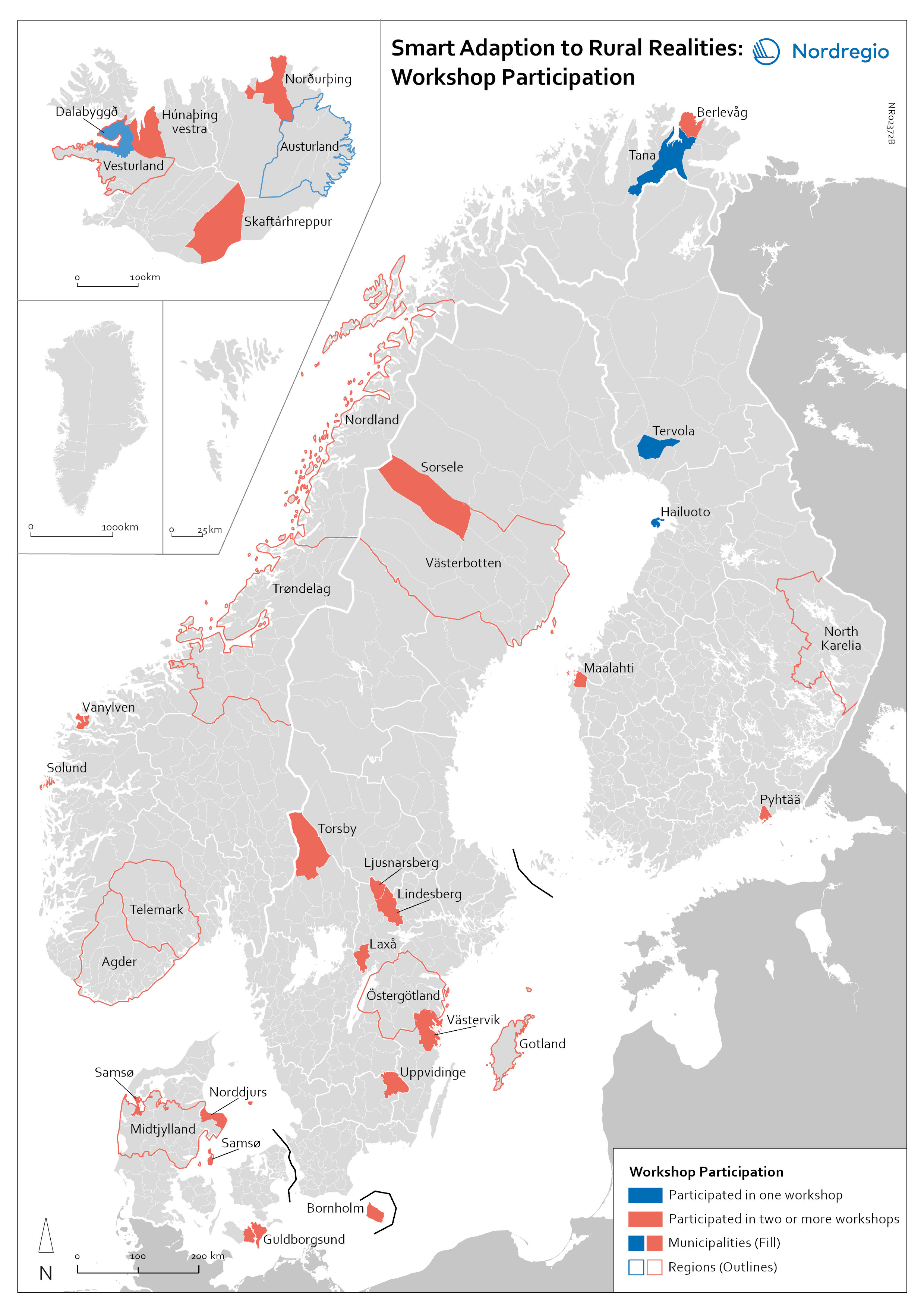
Map 2. Illustration of which municipalities and regions in Sweden, Norway, Finland, Denmark, and Iceland participated in the project workshops. The legend indicates number of occasions each municipality or region had one or more representatives participating.