What is smart adaptation and why is it relevant?
The demographic development of the Nordic Region is marked by spatially unbalanced distribution. Population growth has during the last decades largely been concentrated around certain large and medium-sized cities and their surrounding regions, while population decrease is more dispersed over larger areas. Many smaller, rural and/or more sparsely populated areas face long-term population shrinkage, though this trend is not limited to rural areas (Stjernberg et al., 2024). Map 1 illustrates the percentage change in total population for all municipalities in the Nordic countries from 1990 to 2022. This total population change accounts for both natural change (births minus deaths) and net migration.
Shrinking populations affect municipal public services, infrastructure, revenues and planning. As population bases shrinks, revenues from tax income and fees decrease. The Nordic countries typically feature long distances and extensive rural areas, posing challenges for the municipal and regional sectors. Infrastructure systems become oversized to current and future population size and its distribution, while management and reinvestments remain necessary to maintain statutory societal services (Grundel & Magnusson, 2022). Depopulating areas also struggle with managing vacant housing, as well as a lack of suitable housing for specific needs (Eliasen et al., 2020). A reduced workforce, capacity challenges in public administration and governance and education planning as pupil numbers decrease are other well-known issues (Slätmo et al., 2024; Carson et al., 2022). Furthermore, as the population collectively ages, the demand for elderly care and healthcare intensifies (Heleniak & Sánchez Gassen, 2020). Finally, shrinkage can also affect social dynamics and how places are experienced (Syssner, 2024).
Although political institutions at supranational, national and regional levels address demographic decline in various ways (Copus et al., 2021), Nordic policymakers have continued the established practices of planning for population growth (Syssner, 2022). However, literature also identifies “hybrid” approaches, where municipalities or regions officially commit to growth but include adaptive elements in day-to-day decisions (Kahila et al., 2022; Hagen et al., 2023). In the Nordic Region, inter-municipal cooperation is a common strategy for efficiently redirecting resources to meet shrinkage challenges. Other examples include optimising infrastructure and service plans, innovative solutions for labour shortages and focusing on the needs of remaining residents (Kahila & Teräs, 2021; Syssner, 2022). Smart adaptation as an approach entails proactively adjusting policies, resources, and services to align with shrinking and aging populations. Tackling demographic realities by means of adaptive responses can open new opportunities for municipalities and regions in place-making, organisation of services and community dynamics.
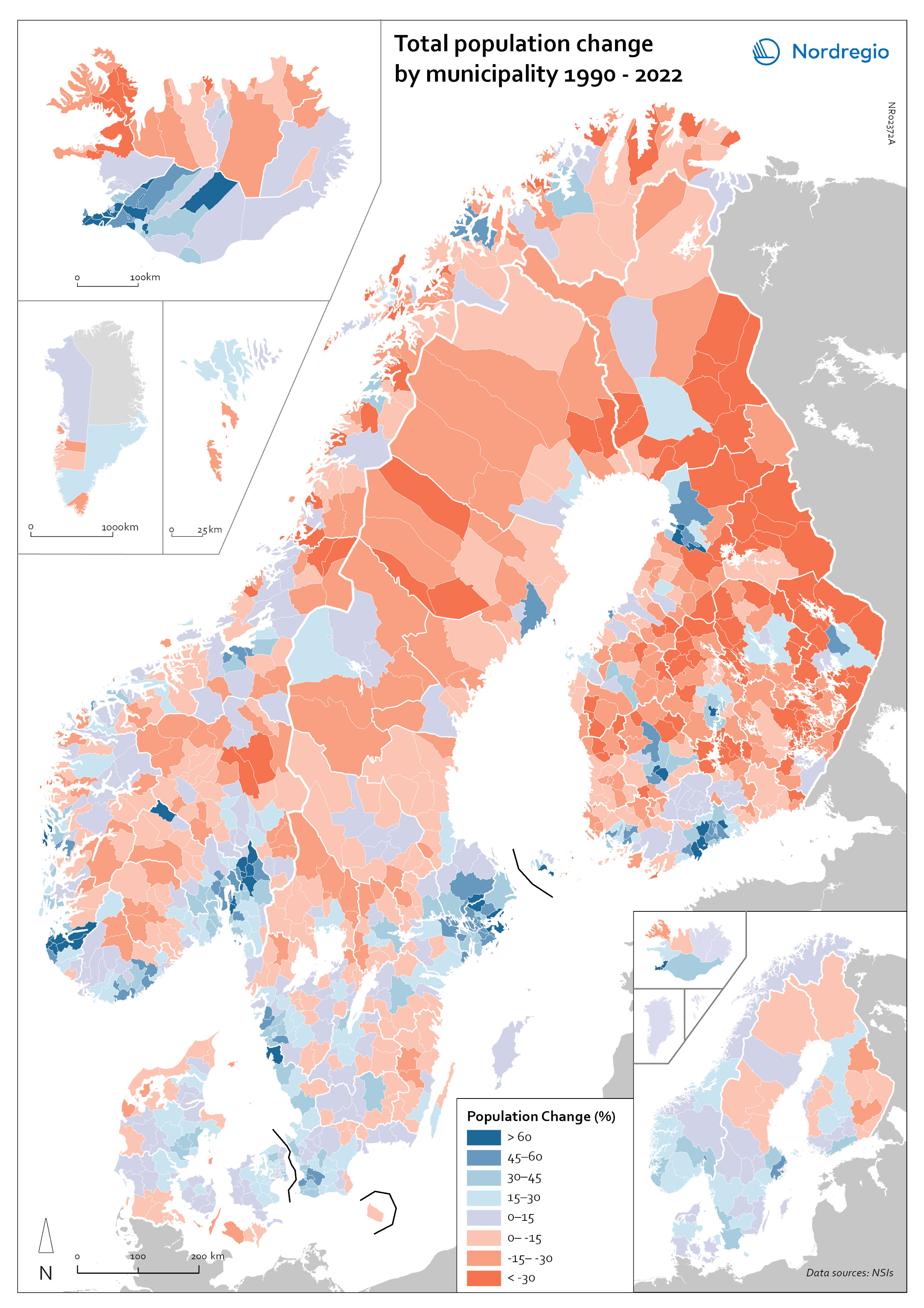
Map 1: Total Population Change by Municipality in the Nordic countries, 1990–2022 (1992–2022 for Iceland due to the lack of available data prior to 1992). The smaller map in the bottom right corner highlights the total population change at the regional level across the Nordic countries.