Source: Stockholms Stad
The need for transformative urban futures
Cities are responsible for around 70% of global resource and energy consumption, over 70% of greenhouse gas (GHG) emissions, and more than 70% of global waste production (Paiho et al., 2020). Despite these figures, cities play a crucial role in achieving sustainability goals. For example, the New Leipzig Charter 2020 provides a policy framework for implementing European and global agreements—such as the Paris Agreement and the European Green Deal—at the urban level and highlights the transformative power of cities in promoting the common good (European Commission, 2020a). Furthermore, it is estimated that about two thirds of the 169 SDG targets can only be achieved through local and regional engagement (OECD, 2020). While local governments are sometimes limited in implementing such changes, they play a fundamental role in responding to global challenges like climate change.
As challenges grow increasingly complex and multifaceted, the prevailing innovation policy framework requires national and local governments to focus on addressing significant societal challenges, moving beyond simple market corrections and economic growth regulation (Diercks, 2019; Grillitsch et al., 2019). Recently, the mission-oriented approach has gained prominence within innovation policy, emphasizing the mobilisation of science, technology, and innovation to meet societal needs (Grillitsch et al., 2019). This approach, emerging alongside other concepts such as transformative and challenge-oriented policies, shares a common goal: to effectively tackle societal challenges (Giacometti & Jessen, 2024).
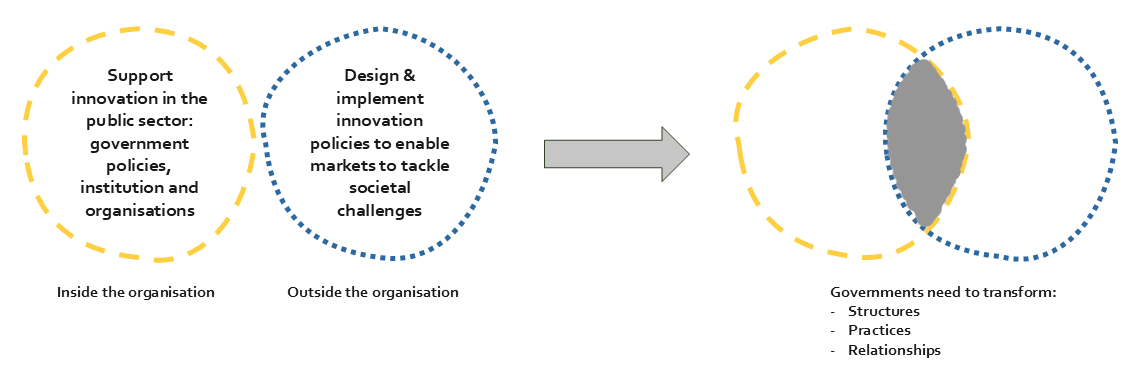
This shift in policy directionality demands enhanced administrative and organisational capacities of public institutions in instigating systems transformation (Giacometti & Jessen, 2024). It requires local governments to manage complex issues that demand collaboration across a diverse array of actors, moving beyond merely addressing technical problems within isolated government agencies (Kattel & Mazzucato, 2018). While varying governance frameworks and other factors significantly influence local governments’ capacities to act (see Box 1), local governments are increasingly expected to: (1) support innovation in the public sector, including government policies, institutions, and organisations, and (2) design and implement innovation policies to enable markets to tackle societal challenges, thereby boosting productivity and economic growth (Karo & Kattel, 2016).
In this landscape, local administrations are transitioning from controllers to enablers or drivers of innovation, adopting more entrepreneurial roles. This kind of transition, however, is not an easy task. It requires greater flexibility and better interaction with external stakeholders such as the private sector, academia, civil society. Furthermore, it demands implementing different routines, demands new capacities and knowledge, requires horizontal and vertical alignment (Karo & Katell 2016). However, this shift may also complicate efforts to govern for the public good, especially in balancing the agility required to address urgent societal challenges with the need for transparency and equitable participation. Moreover, this change increases the risk-taking required of public administrations, which must often operate experimentally to develop and implement the policies and mechanisms necessary for sustainable solutions (Karo & Katell, 2016).
Figure 1 shows the transformations local governments should undertake to destabilise existing socio-technical systems (Haddad et al., 2022). This requires transforming their structures, (e.g., cultural values, collective practices, governance, funding), practices, (e.g., innovation, visioning, participatory processes, reflexivity, knowledge), and relationships (e.g., with researchers, civil society, private sector). Such changes in the administration and organisational capacities of public organisations are key for delivering transformative innovation policy.
Given this background, and drawing on the lessons learned from the TANGO-W project, this policy brief addresses the following questions to foster the implementation of transformative policies:
- How can local authorities be structured to promote innovation that effectively addresses contemporary challenges?
- How can public organisations develop, implement, and sustain practices (e.g. skills, resources, capabilities, routines) necessary to effectively address contemporary challenges?
- How can changes in the structure and practices of local governments enable them to foster collaborative relationships with stakeholders to effectively address contemporary challenges?
These questions are addressed in the context of seven Urban Living Labs (ULLs) within the JPI Urban Europe project TANGO-W. The questions use the lens of Urban Transformative Capacity (UTC), which outlines cities’ potential to bring about social, environmental, and economic changes to address urban challenges (Wolfram, 2016).