Unemployment may be an economic driving force to take a job in another Nordic country. Photo: Miquel Perera
Research project outline
Based on the literature review on migration and labour market mobility and cross-border labour market mobility in the Nordic Region, we will now describe the analytical framework and project outline for the research project in order to answer the two research questions:
2. What drives labour market mobility in the Nordic Region?
3. What are the obstacles (previously known and recently learnt) for labour market mobility in the Nordic Region?
Analytical framework
Based on the Push and pull model (Everett Lee, 1966, in Barcus and Halfacree, 2018) referred to earlier in this paper, we will take as our point of departure the assumption that the decision of an individual to take a job in another Nordic country is based on both push and pull factors, including driving forces, attraction forces, intervening obstacles and personal obstacles.
Driving forces | Intervening obstacles |
Attraction forces | Personal obstacles |
Table 1: Push and pull model
Three of these parameters are general in nature and refer to institutional factors. In the following, we will focus on those, i.e. the driving forces, attraction forces and intervening obstacles.
In the literature, we found enabling and hampering factors for cross-border labour market mobility in three different realms or spheres of society: economic, political/legal/administrative and social/cultural. In our analysis, we will, therefore, supplement each of the driving forces, attraction forces and intervening obstacles with those three realms.
Driving forces - Economic - Political/ Legal/ Administrative - Social/ Cultural | Intervening obstacles - Economic - Political/ Legal/ Administrative - Social/ Cultural |
|---|---|
Attraction forces - Economic - Political/ Legal/Administrative - Social/ Cultural |
Table 2: Driving forces, attraction forces and intervening obstacles in three different realms, i.e. the economic, political/legal/ administrative and social/cultural realms
Examples of driving forces in different realms include that unemployment may be an economic driving force to take a job in another Nordic country, while meeting a future partner may be a social driving force. Higher wages in neighbouring countries usually represents an economic attraction force, while attitudes towards immigrants may work both as a political/legal or a social/cultural attraction force. Price rises for commuting represent an intervening economic obstacle, while lack of clarity on taxation is a political/legal/administrative obstacle and living far from friends and family is a social obstacle.
Institutional analysis will be used to deepen our understanding of and further explore the nature of the driving forces, attraction forces and obstacles. Institutional analysis sees institutions as humanly devised constraints that structure political, economic and social interaction (North, 1990). Those constraints may be formal rules, such as legislation or regulations, or informal rules, such as norms, values and what is understood to be appropriate behaviour in a particular situation. Another distinction is to differentiate between de jure and de facto institutions. Although informal rules often support formal ones, it is important to recognise that institutions may be complementary, substitutive or even conflicting (Voigt, 2013).
We will apply an institutional framework when analysing the results in order to gain further insights into enablers and hampering factors for cross-border labour market mobility in the Nordic Region.
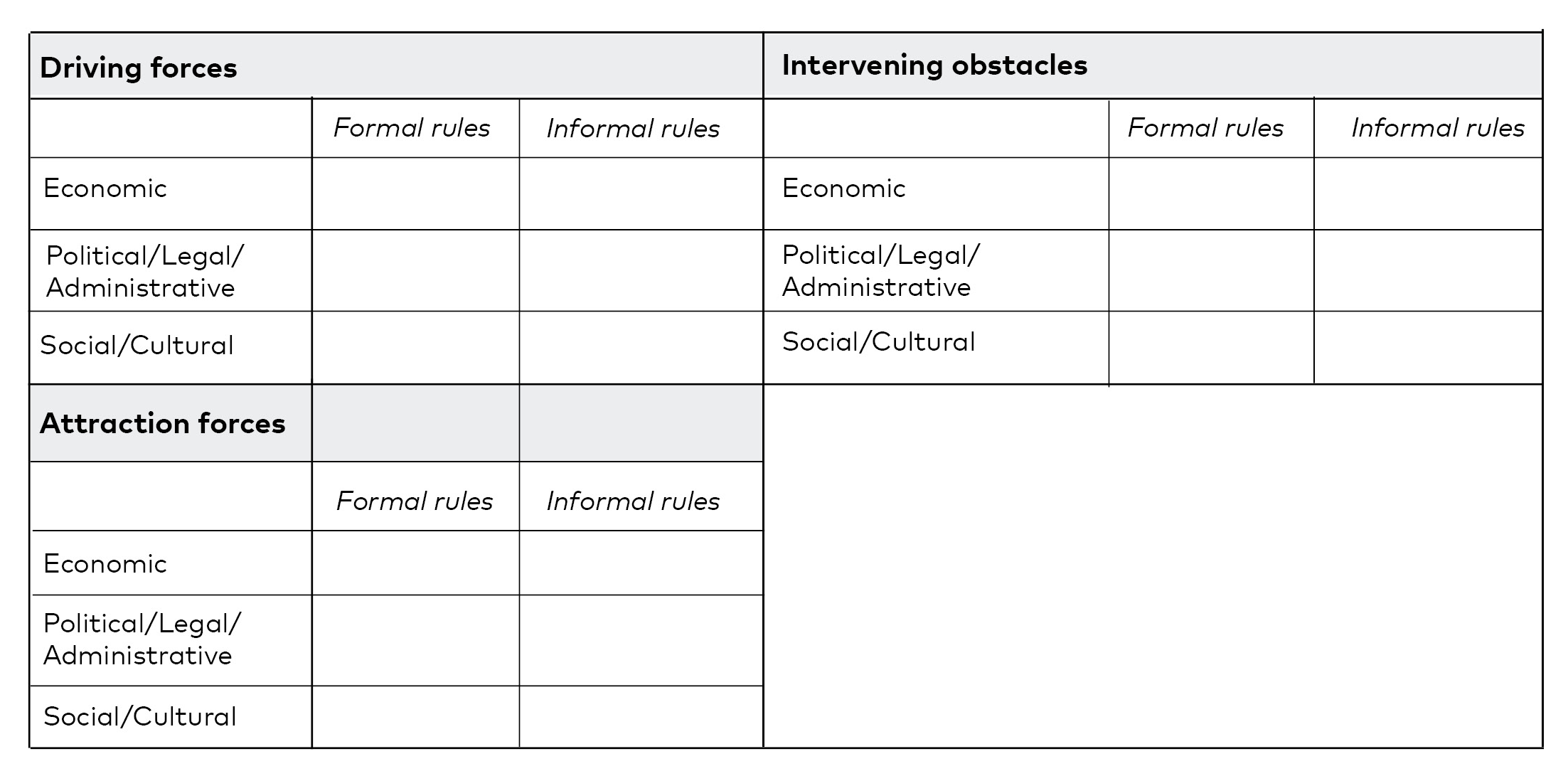
Table 3: Institutional analysis of driving forces, attraction forces and intervening obstacles in the three different realms of the push and pull model
Methods
The project will use a multi-method approach to answer the research questions. In addition to statistical and GIS data, which was also presented in a special chapter (Lundgren et al., 2022) of State of the Nordic Region 2022 (Norlén et al., 2022), the project will also include a literature review, three case studies and interviews in the case study regions.
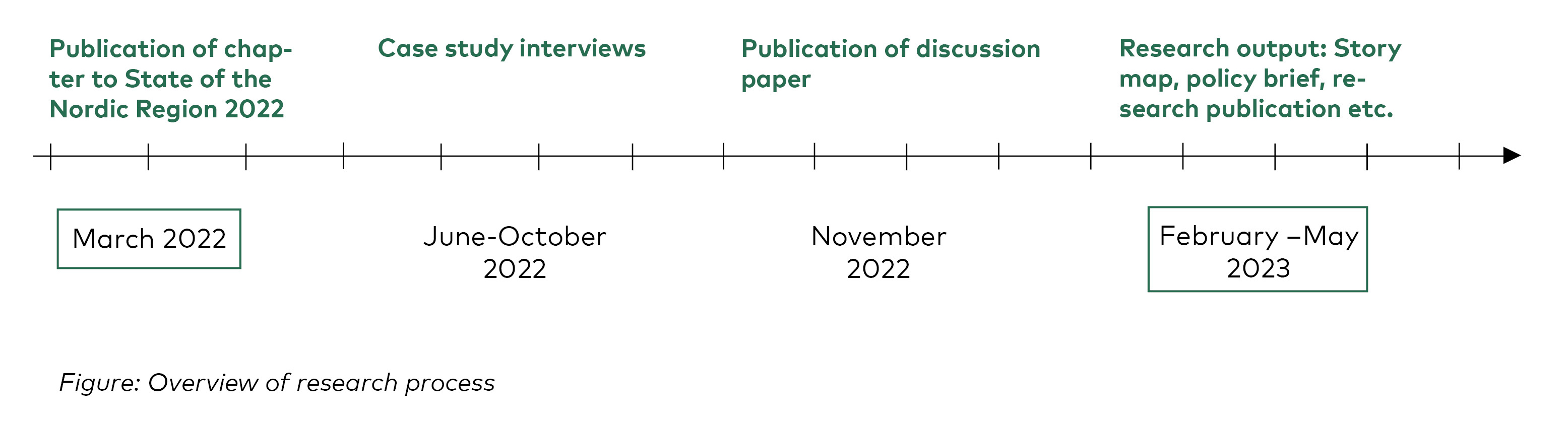
The literature review includes scientific literature based on searches in Scopus and ScienceDirect using search terms relating to mobility, migration, commuting and the labour market in combination with the names of the Nordic countries and Scandinavia. It also includes “grey literature”, i.e. reports and policy documents, among them recent surveys on cross-border mobility by, for example, the Freedom of Movement Council, Info Norden and cross-border regional councils.
Three case studies will be conducted in three very different regions: Greater Copenhagen, which is a metropolitan region on the border between Sweden and Denmark, Vestfold Telemark on the Norwegian south coast which has connections to and attracts labour from both Sweden, Denmark and elsewhere, and Greenland which is a remote region highly dependent on foreign workers and has links to Denmark.
The aim of the study is explorative, i.e. it will seek to understand the different motivations, obstacles and attraction forces for labour market mobility. As a result of this approach, the selection of case studies will be based on a strategy of looking into different rather than similar case studies (Bryman, 2008, Yin, 2014).
The project will use both quantitative and qualitative methods for the case studies. The quantitative part will consist of statistical analyses of labour market and cross-border mobility in the selected case study regions (Greater Copenhagen, Vestfold Telemark and Greenland). Based on accessible statistics, we will make comparisons between the case study regions and national-level data for both migration and commuting and conduct a cross-case analysis.
The qualitative part will consist of document studies, among them surveys of mobility in cross-border regions and interviews with relevant actors from the selected case study areas and cross-border regions. These will include people working on labour market issues on both sides of the borders within the municipalities and regions, trade unions, chambers of commerce, employers’ associations as well as organisations, both public and private, which promote a more closely integrated cross-border labour market.
Based on the analytical framework presented in this paper, the interviews will focus on identifying driving forces, attraction forces and intervening obstacles for labour market mobility in the case study regions. In the analyses of the results, attention will be paid to the nature of the forces, i.e. are they economic, legal/political/administrative or social/cultural. We will also analyse whether they are formal, for example, laid down in legislation or regulations or informal, relating to norms, values and habits, for example.

Photo: Wonderlane
Next steps and lessons learned in the Nordic Region
The project’s fourth research question is “What can the Nordic Region learn, and how can Nordic labour market mobility be re-started”? By identifying both the realms and the nature of the obstacles to cross-border labour market mobility, the project will seek to present the lessons learned in the Nordic Region and present recommendations to policymakers about how to promote greater cross-border labour market mobility.
A reference group comprising representatives of cross-border regions and Info Norden was set up to make the research more relevant and provide input (see appendix for a list of participants). The reference group will meet 3–4 times during the project. A workshop involving key stakeholders will be held in late 2022 to discuss the results and provide input into the Nordic lessons learned and into the policy recommendations.
Initial results from the case studies will be presented at Nordregio’s annual Nordregio Forum event in Hamar, Norway, 23–24 November 2022. The Forum will also provide an opportunity to engage with stakeholders and learn more Nordic lessons.

Photo: Hamar Regionen