
Myth #6: Cycling cannot make serious environmental impacts. Instead, we can achieve sustainability goals by trading in our fossil-fuel cars for electric vehicles.
Reality: Sustainability goals cannot be achieved unless we develop a built environment that facilitates active mobility.
Biking in the suburbs of Gothenburg, Sweden. Photo: iStock
Within the Nordic Region, road transport is responsible for just over 87% of transportation sector emissions, which has changed little since 1990 (see Box 2). When looking at total GHG emissions in the Nordic Region, 26% of total emissions are attributed to transportation and 23% to road transport specifically. This is a European-wide trend, with transport accounting for just under 30% of total emissions in the EU in 2022.
European Environment Agency. (2024). Climate: Key messages. Accessible at: https://www.eea.europa.eu/en/analysis/publications/sustainability-of-europes-mobility-systems/climate
Kester, J., Noel, L., Zarazua de Rubens, G., & Sovacool, B.K. (2018). Policy mechanisms to accelerate electric vehicle adoption: A qualitative review from the Nordic region. Energy Reviews, 94, 719-731. https://doi.org/10.1016/j.rser.2018.05.067
European Environment Agency. (2024). Climate: Key messages. Accessible at: https://www.eea.europa.eu/en/analysis/publications/sustainability-of-europes-mobility-systems/climate
European Environment Agency. (2024). Passenger transport activity. Accessible at: https://www.eea.europa.eu/en/analysis/publications/sustainability-of-europes-mobility-systems/passenger-transport-activity?activeTab=9b9a7a22-9b94-4bd6-9d8b-699fc71921f8
Making cities more sustainable requires rethinking the built environment. The existing backbone of the living environment is often the street, specifically a street designed according to the dimensions of large motor vehicles. Research highlights the problems that electric vehicles pose to land use. One concern is the inevitable maintenance and potential expansion of impervious surfaces that come along with this space-occupying mode of transport associated with sprawling urban settlements.
Orsi, F. (2021). On the sustainability of electric vehicles: What about their impacts on land use? Sustainable Cities and Society 66, 102680. https://doi.org/10.1016/j.scs.2020.102680
Researchers at Chalmers University in Sweden recently conducted a study to evaluate the potential impact of substituting passenger car trips with e-bikes. Using the Västra Götaland county of Sweden (where Gothenburg sits) as a case study, the researchers ran a simulation study showing that, based on factors such as speed, trip duration, street gradients, and activities of trips, “e-bikes could replace 57.6% of car trips” in the county.
ozluoğlu, Ç., Liao, Y., & Sprei, F. (2024). Potential of e-bikes to replace passenger car trips and reduce greenhouse gas emissions. Journal of Cycling and Micromobility Research, 2, 100043. https://doi.org/10.1016/j.jcmr.2024.100043
For a sustainable mobility system, electric vehicles alone will not be enough. Moreover, production of electric vehicles will still require substantial resources and generate pollution. Electric vehicles will also not solve the
problem of growing transport demand, time spent in traffic, or finding a parking spot.
Figure 1. Total GHG emissions (without LULUCF) in the Nordic Region, 1990 v. 2021 (tonnes of CO2e).
Data source: UNFCCC
Data source: UNFCCC
Figure 2. GHG emissions attributed to transportation sector in the Nordic Region, 1990 v. 2021 (tonnes of CO2e).
Data source: UNFCCC
Data source: UNFCCC
Figure 3. Percent of transportation emissions attributed to road transport v. other means of transport in the Nordic Region.
Data source: UNFCCC
Data source: UNFCCC
Policy/planning implications:
Redefine sustainability in terms of the whole landscape, not just the mode of transport.
Transport solutions are not sustainable if they require cities and regions to invest in and maintain infrastructure that contradicts long-term social, economic, or environmental goals. Instead, the high emissions status of the transport sector requires planners and policymakers to reconsider land use and rethink policies that support or hinder the development of living environments as a whole. For example, investments that open streets to other public uses may also have payoffs for social and economic sustainability. Cycling is an important mode of transport not only for its energy efficiency, but also because building a city at the scale of the cyclist helps cities to achieve other cross-sectoral aims. Approaches such as Avoid-Shift-Improve may be one way to consider how improving the efficiency of electric vehicles works only alongside reducing overall travel or shifting to more sustainable modes.
Identify structural barriers that disable residents from challenging car-centric norms.
While some long-distance trips may not be able to be replaced by a bicycle or e-bike, the percent of trips made by car for short journeys is surprisingly high. In Denmark, the car is the mode of transport that accounts for 46% of all trips between 4 and 9.9 km, and 23% of all trips between 2 and 3.9 km.
Integrate active travel modes into climate commitments.
Walking and cycling can play a larger role in discussions for reducing emissions. This can happen by making active mobility a key action item in, for example, Nationally Determined Contributions.
Transport solutions are not sustainable if they require cities and regions to invest in and maintain infrastructure that contradicts long-term social, economic, or environmental goals. Instead, the high emissions status of the transport sector requires planners and policymakers to reconsider land use and rethink policies that support or hinder the development of living environments as a whole. For example, investments that open streets to other public uses may also have payoffs for social and economic sustainability. Cycling is an important mode of transport not only for its energy efficiency, but also because building a city at the scale of the cyclist helps cities to achieve other cross-sectoral aims. Approaches such as Avoid-Shift-Improve may be one way to consider how improving the efficiency of electric vehicles works only alongside reducing overall travel or shifting to more sustainable modes.
Berg Mårtensson, H., Larsen, K., & Höjer, M. (2023). Investigating potential effects of mobility and accessibility services using the avoid-shift-improve framework. Sustainable Cities and Society, 96, 104676. https://doi.org/10.1016/j.scs.2023.104676
Identify structural barriers that disable residents from challenging car-centric norms.
While some long-distance trips may not be able to be replaced by a bicycle or e-bike, the percent of trips made by car for short journeys is surprisingly high. In Denmark, the car is the mode of transport that accounts for 46% of all trips between 4 and 9.9 km, and 23% of all trips between 2 and 3.9 km.
Christiansen, H. & Baescu, O. (2022). The Danish National Travel Survey: Annual Statistical Report for Denmark for 2021. DTU Orbit. Department of Technology,
Management, and Economics. Accessed 5 June 2023 from https://orbit.dtu.dk/en/publications/the-danish-national-travel-survey-annual-statistical-report-for-d
Integrate active travel modes into climate commitments.
Walking and cycling can play a larger role in discussions for reducing emissions. This can happen by making active mobility a key action item in, for example, Nationally Determined Contributions.
Good practice examples:
As part of the car-free strategy, the City initiated the so-called Living Streets (Levende Gater) project
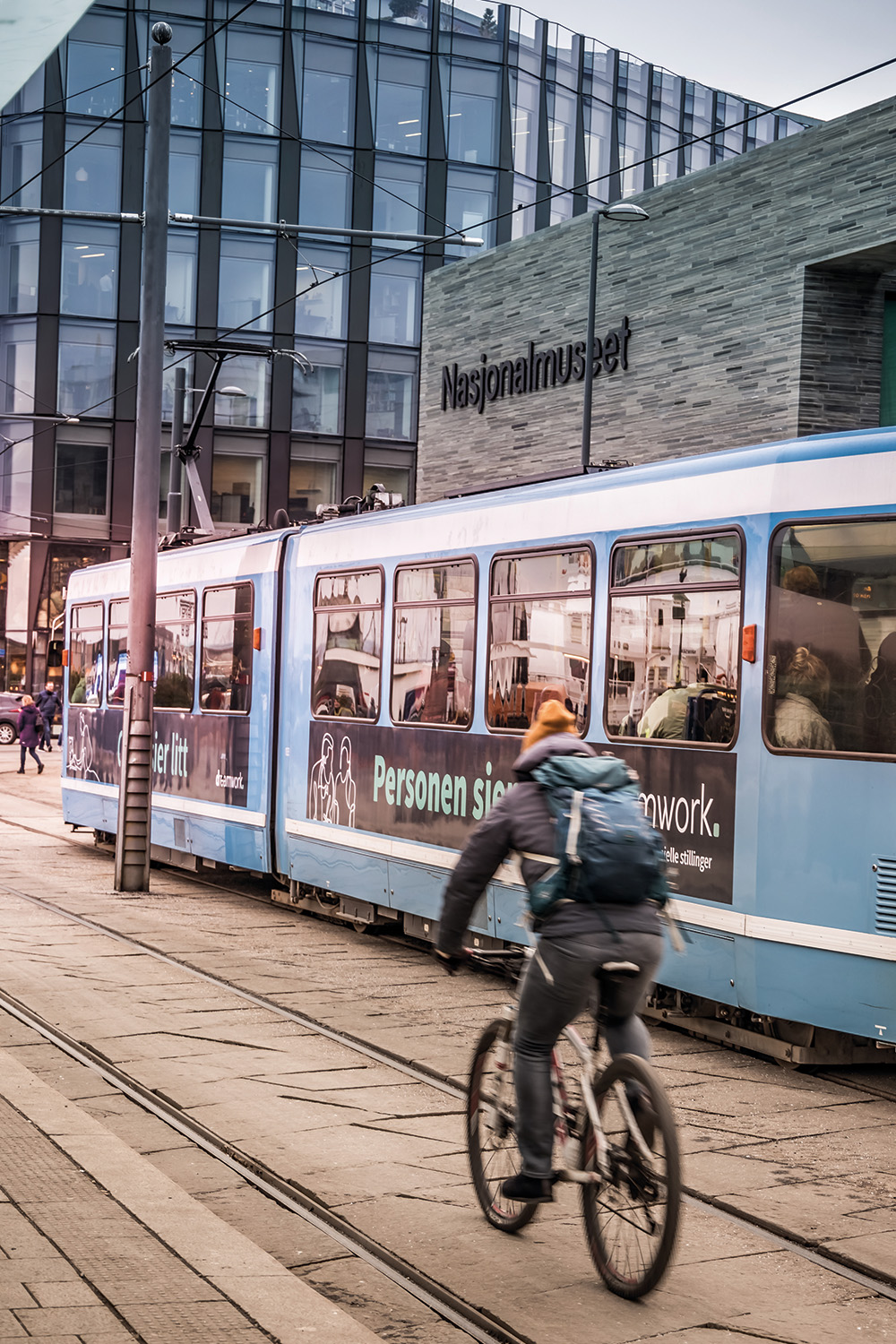
A bicyclist rides alongside a tram that has
just stopped at the Aker brygge station
in Oslo, Norway. Photo: iStock
just stopped at the Aker brygge station
in Oslo, Norway. Photo: iStock