Myth #7: Cycling only benefits cyclists.
Reality: Cities built for cycling, walking, and public transport benefit all members of society by providing them with agency, safety, and high quality of life.
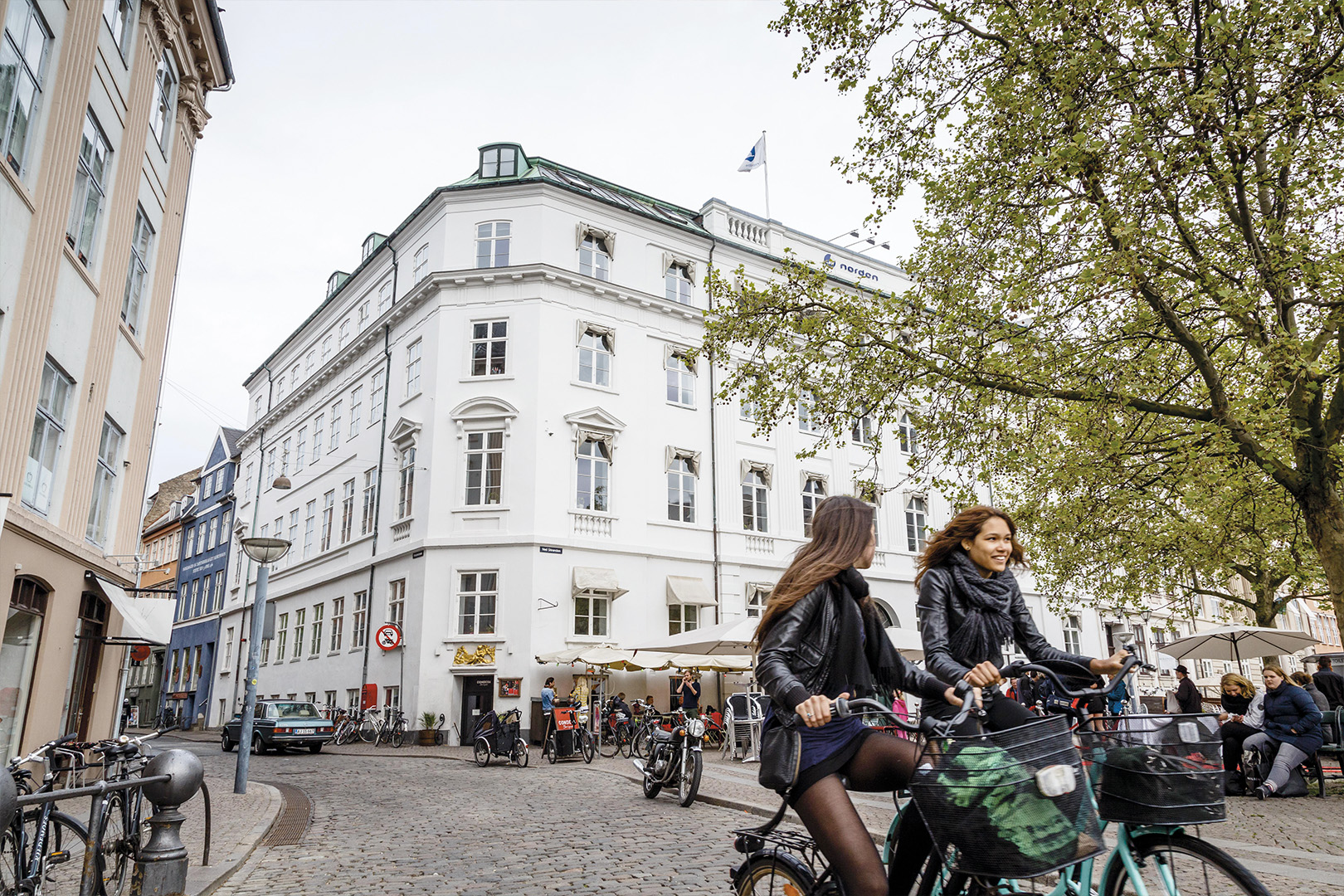
Cyclists passing through a human-scaled built environment in Copenhagen, Denmark. Photo: Yadid Levy / norden.org
When planners speak about reducing the number of cars on the road, the aim is not to initiate a war against drivers but to improve quality of life for all inhabitants. We are not all drivers, but we are all pedestrians at some point in our day—whether at the start of our journey with a walk to unlock our bicycle, in the middle of our journey as we transfer from one bus to another, or at the end of our journey when we lock the car and walk to the entrance of our destination. Therefore, designing cities at the human scale is a way to account for all inhabitants rather than focussing predominantly on those operating a vehicle. Since cycling and other forms of micro-mobility remain at the human scale, these transport options accommodate similar goals. In other words, cities that cater to cyclists have built environments that support other kinds of sustainability.
But what does this mean for those who do need to drive? Does improving cycling inherently mean reducing quality of life for those who, under various circumstances, require a private car? If cities offer things like well-maintained cycling paths, safe and convenient bicycle parking infrastructure, and convenient multi-modal transport accessibility, more people may choose to cycle. And if more people who can cycle choose to do so instead of taking a car, the reduction of private vehicles on the street can lead to improved traffic conditions for those who do need to drive—particularly when it comes to congestion. This has the potential to lower stress levels among those who need to use the car. More cyclists and fewer cars on the road also means less air pollution and noise pollution for everyone and can lead to improved health for the population and greater road safety conditions—including for drivers.
Safety is often reported as a major factor that inhibits residents from cycling. In line with the EU, all Nordic countries have subscribed to a Vision Zero goal regarding traffic deaths, but in 2022, there were still over 700 reported road fatalities in the Nordic countries, and another 27,000 injured.
Icelandic Transport Authority. (2024). Umferðarkönnun 2024 [Traffic survey 2024]. Accessible at: https://downloads.ctfassets.net/8k0h54kbe6bj/1KWK16G7gpeStmPz4zzbSG/70d12986b35d98af57438276336a3736/4035931_Umferdarkonnun-2024_Samgongustofa_301024.pdf
Ferenchak & Marshall, 2024
Another benefit of developing cities and regions for cycling regards health. Researchers in Sweden studied health impacts by modelling a scenario of just over 100,000 commuters shifting from car to bicycle in Stockholm. Based on changes in traffic flows and the resulting impacts on air pollution, road traffic injuries, and physical activity, researchers showed how swapping out the car for the bicycle when commuting could have major health benefits.
Sommar et al., 2022
Fleming, R. (2023). Cycle for mental health—World Mental Health Day 2023. European Cyclists’ Federation. Accesisble at: https://ecf.com/news-and-events/news/cycle-mental-health-%E2%80%93-world-mental-health-day-2023-0
Policy/planning implications:
Reduce barriers that threaten the comfort and safety of vulnerable road users.
A recent study in Sweden shows how cyclists find a reduction of traffic volume to be the greatest indicator of a safe cycling route.
It’s important to note that safety is both an actual and perceived measure, and what is objectively considered safe may not be experienced as such by all user groups. Therefore, engaging with citizens to understand their mobility concerns can also help to make mobility of all kinds more inclusive.
A recent study in Sweden shows how cyclists find a reduction of traffic volume to be the greatest indicator of a safe cycling route.
Olsson & Elldér, 2023
Ekman, L., Lisra, B., Pettersson, M., Wells, L., & Öhling, I. (2023). Uppdrag att utveckla arbetet med hasitghetsanpassiningar [Assignment to develop the work with speed adaptations]. Trafikverket. 2023:036. Accesisble at: https://trafikverket.diva-portal.org/smash/get/diva2:1746164/FULLTEXT01.pdf
It’s important to note that safety is both an actual and perceived measure, and what is objectively considered safe may not be experienced as such by all user groups. Therefore, engaging with citizens to understand their mobility concerns can also help to make mobility of all kinds more inclusive.
Communicate about the benefits of cycling that matter most to residents.
Planners and policymakers may need to shift their approach in how they communicate about mobility behaviour. In a 2022 survey, residents in Copenhagen reported that the reason they cycle is mainly because it is faster and easier than other modes of transport, and because it has positive health benefits. For the public, the environmental-friendly benefits may be less of a priority. Therefore, instead of communicating narrowly about the ways that cycling can contribute to emissions reductions, planners and policymakers can appreciate those benefits while communicating to the public about the many other benefits that cycling can have for their quality of life.
This also applies to the narrative planners and policymakers employ regarding cycling in the city. Street closures, for example, are only closed for those who inhabit the street by car, but for all other forms of human interaction, the street can be described as open and available for new forms of social and economic interaction.
Build bridges across administrative departments for effective cycling planning.
Cycling has many cross-sectoral benefits and can therefore be used as a means for achieving objectives across different departments and policy areas. Simply put, improving cycling cannot be done in isolation. It requires the coordination and commitment from many different actors to be successful. And while this is a challenge, the versatility of the bicycle to meet the needs and interests of society can make it a simple solution for a range of different stakeholders—from health care and business to tourism and social service sectors—to rally around. Additionally, as suggested by the European Public Health Alliance, health perspectives can be integrated into mobility strategies to more effectively link active mobility and health and well-being.
European Public Health Alliance. (2023). Prioritising health in mobility planning: Assessing health and co-benefits in European Sustainable Urban Mobility Plans. Accessible at: https://epha.org/wp-content/uploads/2023/12/gph_urban-mobility-sumps.pdf
Good practice examples:
Jorun Andenes, L. (2023). Cycling data [presentation]. City of Oslo.
Ibid.
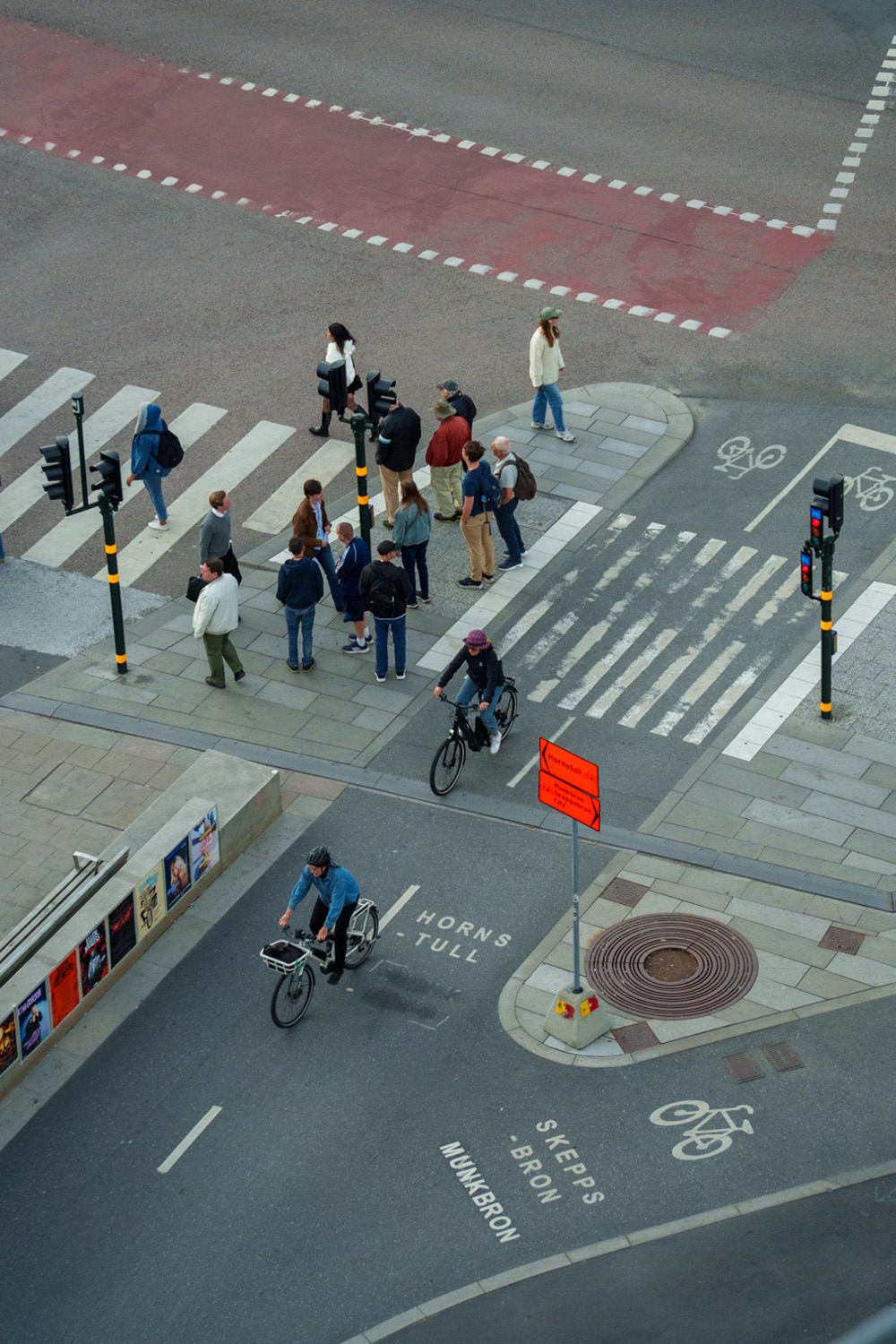
Cyclists and pedestrians crossing the
street at an intersection in Stockholm.
Photo: Dawid Tkocz, Unsplash