Photos: Maja Brynteson, Sigrid Jessen/Nordregio
3. Methods
The following section presents the empirical settings of the Faroe Islands, Greenland and Åland, along with a discussion of the relevant methodological considerations, including data collection and analysis.
3.1 Empirical context: The Faroe Islands, Greenland and Åland
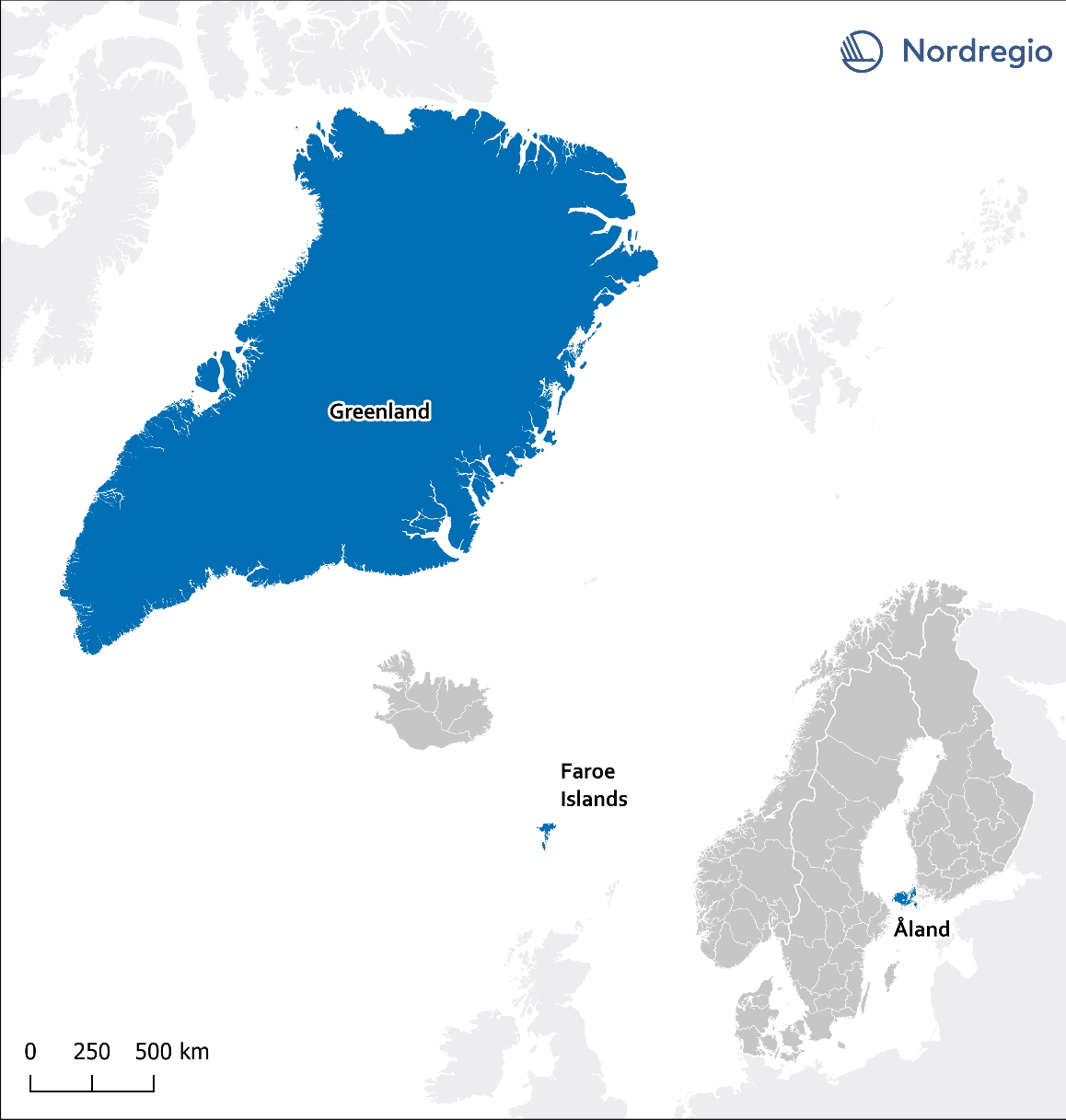
Figure 1: Map of the Nordic countries highlighting Greenland, Åland and the Faroe Islands.
One aim of this research was to understand the mechanisms behind inclusive eID rollout in geographically remote, smaller regions, taking the three Nordic autonomous societies, the Faroe Islands, Greenland and Åland, as the empirical point of departure.
“Remoteness” in this study is defined by geographical distance from inner urban areas and limited physical accessibility due to geographical features, such as the island nature of Greenland, the Faroe Islands and Åland.
Today, all three are self-governing, but the path to their autonomous status has differed significantly. Åland is part of Finland, whereas the Faroe Islands and Greenland are part of the Danish Kingdom. Åland has shifted between Swedish and Finnish control for much of its history. It was eventually granted autonomy within the Finnish state in 1920,
This autonomy was later reaffirmed in 1921.
The Faroe Islands became self-governing in 1948, when the Faroese Home Rule Act was implemented. Today Faroese and Danish are the two official languages in the Faroe Islands (Wylie, 1987). Greenland, on the other hand, first achieved autonomy in 1979 through the Home Rule Act, with further expansion of Greenlandic control in 2009 under the Self-Government Act (Kuokkanen, 2017). Greenlandic (Kalaallisut) is the official language of Greenland. In contrast to the Faroe Islands – an island group without a pre-existing indigenous population and settled by Norse people in the 9th century – Greenland was claimed by Denmark in 1721 (Dahl, 1970). The colonisation of Greenland involved suppression of the indigenous Inuit population’s self-determination for several centuries, as the Danish language, religion, education system and way of life were imposed on the local population in an attempt to assimilate the local population. External trade was also dominated by Denmark as the ruling power (Dyrendom Graugaard, 2009). Although the Faroe Islands were not colonised in the same manner, their history also features elements of colonisation (Kočí & Baar, 2021). At present, in early 2025, independence discussions are underway in both the Faroe Islands (DIIS, 2025) and Greenland (Jakobsen & and Larsen, 2024).
Today, the Faroe Islands, Greenland and Åland hold exclusive political competence in most areas. In the Faroe Islands, areas still under Danish control include foreign policy, security and defence policy, citizenship, the Supreme Court and currency and monetary policy (West, 2024). Digitalisation comes under Faroese control and is the responsibility of various ministries, including the Ministry of Finance (Nordic Cooperation, n.d.-a). In Greenland, the picture is similar, with the exception that Greenland has its own Digitalisation Agency (Digitalinngortitsinermut Aqutsisoqarfik, n.d.). In Åland, foreign affairs, most areas of civil and criminal law, customs policy and monetary policy fall under Finnish control. Digitalisation initiatives in Åland are managed by the Digitalisation Council (Government of Åland, 2017). While this council operates within the autonomous government of Åland, it collaborates with Finnish authorities on digitalisation matters.
The Faroe Islands, Greenland and Åland also differ in terms of digital accessibility. Connectivity is more expensive in Greenland due to factors including its larger geographical scale and harsher Arctic weather conditions, which increase the risk of breakdowns (Abildgaard, 2022; Reinhold, 2024). The Faroe Islands, in general, are digitally advanced, with 4G connectivity available to the majority of the population for several years and the rollout of 5G underway (Wendt-Lucas & de Jesus, 2023). In Åland, the rollout of 5G is still in progress, while 4G is widely accessible (ibid).
The three societies also differ demographically. In 2023, the average age in the Faroe Islands was 39.7 years (Statistics Faroe Islands, 2025), in Greenland 36.4 years (Statbank Greenland, 2025) and in Åland 44.6 years (Statistics and Research Åland, 2023), the highest average age of the three case studies. While only limited data are available on the proportion of homeless individuals in each society, as a clear definition of the term is lacking, there have been observations of a general increase in people who can be considered homeless. In 2023, a Faroese newspaper reported that homeless shelters in the Faroe Islands were increasingly operating at full capacity (Nielsdóttir, 2023) while a research paper from 2024 found that the number of individuals experiencing acute and “hidden” homelessness was also on the rise in Greenland (Christensen et al., 2024). Another aspect that should be highlighted is the difference in average annual income between the Faroe Islands, Greenland and Åland. In 2023, the average disposable income for individuals aged 14 and above in Greenland was DKK 185,959 (Statbank Greenland, 2023).
The lower average disposable income, especially among the rural population, can be attributed to the traditional lifestyle of the residents, who often rely on hunting and gathering to supplement their food intake (Poppel & Kruse, 2009).
Exchange rate from EUR to DKK on 14 April 2025.
Factbox: The Faroe Islands
|
800
The Faroese Paliament is established.
↓
1816
The Faroe Islands are recognised as a Danish county.
The Faroe Islands are recognised as a Danish county.
↓
1948
The Home Rule Act enters into effect and Faroese becomes the official language in the Faroe Islands. Several key areas are transferred to Faroese control.
The Home Rule Act enters into effect and Faroese becomes the official language in the Faroe Islands. Several key areas are transferred to Faroese control.
↓
2005
The Home Rule Act is expanded by the Takeover Act and the Powers of Attorney Act. Several key areas are transferred to Faroese control.
The Home Rule Act is expanded by the Takeover Act and the Powers of Attorney Act. Several key areas are transferred to Faroese control.
↓
2015
Talgildu Føroyar, the National Digitalisation Programme of the Faroe Islands, is established by the Ministry of Finance.
Talgildu Føroyar, the National Digitalisation Programme of the Faroe Islands, is established by the Ministry of Finance.
↓
2017
Mínlykil (the first Faroese eID) is launched.
Mínlykil (the first Faroese eID) is launched.
↓
2020
Samleikin is launched and Mínlykil is terminated.
Samleikin is launched and Mínlykil is terminated.
Figure 2: A brief timeline of Faroese history, focusing on Faroese independence, digitalisation and eID. Sources: (Føroya Løgting, n.d.; Government of the Faroe Islands, n.d.; Nordic Cooperation, n.d.-a; Nordics Info, 2019; Signicat, n.d.; Talgildu Føroyar, n.d.).
Factbox: Greenland
|
Approx. 2500 BCE
The first Paleo-Eskimos arrive and settle in Greenland.
↓
1721
A Danish-Norwegian missionary colony is established in Greenland.
A Danish-Norwegian missionary colony is established in Greenland.
↓
1953
Greenland changes status from a colony to a Danish county, with Greenlanders granted full Danish citizenship.
Greenland changes status from a colony to a Danish county, with Greenlanders granted full Danish citizenship.
↓
1979
The Home Rule Act is introduced, alongside establishment of the Greenlandic government (Naalakkersuisut) and Greenlandic parliament (Inatsisartut). Several key areas such as health and education are transferred from Danish to Greenlandic control in the years following the Home Rule Act.
The Home Rule Act is introduced, alongside establishment of the Greenlandic government (Naalakkersuisut) and Greenlandic parliament (Inatsisartut). Several key areas such as health and education are transferred from Danish to Greenlandic control in the years following the Home Rule Act.
↓
1985
Greenland leaves the European Economic Community (today European Union).
Greenland leaves the European Economic Community (today European Union).
↓
2009
The Self-Government Act enters into effect, extending the areas of Greenlandic control, including police, judiciary, natural resources and digitalisation (e.g. digital infrastructure, telecommunications and digital services).
The Self-Government Act enters into effect, extending the areas of Greenlandic control, including police, judiciary, natural resources and digitalisation (e.g. digital infrastructure, telecommunications and digital services).
↓
2022
Denmark introduces a new national eID called MitID, replacing NemID, the previous eID. Greenland starts implementing MitID simoultanously with Denmark.
Denmark introduces a new national eID called MitID, replacing NemID, the previous eID. Greenland starts implementing MitID simoultanously with Denmark.
Figure 3: A brief timeline of Greenlandic history, focusing on Greenlandic independence, digitalisation and eID. Sources: (BBC, 2012; Heinrich, 2023; Nordic Cooperation, n.d.-b; Sullissivik, n.d.).
Factbox: Åland
|
Approx. 4000 BC
The first humans reach the Åland archipelago, marking the beginning of its history.
↓
1809
Åland, along with Finland, is ceded by Sweden to the Russian Empire after the Finnish War. It becomes part of the Grand Duchy of Finland.
Åland, along with Finland, is ceded by Sweden to the Russian Empire after the Finnish War. It becomes part of the Grand Duchy of Finland.
↓
1917-1921
Following Finland’s independence from Russia in 1917, Ålanders seek to reunite with Sweden. The Ålandic independence movement emerges, with the issue settled diplomatically in 1921, when the League of Nations grants Åland autonomy under Finnish sovereignty.
Following Finland’s independence from Russia in 1917, Ålanders seek to reunite with Sweden. The Ålandic independence movement emerges, with the issue settled diplomatically in 1921, when the League of Nations grants Åland autonomy under Finnish sovereignty.
↓
1922
Åland's autonomy is formalised with the first session of the Åland Parliament (Lagtinget), giving Åland extensive self-governing rights, including language, education and cultural matters.
Åland's autonomy is formalised with the first session of the Åland Parliament (Lagtinget), giving Åland extensive self-governing rights, including language, education and cultural matters.
↓
1995
Åland joins the EU along with Finland but maintains special tax exemption status, including remaining outside the EU VAT system.
Åland joins the EU along with Finland but maintains special tax exemption status, including remaining outside the EU VAT system.
↓
2012
Åland develops its Digital Agenda, focusing on digitalisation of public services and broadband expansion.
Åland develops its Digital Agenda, focusing on digitalisation of public services and broadband expansion.
↓
2024
Åland is awaiting Finland's decision on state-issued eID to determine how to adopt or implement it in the Ålandic context.
Åland is awaiting Finland's decision on state-issued eID to determine how to adopt or implement it in the Ålandic context.
Figure 4: A brief timeline of Ålandic history, focusing on Ålandic independence, digitalisation and eID Sources: (Nordiskt Samarbete, n.d.-b; Utrikesministeriet, n.d.; Visit Åland, n.d.).
3.2 Research design: Data collection and analysis
The empirical work underlying this report was conducted in two stages. The first stage consisted of desk research focusing on policy/document analysis, stakeholder mapping and online interviews with national experts. This laid the groundwork for the second stage of the research, which consisted of in-depth fieldwork in Åland, the Faroe Islands and Greenland during 2024. The fieldwork in Åland took place in Mariehamn in February 2024, where 11 interviews were conducted with 12 participants. The fieldwork in the Faroe Islands took place in Tórshavn and the surrounding towns, as well as in Klaksvig, in March 2024, with nine interviews and one focus group, bringing the total number of participants interviewed to 19. The last fieldwork occurred in Nuuk, Greenland, over ten days from September to October 2024. Here, 17 interviews and one focus group were conducted with 20 participants. The interviewees consisted of representatives from agencies and ministries, politicians, bank representatives, human rights advocates, NGOs working with various population groups (including homeless individuals), library representatives and representatives from the IT and telecommunications sector.
The interviews were generally conducted in Swedish and Danish, except for one in English and one using a sign language interpreter. All interviewees were offered the opportunity to conduct the interview in English or their national language, accompanied by a translator, but all declined the latter option. The interviews and focus groups were all semi-structured, focusing on the challenges and solutions of an inclusive eID rollout. All interviewees were given information sheets prior to the interviews and were asked to give written consent, confirming that they had read and understood the information on the project and on the handling of data, including anonymisation.