1. Case for action for a transformative curriculum for urban development and research
1.1. Climate change adaptation requires complex, urban transformation processes
Since the first Club of Rome report in 1972 (Meadows et al., 1972), we have accumulated a great deal of knowledge about humanity's role in climate change - but we are still a long way from effectively reducing it. Complex challenges in times of climate change require not only complex solutions, but also the awareness that their implementation goes far beyond technological solutions and entails a fundamental change in the roles and routines of municipal project managers, consultant researchers and all relevant stakeholders.
The formats of living labs and transdisciplinary real-world laboratories that have been successfully implemented in recent decades thanks to the EU Horizon 2020 programmes have presented researchers and municipal project managers with the challenge of abandoning their traditional roles and looking for opportunities for mutual support and cooperation.
Which goals and measures to reduce climate-damaging emissions can be realised in a specific context? How can complex change processes in one's own city or region be understood and moderated? How do researchers and municipal project managers have to organise their role, project structures and cooperation so that a "new wine" in "new wineskins" becomes possible in the first place?
"We have suitable technological solutions for you!" we often hear from experts, immediately followed by complaints about the fact that valid (hierarchical) structures and (municipal decision-maker) roles in the cooperation between representatives of politics and administration are a major obstacle to realisable technological change. The municipal "playing field" is perceived as resistant to change.
The experience of many research projects has shown that change that does not respect existing hierarchies is rejected by the system and loses any chance of realisation. Lessons learnt also show that transformation projects that only use existing hierarchical information and decision-making processes are assimilated by the communication patterns of the system. "New wine" seems to be neutralised by "old wineskins" and reduced to a minimum.
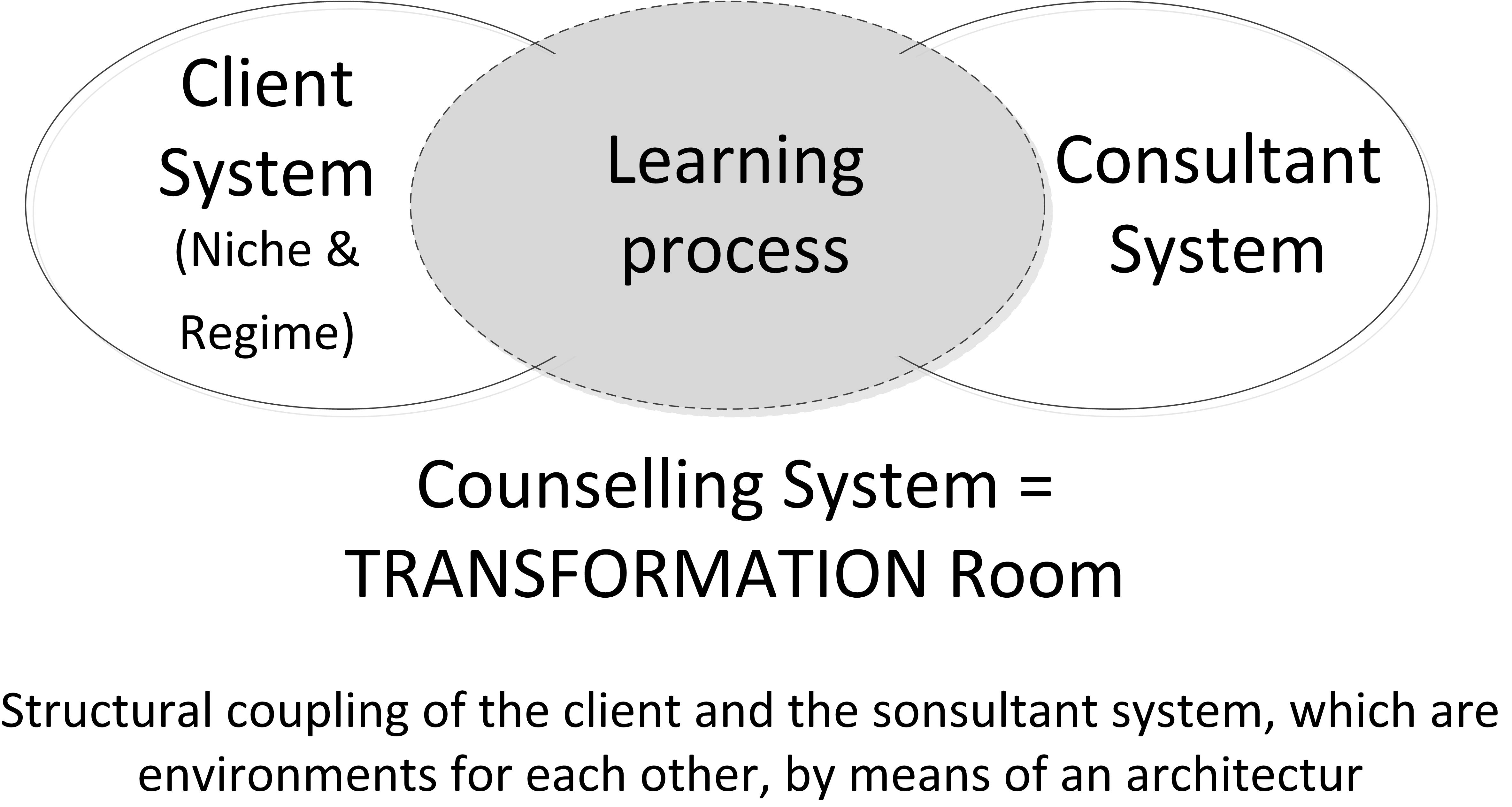
Change therefore requires system learning or system transformation: This leads to the question of how and at what levels municipal project managers and consulting researchers need to work both with established municipal hierarchies and build cross-sector, multi-level transformation room for learning and experimentation processes. This gives rise to two further follow-up questions.
It must be clarified in which way which central actors of the "municipal hierarchy" must be integrated into the multi-level transformation room in order to be part of the learning and experimentation process and thus be able to understand the new solutions and then represent and support them in municipal decision-making processes. It must also be answered when and in what way the prescribed decision-making processes of the municipality must be addressed and utilised so that the new solutions can be reviewed by the formal decision-making bodies/institutional authorities and officially approved for integration into specific work processes.
And everyone knows that transformation processes cannot be controlled and instructed. Despite careful clarification of objectives, a clear focus and the best planning, their dynamics are always open-ended and therefore a risk. The phase of "integrating" new solutions into existing operational processes is therefore a particularly critical moment because this is where existing processes are productively disrupted and, at best, expanded. Reinhard Nagel, a systemic Austrian organisational counsellor (D. Wilhelmer/ R. Nagel 2009), therefore characterises this phase of transition as a "jolting phase", where new solution ideas initiate changes to existing processes and are simultaneously changed by the existing processes once again. This makes the implementation steps of transformation processes an important part of the transformation process itself.
1.2. Urban development needs context governance and transformation companions from two worlds
In turn, both "transformative facilitators" need to be equally open and willing to learn for the innovative combination of governance formats from a) "urban and regional development" (e.g. urban living labs, real-world labs, testbeds, sustainable foresight) and b) organisational development (e.g. communities of practice, social and temporal project architectures, supervision, focus groups, etc.). The following applies: the greater the variety of available formats and roles, the higher the probability of tailoring a suitable context governance approach to the specific case.
Transformative jolts require municipal project managers to reflect on their own situation from an external perspective time and again, while keeping an eye on their current status and their own creative role in the overall process. By pursuing the unusual questions and observations of external researchers via, municipal project managers can switch from time to time to the realm of possibilities of alternative solutions and procedures and perceive their own situation differently from this external perspective. As long as consultant researchers provide municipal project managers with a helpful external perspective and flexibility in their own actions, they represent an indispensable added value as co-operation partners in governing the transformation process. This requires both transformation facilitators to be mutually attractive in the sense of respecting and wanting to understand each other's perspectives and trusting that, come what may, both will find meaningful reactions and next steps based on this in order to achieve the overarching goal. Mutual attractiveness and reliability provide the breeding ground for co-operative governing.
What is needed, therefore, are new cooperation and governance formats that enable co-creation in experimenting, testing and replicating new concepts in real contexts beyond the day-to-day operations of hierarchical structures, allowing new cooperation roles and rules and socio-technical solutions to emerge experimentally in the process - without disrupting regular operations.

1.3. Transformative jogging routes need communal and research-based learning
Consultant researchers are required to understand the meaning and purpose of unfamiliar municipal processes in order to scrutinise their functionality and be able to use and adapt them for content-related and social transformations. Municipal project managers, on the other hand, are challenged to overcome existing prejudices towards internal colleagues and to gain an understanding of cycles of impact. For the first time, this will enable them to recognise the beneficial and detrimental effects of their own way of fulfilling tasks and shaping roles on the progress of the transformation process.
This task of observing and changing one's own contributions within the impact processes of transformation processes is also new for many consulting researchers: research organisations continue to attach the highest priority to the development of content-related skills when socialising young researchers and neglect the development of skills and abilities in managing and dealing with complex change processes.
In this context, we see describing one's own actions as an effect and oneself as a victim of "change-resistant communities" as overtaxing consulting researchers in dealing with complex change processes: seeing self-reflection and changing one's own role as the key to shaping successful transformation processes requires a high willingness to criticise and learn on the part of everyone.
Well-intentioned is not always good: research projects have shown that experts can trigger violent defensive actions in the system by unilaterally pushing a technological solution - in ignorance of the organisational, legal and social problems this triggers in the municipality - and thus unintentionally discredit their own technical solution. Only the city's decision-makers can assess the effects and thus the opportunities and risks of individual decisions and thus take responsibility for the results of their implementation. In this process, consulting researchers take on the role of a supplier of substantive solution proposals or helpful procedures and implementation methods or helicopter, which repeatedly enables the adoption of an external perspective and thus reflection and governance of the overall process.
Cooperation experiences from the past determined mutual expectations in the present: What can I expect from the municipal project manager? What positive added value does the consultant researcher bring and what should I, as the municipal project manager, expect from them in the worst-case scenario during transformative shake-ups? Does the researcher have vested interests that are more important to him than the municipal transformation process? Neutral actions on the one hand can reactivate old experiences and trigger reflexive protective reactions on the other. Since, according to Schopenhauer, misunderstandings are the rule in communication and understanding is the exception, a lack of regular evaluation processes of current co-operation can lead to a build-up of mistrust and communication blockages over time.
Clarifying old role experiences and agreeing on a desirable role design thus becomes a central point of the mutual learning process.
1.4. Can UTC itself be an object of research?
Are transformative researchers in a position to observe transformation processes in the system beyond their substantive expertise and to promote their positive development through autonomy and substantive and methodological impulses? Can the HOW of transforming social systems and the role design required for this be a subject of research for researchers themselves?
Transformative research does not transfer the natural scientific principle to the description of urban transformation processes. Every description always includes the role of the describing and analysing party, and thus of the researcher, in the investigation. This distinguishes transformative, change-supporting research from transformation research, which purports to describe transformation processes in complex systems from a quasi "objective position" beyond socio-historical circumstances or interests.
1.5. The relevance of the transformative TANGO-W curriculum today...
The globally visible effects of climate change make it imperative to concentrate all efforts on reducing climate-damaging emissions beyond traditional socio-technical solutions and traditional routines in communities and research organisations.
New types of cooperation are changing established roles and governance instruments.
Neither happens by itself, but must be developed and realised experimentally in protected learning spaces and experimental real-world laboratories through on-the-job training. Above all, however, such learning processes require new attention from local authorities and research organisations and time to mature and take root.