2. New role requirements for transformation facilitators from two worlds
Transformative leadership requires a co-creative governance relationship between internal, communal project managers and external, consultant researchers in the moderation of all development and decision-making processes in the transformation room. Their task is to make an external perspective with a variety of possible solutions and an internal perspective with the ability to assess the impact of different solution models accessible to cities within the framework of participatory living lab formats.
The absence of one of the two sides would inevitably lead to a weakening of either innovative strength or implementation strength.
2.1. European municipalities operate in a diverse and dynamic environment
European municipalities operate in a dynamic environment characterised by a mix of formal rules, informal practices, and resource structures. These elements both limit and promote their potential for transformative change.
Furthermore, municipalities are not homogeneous entities: they consist of different sub-governments each with their own interests, resources, and objectives. The degree of autonomy and independence of these municipalities varies greatly across European regions and countries, reflecting the different institutional contexts within the EU (Kronsell/Mukhtar-Land gren, 2018). What they have in common is that the municipalities represent a crucial interface where policy and administrative implementation meet.
Civil servants are increasingly becoming key figures in the evolving landscape. Contrary to the traditional view that they merely implement policies, they can initiate and shape policy agencies (Skoog/Svensson 2023). Their role is crucial for maintaining consistency and coherence in the long term, especially in the face of transformative policies aimed at fundamental change (Braams et al. 2021, Weber and Rohracher 2012). This role of civil servants emphasises the importance of strengthening public administrations from within to ensure that they are equipped not only for today's challenges but also for future governance and policy implementation requirements.
2.2. Requirements for new skills and competences of municipal project managers
The new requirements of initiating and co-designing fundamental transformation processes address an expansion of personal, professional and interpersonal, i.e. social skills of civil servants for their cooperation with their working environment, their colleagues and the public. At the same time, the requirements for knowing and using specific management methods, procedures, techniques and tools that civil servants need as municipal project managers in transformation projects are also increasing.
When expanding social skills and methodological competences, the focus is always on the "how", i.e. on approaches and methods that can be used for joint internal/external planning, governing, implementation and evaluation of the various interventions in transformation processes.
The results of a survey in all TANGO W ULLs have shown that project management runs like a common thread through all job profiles and emphasises the importance of leading teams and different stakeholder groups to achieve transformative goals. This is not just about leadership, but also about promoting collaboration between disciplines and individual departments and breaking down silos, as is explicitly required in Sweden, Norway, and Austria. Successful project management also involves strategic planning and the use of agile governance and measurement tools to ensure that communications are organised and moderated effectively and resources are used sensibly to achieve the overarching goals.
At the level of the attitude as a professional transformation facilitator, systemic project management also requires an exit from causal-logical patterns of attributing blame according to the motto "Because you are like this - therefore I am like this". Instead, what is required is the ability to perceive the impact of one's own contributions to the achievement of objectives within concrete cycles of effects from a meta-perspective and to be able to change them in such a way that potentially undesirable effects can be eliminated (Simon, F.B. (2002), G. Schmidt, G. 2015).
Curiosity, a willingness to learn and a readiness for conflict mediation are key additional skills for municipal project managers. It is also important to build up role distance and expand one's own scope for action in the working environment of the municipality in order to assess the need for change in the municipality as a whole and to be able to react flexibly to the need for change on the part of the consulting researcher or external stakeholders.
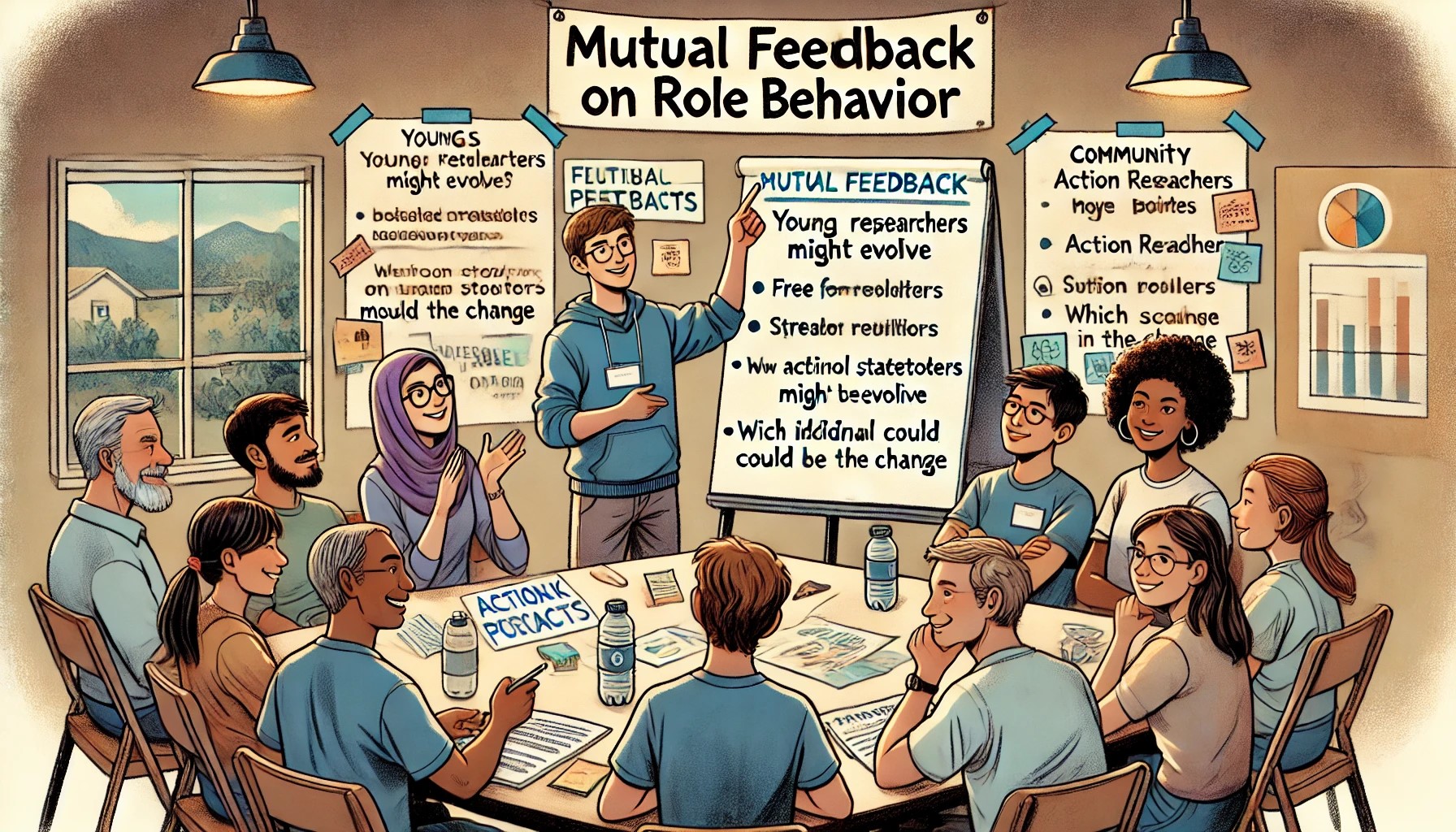
People do not see what they do not see. Here, the possibility of cooperation between the municipal project manager and an external, consulting researcher offers the opportunity to better recognise one's own blind spots and thus actively counteract the undesirable effects of one's own actions. This resource also applies vice versa for the consulting researcher with the help of feedback from municipal project managers. In this way, the skills of self-reflection and self-governance and the orientation towards overarching transformation goals (visions) take the place of uncritically rapid and correct implementation of political decisions and hierarchically anchored goals according to the principle of "top trumps bottom".
Only the format of co-creative "external/internal" governance of transformation projects between municipal project managers and consulting researchers allows both to distance themselves from previous patterns of cooperation and experiment with new tools and skills: Co-creative initiation, governing, implementation and evaluation of transformation projects is the new normal. The added value of this is reflective, intervisory support for the municipal project managers by consulting researchers who actively support them in their leadership and dealings with the municipal cooperation partners and the relevant external stakeholders.
A high level of communication skills and the development of understanding and commitment for the various interest groups also run through the surveys of all TANGO W ULLs as a common thread and requirement for all-partiality. Whether working with political representatives, involving citizens or working with business and commercial interest groups, networking and collaboration skills are required in all countries.
And, of course, expertise in the respective municipal area also plays a key role in all countries. Whether in the fields of education, environmental planning, mobility, energy, sustainability or financial management, a deep understanding of the respective area of expertise is the basis for civil servants to support sound decision-making recommendations and partial outcomes of transformation projects and to operate and manage their proper implementation in good tradition. Of course, the traditional requirements of accountability and responsibility remain fundamental qualities that are required in all countries of a competent administration that pursues long-term strategies and decisions sustainably in the service of the common good, beyond short-term political decisions. These qualities also include ethical standards such as a commitment to acting with integrity, transparency and a sense of duty to the public interest.
According to the survey, methodological knowledge of strategic planning and management is also required in all countries: this involves the requirement that civil servants must keep an eye on both the current needs and the future challenges of their communities. Strategic planning involves the ability to formulate clear, long-term goals that make current needs understandable and realisable as a step towards a sustainable future, while thinking through detailed action plans from a sustainable future.
Equally important is knowledge of financial management in terms of integrity and transparency in the use of public funds, as well as analytical skills and data analysis to support fact-based decision-making processes at a time when data is abundant and the ability to gain insights from information is becoming critical to the development of new strategies and complex decision-making processes.
It goes without saying that there are differences between countries and their respective traditions and models of public administration in terms of the emphasis on the social skills and methodological knowledge required to initiate, govern, implement and evaluate transformative processes. Overall, it can be said that there is an increasing trend towards the development of social skills for collaboration and participatory decision-making. The emphasis on creativity, adaptability and willingness to learn in the EU countries points to an approach of increasing dynamism in the public sector, which faces the challenge of confronting new situations and developing innovative solutions to them.
2.3. Requirements for new skills and competences of consultant researchers
The term transformative research emerged in the 2000s, following on from the solution-orientation of transdisciplinary research and, analogous to action research (Lewin, K. 1951), breaking with the scientific paradigm of the separation of subject and object. Analytical distance is replaced by self-reflective, consulting research within the framework of pilot projects, which actively contributes to the development of solutions through social interventions. For the first time, content-related and technological expert knowledge takes a back seat and, where necessary, only serves as a stimulus and impetus for the independent search for solutions by municipalities and regions, which is orientated entirely towards the urgent, real-life challenges of the municipalities and their stakeholders. One consequence of this is that transformative research sees itself as a force for change towards greater sustainability in the world.
ROLE | |
"Away from" → → → "Towards" | |
|---|---|
|
|
In contrast to action research, transformative research does not assume that the world as it is can be recognised by the research. In the tradition of constructivism (Förster, H.v. 1998), reality is never completely recognisable for them. Self-reflexive, consultative research can only develop temporary, customised "situational optima" for specific questions in cooperation with communal cooperation partners and stakeholders.
What counts here is that transformative research does not aim to evaluate or change people or implement optimal solutions. Rather, it focuses on creating innovative contexts in which stakeholders and social networks of regions, cities and organisations can transform in a self-determined way. This requires a) the establishment of a transformative governance for the co-creative governance of change processes as a cooperation between consulting researchers and municipal project managers and clients and b) the design of living labs/real-world laboratories as a transformation room (for learning and decision-making processes) with clear roles and rules of cooperation.
CONTEXT GOVERNANCE | |
"Away from" → → → "Towards" | |
|---|---|
| Setting up project architectures for
|
The goal of expanding the transformative capacity of cities often relies on the establishment and networking of innovative multi-level networks of actors from a wide variety of agencies, institutions and organisations at different levels. But how can such networks emerge and where do these key players come from?
Learning takes place in the joint creation and testing of new things: this requires the creation of a protected learning and experimental room in which co-operation partners from different municipal departments, institutions and stakeholder groups develop new solutions together, test them and transfer them to implementation.
Anyone who has not been part of the learning process in the transformation room cannot credibly represent the results to third parties and provide sustainable support for their implementation. This makes the actors in the transformation room (e.g. from UILLs) key multipliers for sustainable change processes in their communities and regions.
FOCUS | |
"Away from" → → → "Towards" | |
|---|---|
|
|
Knowledge and truth are replaced by opening up the space for a wide variety of solutions possibilities for specific situations. In their consultant role focussed on social systems , transformative researchers are required to create clarity and understanding for the different goals of all stakeholders: Only stakeholders who recognise their own goals in the overarching objective will support transformation projects, even in shake-up phases, in order to achieve their own goals.
In contrast, today's transformative researchers are required, in the tradition of systemic consulting with additional scientific expertise in the background, to position themselves neutrally a) towards different actor groups (e.g. clients, stakeholders, etc.) and b) towards different substantive solution concepts and also to behave in a c) change-neutral manner with regard to the question of whether a certain situation should be changed or left unchanged. Concrete decisions therefore always remain the responsibility of the municipal decision-makers and their stakeholders.
NEUTRALITY | |
"Away from" → → → "Towards" | |
|---|---|
|
Neutral to
Implementation planning and experimental piloting is part of the research |
How can one see oneself as a driver of change on the one hand and remain neutral towards the question of the necessity of change on the other? Is this a new weakness of transformative research compared to the normative orientation of action research?
This reveals one of the well-known paradoxes of social processes : only by critically scrutinising the demands for change is it possible to sharpen the existing "case for action" and precisely define change objectives by those affected themselves. Instead of instructively forcing change from the outside, the change neutrality of consulting researchers opens up the room for the emergence of change energy within the system itself: only in this way can learning and successful transformation become reality.
How can municipal project managers and clients be empowered without publicly forcing their change objectives in a one-sided manner? Circular goal-setting processes with different stakeholder groups are based on the knowledge that transformation projects can only fulfil the goals of municipal clients once these have been supplemented or concretised by the goals and needs of the stakeholders involved or affected. This requires a public debate to concretise the research project with its respective objectives, which are then carried collectively across the home straight by everyone instead of having to be enforced against the resistance of some target groups.
Transitions between transdisciplinary and transformative research appear to be fluid here: only the realisation of the impossibility of true knowledge (constructivism) and the necessity of self-reflection and changing one's own actions (second-order cybernetics) distinguish transformative researchers from transdisciplinary researchers.
And what skills and competences do these new requirements demand of transformative researchers?
The prerequisites for working as a consulting researcher are the ability to abstract and analytical skills as a basis for basic scientific training and further professionalisation through publications in a scientific community (e.g. urban planning, innovation and futurology, economics, energy/mobility systems, political science, urban and multi-level governance, etc.).
However, transformative research takes place in a multi-stakeholder dialogue: Analogous to the communal project managers, transformative researchers also have increased requirements for social skills such as listening, asking clarifying questions, empathising with people's fears and dreams and mediation skills beyond "bossiness" in cases of conflict. Expanded to include the organisational dimension, this also means the necessary development of leadership skills abilities such as the selection and integration of project team members, ongoing clarification of consultancy and research objectives, governance of clarification and decision-making processes and the ability to distance oneself from the expectations of the research organisation that are dysfunctional for transformation processes.
At the same time, their role as leaders of transdisciplinary and transformative research projects requires the development of project management skills in the areas of project development, planning, budgeting and project controlling, including knowledge of the necessary instruments and tools. These project management skills always build on the above-mentioned social skills, without which it is impossible to set up and manage projects.
In contrast to the municipal project managers, their role as consulting researchers also requires the development of counselling skills and competences from the field of systemic organisational development . A basic key skill here is the ability to perceive the effects of one's own actions from an external perspective and, if necessary, to be able to change them. Among other things, this also involves recognising one's own feelings as signals for coherent or dysfunctional communication patterns in the system and using them as an opportunity for self-reflection and the evaluation of impact cycles with the help of feedback loops. A second key skill is learning to be impartial (social neutrality) and personally open to all possible solutions (construct neutrality) and communal decisions for changing or changing existing solutions. This is only possible on the basis of appreciating a) existing, high potentials in the municipal system and focussing on b) solutions instead of problems.
A further basic skill of systemic consulting expertise is knowing and being able to use appropriate methods of circular order clarification and being able to set up a governance architecture for co-creative governing of the transformation process between the municipal project managers and clients on the one hand and the consulting researcher on the other. In addition to this, knowledge of the conceptualisation and implementation of social and temporal architectures for the creation of innovation-friendly contexts is also required. Additional methods of systemic questioning and moderation of processes as well as analogue and analytical methods can be learned and developed step by step depending on the issue at hand.