Regional networks and superhighways in Nordic cycling strategies
The C25 supercykelväg, also known as Hardebergaspåret, is an 11-kilometre cycle path in Region Skåne linking Lund to Södra Sandby. Source: Innovation Skåne
Regional cycling networks and cycle superhighways are addressed at varying degrees in local and regional cycling strategies in the Nordic Region. The amount of attention they receive differs not only between Nordic countries, but also across regions within the same country. Regional cycling networks and cycle superhighways are primarily outlined in regional cycling strategies, rather than local strategies that cover individual cities (Greater Copenhagen, 2021; Region Skåne, n.d.; Super Cykelstier, n.d.-a). This review shows that while regional strategies focus on the broader planning and implementation of cycle superhighways, local municipal cycling strategies provide more context-specific and place-based solutions to enhance mobility.
Cycle superhighways in regional strategies
Denmark (Region Midtjylland and the Capital Region) and Sweden (Region Skåne and Region Stockholm) have the most detailed and structured strategies of the analysed areas
The findings here are based on a review of the local and regional strategies of the network members within the Nordic Cycle Network project. This includes Aarhus, Copenhagen, Roskilde, Capital Region, and Region Midtjylland (Denmark); Helsinki, Tampere, Helsinki Region (Finland); Reykjavik, Capital Region (Iceland); Bergen, Oslo (Norway); Gothenburg, Helsingborg, Malmö, Örebro, Stockholm, Region Stockholm, Region Skåne (Sweden)
Not all areas use the same phrasing to describe the regional networks. While some introduce the term of cycle superhighways (supercykelstier or supercykelvägar), others choose to name the regional networks as commuter cycle networks (pendlingscykelnät), regional cycle routes (regionala cykelstråk), the Banna network, bicycle highways, or simply long cycling paths.
Overarching principles of cycle superhighways, widely applied across regions, guide network development and offer a general definition of what constitutes a cycle superhighway. While the characteristics vary among the municipalities and regions, there are several main principles that apply across the Nordic Region: (1) the path is wide enough for cyclists travelling at different speeds to pass each other with ease; (2) at intersections, cyclists on cycle superhighways are given priority, allowing continuous movement and reducing stop-start interruptions; (3) it is maintained at a high level with regular sweeping and snow removal; (4) it is used for longer trips (to work or school) and sometimes for recreational purposes; (5) it usually connects neighbouring municipalities, joins suburban neighbourhoods to the city centre, and links to other transportation hubs; (6) it is separated from other traffic; and (7) it includes constant lighting (City of Copenhagen, 2011; City of Helsinki Urban Environment, 2020; City Planning Helsingborg Committee, 2017; Gothenburg Traffic Office, 2015; Malmö municipality, 2024; Region Stockholm, 2014; Roskilde kommune, 2017). When discussing the regional cycling networks, most areas base the discussion on benefits of reducing the climate impact by reducing car travel as well as promoting health of local societies.
Although cycle superhighways in the Nordics share general characteristics, regions with more advanced plans provide more detailed descriptions of the routes. For instance, in Denmark (in both the Capital Region and Region Midtjylland), cycle superhighways have specific quality goals that ensure a good cycling experience: coherence, accessibility, comfort, safety, sense of security and identity (Super Cykelstier, n.d.-b, n.d.-a). Both regions have a specific cycle superhighway logo (an orange background with the letter “C”) that helps cyclists to recognise and follow the route with ease. In the Capital Region, the regional Office for Cycle Superhighways has close collaboration with the Capital Region and the surrounding 27 municipalities to cooperate on bicycle infrastructure, otherwise known as the Cycle Superhighway Collaboration. In Region Midtjylland, the collaboration involves the regional authority and 12 nearby municipalities (see Figure 1).
Region Skåne currently collaborates with seven municipalities as well as the Swedish Transport Administration and also has similar characteristics, describing the concept as being commuter-focused, developed through upgrading existing paths, spanning 5–20 km of cycling corridors, and aiming to provide high-quality everyday infrastructure rather than new or recreational paths, with progress prioritised over perfection (Region Skåne, n.d.). Similarly to Denmark, Skåne has a dedicated logo for marking these paths as cycle superhighways.
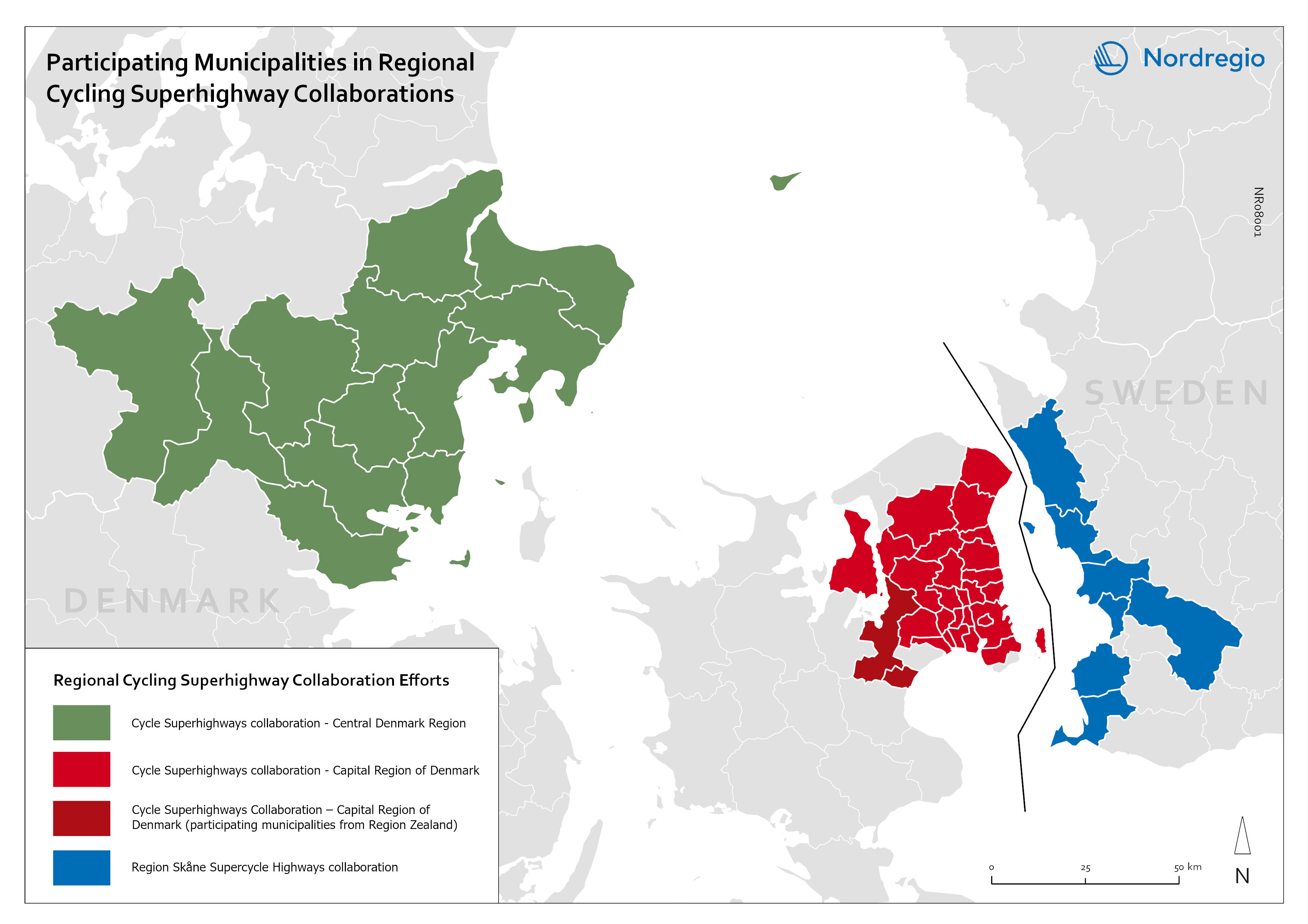
Capital Region Denmark | Central Denmark Region | Region Skåne | |
Albertslund | Herlev | Aarhus | Helsingborg |
Allerød | Hillerød | Favrskov | Kävlinge |
Ballerup | Hvidovre | Hedensted | Landskrona |
Brøndby | Høje-Taastrup | Herning | Lomma |
Copenhagen | Hørsholm | Horsens | Lund |
Egedal | Ishøj | Ikast-Brande | Malmö |
Fredensborg | Lyngby-Taarbæk | Norddjurs | Vellinge |
Frederiksberg | Tårnby | Odder | |
Frederikssund | Rudersdal | Randers | |
Furesø | Rødovre | Silkeborg | |
Gentofte | Vallensbæk | Skanderborg | |
Gladsaxe | Region Zealand | Syddjurs | |
Glostrup | Roskilde | ||
Helsingør | Solrød | ||
Nevertheless, unlike the other strategies, the cycle superhighways in Skåne have developed a system, comprised of two levels, to organise the process. Generally, at Level 1, the cycling path becomes a cycle superhighway. At Level 2, infrastructure upgrades are added and enhanced. The idea is that road operators draw up an action plan for each path, detailing needed measures for it to reach the standard Level 1 and, following that, Level 2 (Region Skåne, n.d.). The upgrades for the different routes are both technical and communicative (e.g., demarcating with signs). Most importantly, however, is that cycle highways meet or are improved over time to include the primary principles of safety and security, accessibility, comfort, and flow.
Cycle superhighways in local strategies
As mentioned above, some local cycling strategies also incorporate regional cycling networks, but to a lesser extent. With some exceptions, local cycling (or mobility) plans focus on cycling within the urban area of the city and its centre, rather than in suburbs or beyond city limits. They emphasize the necessity of collaboration across municipal boundaries rather than introducing the concept itself. In some instances, the strategies outline how the regional network should look or how long the route is planned to be; however, compared to the regional strategies described above, the municipal ones are less structured and focus on future possibilities of such collaboration (City of Helsinki Urban Environment, 2020; City of Reykjavík, 2021; Oslo kommune, 2015). On the other hand, Copenhagen’s cycling strategy proposes intelligent traffic systems along cycle superhighways in which the traffic signals are programmed to adapt to cyclist speed during, for example, rush hour times in the city. These “green waves” save cyclists from frequently breaking or coming to a complete halt during their journey (City of Copenhagen, 2011). The city has plans to expand these routes in 2026, with the idea of using barometers that account for different cycling speeds to improve bicycle traffic flow (Niranjan, 2025). In this way, the city adopts some of the same principles of the cycle superhighways (like coherency and comfort) even in dense urban environments. In Region Skåne, the local municipalities integrate their local strategies into the broader regional cycling plan, highlighting synergies and demonstrating a coordinated approach to the development of regional cycling networks (City Planning Helsingborg Committee, 2017; Malmö municipality, 2024; Region Skåne, n.d.).
Cross-country regional cycling strategies
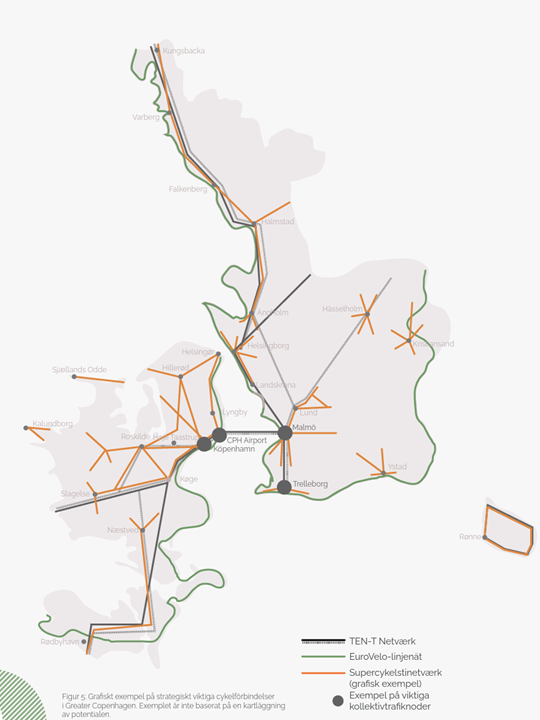
To reinforce cycling connections across municipal and national borders, the Greater Copenhagen collaboration (regional cooperation of municipalities in Denmark and Sweden) brings together Denmark’s Capital Region and Sweden’s Skåne Region. The Greater Copenhagen cycling strategy offers a more nuanced perspective on cycle superhighways spanning both countries. To optimise travel across the region and accommodate substantial cross-border commuting, the strategy proposes to extend the cycle superhighways throughout the Greater Copenhagen area (see Figure 2). The strategy focuses on identifying key transport hubs in and around the area of coverage to create a coherent transport system. While doing so, it takes note of interregional transport corridors, recreational routes, regional commuter connections, and synergies with public transport. The cycle superhighways are also considered in terms of integrating the network within the more extensive Trans-European Transport Network (TEN-T). Additionally, the strategy seeks to integrate cycling in Mobility as a Service (MaaS) solutions to cover longer travels. While not directly related to cycle superhighways, such initiatives would leverage digital solutions to inform individuals about the possibility to bring bicycles on public transport, ticketing on trains, and parking options (Greater Copenhagen, 2021). While the strategy highlights several important initiatives, it is not an official strategy for the Greater Copenhagen area or Skåne, and its points are only proposals to initiatives.
Financing of cycle superhighways
The financing measures are crucial in the development of cycle superhighways and receives significant attention within the strategies. While there are some differences, the regional networks are financed by the formal cycle route planning at both regional and municipal levels. In some instances, the responsibility is divided between the municipalities with support from regional authorities and national transport authorities (Region Skåne, n.d.; Region Stockholm, 2014; Super Cykelstier, n.d.-b).