6. Skills and occupations
Image: Vitaly Gariev / unsplash.com
Sectoral churn shows where labour market adjustment is particularly pronounced but does not reveal whether the types of jobs or skills within industries are also changing. To understand these changes more fully, it is necessary to examine the occupational and skills structures of employment. Here, occupational skills, as classified by the International Standard Classification of Occupations (ISCO), refer to the nature and complexity of tasks and duties performed in an occupation, as well as the level of formal education, informal on-the-job training and/or previous work experience required (ILOSTAT, n.d.-a). Based on these occupational skill levels, occupations have been grouped into low-, medium- and high-skilled categories (for details, see footnote 4). Examining changes in the relative shares of these groups helps to reveal the direction of labour market restructuring: whether employment is shifting towards high-skilled occupations (upgrading) or is characterised by growth in high- and low-skilled jobs, while medium-skilled jobs decline (polarisation).
Labour market churn between occupational categories can provide a broad indication of the extent to which the skills composition of an economy is changing. Figure 14 shows that the extent of employment reallocation is broadly similar across all countries, except in Iceland, which stands out for its substantial compositional changes in both occupations and sectors. Denmark and Norway display similar patterns in employment shifts, while Sweden has higher churn in terms of both occupations and industries. Although Finland has a similar level of sectoral change as Sweden, its occupational composition has changed much less. This suggests that either the sectoral changes are occurring between branches with similar occupational profiles, or that occupational mixes within industries are changing more slowly.
Figure 14. Sectoral (2014–2023) and occupational churn (2016–2025).
Note: Occupational churn is measured at the ISCO two-digit level and sectoral churn at the NACE two-digit level.
Source: Nordregio calculations based on data for sectoral employment from national statistical institutes and occupational employment from Eurostat. Occupations with missing or unreliable data were excluded. Where possible, missing employment figures at the two-digit occupation level was estimated using aggregate employment at the one-digit level.
Box: Labour market polarisation and upgrading
Technological change leads to labour reallocation across occupations and sectors, generating distinct effects on the distribution of skill and wages. A major debate concerns whether changing employment structures primarily lead to upgrading—a steady shift toward higher-skilled jobs—or polarisation—a hollowing out of the middle of job distribution, with faster growth at both the top and bottom (Acemoglu & Autor, 2011; Autor et al., 2006; Fernández-Macías & Hurley, 2017; Goos et al., 2009; Katz & Murphy, 1992; Oesch & Piccitto, 2019).
While the prevalence of universal job polarisation is a dominant theme in US-focused research (Autor et al., 2006), a closer look at Europe reveals a more nuanced picture. European labour markets exhibit a variety of structural change patterns, with job polarisation less common than occupational upgrading (Eurofound, 2017; Fernández-Macías & Hurley, 2017; Torrejon et al., 2024). Upgrading has been the dominant pattern in EU employment shifts since 1995, particularly over the past decade, when jobs in the top wage quintile accounted for nearly all net employment growth (Hurley et al., 2025). Recent US evidence also points to a shift towards upgrading in 2016–2022 (Deming et al., 2024).
In the Nordic Region, the picture is similarly mixed, varying by country, period and methodology (Berglund et al., 2019, 2025; Hurley et al., 2025). In recent years, only Denmark has shown a clear pattern of polarisation, although even there growth in top-tier jobs has been significantly higher than in bottom-tier jobs. Norway and Sweden are experiencing upgrading, as is Finland, although medium-skilled jobs have been more strongly affected by employment decline there. Furthermore, upgrading in Sweden is driven by the public sector, while the private sector exhibits modest polarisation (Berglund et al., 2019).
These patterns in European employment also differ by gender. In the past two decades, women have generally experienced stronger occupational upgrading, while the structure of male jobs has polarised. The patterns, however, vary by time period and country, depending on which sectors are driving the growth (Torrejon et al., 2023, 2024).
Job polarisation is also a place-based process (Henning & Eriksson, 2021). While national-level studies usually show upgrading or polarisation, analyses at the regional level also reveal (relative) downgrading and considerable spatial variation (Hurley et al., 2019). Polarisation often emerges in particular local contexts such as metropolitan areas or declining industrial regions, while many other regions continue on an upgrading trajectory. Capital cities represent a special case, often combining growth in both high-paid and low-paid jobs (Hurley et al., 2021; Mazzolari & Ragusa, 2013). Similarly, analysis of West-German local labour markets in 1980–2010 suggests that job polarisation is predominantly an urban phenomenon (Dauth, 2014). In Sweden, polarisation has occurred both in declining manufacturing regions and fast-growing metropolitan areas, while most municipalities have experienced job upgrading (Henning & Eriksson, 2021).
Figure 15. Share of occupational skill groups by country and change between 2014 and 2023 for men and women.
Source: Nordregio calculations based on data from national statistical institutes and Eurostat. Data for Sweden 2014 have been adjusted to account for the transition in labour market statistics from RAMS to BAS.
* Nordic Region = Denmark, Finland, Iceland, Norway, Sweden and Åland.
Source: Nordregio calculations based on data from national statistical institutes and Eurostat. Data for Sweden 2014 have been adjusted to account for the transition in labour market statistics from RAMS to BAS.
* Nordic Region = Denmark, Finland, Iceland, Norway, Sweden and Åland.
Figure 15 shows the share of occupational skill groups
by country and change (in percentage points) between 2014 and 2023, for men and women. Across the Nordic Region, the occupational structure of employment shifted towards high-skilled occupations between 2014 and 2023. The share of high-skilled occupations increased for both women and men, while the share of medium-skilled occupations generally declined. Low-skilled occupations account for a much smaller share of employment and changed relatively little. The overall direction of change was therefore similar for women and men, although the shift towards high-skilled occupations was more marked among women than among men.
The analysis uses the Major Occupational Groups (at the ISCO one-digit level), ranging from groups 1 to 9. Group 0 (Armed Forces Occupations) is excluded due to a lack of data. High-skilled occupations comprise managers, professionals, technicians and associate professionals. Medium-skilled occupations comprise clerical support workers; service and sales workers; skilled agricultural, forestry and fishery workers; craft and related trades workers; and plant and machine operators and assemblers. Low-skilled occupations correspond to elementary occupations (ILOSTAT, n.d.-a).
Among women, the shift from medium- to high-skilled occupations was particularly pronounced in Åland, Iceland and Norway. In each case, strong growth in the share of high-skilled occupations was accompanied by a substantial decline in medium-skilled occupations. Denmark, Finland and Sweden show the same broad direction of change, but to a lesser extent. In 2023, over half of employed women in Denmark, Iceland, Norway and Sweden were employed in a high-skilled group, with the highest share recorded in Iceland at 65%. Among men, the most pronounced increases were recorded in Iceland and Åland. The countries with the highest share of men in high-skilled occupations were Iceland and Norway at 51%.
Maps 2 and 3 show these changes in occupational structure across municipalities, separately for men and women. The maps reveal strong gender and spatial variation in occupational shifts across Nordic labour markets, consistent with previous studies highlighting the place-based and gendered nature of labour market restructuring (Berglund et al., 2025; Henning & Eriksson, 2021). For women, upgrading is clearly the dominant pattern, at both the municipal and regional levels. In Sweden, Finland and Norway, a large share of local labour markets, both metropolitan and more peripheral, are experiencing upgrading. Stable or mixed development is also quite common, while polarisation is less prevalent and geographically scattered. Downgrading is rare and appears in only a handful of places. Denmark presents a more mixed picture, with polarisation more evident alongside upgrading. In Iceland, labour market is upgrading, reflecting the strong national trend (see Figure 15).
For men, local patterns of occupational change are considerably more diverse. Large areas in Sweden, Norway and parts of Finland are characterised by mixed or stable development. Notably, both polarisation and downgrading are also more widespread among men than among women. Norway displays an especially patchy pattern. In the southern and western parts of the country, numerous areas are experiencing polarisation or downgrading (together accounting for 30% nationally), outnumbering areas experiencing upgrading. The contrast between the labour market trends for women and men is similar in Sweden—upgrading is much more widespread among women, while the dominant pattern for men is stable/mixed development. These stable/mixed areas are interspersed with local pockets of polarisation and downgrading. In Finland, labour market changes for both men and women show mixed patterns. However, among men the shares of local labour markets experiencing upgrading, stable, downgrading and polarisation are relatively evenly distributed. In Denmark, the polarisation tendencies for both genders are the most visible, consistent with the earlier national-level findings (Berglund et al., 2019, 2025; Hurley et al., 2025). By contrast, Iceland’s labour market shows no clear employment shift pattern among men.
Overall, upgrading is the dominant pattern at the national level across the Nordic Region, but the results highlight two important aspects of employment trajectories. First, occupational change varies considerably between municipal labour markets within the same country, supporting the argument that labour market restructuring is, to a large extent, a place-based process (Henning & Eriksson, 2021). Second, these processes have a clear gender dimension. Women’s employment has generally shifted towards high-skilled occupations, not only at the national level, but also in the majority of municipal labour markets. Men’s employment, by contrast, displays diverse trajectories, including greater polarisation and downgrading at the local level.
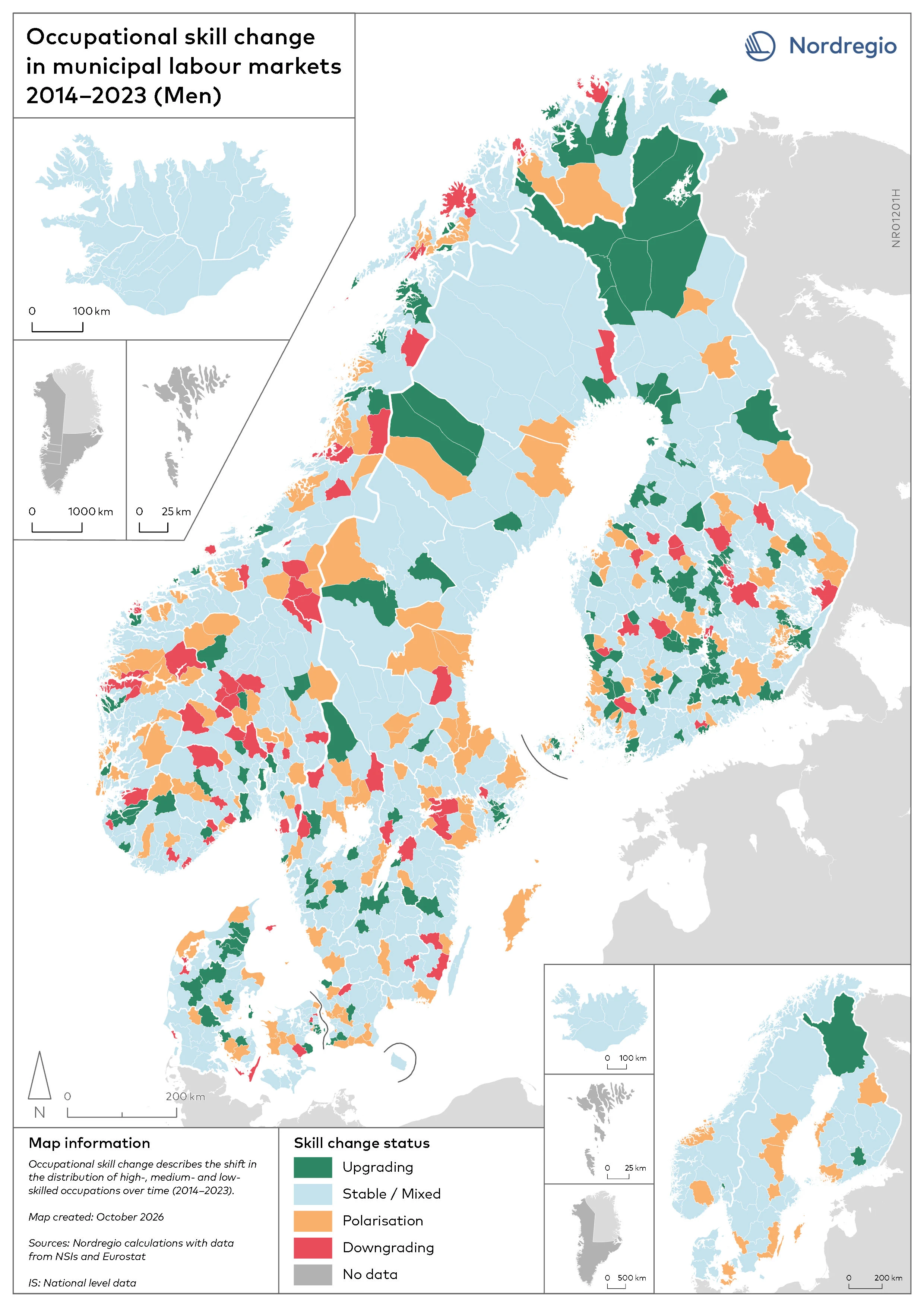
Map 2. Occupational skill change in Nordic municipal labour markets 2014–2023 (men).
Source: Nordregio calculations based on data from national statistical institutes and Eurostat. No data are available for Greenland and the Faroe Islands. Data for Sweden 2014 have been adjusted to account for the transition in labour market statistics from RAMS to BAS. Data for Iceland are at the national level.
Note: Upgrading and downgrading refer to clear shifts towards higher- or lower-skilled employment respectively; polarisation refers to simultaneous growth in high- and low-skilled employment combined with a decline in medium-skilled jobs; the stable/mixed category covers the areas that lack a dominant structural change. A detailed description of the classification is provided in Appendix.
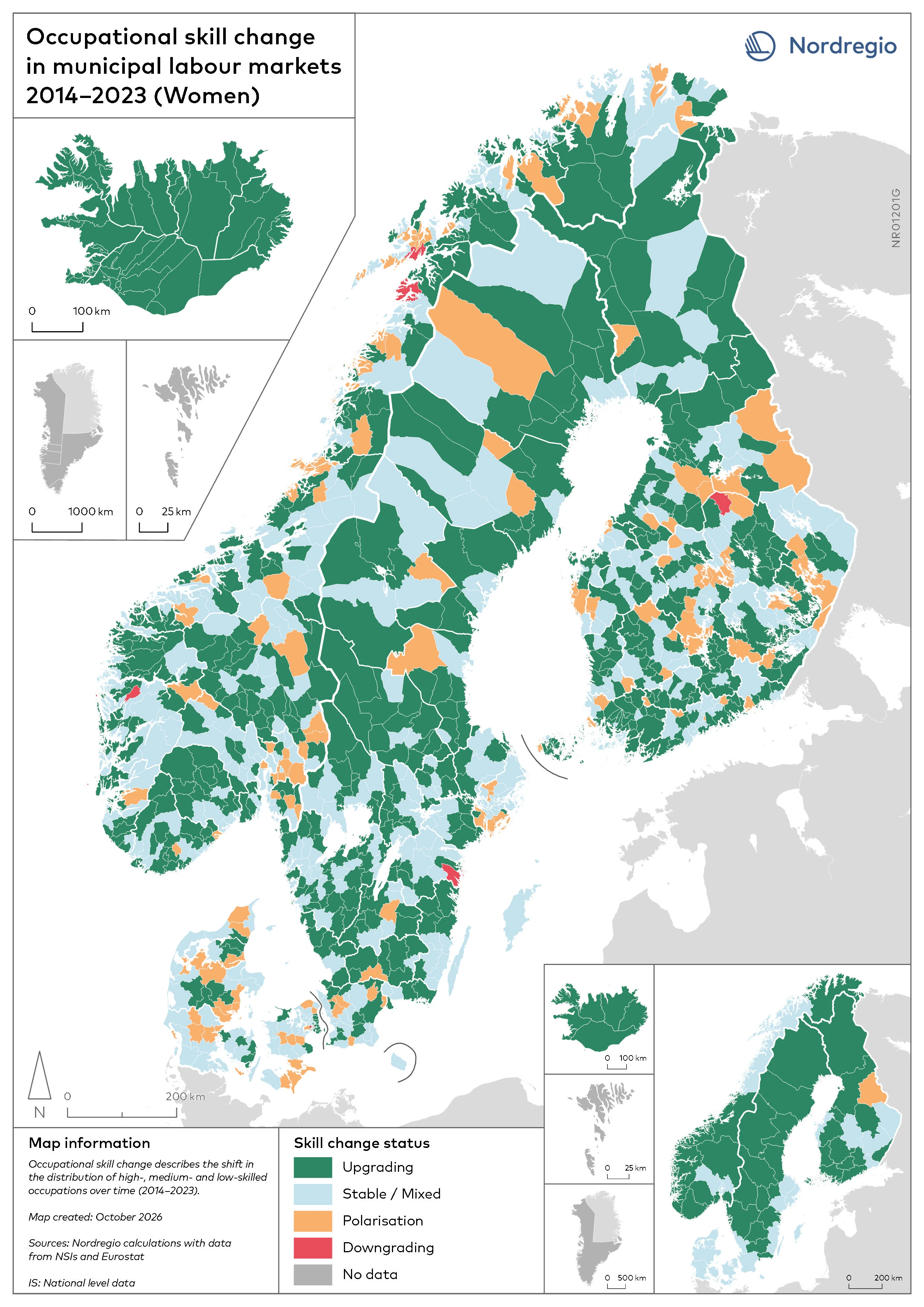
Map 3. Occupational skill change in Nordic municipal labour markets 2014–2023 (women).
Source: Nordregio calculations with data from national statistical institutes and Eurostat. No data are available for Greenland or the Faroe Islands. Data for Sweden 2014 have been adjusted to account for the transition in labour market statistics from RAMS to BAS. Data for Iceland are at the national level.
Source: Nordregio calculations with data from national statistical institutes and Eurostat. No data are available for Greenland or the Faroe Islands. Data for Sweden 2014 have been adjusted to account for the transition in labour market statistics from RAMS to BAS. Data for Iceland are at the national level.
Note: Upgrading and downgrading refer to clear shifts towards higher- or lower-skilled employment respectively; polarisation refers to simultaneous growth in high- and low-skilled employment combined with a decline in medium-skilled jobs; the stable/mixed category covers the areas that lack a dominant structural change. A detailed description of the classification is provided in Appendix.
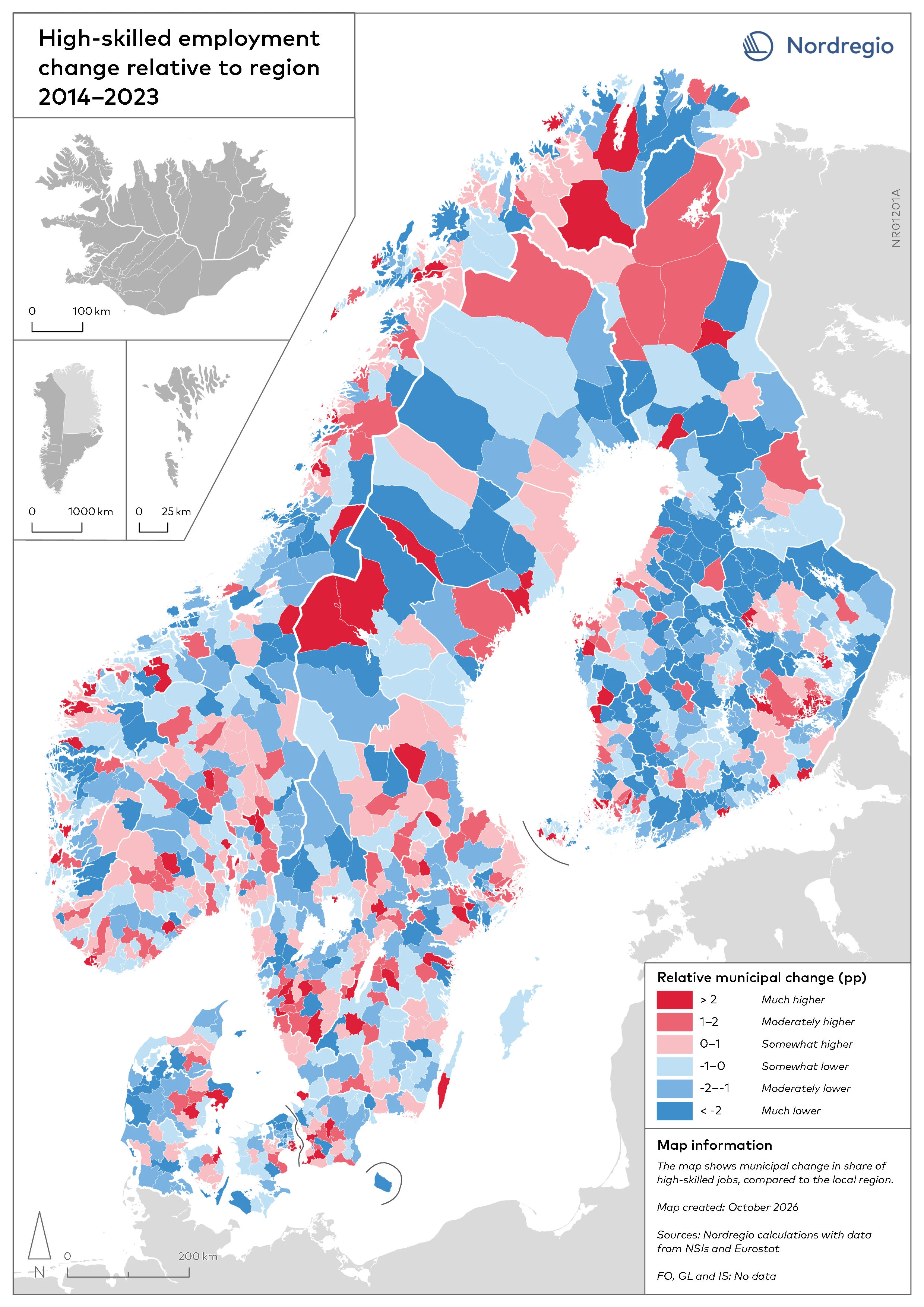
Map 4. Municipal change in high-skilled employment relative to the regional average, 2014–2023.
Source: Nordregio calculations based on data from national statistical institutes and Eurostat. No data are available for the Faroe Islands, Greenland and Iceland.
Source: Nordregio calculations based on data from national statistical institutes and Eurostat. No data are available for the Faroe Islands, Greenland and Iceland.
Map 4 displays the changes in the share of high-skilled employment in municipalities relative to the regional average. It illustrates even more explicitly how upgrading in municipal labour markets is concentrated in particular local areas. The patchy patterns on the map reveal how the upgrading (or increase in high-skilled employment) forms pockets within regions, while surrounding areas are experiencing less favourable developments. Such trends are visible, for example, in capital regions, with Helsinki and Copenhagen showing a much larger shift towards high-skilled workers than in the rest of the region. In Finland, several cases stand out where one or two municipalities outperform the rest of their respective regional labour markets, while relatively large clusters of surrounding municipalities experience slower growth in high-skilled employment. In Sweden and particularly in Norway, by contrast, the local clusters of outperforming municipalities are sometimes much larger, while the weakest performance is concentrated in a few municipalities.