Image: Sofia Sabel/imagebank.sweden.se
A final, playful reflection on youth participation
Youth participation is often approached through individual initiatives, such as youth councils or consultations. In practice, however, its effectiveness depends on both how these initiatives function and how they relate to one another. We use the image of a Rubik’s Cube to visualise this governance challenge.
This builds on Archon Fung’s Democracy Cube, which distinguishes between who participates, how participation is organised and the extent of the participants’ influence. The Rubik’s Cube model highlights that these dimensions are interconnected. Changing one affects the others, and effective participation depends on how they are aligned in practice.
Seen in this way, youth participation becomes a question of calibration. Municipalities and regions need to reach relevant groups of young people, use appropriate methods and ensure that participation is meaningfully linked to decision-making. Different contexts require different configurations, and what works in one setting may not work in another.
At the same time, within municipalities and regions, participation unfolds across several initiatives, each of which is structured by who participates, how participation is organised and the participants’ level of influence. Together, these initiatives form a connected design space for youth participation. The challenges are therefore to make participation work within each initiative, by aligning these three dimensions, and to ensure that different initiatives connect and reinforce one another across the wider municipal and regional system.
Solving this governance challenge requires strengthening leadership, building consensus and ensuring meaningful scope for participatory processes.
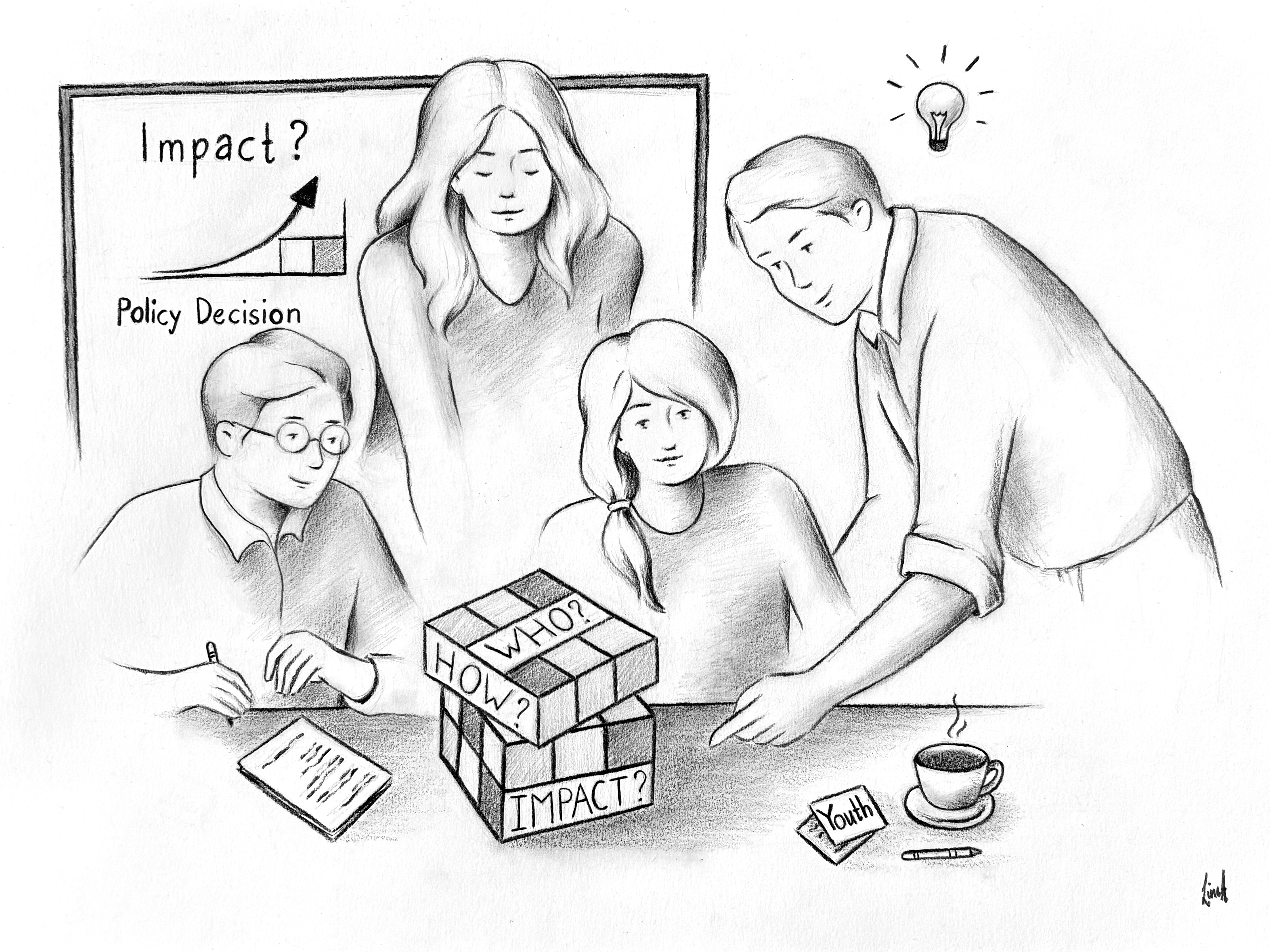
Illustration by Line Andreasen, Nordregio.