Photo: Nordregio
I. AN INTRODUCTION TO MISSION-ORIENTED APPROACHES TO INNOVATION POLICY.
Sigrid Jessen & Alberto Giacometti, Nordregio
In the public sector, mission-oriented innovation policy (MOIP) is an increasingly popular approach to specifying directions in innovation work and setting out timelines. This introductory chapter briefly unwraps the mission-oriented approach in the current policy context and academic debate. It also mentions related approaches, e.g. transformative or challenge-based policies, and how ‘challenge-based’ missions represent (or can potentially represent) a paradigm shift for innovation policy. It explores more specific ways in which MOIPs are being utilised in European Union (EU) policy. The chapter then delves into the academic debate that has emerged regarding the practical implementation of missions in countries and regions with fundamentally different innovation systems and policy traditions. Finally, the chapter looks at the Nordic context, specifically the cases of Sweden, Finland and Denmark, which are the focus areas of this policy overview. The introductory chapter sets the scene for the subsequent chapters, which take a deeper dive into the innovation policy structure and traditions in Denmark, Finland and Sweden, and explore whether (and how) MOIPs are influencing national and sub-national policy frameworks.
1. The concepts: What is meant by a mission-oriented approach to innovation policies?
The mission-oriented innovation approach, originally conceptualised by Ergas (1986) as ‘big science for big problems’, aims to address specific challenges by providing innovative solutions (Edler & Fagerberg, 2017). In recent years, the mission-oriented approach has gained prominence in innovation policies at various spatial levels, from European to local, and has been employed as a response to evolving global challenges, and in recognition of the pivotal role of government-led missions in fostering innovation-driven economic growth (Uyarra et al., 2019; Schot & Steinmueller, 2018). In many ways, the MOIPs represent a paradigm shift towards addressing ‘grand societal challenges’, and a departure from previous innovation policies that focused primarily on economic growth, by emphasising the mobilisation of science, technology and innovation to meet societal needs (Grillitsch et al., 2019; Hekkert et al., 2020). MOIPs are characterised by a systemic approach and a reliance on frontier knowledge to achieve specific goals. They do so by operationalising an innovation agenda led by the public sector and aimed at addressing societal challenges (Mazzucato & Semieniuk, 2017).
The mission-oriented approach emerged alongside other concepts and policy approaches, including transformative and challenge-oriented policies. All of these are interrelated, but emphasise different issues (Hekkert et al., 2019). What all of these concepts have in common is the aim of tackling societal challenges. Transformative Innovation Policies (TIPs), MOIPs and challenge-oriented policies all provide ‘directionality’ to innovation efforts. Janssen et al (2023) note that, increasingly, this is a core principle for innovation policy frameworks focusing on government entities’ active role in leading and shaping innovation activity.
The specific focus on addressing ‘grand societal challenges’ represents a new ‘paradigm for innovation policy’ (Grillitsch et al., 2019), for several reasons. One key peculiarity is the introduction of timeframes. The urgency of tackling the climate crisis has spurred concerted efforts to mitigate its impacts within a defined period of time, e.g. as outlined in the Sustainable Development Goals (SDGs) and the Paris Agreement. The pursuit of a ‘green transition’ underscores the alignment of innovation policies with sustainability objectives, by introducing scheduling (timeframe) and directionality to innovation endeavours.
While there is growing awareness of major environmental and societal challenges, it remains largely unclear how the state authorities, despite their prominent role in addressing these challenges, should act. Visible responses to this demand can be seen in the design of TIPs and MOIPs. Many studies have focused on the rationale for transformative innovation, e.g. fostering economic growth or solving societal challenges, but few have focused on what is required from public institutions and policy-makers to instigate systems transformation (Janssen et al., 2023). This process is expected to demand higher levels of knowledge and capacity on the part of the implementing organisation, compared to previous neoliberal policies (ibid., Ghosh et al., 2021). However, a growing body of literature is focusing on change agency, and on exploring the roles of different actors, including public institutions, in instigating systems transformation (e.g. Grillitsch & Sotarauta, 2020). Other focus areas include the capacities needed to govern transitions (e.g. Hölscher et al., 2019) or the public-sector capabilities needed to lead transformational change (e.g. Kattel & Mazzucato, 2018).
2. The organisation: The integration of MOIPs into EU policy frameworks
The European Commission stands out as a key driver of the transformative shift in innovation policies. Through initiatives like the Horizon 2020 research and innovation programme (2014–2020), the EU focused on addressing broad societal challenges while fostering economic growth and industrial leadership. Building on this foundation, the Horizon Europe programme, with its substantial budget of €100 billion, takes a more ambitious approach. Drawing inspiration from Mazzucato’s work (2016), it introduces the concept of ‘missions’ aimed at tackling pressing societal issues. These missions – defined as urgent strategic goals that require transformative systems change to overcome complex societal problems – guide the Commission’s efforts, with missions outlined in areas such as climate change adaptation, cancer research and ocean health.
Furthermore, the integration of MOIPs into broader EU policy frameworks is evident in initiatives such as the European Green Deal, which aligns with the SDGs and allocates substantial funding to missions aimed at addressing pressing societal challenges (McCann & Soete, 2020). In addition, Smart Specialisation Strategies (S3) serve as a vehicle for fostering place-based innovation, with emerging concepts such as Smart Specialisation Strategies for Sustainable and Inclusive Growth (S4+) that emphasise the alignment of regional policy priorities with societal challenges (Interreg Europe, 2020).
Cappellano et al. (2023) explore the links between the mission-oriented approach and Cohesion Policy, and advocate for mutual policy learning, which may enable both parts to solidify their positions in the EU policy landscape. They argue that Cohesion Policy risks losing further its identity, due to, e.g. increasingly broad priorities, pressures on the national budgets, varying policy results and differing national goals, while the mission-oriented approach lacks a territorial perspective (Cappellano et al. 2023). However, the two may benefit from policy cross-pollination: By adopting mission-oriented principles, Cohesion Policy can align priorities with societal challenges, thereby enhancing its rationale and political support. Mission-oriented principles, on the other hand, would be further integrated into the fabric of the EU’s overall objectives, and as such would be directed towards territorial policy considerations. In addition, directionality concepts can bolster the result orientation of Cohesion Policy. However, Cappellano et al. (2023) acknowledge some uncertainty as to the possible impacts of increasing the directionality of Cohesion Policy. They suggest leveraging the mission-oriented combination of top-down and bottom-up approaches to streamline Cohesion Policy governance. The mission-oriented approach can benefit from both Cohesion Policy’s adaptability to regional contexts, as well as an equity-focused, redistributive approach. Scholars arguing for more spatially targeted missions, among others, have expressed support for this idea.
2.1. The relationship between MOIPs from EU level to the national context
The shift towards MOIPs is also visible in national and sub-national policy. For instance, the Scottish National Investment Bank (SNIB) has adopted a mission-oriented approach (Brown et al., 2021), and the Netherlands has developed ambitious missions to guide national strategies and public-private R&D initiatives. One such Dutch mission aims to significantly reduce national greenhouse gas emissions by setting specific targets for the coming decades (Hekkert et al., 2020). In their investigation of the role of the regional level in promoting challenge-driven innovation, Hassink et al. (2022) focus on the recent renewable energy innovation policy in Schleswig-Holstein, Germany.
However, while MOIPs are gaining popularity, both at EU level and among member states, the diffusion of MOIPs at different territorial levels might be easier said than done (e.g. Nelson, 2011; Wanzenböck & Frenken, 2020). One recurring critique is that challenge-based missions are highly complex. As opposed to the classic example of putting a man on the Moon, which had a clearly defined and mostly technical objective and solution, most of the societal challenges that MOIPs aim to tackle are so-called ‘wicked problems’. In other words, even if the objective is clear, these challenges are highly complex, difficult to solve, involve numerous stakeholders with varying and conflicting interests, require action at different institutional and territorial levels, and do not lend themselves to a single solution or approach (Foray et al., 2012; Boon & Edler, 2018; Elia & Margherita, 2018). In addition, several scholars have long argued that applying one-size-fits-all policies to innovation efforts is at best not feasible, and even risks damaging regions by disregarding existing regional specificities and capacities (Tödtling & Trippl, 2005). This argument has also been raised more specifically in relation to MOIPs. In particular, economic geographers have challenged the validity of MOIPs by questioning the extent to which this approach recognises geographical variation, and whether sufficient geographical knowledge is taken into account (e.g. Coenen et al., 2015).
2.2. Implementation: Challenges and proposed solutions for MOIPs in different regional contexts
The critique of MOIPs’ spatial blindness has resulted in a scholarly debate on the possibilities and potential impacts of applying missions across different countries and regions. Some studies go so far as to argue that certain countries and regions are not suitable for MOIPs (Brown, 2021). Brown (2021) argues that countries with innovation systems that are more dependent on an incremental and largely Doing-Using-Interacting (DUI)-based innovation mode (Jensen et al., 2007), i.e. the Nordic countries, are not well-equipped to successfully deploy MOIPs. The argument is that some missions are more urgent and time-sensitive than others, and therefore require more traditional scientific and technological innovation (STI)-based solutions, e.g. developing Carbon-Capture-Utilisation-Storing (CCUS) technologies and finding cures for cancer. Brown (2021) emphasises the need for customised regional innovation policies that are aligned with local innovation ecosystems, and advocates for context-driven rather than mission-driven policies, specifically in low innovation-intensive contexts. At the same time, however, recent empirical studies from the Nordic Region indicate that this stance lacks subtlety and that the suitability of MOIPs is not as black-and-white as Brown (2021) suggests. For example, Bugge et al. (2022) and Craens et al. (2022) note that MOIPs are gaining popularity in the Nordic countries. Bugge et al. (2022) argues that, in Norway, the continued mobilisation of existing regional resources, actors and structures led to a successful reorientation of the innovation system towards mission-oriented approaches.
In general, an increasing volume of literature emphasises that both the design and the implementation of missions require careful consideration of regional complexities – in terms of both regional strengths and weaknesses, as well as the comparative advantages and institutional contexts – to ensure that they effectively meet regional needs and create positive outcomes in all regions. In recent years, there have been several attempts to develop frameworks that allow for a higher degree of geographical knowledge to be incorporated into the design and implementation of the MOIPs. Examples include the small wins strategy for underdeveloped regions (Morrison et al., 2023) and ‘challenge-oriented RISs’ (Tödtling et al., 2022). Together, these studies form a comprehensive body of literature that illuminates not only the ways in which a geographical perspective can be applied in the MOIPs, but also the need for a geographical perspective that can help develop and implement successful MOIPs across a broad range of spatial contexts.
Morisson et al. (2023) argue that the complex nature of the new generation of innovation policies aimed at solving societal challenges poses a potential risk for less-developed European regions. They argue that these regions face being marginalised due to their comparatively lower institutional and governance capacities. In response, Morisson et al. (2023) advocate for the adoption of a so-called ‘small wins strategy’, which serves to empower less-developed regions and involve them in mission-oriented efforts aimed at addressing location-specific societal challenges. The small wins strategy emphasises the implementation of small-scale, bottom-up initiatives driven by a shared mission to tackle complex and persistent problems.
Tödtling et al. (2022) emphasise that regions possess varying capacities for transformative change and challenge-oriented innovation. They contend that a comprehensive re-evaluation of the Regional Innovation System (RIS) approach is required to better inform the development of the next generation of regional innovation policies. They also advocate for an alternative perspective on innovation, inspired by recent advancements in mission-oriented and transformative innovation policies. This alternative perspective introduces the concept of ‘challenge-oriented RISs’ (CoRISs), which stands in contrast to traditional RIS interpretations (Tödtling et al. 2022). CoRISs embrace a more critical stance toward innovation, emphasise the direction of change, invite new innovation stakeholders at various territorial scales, and prioritise the practical application and scaling up of innovations within and beyond regional boundaries.
3. The scope: Nordic countries
The Nordic countries are interesting cases for further analysis. They are high-income countries, renowned for prioritising innovation, yet compared to other high-income countries, they are more reliant on DUI and incremental innovation strategies. However, within the Nordic Region, there are important differences between the countries in terms of industrial structures and policy traditions. Asheim et al. (2011) note that Nordic economies have achieved a high level of performance despite their strikingly different innovation policies and strategies. Focusing more specifically on Sweden, Finland and Denmark, the literature highlights that these three countries have adopted different pathways in innovation policy frameworks and strategies. Finland’s science-driven approach focuses on radical product innovation, with a specific emphasis on the ICT sector. Sweden, on the other hand, emphasises technology-based strategies and process innovations. Denmark has adopted a market-based, largely user-driven strategy, in which incremental, non-R&D-driven innovation dominates the consumer goods sectors (Asheim et al., 2011). These variations are also evident when looking at the countries’ expenditure on R&D – a core indicator of state-level engagement in innovation.
R&D expenditure in 2021 in Sweden, Finland and Denmark was among the highest in the 28 EU member states – at second, fifth and sixth place, respectively (Figure 1; OECD, 2024). Sweden was only surpassed by Belgium, which has experienced an exponential growth rate in the last ten years, while Germany and Austria ranked third and fourth, respectively. Of the three countries, Finland has experienced the largest drop in R&D expenditure, from a high of 3.73% of GDP in 2009 to a low of 2.72% in 2016. However, in January 2023 the Finnish government substantially increased the annual R&D expenditure for 2024–2030 (Finnish Prime Minister’s Office, 2023). On the other hand, Sweden’s level of expenditure has been consistently high over the last 20 years. Overall, Denmark’s expenditure has been lower than the other two countries but has increased over time.
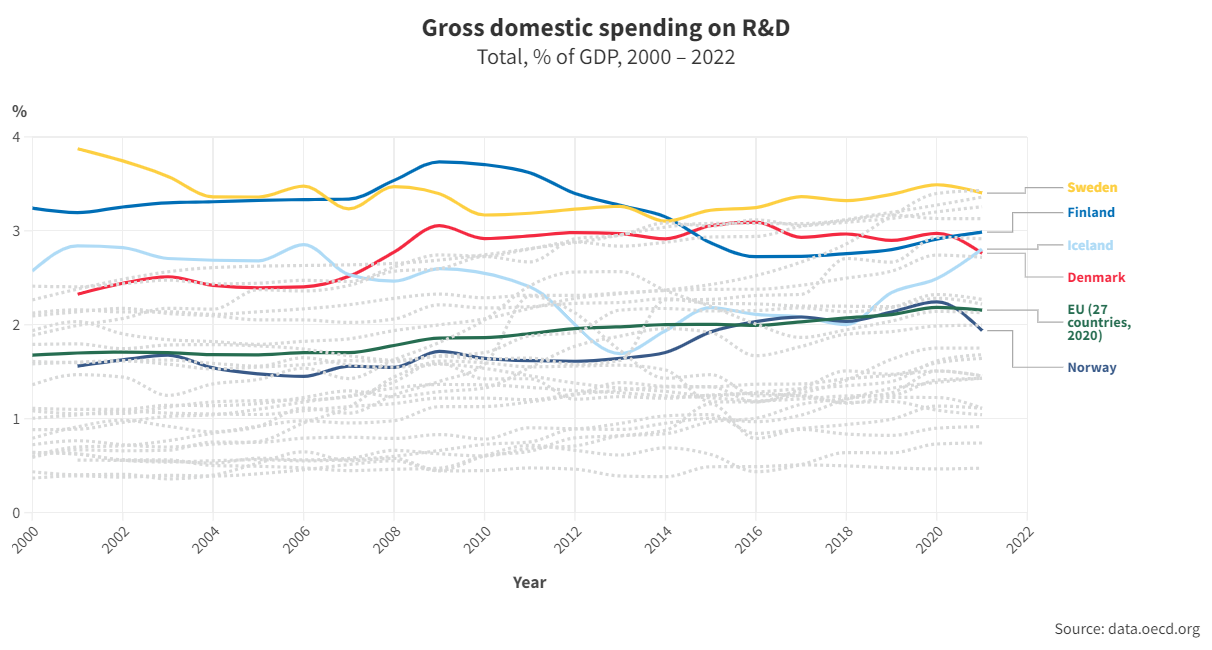
Figure 1: Gross domestic spending on R&D in EU countries as a total % of GDP, 2000–2022. Denmark, Finland and Sweden highlighted. Source: OECD (2024)
Furthermore, in the context of recovery from different crises, while also strengthening the political and societal focus on transformation towards green economies, the 2020 edition of the World Economic Forum’s Global Competitiveness Report highlights the ‘Nordic model’ as ‘the most promising in leading economic systems towards greater sustainability and shared prosperity’ (Schwab & Zahidi, World Economic Forum, 2020). Specifically, the report highlights Finland, Denmark and Sweden, and declares these three countries as being ‘among the best-prepared […] for an economic transformation’ (ibid.). The analysis is based on a combination of indicators that affect innovation ecosystems in different ways. However, as the following chapters will point out, the three countries have taken significantly different approaches to the state-level implementation of MOIPs. Denmark was the only country to select national missions focusing on the green transition, while Sweden and Finland have no nationally declared missions. However, as chapters II and III will show, this does not mean that these two countries lack transformative processes in their respective innovation systems. In fact, Sweden and Finland have long traditions of transformative innovation policy – and in Finland, this transformation is largely led by the private sector.
All of these different factors, particularly the move toward transformative and mission approaches, make the Nordic countries interesting case studies when investigating innovation. The following chapters aim to shed light at the characteristics of the three countries’ innovation systems in relation to TIPs and MOIPs.
4. References
Asheim, B., Isaksen, A., Moodysson, J., Sotarauta, M. (2011). Knowledge bases, modes of innovation and regional innovation policy: A theoretical re-examination with illustrations from the Nordic countries.
Boon, W., and J. Edler. 2018. “Demand, Challenges, and Innovation. Making Sense of New Trends in Innovation Policy.” Science and Public Policy 45 (4): 435–447. doi:10.1093/scipol/scy014
Brown, R. (2021). Mission-oriented or mission adrift? A critical examination of mission-oriented innovation policies. European Planning Studies, 29(4), 739-761.
Bugge, M. M., Andersen, A. D., & Steen, M. (2022). The role of regional innovation systems in mission-oriented innovation policy: exploring the problem-solution space in electrification of maritime transport. European Planning Studies, 30(11), 2312-2333.
Cappellano, F., Molica, F., & Makkonen, T. (2023). Missions and Cohesion Policy: Living separate or dancing together? (No. 2023-02). JRC Working Papers on Territorial Modelling and Analysis, No 02/2023.
Cappellano, F., Makkonen, T., Dotti, N. F., Morisson, A., & Rizzo, A. (2022). Where innovation meets directionality: An index to measure regional readiness to deal with societal challenges. European planning studies, 30(8), 1549-1576.
Cappellano, F., & Kurowska-Pysz, J. (2020). The mission-oriented approach for (cross-border) regional development. Sustainability, 12(12), 5181.
Coenen, L., Hansen, T., & Rekers, J. V. (2015). Innovation policy for grand challenges. an economic geography perspective. Geography Compass, 9(9), 483-496.
Craens, J., Frenken, K., & Meelen, T. (2022). Mission-orientated innovation policy: The case of the Swedish “Vision Zero” approach to traffic safety. In: van Wee, B., Annema, J.A., & Köhler, J. (Eds.), Innovations in Transport (pp. 343-358). Cheltenham, Edward Elgar.
Edler, J., & Fagerberg, J. (2017). Innovation policy: What, why, and how. Oxford Review of Economic Policy, 33(1), 2-23.
Elia, G., and A. Margherita. 2018. “Can We Solve Wicked Problems? A Conceptual Framework and a Collective Intelligence System to Support Problem Analysis and Solution Design for Complex Social Issues.” Technological Forecasting and Social Change 133: 279–286. doi:10.1016/j.techfore. 2018.03.010.
Ergas, H. (1987). Does technology policy matter. Technology and global industry: Companies and nations in the world economy, 191, 245.
Finnish Prime Minister´Office (2023). New momentum for the Finnish RDI system – parliamentary working group sets objectives for the allocation of R&D funding. Retrieved 03-04-2024 at: https://vnk.fi/en/-/new-momentum-for-the-finnish-rdi-system-parliamentary-working-group-sets-objectives-for-the-allocation-of-r-d-funding
Foray, D.; D.C. Mowery; and R.R. Nelson. 2012. Public R&D and social challenges: What lessons from mission R&D programs? Research Policy 41:1697-1702.
Ghosh, B., Kivimaa, P., Ramirez, M., Schot, J., & Torrens, J. (2021). Transformative outcomes: assessing and reorienting experimentation with transformative innovation policy. Science and Public Policy, 48(5), 739-756.
Grillitsch, M., & Hansen, T. (2019). Green industry development. European Planning Studies, 27:11, 2163-2183. doi:10.1080/09654313.2019.1648385
Grillitsch, M., & Sotarauta, M. (2020). Trinity of change agency, regional development paths and opportunity spaces. Progress in Human Geography, 44(4).
Grillitsch, M., Hansen, T., Coenen, L., Miörner, J., & Moodysson, J. (2019). Innovation policy for system-wide transformation: The case of strategic innovation programmes (SIPs) in Sweden. Research Policy, 48(4), 1048-1061. Retrieved from https://doi.org/10.1016/j.respol.2018.10.004
Hassink, R., Gong, H., Fröhlich, K., & Herr, A. (2022). Exploring the scope of regions in challenge-oriented innovation policy: The case of Schleswig-Holstein, Germany. European Planning Studies, 30 (11), 2293-2311.
Hekkert, M. P., Janssen, M. J., Wesseling, J. H., & Negro, S. O. (2020). Mission-oriented innovation systems. Environmental innovation and societal transitions, 34, 76-79.
Hölscher, K., Frantzeskaki, N., & Loorbach, D. (2019). Steering transformations under climate change: capacities for transformative climate governance and the case of Rotterdam, the Netherlands. Regional Environmental Change, 19(3), 791-805.
Janssen, M. Wanzenböck, I., Fünfschilling, L. & Pontinakis, D. (2023). "Governance arrangements for the implementation of transformative innovation policy: Insights from a comparative case study," Papers in Innovation Studies 2023/13, Lund University, CIRCLE - Centre for Innovation Research.
Janssen, M. J., Wesseling, J., Torrens, J., Weber, K. M., Penna, C., & Klerkx, L. (2023). Missions as boundary objects for transformative change: understanding coordination across policy, research, and stakeholder communities. Science and Public Policy, 50(3), 398-415.
Kattel, R. & Mazzucato, M. (2018). Mission-oriented innovation policy and dynamic capabilities in the public sector, Industrial and Corporate Change, Volume 27, Issue 5, Pages 787–801, https://doi.org/10.1093/icc/dty032
Larrue, P. (2021). The design and implementation of mission-oriented innovation policies: A new systemic policy approach to address societal challenges. OECD.
Mazzucato, M. (2018). Mission-oriented innovation policies: challenges and opportunities. Industrial and corporate change, 27(5), 803-815.
Mazzucato, M., & Semieniuk, G. (2017). Public financing of innovation: new questions. Oxford Review of Economic Policy, 33(1), 24-48.
Morisson, A., Liotard, I., & Revest, V. (2023). Small Wins through Inducement Prizes: Introducing Challenge-Oriented Regional Prizes (CORP). Sustainability, 15(4), 3240.
Nelson, R. (2011). The Moon and the Ghetto revisited. Science and Public Policy, 38(9), 681-690.
Schot, J., and W. Steinmueller. 2018. “Three Frames for Innovation Policy: R&D, Systems of Innovation and Transformative Change.” Research Policy 47 (9): 1554–1567. doi:10.1016/j. respol.2018.08.011
Schwab K. & Zahidi S., World Economic Forum (2020). The Global Competitiveness Report Special Edition 2020: How Countries are Performing on the Road to Recovery’. Geneva, Switzerland. ISBN 978-2-940631-17-9
Tödtling, F., & Trippl, M. (2005). One size fits all? Towards a differentiated regional innovation policy approach. Research Policy, 34(8), 1203-1219
Tödtling, F., Trippl, M., & Desch, V. (2022). New directions for RIS studies and policies in the face of grand societal challenges. European Planning Studies, 30 (11), 2139-2156.
Uyarra, E., Ribeiro, B., & Dale-Clough, L. (2019). Exploring the normative turn in regional innovation policy: Responsibility and the quest for public value. European Planning Studies, 27(12), 2359-2375.
Wanzenböck, I., & Frenken, K. (2020). The subsidiarity principle in innovation policy for societal challenges. Global Transitions, 2, 51-59.
Wittmann, F., Hufnagl, M., Lindner, R., Roth, F., & Edler, J. (2021). Governing varieties of mission-oriented innovation policies: A new typology. Science and Public Policy, 48(5), 727-738.
Wittmann, F., Hufnagl, M., Roth, F., Yorulmaz, M., & Lindner, R. (2021). From mission definition to implementation: Conceptualizing mission-oriented policies as a multi-stage translation process (No. 71). Fraunhofer ISI Discussion Papers-Innovation Systems and Policy Analysis.