Photo: Adrien Hobbs / Unsplash.com
IV. DENMARK: ON A MISSION TOWARDS MISSION-ORIENTED INNOVATION POLICY.
Teis Hansen, University of Copenhagen & SINTEF
1. The Danish research and innovation system
Similarly to Finland and Sweden, Denmark is performing well in international rankings of science and innovation capacity. Denmark performs very highly on measures relating to its skill base, digitalisation and use of ICT, as well as collaborations across sectors and geographies (European Commission, 2023). In a European context, Denmark also has a relatively high level of investment in R&D, albeit not quite on par with the EU leaders Belgium and Sweden (Eurostat 2024). Also, while SMEs make up a very significant share of the Danish economy, Denmark is not matching the EU’s strongest performers in terms of SME innovativeness (European Commission 2023).
Danish research and innovation policy has been through a number of iterations in recent decades. In the 1980s, a number of technology-development programmes were introduced to steer research towards specific fields (IT, material technologies, and environment and food) that were deemed of significant societal relevance (Mejlgaard, Aagaard and Siune 2002). The importance of the societal relevance of research was accentuated throughout the 1990s. It was central to the 2003 strategy ‘From thought to invoice’
In Danish, ‘Fra tanke til faktura’. In the broader public debate, this was more frequently expressed as ‘From research to invoice’ (in Danish, ‘Fra forskning til faktura’).
The Ministry of Higher Education and Science is the central ministry responsible for Danish research and knowledge-based innovation policy. However, other ministries are also engaged in innovation policy. The Ministry of Industry, Business and Financial Affairs is responsible for business support, including intellectual property rights and (via the Danish Board of Business Development, and jointly with the Ministry of Higher Education and Science) the national cluster programme. Through the Danish Board of Business Development, the Ministry of Industry, Business and Financial Affairs is also responsible for eight so-called regional ‘Business Beacons’, which are aimed at stimulating growth and competitiveness with a place-based approach in selected areas, many of which have a green focus, e.g. BioSolutions in Region Zealand, life sciences in the capital region, CCUS and PtX in North Jutland. In addition, other ministries, e.g. the Ministry of Climate, Energy and Utilities, administer research and innovation programmes pertaining to their specific empirical domains. Finally, a unique feature of the Danish research and innovation support system is the very large role played by private foundations such as Novo Nordisk Foundation, Carlsberg Foundation, Lundbeck Foundation and Villum Foundation in financing research at universities and research institutes. Other foundations, such as the Danish Industry Foundation, primarily support innovation and efforts to improve competitiveness. Figure 8 illustrates the structure of the Danish R&I system.
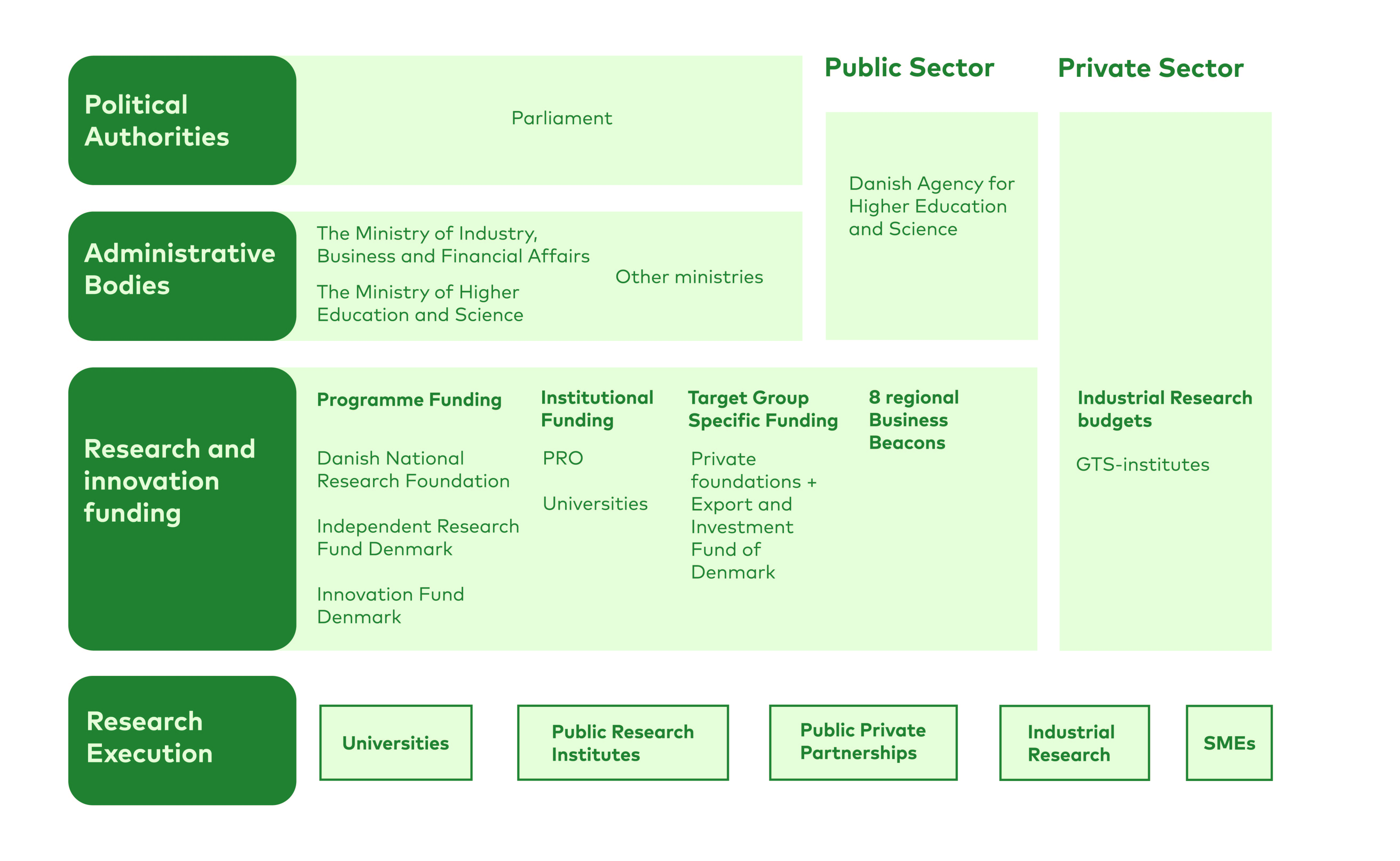
Figure 8: Structure of Danish Research and Innovation System. Source: Updated and adapted from Meissner, European Commission
In summary, the policy landscape prior to the introduction of the missions approach could be described as somewhat fragmented (Ketels et al. 2019, see also below). The Ministry of Higher Education and Science’s research and innovation policy instruments were characterised by a hands-off approach, under which excellence in research and commercial potential of innovations steered the allocation of funds. However, this coexisted with quite specific funding tools for more narrowly defined research and innovation activities controlled by other ministries.
2. The position of MOIP in the national innovation policy landscape
In September 2020, the Danish Government launched a green research and innovation strategy that explicitly integrated a mission-oriented approach into national-level policymaking (Ministry of Higher Education and Science 2020). Previous policy successes – in particular, in the field of wind energy – may be said to have provided important lessons relevant to implementing MOIPs (Wohlert et al. 2022). However, the 2020 strategy represented a break with the previously dominant policy approach of the Ministry of Higher Education and Science, which attached little directionality to its funding allocation.
The green research and innovation strategy outlined four missions:
- Carbon capture and storage or utilisation
- Green fuels for transportation and industry (power-to-X, etc.)
- Climate- and environment-friendly agriculture and food production
- Recycling and reduction of plastic waste (later expanded to ‘plastic and textiles’).
Importantly, the directionality provided by these four missions does not permeate Danish research and innovation policy efforts as a whole. Firstly, existing non-mission-oriented policies under the Ministry of Higher Education and Science continue to operate. Crucially, these include base funding for universities; funding for basic research (in particular, Centres of Excellence) allocated by the Danish National Research Foundation; funding for excellent, original and internationally competitive research through the Independent Research Fund Denmark; and funding for applied and solution-oriented research and innovation activities (many with clear commercial potential) via Innovation Fund Denmark. Secondly, there was an ambition that the missions would not only pertain to research and innovation funds distributed by the Ministry of Higher Education and Science, but also help to coordinate efforts across ministries. However, this has not yet fully materialised. In summary, the green research and innovation strategy marked a significant change in Danish research and innovation policy, but has not yet fully revolutionised it.
3. Why a MOIP approach?
An important precursor to the missions approach in Denmark was the publication in 2019 of the Ketels committee’s ‘Peer Review of the Danish R&I System’ (Ketels et al. 2019), under the European Commission’s Horizon 2020 Policy Support Facility. One of the report’s key conclusions was that ‘[t]here is no sufficiently clear, deliberate, overarching strategic direction of the Danish innovation system’ (p. 12). Consequently, it calls for ‘outlining an overarching innovation strategy […] around a widely shared value proposition’ (p. 15). The report explicitly mentions the mission-oriented approach as a framework for developing this strategy, as it would help address issues associated with fragmentation in publicly funded research and innovation activities.
In addition, following the 2019 election, the governing Social Democrats and its three supporting parties in parliament – the Social Liberal Party, the Green Left and the Red-Green Alliance – drafted an agreement of ‘common understanding’ (in Danish: ‘forståelsespapir’). The 2019 election is known as the ‘climate election’, due to the topic’s importance in the preceding debates. Consequently, the first topic in the ‘common understanding’ agreement was ‘a green and sustainable future’, with a strong emphasis on climate change mitigation, including the role of research (Socialdemokratiet et al. 2019).
In this context, the MOIP approach was considered favourably, as it would answer the recommendations in Ketels’ report and was in alignment with the programme of the incoming government. Additional supporting, albeit secondary, factors informed missions beyond the Ministry of Higher Education and Science, in particular the Ministry of Climate, Energy and Utilities, and the adoption of the European Commission’s missions-oriented approach.
4. Who chooses the missions?
A relatively top-down approach was taken in the selection of missions (Normann et al., 2022). The Ministry of Higher Education and Science mapped research needs and potential, as well as research and industry strengths and potential. The mapping process was conducted following consultation with a group of stakeholders (e.g. universities and the so-called Climate Partnerships, consisting of key private-sector actors), primarily representing traditional key actors in the research and innovation system (Wohlert et al., 2021). These consultations pointed to some clear priority areas, e.g. power-to-X and CCS, although it proved more difficult to achieve consensus around promising technologies with respect to agriculture. Ultimately, the four missions were selected by the Ministry of Higher Education and Science, and subsequently approved by the government. According to the Ministry of Higher Education and Science (2020), the decision was based on four criteria:
- Green potential
- Business strength and potential
- Research strength
- Partnership potential, i.e. missions should be suitable for collaboration in partnerships between universities, industry, public sector, etc.
While these criteria are broad and not clearly quantified in the strategy, green potential – more specifically, the potential contribution to reducing domestic greenhouse gas emissions – was a central criterion when selecting potential missions. In this way, the Danish government’s ambitious emissions targets (70% reduction by 2030 relative to 1990; net zero target for 2050; and the proposed ambition of the government appointed in December 2022 of reaching net zero by 2045) provide an overarching rationale for the missions: to ensure that public research and innovation funds contribute to achieving Danish climate policy targets.
5. How specific are the missions?
As evident from the titles, the four missions vary considerably in terms of their degree of specificity. Contrary to Mazzucato’s approach to thinking about missions in policy-making (e.g. Mazzucato 2018), not all missions are problem- or challenge-driven. In particular, ‘carbon capture and storage or utilisation’ can be characterised as a potential solution to the decarbonisation challenge faced by the energy-intensive processing industry (e.g. cement, steel and chemicals),
Previously, carbon capture and storage was considered a promising solution to emission reductions from fossil-based electricity production, but it has been abandoned in the Danish context.
Not all decarbonisation options are equally feasible across these industries, e.g. the importance of process emissions in cement production implies that not all emissions can be abated through, e.g. electrification.
The mission is also concerned with emissions from bioenergy production and direct air capture. As such, this formulation could be extended to also cover negative emissions.
The strategy does not provide any specificity in terms of time-frames or place-sensitivity. While the strategy outlines that the government will continuously evaluate the need to add or modify missions, it does not provide a timeline or stipulate success criteria for the missions (cf. the way missions are applied by the EU, Mazzucato 2018). Rather, these matters are to be decided at the implementation stage.
6. Mission implementation
Following the green research and innovation strategy, the government initiated a number of initiatives related to green research and innovation in general. These include internal capacity-building for green transition policy, and continuing the allocation of a significant share of public research and innovation funds to green research and innovation activities (Ministry of Higher Education and Science, 2020; Ekspertgruppen om forskningens betydning for den grønne omstilling, 2023). Regarding the latter, parts of this funding are distributed through thematic calls by Independent Research Fund Denmark, as well as through broader thematic funding instruments by Innovation Fund Denmark. However, these funds do not necessarily contribute to the four specific missions. In fact, as highlighted by Aagaard, Norn and Stage (2022, p. 13), representatives from the Independent Research Fund Denmark and Innovation Fund Denmark deliberately seek to ‘influence the political formulation of call texts to make sure that they are formulated as broadly as possible, but also subsequently seek to interpret them as broadly as possible’ in the name of scientific quality. As such, there is no clear alignment between the directionality provided by the missions and the distribution of funds earmarked for green research and innovation activities. Consequently, the central policy instrument deployed in response to the missions has consisted of four so-called Innomission partnerships, funded through Innovation Fund Denmark. In 2021, a total of DKK 700 million was reserved for financing the partnerships in the period 2022–2026, with an additional DKK 300 million allocated in 2022 and again in 2023.
The Innomission partnerships emerged out of a two-stage development process. In phase 1, Innovation Fund Denmark launched a call for the development of mission roadmaps towards 2030 and 2050. Essentially, these roadmaps were to include a review of the global state-of-the-art in relation to the given mission. This involved identifying key barriers, Danish specialisations of relevance, a strategy for addressing the mission including proposed workstreams and activities in the first phase of the partnership, and the envisioned impact and milestones for successful completion (Innovation Fund Denmark 2021b, 2021a). The time frame for developing the roadmaps was very short (less than two months). This resulted in a hectic process in which heterogenous consortia, spanning universities, research institutes, cluster organisations and beyond, attempted to reach a consensus regarding the Danish research and innovation priorities in relation to the missions. Importantly, during this first step, no funding was allocated. Rather, it was seen as a bottom-up approach to defining the missions’ directionality in more detail. However, among the actors involved, it was clearly seen as important to position research and innovation activities within the roadmaps, as a step towards future funding opportunities. The interests of core actors in the consortia therefore had a significant influence on the content of the roadmaps, partly due to the short time frame for their development, which allowed for only limited deliberation. A total of 12 roadmaps were submitted for the four missions. Following a review process, six of the roadmaps were selected, and formed the basis for calls for partnerships.
Subsequently, Innovation Fund Denmark launched a call for partnerships – again, with a short deadline of approximately two months. Applicants responding to this phase 2 call were to detail an organisational structure for the partnerships and propose activities leading to the implementation of the roadmaps. Funds of DKK 195 million were reserved for each of the missions 1, 2 and 3, and DKK 100 million for the mission on a circular plastics and textile economy,
Subsequently, Innovation Fund Denmark launched a call for partnerships – again, with a short deadline of approximately two months. Applicants responding to this phase 2 call were to detail an organisational structure for the partnerships and propose activities leading to the implementation of the roadmaps. Funds of DKK 195 million were reserved for each of the missions 1, 2 and 3, and DKK 100 million for the mission on a circular plastics and textile economy,
These figures account for the size of public funding to the partnerships. In addition, substantial co-funding (in terms of both time and money) from participating organisations should be included.
Place sensitivity was largely absent in the implementation of the missions. In the calls for both phases 1 and 2, little consideration was given to sub-national differences, requirements for geographically balanced participation, etc. Consequently, the partnerships did not emphasise these aspects in their applications. For instance, the successful application for the plastics and textiles circular economy partnership simply mentions the importance of involving regional and local authorities as part of the partnership’s stakeholder engagement activities, and acknowledges the importance of establishing links to innovation projects initiated by, e.g. municipalities, regarding issues such as the collection of household textiles (CE-PT-Partnership 2021). Naturally, some specific projects will be strongly embedded in a local context. However, the overall implementation of the missions has a very strong national focus, and the missions are much more oriented towards global developments and the position of Danish actors in relation to international competition, rather than regional and local characteristics and opportunities. To some extent, this is a consequence of Denmark’s relatively small geographical size.
The missions-oriented approach is still relatively new in Denmark, and as such there appears to be additional potential for strengthening its directionality. In particular, this is about ensuring coordination between the decisions taken by the partnerships and other relevant actors to avoid the partnerships becoming additional grant-awarding islands in a much larger research- and innovation-funding ocean (see also Normann et al., 2022). Strong dialogue between partnerships and relevant ministries is central to minimising this risk, especially as other research- and innovation-funding bodies of clear relevance to the missions are established and operated in parallel, e.g. the Plant-Based Food Grant initiated in 2021 to increase Danish production and consumption of plant-based food; or the Energy Technology Development and Demonstration (EUDP) programme, which also funds power-to-X and CCUS activities at similar levels of technology-readiness as the missions. Similarly, as the focus of several regional business beacons clearly overlaps with the missions (e.g. CCUS and power-to-X in North Jutland or biosolutions on Zealand), they may be seen as more geographically sensitive manifestations of the missions, with a greater focus on upscaling and commercialisation. Organisationally speaking, however, the regional business beacons are separate from the missions. Generally speaking, therefore, the current degree of coordination appears to be insufficient and highlights the need to strengthen the governance structure around the partnerships. One alternative to strong coordination between such initiatives would be to concentrate resources. This would provide the missions with greater critical mass, and necessitate a stronger governance structure for the partnerships.
7. Summary
Insights from policy studies literature can be used to summarise the location of the decision-making power of MOIPs in Denmark (and potentially facilitate comparison between countries) – in particular, literature relating to policy design elements and policy abstraction (Cashore and Howlett 2007; see also Gong and Hansen 2023; Haelg, Sewerin and Schmidt 2020). Cashore and Howlett (2007) distinguish between policy aims (i.e. the goals that policies pursue) and policy means (i.e. the actions implemented in light of these aims). A distinction is also made between high-, mid- and low-level abstraction, which points to differences between ‘fundamental aims of policy and core assumptions about how policies (should) work’ (high-level) (Gong and Hansen 2023, p. 3), choices of policy objectives and types of instruments (mid-level), and ‘specific policy settings and instrument calibrations’ (low-level) (Haelg, Sewerin and Schmidt 2020, p. 313).
In relation to the Danish MOIPs, at the high level of abstraction, the policy aim (climate change mitigation) and overall policy approach (missions) were established top-down by the government, including the Ministry of Higher Education and Science. Similarly, the Ministry of Higher Education and Science and the Innovation Fund Denmark selected the specific missions and took the decision to organise mission implementation through partnerships, which points to a predominantly top-down approach at the mid-level of abstraction. However, at the low level of abstraction, a more bottom-up approach is taken, as stakeholders involved in the missions formulate goals and milestones for the missions, and make funding decisions for projects (Table 1).
Aims | Means | |
High-level abstraction | Policy aim: climate change mitigation The government sets cross-cutting aims across policy fields (top-down) | Policy approach: MOIP The Ministry of Higher Education and Science initiates an MOIP approach (top-down) |
Mid-level abstraction | Policy objectives: four missions The Ministry of Higher Education and Science establishes missions with inputs from stakeholders (top-down) | Policy instruments: partnership structure Innovation Fund Denmark selects the partnerships (and the framework for their organisation) to be used as a vehicle for implementing missions (top-down) |
Low-level abstraction | Policy targets: goals and milestones in mission roadmaps Stakeholders set targets based on self-organised deliberations (bottom-up) | Project funding selection criteria and decisions Decisions regarding the selection of specific projects for funding are made via partnerships located at the partnership boards (bottom-up) |
Table 1. Policy design elements for the Danish mission-oriented research and innovation policy
By examining the differences between more top-down and more bottom-up approaches to policy design at this granular level, it becomes possible to overcome the quite simplistic distinctions between them that are rarely seen in reality. At least, it is probably unusual to see high-level abstraction decisions determined in a bottom-up manner, whereas some policy fields may traditionally be characterised by a top-down approach to policy design at all levels of abstraction. At the same time, looking at the top-down versus bottom-up focus for the six policy design elements, it becomes apparent that there are indeed choices to be made regarding the design of MOIPs, and that countries may take decisions about them in different ways, which favour top-down and bottom-up decision-making to varying extents.
8. References
Bloch, C. and K. Aagaard. 2012. Fra tanke til faktura. In Dansk forskningspolitik efter artusindskiftet, ed. K. Aagaard and N. Mejlgaard, 95-132: Aarhus University Press.
Cashore, B. and M. Howlett. 2007. Punctuating Which Equilibrium? Understanding Thermostatic Policy Dynamics in Pacific Northwest Forestry. American Journal of Political Science 51:532-551.
CE-PT-Partnership. 2021. Circular Economy for Plastics and Textiles - Developing solutions for 2030 and 2050: CE-PT-Partnership.
Ekspertgruppen om forskningens betydning for den grønne omstilling. 2023. Rapport 1. Baggrunden for ekspertgruppen om forskningens betydning for den grønne omstilling.
European Commission. 2023. European Innovation Scoreboard 2023. Brussels: Directorate-General for Research Innovation, Publications Office of the European Union.
Eurostat. 2024. R&D expenditure.
Gong, H. and T. Hansen. 2023. The rise of China's new energy vehicle lithium-ion battery industry: The coevolution of battery technological innovation systems and policies. Environmental Innovation and Societal Transitions 46:100689.
Haelg, L.; S. Sewerin; and T.S. Schmidt. 2020. The role of actors in the policy design process: introducing design coalitions to explain policy output. Policy sciences 53:309-347.
Hansen, T.; Andersson, J.; Finstad, J.; Hanson; J.; Hellsmark, H.; Mäkitie, T.; Nordholm; A. & Steen, M. (2024): How aligned are industry strategy and government policy for the decarbonisation of energy-intensive process industries? Climate Policy, in pressINNO-CCUS. 2023. Process for investment in Pool 2: INNO-CCUS.
Innovation Fund Denmark. 2021a. Call for: Roadmaps for mission-driven green research and innovation partnerships (Innomission-roadmaps). Aarhus: Innovation Fund Denmark.
———. 2021b. Structure for Innomission-roadmap content. Aarhus: Innovation Fund Denmark.
Ketels, C.; M.D. Hanouz; J. Hunter; S. Kuhlmann; T. Raven; P. Heringa; U. Gabai; G. Marklund; and C. Palmberg. 2019. Peer Review of the Danish R&I System: Ten steps, and a leap forward: Taking Danish innovation to the next level. Brussels: European Commission.
Mazzucato, M. 2018. Mission-oriented research & innovation in the European Union. Brussels: European Commission.
Mejlgaard, N.; K. Aagaard; and K. Siune. 2002. Politik og forskning. Forskningspolitik mellem autonomi og heteronomi. Aarhus: Analyseinstitut for Forskning.
Ministeriet for Forskning Innovation og Videregående Uddannelser. 2012. Danmark - Løsningernes Land. København: Ministeriet for Forskning Innovation og Videregående Uddannelser,.
Ministry of Higher Education and Science. 2020. Fremtidens grønne løsninger – Strategi for investeringer i grøn forskning, teknologi og innovation. Copenhagen: Ministry of Higher Education and Science.
Normann, H.E.; L. Scordato; E. Solberg; T. Thune; and P.M. Koch. 2022. Målrettede samfunnsoppdrag i Norge. Oslo: NIFU.
Regeringen. 2003. Nye veje mellem forskning of erhverv – fra tanke til faktura. København.
Socialdemokratiet; Radikale Venstre; SF; and Enhedslisten. 2019. Politisk forståelse mellem Socialdemokratiet, Radikale Venstre, SF og Enhedslisten: Retfærdig retning for Danmark.
Wohlert, J.; K.T. Jakobsen; J. Westergaard; S. Ramsing; and O. Stavnem. 2022. Arven fra vindmøllerne. København: Tænketanken DEA.
Wohlert, J.; J.K. Lind; M.T. Norn; S. Bigandt; and O. Stavnem. 2021. Forskning og innovation målrettet et klimaneutralt Danmark. Copenhagen: DEA.
Aagaard, K.; M.T. Norn; and A.K. Stage. 2022. How mission-driven policies challenge traditional research funding systems [version 1; peer review: 2 approved with reservations, 1 not approved]. F1000Research 11.