ABOUT THE NORDIC COOPERATION PROGRAMME
The Nordic Regional Cooperation Programme and its participating institutions
The Nordic Regional Policy Cooperation Programme (RCP) involved the following actors: the Council of Ministers for Sustainable Growth (MR-Vekst); the Executive Committee for Regional Policy and Planning (EK-R); the three Thematic Groups, the Secretariat of the Nordic Council of Ministers; Nordic research institution Nordregio; 12 cross-border committees (CBCs), the Nordic Atlantic Ccooperation agency NORA, and the Nordic development fund Vestnordenfondet.
Implementation of the RCP fell to the three thematic groups, the CBCs, NORA and Nordregio, with the latter coordinating activities between these institutions.
MR-Vækst and EK-R
The Nordic Council of Ministers for Sustainable Growth (MR-Vekst), represents the highest decision-making body when it comes to regional policy cooperation. It is led by the Nordic ministers for business, energy and regional policy, who usually meet once a year. The meeting acts as a forum for political discussions, experience exchanges and developing new collaborations. The chairmanship rotates annually between the Nordic countries.
The Committee of Senior Officials for Regional Policy (EK-R) holds technical and administrative responsibility for regional sector activities, in close cooperation with the Secretariat of the Nordic Council of Ministers. The EK-R chairmanship, which leads the committee’s work, follows the presidency of the Nordic Council of Ministers. EK-R acts as a platform for knowledge and experience exchanges, as well as collegial discussions supportive of policy development within and across national borders. EK-R is tasked with following up on the RCP’s implementation, and towards this end receives and assesses the results of the programme.
Nordregio
Nordregio, founded in 1997, is a research institute for the regional sector working under the Nordic Council of Ministers (NCM). Its obligations towards the NCM are delineated in a Strategic Mandate included in the Nordic Cooperation Programme for Regional Policy and Planning 2020–2024 and an Annual Grant Letter. NCM’s steering model includes two annual meetings between the council’s secretariat and Nordregio.
Nordregio is a key player in the RCP. In collaboration with EK-R and the thematic groups, it is responsible for planning and carrying out the programme’s implementation activities, as well as disseminating the resultant knowledge and learnings.
The three thematic groups
The committees for the three thematic groups are comprised of national-, regional- and municipal-level policymakers from the five Nordic countries and three self-governing regions, with the cross-border committees and NORA also represented. Nordregio, as well as bearing primary responsibility for the work carried out, acts as secretariat for the thematic groups.
The thematic groups operate as unique socioeconomic laboratories for Nordregio’s research on regional development, providing invaluable local knowledge on relevant challenges and opportunities. The policymakers involved also act as ambassadors, ensuring locally adapted dissemination and creating Nordic added value through cross-regional knowledge exchanges.
The thematic groups are divided up according to the following three themes: 1) Green and Inclusive Urban Development (TGA); 2) Green and Inclusive Rural Development (TGB); and 3) Green, Innovative and Resilient Nordic Regions (TGC). A bibliography of English-language publications produced under these three themes is given below.
TGA
- Nordic overview of national support initiatives in urban planning (Discussion Paper)
- Attractive Smaller Towns (Report) (Will be published in September 2025)
TGB
- Roadmap for Nordic rural development (Storymap)
Roadmap is also available in Danish, Finnish, Icelandic, Norwegian, Swedish
Roadmap one-pager (in English) - (Cross-TG) Collaborative Regional Leadership in the Nordic Region (Report)
- (Cross-TG) Remote work in rural areas: possibilities and uncertainties (Report)
- (Cross-TG) Remote Work in Smaller Towns: Possibilities and uncertainties (Report)
- Strengthening Nordic cooperation on remote work and multilocality (Policy Brief)
Also available in Danish - (Cross-TG) Local and regional experiences of remote work and multilocality (Report)
- (Cross-TG) Remote work: Effects on Nordic people, places and planning 2021-2024 (Report)
TGC
- Implementing missions in Nordic regions (Policy Brief)
- Making Innovation a Mission? (Report)
- Innovation Dynamics in Wood Construction in Sweden and Finland (Working Paper)
- The Systems Perspectives on Green Innovation (Discussion Paper)
- Re-start competence mobility in the Nordic Region (Working Paper)
The cross-border committees
Cross-border cooperation in the Nordic countries relies on 12 cross-border committees (CBCs), which work in the border areas between Denmark, Sweden, Finland and Norway (see map below). The CBCs are membership organisations that bring together local and regional actors to work on integration across national borders.
The CBCs primarily work to promote business sector competitiveness; identify and mitigate border obstacles; foster sustainable and climate-friendly environmental and energy solutions; develop relevant infrastructure and communications; and manage land use. Their areas of interest vary according on their location and historical context. The work of each committee is carried out in collaboration with local businesses, knowledge organisations and civil society.
The 12 border committees and their websites are listed below, followed by a map displaying the areas covered by the respective CBCs:
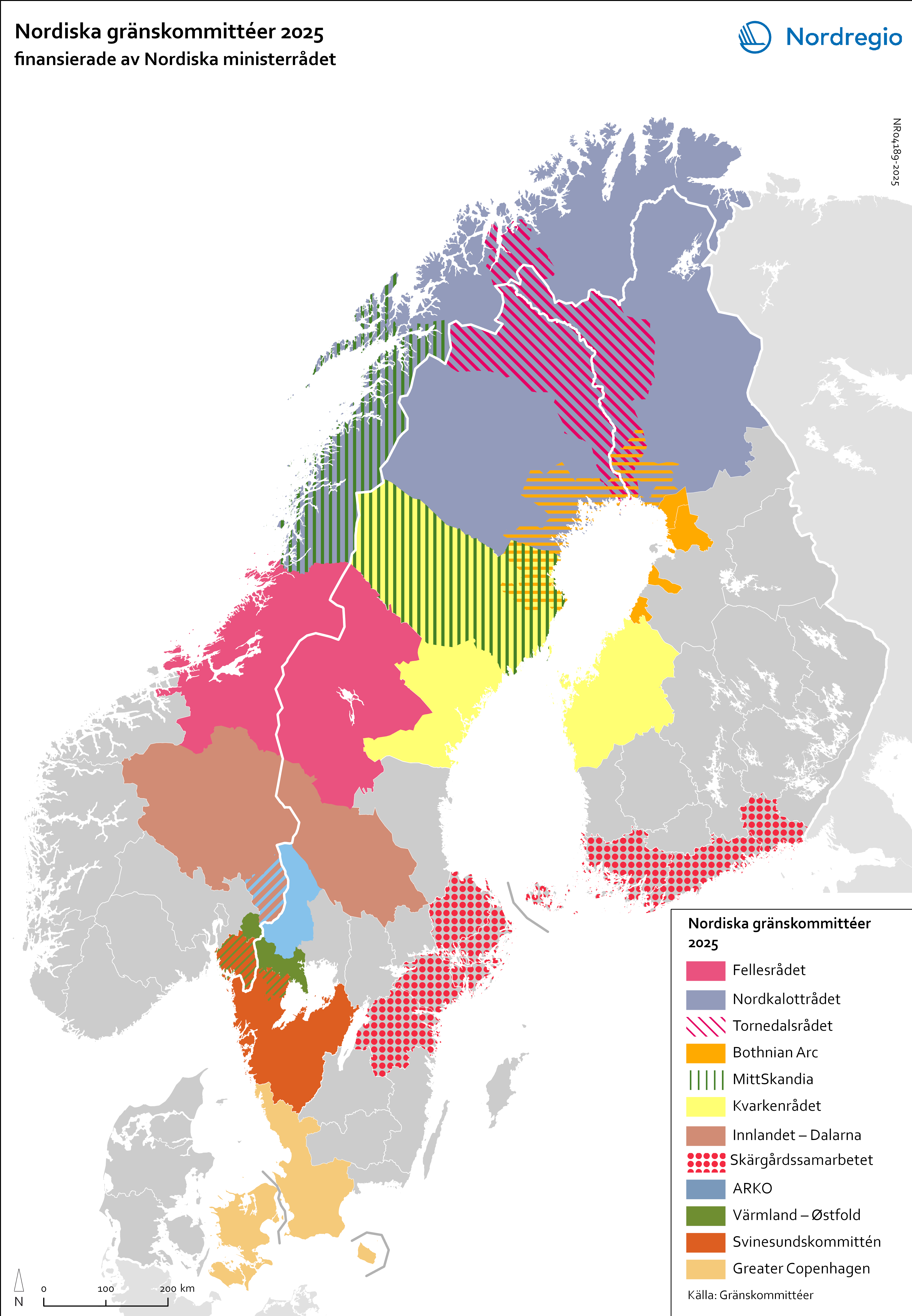
Map showing the areas covered by the Nordic cross-border committees.
NORA
Nordic Atlantic Cooperation (NORA) works to develop networks, strengthen cooperation, and support projects aimed at ensuring strong, sustainable economic development across the North Atlantic region. NORA’s scope of operations encompasses the Faroe Islands, Greenland, Iceland and coastal Norway (see map below).
NORA contributes to implementation of the RCP through direct assignments received from EK-R, as well as its participation in the thematic groups. The table below provides a broad overview of NORA’s activities and publications.
NORA contributes to implementation of the RCP through direct assignments received from EK-R, as well as its participation in the thematic groups. The table below provides a broad overview of NORA’s activities and publications.
Overview of NORA projects 2021-2024: Download as pdf
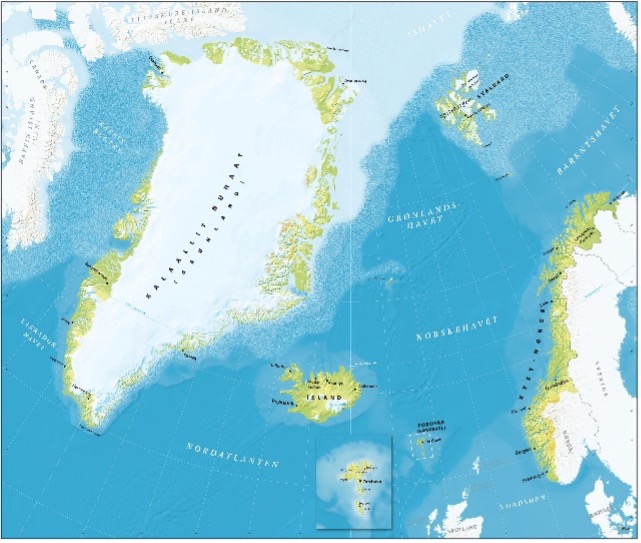
Map of the area/countries covered by NORA.