7. Are there rural-urban differences in attitudes towards the green transition?
The preceding section highlighted a potential link between the green transition and public discontent. Areas with a higher number of green jobs show increased support for populist parties, while people in municipalities with traditional polluting industries are less likely to vote for these parties. This finding raises questions about the attitudes of people in the Nordic Region towards the green transition, including their expectations and concerns. Are there spatial differences in Nordic residents’ attitudes?
A survey conducted by Nordregio in October-November 2022 provides insights into these questions (Tapia et al. 2023). The survey included a representative sample of the adult population living in the Nordic Region, covering five countries (Denmark, Finland, Iceland, Norway and Sweden) and three autonomous regions (Åland, Greenland and Faroe Islands). The survey involved 5,178 telephone interviews, with respondents randomly selected to ensure representative gender and age quotas.
The survey results show that perceptions and attitudes towards climate change and the green transition vary among people living in urban, intermediate and rural areas in the Nordic Region (Figure 5). People living in cities are more likely to view climate change as a serious or very serious problem (82%), compared to those living in small towns and suburbs (68%) and rural areas (62%). Similarly, a majority of city dwellers support investing more public financial resources in preventing climate change, even if it means that taxes are raised (59%). This support is lower among residents of small towns and suburbs (47%) and rural areas (39%). These differences are statistically significant.
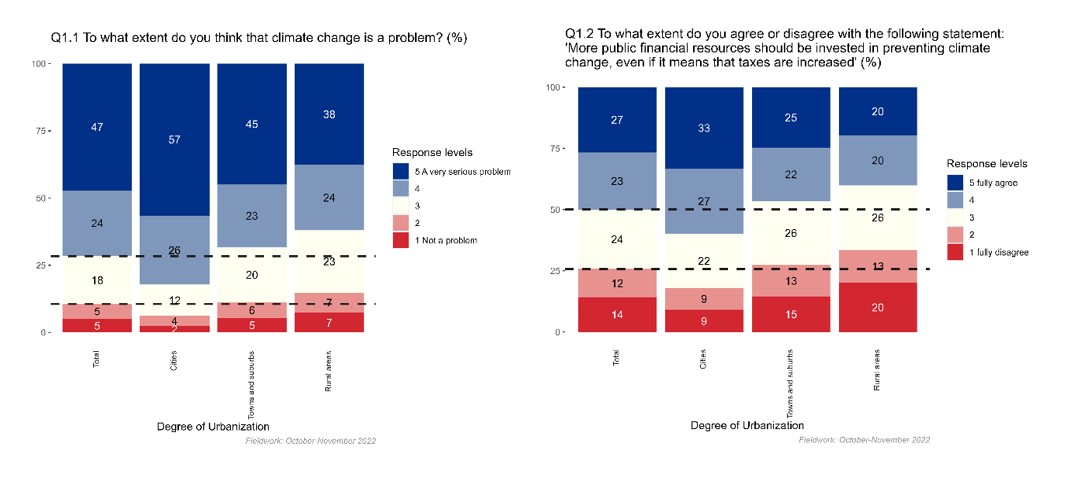
Figure 5: Attitudes towards climate change and ambitious green transition policies by degree of urbanization (2022)
Source: Tapia et al. (2023).
Source: Tapia et al. (2023).
The survey also reveals significant attitudinal differences towards climate policies and the green transition among residents in urban, intermediate and rural areas:
- Worries about job loss: Urban residents are less concerned about job losses due to the green transition (22% of respondents) compared to those in intermediate (30%) and rural areas (31%).
- Worries about price increases: Less than half (46%) of survey respondents in urban areas expect prices and the cost of living to rise due to the green transition. Their counterparts living in intermediate or rural areas were more concerned about such effects (54% in each of these groups).
- Expectations about more sustainable lifestyles: Survey respondents in urban, intermediate and rural areas also differ with respect to potential positive impacts from the green transition. Urban residents are more likely to expect that the green transition will lead to more sustainable lifestyles in the area where they live (60%). Respondents in intermediate areas (46%) and rural areas (40%) are less likely to expect such impacts.
- Perceptions about unequal impacts: Residents in urban, intermediate and rural areas also differ in their perceptions about how the green transition affects people in the Nordic Region. When asked if the green transition affects everyone equally, regardless of income, 60% of urban residents disagree, but only 54% of residents in towns and suburbs and 53% of rural dwellers do. Similarly, when asked if everyone in the Nordic Region is equally affected by the green transition, regardless of living in urban or rural areas, 60% of urban residents disagree. Among those in intermediate areas, 53% disagree, and among rural dwellers, 55% do. Thus, urban residents are more likely to perceive the green transition as having unequal impacts compared to their counterparts in intermediate and rural areas.
Overall, the survey results indicate that urban residents are more concerned about climate change and more willing to support ambitious climate policies than people living in towns, suburbs and rural areas. They are also less worried about green transition impacts on jobs and prices, although they more readily acknowledge that the green transition may have unequal effects on people. In contrast, residents in intermediate and rural areas are more concerned about job loss and rising cost of living and are less likely to support ambitious climate policies.
Related project publication:
Tapia, C., Sánchez Gassen, N. & Lundgren, A. (2023). In all fairness: perceptions of climate policies and the green transition in the Nordic Region. Nordregio Report 2023:5. Stockholm: Nordregio. Available at: https://www.nordregio.org/publications/in-all-fairness-perceptions-of-climate-policies-and-the-green-transition-in-the-nordic-region/