Photo: Marcin Jozwiak, unsplash.com
3. The focal areas of this study: from climate policies to household impacts
This section describes the main focal areas that are of interest in this study. We start by defining the key policy areas that are pivotal to reaching Nordic and European climate goals and where ambitious targets have been defined in the Nordic countries. These policy areas are the focus of our modelling. In the second section of this chapter, we explain why it is important to analyse how these policies impact household finances and outline the main pathways through which climate policies may influence household income and consumption.
3.1. Key policy areas for achieving the Nordic climate goals
Finding the right balance between the EU and Nordic climate policy frameworks is a matter of policy efficiency. Analysis of the costs and benefits of having more ambitious emission reduction targets in the Nordic countries than at EU level has formed the subject of much research.
Some researchers have endorsed a normative argument in support of the ambitious climate policies in the Nordic Region. Following the Kantian principle that moral actors should act in the same way as they would like others to act, Greaker and colleagues (2019) argue that each Nordic country could choose to mitigate climate change and accelerate efforts to reduce greenhouse gas emissions regardless of what other countries do. Their status as climate frontrunners may bring concrete benefits for the Nordic countries, most notably in the form of international prestige as global green leaders and inspiring models for others to follow. Green technologies or products developed in the Nordic countries to curb emissions may allow them to set international standards and tap into increasingly climate-conscious consumer markets (Silbye and Sørensen 2023). The adoption of Nordic green innovations by other countries may also contribute to abating emissions at a global level (Greaker, Golombek and Hoel 2019).
On a more practical level, Golombek and Hoel (2023) investigate the role of Nordic climate policies targeting industry and their overlaps with the EU ETS. According to this research, if the proposed Nordic national climate goals described in the previous chapter are to be met, a substantial number of ETS allowances that are not used in the Nordic countries due to lower-than-expected emissions would become available for use by other EU member states. That could effectively transfer greenhouse gas emissions to other EU countries, neutralising the reductions induced by Nordic policies. On those grounds, the authors argue that the Nordic countries should avoid implementing more ambitious policies in sectors already covered by the ETS, since such policies would undermine the market-driven nature of the ETS system. In a similar vein, von Below and colleagues (2023) maintain that more ambitious goals and policies at the national level in Sweden, the largest Nordic economy, could place higher costs on households without making a substantial contribution to climate change mitigation.
Silbye and Birch Sørensen (2023) take a different view on this matter. These authors argue that ambitious climate goals in Denmark have the potential to reduce total EU-wide emissions. They point out that the ETS includes a Market Stability Reserve (MSR), which absorbs emission allowances if there is a large surplus on the market. Since the size of the MSR is limited, when too many allowances are absorbed by the system they are cancelled. The authors argue that, thanks to this mechanism, the authors argue that the ‘overperforming’ climate policies in Denmark and other Nordic countries could still serve to increase the effectiveness of the ETS sector at the EU level and would not necessarily lead to higher emissions in other countries. At the same time, more ambitious climate policies in the Nordic countries may also help shift the European discussion towards a tightening of ETS rules and cuts in total allowance supplies.
A general point of consensus among most of these studies is that the split between the ETS and ESR sectors affects the cost-effectiveness of climate policies. It has been widely recognised that the marginal costs of emission reductions are unlikely to be equalised between the two sectors because the ETS/ESR split is rather arbitrary (Flam and Hassler 2023). Within the ETS sector, equalisation of the marginal cost of emission reductions is facilitated. That is because businesses in this sector either have to acquire emission permits or reduce emissions to the point where the marginal cost of abatement matches the permit price. As described in Section 2.2.2, the ESR sector, on the other hand, is subject to a variety of activity-specific domestic regulations. It cannot be expected that these regulations will deliver equalisation in the marginal costs of emission reductions across the diverse activities within the ESR sector of any country or across similar ESR activities in different countries. That also implies that Nordic policy instruments to reach the national climate goals could most usefully be applied in sectors included in the ESR. Those are sectors for which the EU sets shared goals but does not prescribe policies or mechanisms to attain them; the national governments are hence expected to design and deploy country-specific strategies.
Therefore, considering that this study is primarily intended to inform policy-making in the Nordic countries, it focuses on the Nordic ESR sectors where domestic policies may have a major impact. Placing the focus on ESR policies may allow possible improvements to be pinpointed in terms of marginal cost equalisation. Moreover, many of the measures in the ESR sector directly affect households, giving rise to much of the Nordic policy debate on the effects of climate policies. We contribute to this debate by estimating the effects of ESR policies on costs of living for households in various socio-economic groups and on employment opportunities in various occupations and subnational regions in the Nordic countries.
Within the ESR sector, the main policy initiatives in the Nordic countries for the next decade, and the ones chosen for our study, focus on decarbonising the transport sector. These polices target the electrification of car fleets and an increase in the use of biofuels in the remaining internal combustion engine vehicles. Our study also considers the effects of further decarbonisation of the power sector through the phasing-out of remaining coal generation, which still plays a relevant role in the Finnish energy system (see Section 2.4.2).
3.2. Impacts of climate policies on household finances
Land transport and energy mixes remain key policy areas for the decarbonisation of the Nordic and European economies. In contrast to the previous generation of climate policies, which focused on industrial processes (ETS), the current generation of climate policies – at both the EU and Nordic levels – target sectors and technologies that may have a more direct impact on household finances (ESR). Such impacts can manifest themselves via two pathways, namely household income and household consumption (Figure 6). The following overview draws on an analytical framework developed by Zachmann, Fredriksson, and Claeys (2018).
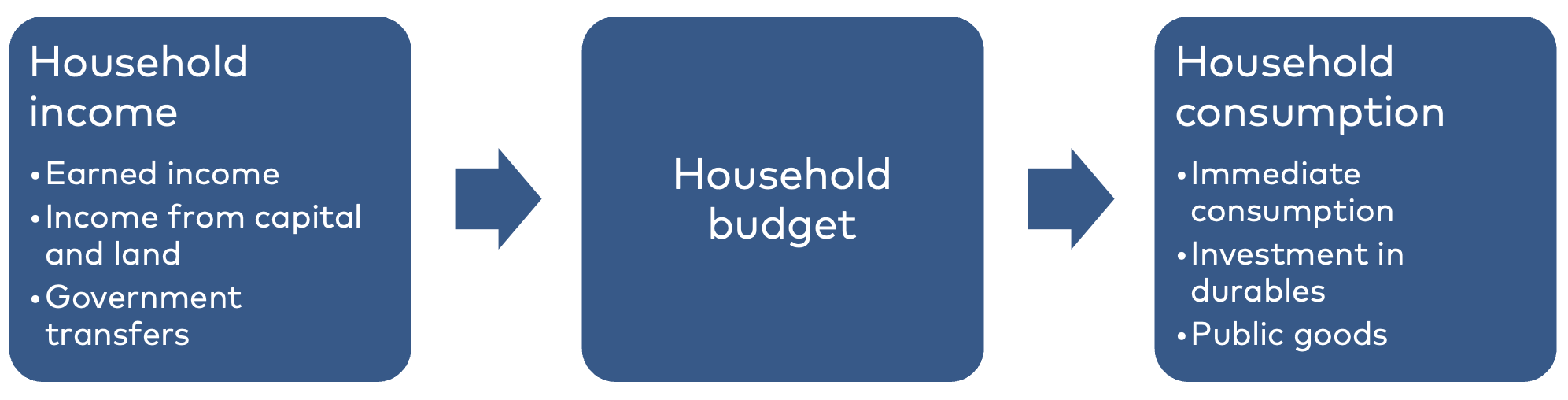
Figure 6. The composition of household budgets
Source: Own figure based on Zachmann, Fredriksson, and Claeys (2018)
3.2.1. Sources of household income
Households generate income through earnings (including wages, salaries, and earnings from self-employment), income from capital, land or property ownership, and government transfers. Climate policies may affect household finances by impacting on these various sources. For example, some jobs in carbon-heavy industries may disappear during the green transition while new jobs in green sectors may be created, affecting the career options and earning potential of employees in such sectors. The income that households generate from capital investment, e.g. through stocks and retirement funds, may also be affected by climate policies, as the market value of various company types fluctuates. Nonetheless, the overall impact of climate policies on capital is likely to be small. Finally, climate policies may affect government transfers to households. For example, climate policies such as carbon taxes may generate government income that could be redistributed to households or could allow governments to reduce other taxes (Zachman, Fredriksson, and Claeys 2018).
Earned income is the main source of income for most households, making it particularly pertinent to analyse the effects of climate policies on this income source. Since climate policies may impact some sectors and industries more than others, any repercussions in terms of employment opportunities or salary developments will particularly affect households that generate income from work in these sectors. Given that the Nordic countries and subnational regions have differing industry mixes, impacts on employment and wages are also likely to be more keenly felt in some regions than in others.
3.2.2. Household expenditure
Households can spend money on immediate consumption or invest in durables. Goods and services that are purchased for immediate consumption include food, fuels, and personal services etc. Investments in durables include goods that can be used over a longer time period, such as furniture or household appliances. In addition to goods for immediate consumption and durables, households also benefit from infrastructure and services that are provided by the government, including health care services and the use of public roads. Households use their available budget to acquire a combination of these different types of goods and services. The exact combination depends on individual and household preferences, the level of the available household budget, and borrowing constraints. Due to a lower total budget and stronger borrowing limitations, low-income households are more constrained in their consumption than high-income households.
Climate policies may affect household consumption through increases in commodity prices, in particular those of energy products. As the prices of various fuels change in response to market fluctuations, households adapt their consumption habits, contributing thereby to large-scale shifts of production technologies, until a new equilibrium is met. The transition between two equilibrium points may be marked by temporary increases in the prices of key energy commodities, particularly in the presence of external shocks, like international geopolitical tensions. These processes may affect households in diverse ways, depending on their specific characteristics. Climate policies may have a disproportionally higher impact on households that are more dependent on fossil fuels and private transport. Furthermore, consumption patterns are often driven by contextual factors rather than by personal choices. For instance, households composed of older people or persons with disabilities tend to be more reliant on private transport, while households living in houses typically consume more energy to keep them at a comfortable temperature compared to those living in condominiums (Tapia 2022). Furthermore, these aspects depend on the geographical location of the dwellings. There is a close link between the degree of urbanisation and the intensity of use of private cars – in terms of a) the frequency of use and transit distance and b) the proportion of people living in houses. In general terms, rural and isolated households tend to consume more energy at home and for personal transport than urban households (Simock et al. 2021).
Figure 7 illustrates the extent to which various commodities account for household expenditure in Denmark, Finland, and Sweden, by type of household location – urban, rural, and intermediate areas – and income deciles. By convention, less affluent households are those included in low-numbered deciles (1-5) while higher income households are those in high-numbered ones (deciles 6 to 10). The values were generated using microdata from the European Household Budget Survey (Eurostat 2022). Appendix 5 summarises the various types of household data inventoried for this study, and Appendix 6 details how some of these data points were processed for analysis.
Figure 7. Household expenditure by commodity and income decile in Denmark, Finland, and Sweden (2015)
Own elaboration based on Eurostat microdata from the Household Expenditure Survey. Expenditure based on normalised household size.
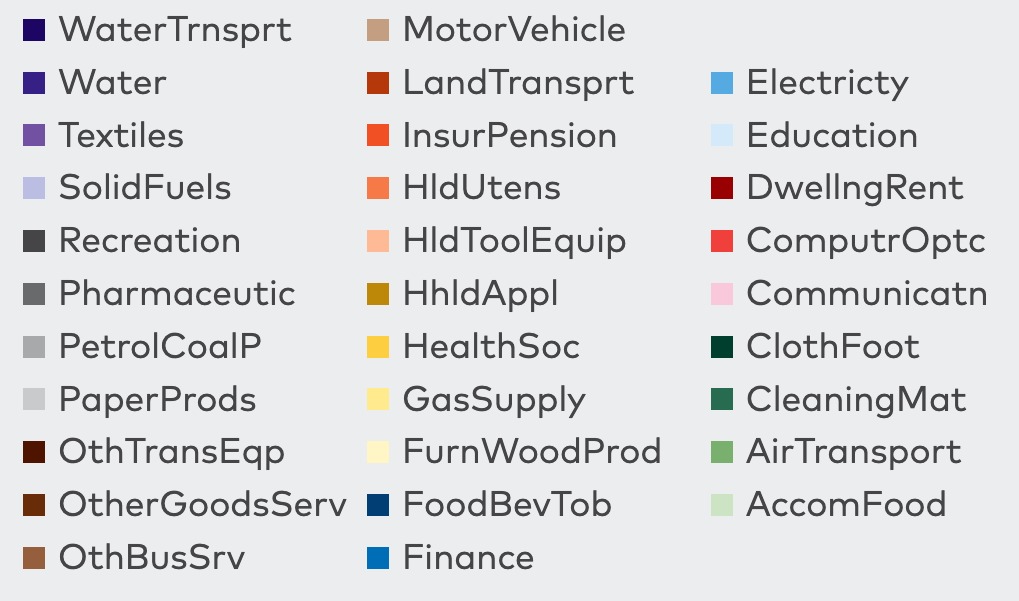
As shown on the individual bar plots in Figure 7, household spending is distributed very differently across countries and types of households. In general, the main expenditure categories in most households are 1) housing, including mainly dwelling and rentals but also goods related to property maintenance, and repair (DwellngRent), 2) food and non-alcoholic beverages (FoodBevTob), 3) recreation, culture, and accommodation (Recreation), 4) water and sanitation (Water), and 5) miscellaneous goods and services (OtherGoodsServ). In relative terms, expenditure on housing tends to decrease with income levels (DwellingRent). The opposite holds true for expenditure on motor vehicles (MotorVehicle) and recreation, culture, and accommodation (Recreation), particularly in urban households. Household expenditure on fuels and lubricants, including both motor fuels and liquid fuels for domestic use (PetrolCoalP) and electricity (Electricity), also tends to increase with income levels and, particularly, with rurality.
Figure 7 shows that fuels and electricity costs are of considerable relevance to household finances. Combined spending on energy fuels ranges from one to six per cent of total household expenditure, depending on the country and type of household. Expenditure on electricity ranges from two to five per cent. Household expenditure on energy commodities tends to be greater in rural areas than in densely populated municipalities. That is driven by a higher dependence on private motorised transportation and greater heating requirements of household dwellings located in such areas, as argued above. Moreover, low-density municipalities in Finland and Sweden tend to be in regions with longer and harsher winters, resulting in greater heating requirements in this type of household.
Given that households differ in terms of how much they spend on items such as fuel and electricity, it is important that climate policies consider differences in household income and geographical location. That approach is not only important to prevent undesired social impacts but also to ensure people’s support for climate policies. A recent Nordic survey on perceptions of climate policies and the green transition (Tapia, Sánchez Gassen, and Lundgren 2023) shows that a large majority of people in the Nordic countries (75%) consider climate change a serious or very serious problem, and roughly half of them agree that more public resources should be spent on mitigating climate change, even if that would result in tax increases. Nonetheless, one in four respondents state that climate policies already affect their own household finances in a negative way, and just as many are concerned that climate policies may put existing jobs at risk. Half of all respondents in the Nordic Region also fear that prices and cost of living will increase due to climate policies. Furthermore, respondents expressed concerns about the fairness of climate policies. Importantly, more than half of the respondents who answered the survey perceive that the impact of climate policies differs between rural and urban areas, and just as many think that impacts differ depending on personal income. In short, many people in the Nordic countries do not consider current climate mitigation efforts to be fair and just in terms of their income-related and spatial effects. It is therefore important to pay particular attention to the impacts of climate policies on these two aspects.
In the following chapters, we analyse the long-term impacts of three key climate policies on wages and household consumption: the attainment of national targets for an increased biofuel share of motor fuels and for an increased share of electric vehicles in passenger car fleets, as well as the phasing-out of coal-fired electricity. More information on these three policies is provided in the next chapter, following a brief description of the Nordic-TERM model used for the analysis.