Photo: Julius Jansson, Unsplash.com
Finland
Overview and targets
Finland has continued to actively implement the 2030 Agenda in recent years, setting even more ambitious climate targets at national and local levels. The country was among the first to submit a voluntary national review (VNR), and Helsinki was the second city in the world to submit a voluntary local review (VLR) in 2018, following the example of New York City at the time. Finland submitted its second VNR in 2020 and is committed to reporting to the High-Level Political Forum (HLPF) every four to five years.
Under the current government the aim is to transform Finland into a socially, economically and ecologically sustainable society by 2030.To amplify SDG efforts, a new Sustainability Roadmap was launched in 2021 both to describe the current status and to identify new policy measures to meet national targets. Based on the roadmap, the National Commission on Sustainable Development renewed its strategy from 2022–2030: A prosperous and globally responsible Finland that protects the carrying capacity of nature.
Strategy of the National Commission on Sustainable Development 2022–2030: A prosperous and globally responsible Finland that protects the carrying capacity of nature, https://julkaisut.valtioneuvosto.fi/bitstream/handle/10024/164157/VNK_2022_12.pdf?sequence=4&isAllowed=y
Governance and multilevel coordination
Finland’s SDG organisation is built on a holistic inclusion of government and society, where all administrative sectors have a shared responsibility for implementing Agenda 2030 and the 17 SDGs. Major structural leaps have been taken since 2016, when there were no mechanisms to maintain the sustainability dialogue between the government and the Parliament. These have now been well established.
The most important forums for the inter-administrative SDG implementation are the meetings of the Permanent Secretaries, the Sustainable Development Coordination Network, the National Sustainable Development Monitoring Network, and the Advisory Staff Network. Other networks include The Development Policy Committee and the Committee for the Future, the latter of which is responsible for the Agenda 2030 issues in Parliament.
All the ministries are represented in these networks and submit annual reports to the Parliament on policies and measures regarding the SDGs in their respective areas. In addition, the National Commission on Sustainable Development, which is led by the Prime Minister, brings together actors from all sectors to review Agenda 2030 implementation.
The Sustainable Development Co-ordination Network makes sure that sectoral policy on sustainable development is co-ordinated by the Prime Minister's Office, while the Sustainable Development Monitoring Network has been tasked with reporting on the work.
Voluntary National Review 2020 Finland: Report on the implementation of the 2030 Agenda for sustainable development p. 21, available at https://julkaisut.valtioneuvosto.fi/handle/10024/162268
Finland also has an Expert Panel on Sustainable Development, which consists of multidisciplinary researchers that assist the co-ordination network and the commission and provide independent input on SDG implementation. The institutional position of the Expert Panel was enhanced in December 2022, when it started working more closely with the National Commission yet maintaining its scientific independence. The Commission’s work is supported and challenged by the Expert Panel and the 2030 Agenda Youth Group.
In 2020, a special Round Table for Climate Policy was established in connection with the Commission for Sustainable Development. The Climate Policy Roundtable does not make decisions; instead, through its work it supports the national processes to prepare and implement climate policy, see e.g. https://ym.fi/en/climate-policy-round-table
Other recent structural reforms include the revised auditing programmes which now follow the same framework set out by the National Audit Office.
National implementation of the 2030 Agenda
Finland is implementing Agenda 2030 and the Sustainable Development goals through a Sustainability Roadmap, which details concrete actions the country needs to take to achieve the goals. Other guiding documents include the government programme, which is based on the SDGs and the country’s two VNRs.
The Sustainability Roadmap sets out six areas in which change is needed (see Figure 2). Two of the areas call for major social change. They are firstly the economy and work promoting wellbeing and sustainable consumption, and secondly, education, competence and sustainable lifestyles. Another area – wellbeing, health and social inclusion – primarily involves a shift in the focus of activities. Two other areas deal with ongoing technological and behavioural change and include: sustainable energy systems, and food systems that promote wellbeing. The area referred to as forest, water and land use promoting biodiversity and carbon neutrality involves measures that will help safeguard diversity but will also require comprehensive change in social behaviour.
The 2030 Agenda Roadmap of the Finnish National Commission on Sustainable Development p. 8–9, https://julkaisut.valtioneuvosto.fi/bitstream/handle/10024/164200/VNK_2022_17.pdf?sequence=4&isAllowed=y
For each area of change, the Roadmap includes a vision exceeding Agenda 2030 targets, a set of objectives that translate the visions into concrete terms, and a description of the key measures that will affect different sectors of society and play a key role in bringing about change. The Roadmap also discusses how Finland can support SDG implementation globally.

Figure 2: The six areas of change defined by the National Commission on Sustainable Development (p. 13)
Regional and local level implementation
The Association of Finnish Local and Regional Authorities, Kuntaliitto, represents Finnish municipalities and cities. Through Commitment2050, the Association pledges to support municipalities in drawing up their own sustainable development commitments. This includes providing tools, education, networks and support at local level.
Over the years, new sustainability approaches have evolved and become an integrated part of municipal planning. Finnish municipalities have a wide range of responsibilities and thus numerous possibilities to influence sustainable development. Ambitious targets have been set for climate action and resource-efficient strategies and play a strong strategic role in many Finnish municipalities. As a result, 45% of the Finnish population lives in a municipality committed to carbon neutrality by 2030. The local strengths in Finland are due to the high educational levels and know-how, as well as strong local democracies and opportunities for participation. The largest sustainable development challenges are related to climate change and social inequality.
Kuntaliitto also supports the municipalities in their development efforts, facilitates networks, and acts as a partner at national level. The key network is SDG46, a network of the six largest cities in Finland which includes Helsinki, Espoo, Tampere, Vantaa, Turku, and Oulu. All the cities in the SDG46 network, except Oulu, have reported voluntary local reviews as of 2022. Another important contributor is USO6, the organisation for small and medium-sized municipalities across Finland.
While municipalities in Finland are undoubtedly making progress, the dialogue between the national and local levels is not seamless, which the association pointed out in its dedicated VNR chapter in 2020. They noted a need for support and clearer co-ordination from the national level, as well as improved synchronisation of the monitoring tools, which primarily comprise indicators designed for national level reporting.
Voluntary National Review 2020 Finland: Report on the implementation of the 2030 Agenda for sustainable development p. 42. Available at https://julkaisut.valtioneuvosto.fi/handle/10024/162268
Engagement of civil society and stakeholders
Engaging civil society and other stakeholders has long been part of Finland’s sustainable development work. This is embedded in the national initiative, called Society’s Commitment to Sustainable Development.
It is also worth noting that Finland’s Agenda 2030 Youth Group was set up as early as 2017 to better integrate the voice of children and young people in the implementation and the National Commission’s work. Minority groups including the indigenous Sámi people and the Swedish-speaking population from Åland are also members of the National Commission.
The most recent VNR reporting process is a clear demonstration of Finland’s engagement with civil society and stakeholders (see Figure 3). The VNR is based on an inclusive process in which civil society has been widely heard, and an independent evaluation of the SDG progress was conducted by civil society representatives.
Follow-up mechanisms, reporting, and international comparisons
Finland monitors Agenda 2030 progress through the UN indicators for sustainable development and its National Indicators on Sustainable Development. The state of sustainable development in Finland is monitored by the National Sustainable Development Monitoring Network while Statistics Finland is responsible for following up on the indicators (reporting once per term to the Parliament). This monitoring framework is currently being reformed to match the new sustainable development strategy as part of which Citizens’ Panels on Sustainable Development enable ordinary people to participate in the assessments.
The National Audit Office of Finland evaluated Finland’s implementation and governance of the Agenda 2030 work in 2019. The project, titled Path2030, concluded that Finland’s policy on sustainable development has succeeded in being inclusive. A new evaluation of Finland’s Agenda 2030 implementation is planned for 2023.
Globally, Finland is ranked first and well on track to achieve five SDGs (including Goal 1, No Poverty, Goal 4, Quality Education, and Goal 7, Affordable and Clean Energy), but challenges remain for seven other goals, and significant or major challenges for seven others (see Figure 1).
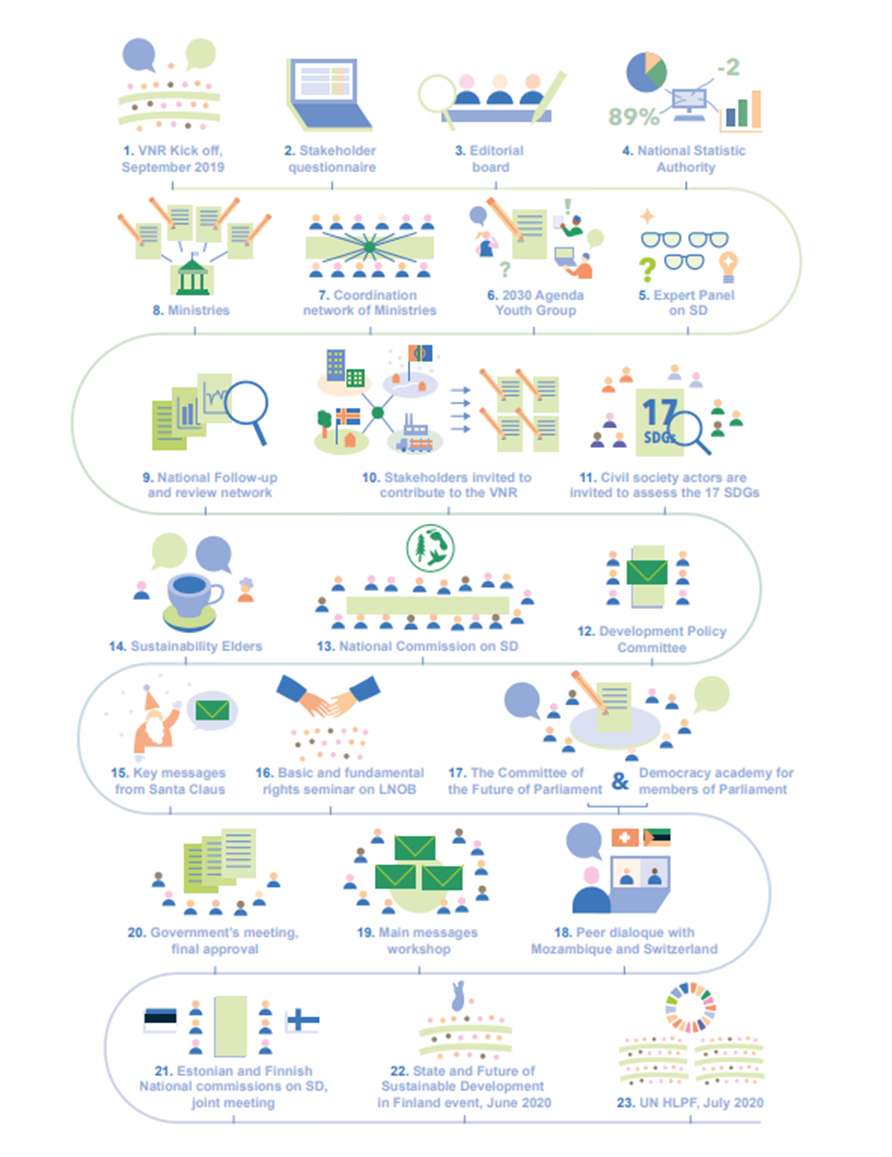
Figure 3: Finland’s VNR reporting process which saw comprehensive engagement by the main stakeholders (VNR, 2020, p. 15).
Voluntary National Review 2020 Finland: Report on the implementation of the 2030 agenda for sustainable
development p. 15 available at https://julkaisut.valtioneuvosto.fi/handle/...