Photo: Justine Ramage, Nordregio
Greenland
Overview and targets
In Greenland, sustainable development is integrated into various strategies and programmes and has become an essential element in many new projects and partnerships, as the SDGs become a central tool to assess sustainability trajectories.
The Greenlandic government, Naalakkersuisut, presented a comprehensive mapping in 2021 of national sustainable development initiatives.
Naalakkersuisut (2021) National Mapping of the SDG 2030 Agenda. Available at: https://indd.adobe.com/view/9c5c8505-53ad-4210-8040-35e8ce0bd83e
Governance and multilevel coordination
The Greenlandic Government has the overarching responsibility for the economic, social, and environmental perspectives of sustainable development in Greenland. The Ministry for Finance and Domestic Affairs, and specifically the Department for Spatial Planning under this ministry, has responsibility for co-ordinating and collecting data relating to sustainability and following up the national work. Statistics Greenland is responsible for developing and applying indicators.
While Greenland has not yet formally committed to Agenda 2030, Denmark endorsed the SDGs in 2015, which include Greenland as part of bilateral agreements. As such, the ministries also have varying ambitions when it comes to sustainable development in policy and strategies (see Figure 4). A common framework for addressing intersectoral priorities across ministries and other national bodies will, therefore, become increasingly important for Greenland in the years to come.
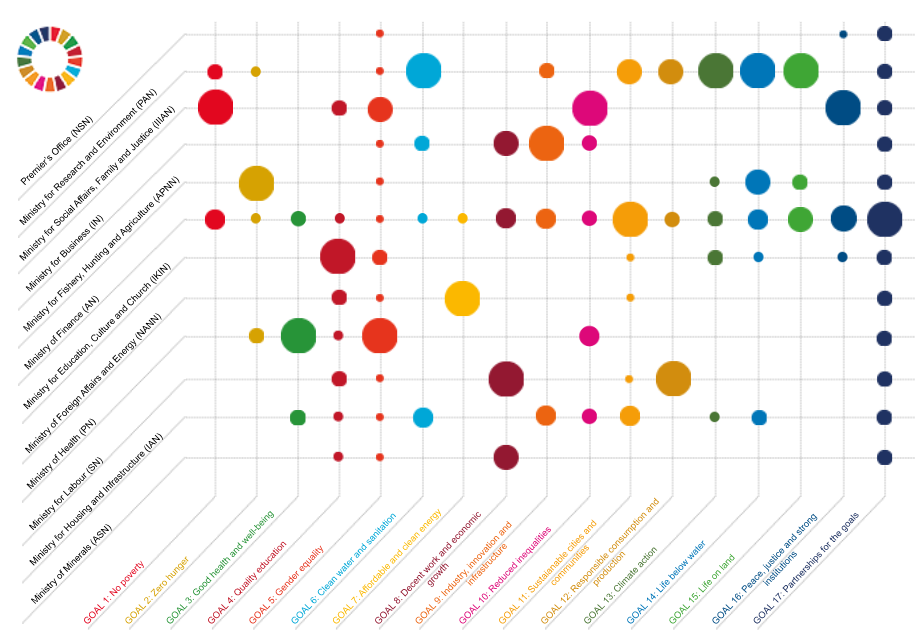
Figure 4: Greenland’s distribution of SDG work and responsibilities according to ministry (figure’s text is in Danish).
National implementation of the 2030 Agenda
In August 2022, Greenland welcomed young people from around the world, including 42 young Greenlanders, to the UNLEASH Regional Innovation Lab which took place in Nuuk. The purpose of this conference was to share ideas, create networks and develop sustainable solutions for the Arctic-Nordic region, but also to develop durable and positive results that will benefit young people and society in Greenland more specifically. The event was the first of its kind in Greenland: UNLEASH is a non-profit organisation in which young people share ideas and create solutions to aid progress toward the Sustainable Development Goals.
At an operational level, the Greenlandic government recognises that national sector planning can contribute to the work on the SDGs and consequently that the SDG framework must become an integral part of templates used to draw up sectoral plans, such as in land use and urban planning. The national mapping report states that there are many benefits to integrating sustainable development into physical planning and the planning system in general. The Planning Act establishes a single coherent national system from an overall strategic level right down to individual land allocation or building permits within the municipality. This approach ensures that sustainable development plays a key role in all sectoral plans and serves as a link between national and global initiatives. Other policy plans documenting progress toward achieving the SDGs are available at www.anguniakkavut.gl.
Greenland’s Sustainability and Growth Plan from 2016 also connects the objectives of sustainable social development and economic growth to the work on Agenda 2030 and the Sustainable Development Goals (SDGs). The aim of that plan was to develop society in a sustainable direction using four main reform paths designed to raise the level of education, promote growth and diversify the economy, modernise the public sector and strengthen and secure the welfare state, both now and in the future.
Greenland has through its involvement in both Arctic and Nordic cooperative bodies, expressed a desire to work toward implementing the relevant SDGs, for example, by signing the Fairbanks Declaration in Alaska in May 2017 and at the Nordic Prime Ministers’ Meeting in Reykjavik in August 2019.
As part of ongoing implementation efforts, both Greenland and the Faroe Islands have initiated a dialogue with Denmark to ensure a clear framework for their work on the 2030 Agenda for Sustainable Development, including future progress reporting to the UN.
Regional and local level implementation
The 2021 mapping report states that municipalities in Greenland play an important role in ensuring concrete implementation of sustainability measures. This could be in the form of local plans or granting approval of specific construction projects, for example.
As part of the 2009 structural reform, Greenland’s 18 districts were consolidated into four large administrative areas (although Qaasuitsup Kommunia was later split in two, so there are now five districts, commonly referred to in Greenland as “municipalities”). The five municipalities have all embraced sustainability to a greater or lesser degree. Some municipalities have openly endorsed the SDGs, while others are working more indirectly through initiatives that focus on a broad interpretation of sustainability.
One example is in Avannaata, which in 2021 allocated resources for local SDG initiatives.
Engagement of civil society and stakeholders
The UNLEASH Regional Innovation Lab in Nuuk engaged several Greenlandic stakeholders and youth representatives. The outcomes of the Lab will hopefully accelerate the social and environmental sustainability of future activities by civil society organisations and local communities. Indeed, the participants in the Lab proposed several SDG solutions for Greenland. These included: “The Arctic Food Cooperative”, a proposal for providing young people in Greenland with enhanced knowledge of Arctic food and to alleviate loneliness, the “SDG Storytelling Park” to create narratives around the SDGs through the lens of the local community, and a “Translation Application” to support people during medical consultations.
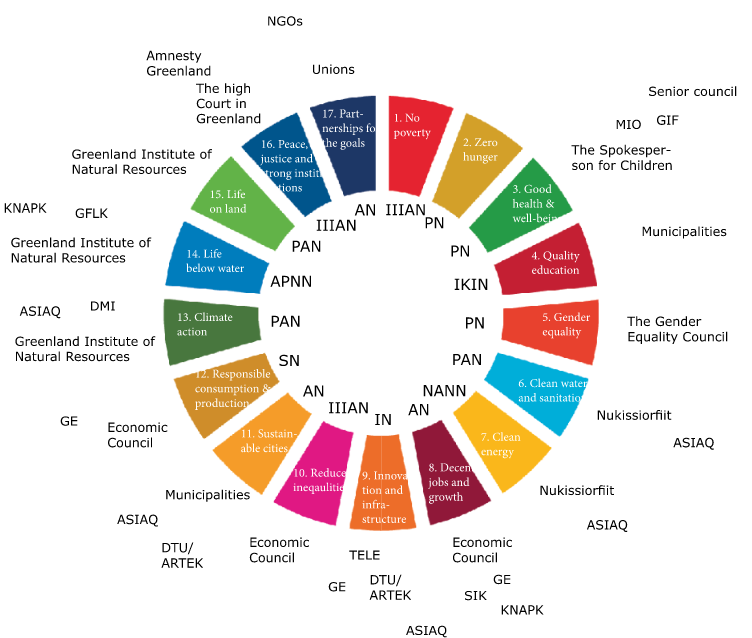
Figure 5. Overview of all the stakeholders involved in Greenland’s Agenda 2030 efforts (National mapping report, p. 19)
NSN: Naalakkersuisut Siulittaasuata Naalakkersuisoqarfia / Premier’s Office
PAN: Ilisimatusarnermut Avatangiisinullu Naalakkersuisoqarfik / Ministry for Research and Environment
IIIAN: Isumaginninnermut, Ilaqutariinnermut, Inatsisinillu Atuutsitsinermut Naalakkersuisoqarfik / Ministry for Social Affairs, Family and Justice
IN: Inuussutissarsiornermut Naalakkersuisoqarfik / Ministry for Business
APNN: Aalisarnermut, Piniarnermut Nunalerinermullu Naalakkersuisoqarfik / Ministry for Fishery, Hunting and Agriculture
AN: Aningaasaqarnermut Naalakkersuisoqarfik / Ministry of Finance
IKIN: Ilinniartitaanermut, Kultureqarnermut, Ilageeqarnermut Nunanullu Allanut Naalakkersuisoqarfik / Ministry for Education, Culture and Church
NANN: Nunanut Allanut Nukissiuuteqarnermullu Naalakkersuisoqarfik / Ministry of Foreign Affairs and Energy
PN: Peqqissutsimut Naalakkersuisoqarfik / Ministry of Health
SN: Suliffeqarnermullu Naalakkersuisoqarfik / Ministry for Labour
IAN: Ineqarnermut Attaveqaqatigiinnermullu Naalakkersuisoqarfik / Ministry for Housing and Infrastructure
ASN: Aatsitassanut Naalakkersuisoqarfik / Ministry of Minerals
Figure 5 provides an overview of all the stakeholders involved in Greenland’s Agenda 2030 efforts. One important private sector stakeholder is CSR Greenland, an organisation founded in 2010 the primary purpose of which is to bring together entrepreneurs and established companies and encourage them to do business in a socially responsible manner. CSR Greenland was one of the first organisations to embrace the SDGs as a core element of their work. More and more member companies have now gained a greater awareness of the active role that they play in sustainable development through their efforts to implement the SDGs. CSR Greenland has successfully run introductory courses, a major SDG accelerator course and a more in-depth training course on the SDGs, CSR and sustainability that has attracted a wide range of companies and organisations.
For an overview of ongoing SDG activities and news, www.anguniakkavut.gl is the national digital communication portal raising public awareness of Agenda 2030 and sustainable development in Greenland. The portal has been developed and edited by the Department of National Planning under the Ministry of Finance and provides recent updates on activities and initiatives under the auspices of public agencies, businesses, as well as civil society and voluntary organisations, and is intended to be accessible for everyone in Greenland wanting to learn more, and to inspire action locally and nationally. The portal also contains a section with the most relevant indicators for each target.more, and to inspire action locally and nationally. The portal also contains a section with the most relevant indicators for each target.
Follow-up mechanisms, reporting, and international comparisons
According to the national mapping report, Greenlandic initiatives related to the SDGs are currently being implemented by the Ministry of Finance, which will play a co-ordinating role for the time being, since the work on sustainable development is closely linked to the government budget (and other economic planning factors) as well as physical planning.
Naalakkersuisut has selected indicators for the official portal from the list of SDG indicators available on Statistics Greenland’s website, www.stat.gl. When indicators are downloaded from the website, reference can be made to their descriptions of sources and methods. In addition, it is often possible to search for more detailed information on the website, where an indicator can, for example, be broken down by location, gender or age group.
Greenland is not included as a separate country in the Sustainable Development Report Index or other large international comparison sites, but since 2017, work has continued to engage the ministries in mapping the areas of focus across Greenland’s central government bodies and agencies. Addressing each of the targets and indicators in the 2030 Agenda has proven to be an extensive process. However, Statistics Denmark received a four-year grant under the Danish national budget to support statistical monitoring and development of indicators for Greenland and the Faroe Islands. Statistics Denmark has seen its budget increase by DKK 1 million annually from 2019 to 2022 to facilitate working with Statistics Greenland to monitor progress on the UN Sustainable Development Goals.