Photo: Samuel Han, Unsplash.com
Norway
Overview and targets
Norway’s second voluntary national review (VNR) in 2021 describes the country’s ongoing efforts towards sustainable development, including an assessment of the progress made between 2016 and 2021. There was considerable momentum leading up to the 2021 VNR, much of which was spurred by an audit completed in 2020 by the Office of the Auditor General of Norway that observed, among other things, that a National Action plan for Sustainability with national targets was not yet in place, but this has since been published.
Overall, in recent years, challenges for Norway have included, (but are not limited to), increasing socioeconomic inequality, a noticeable rise in incidences of gender-based violence during the COVID-19 pandemic, and a disproportionate rate of male students dropping out of higher education. As in many other industrialised countries, high levels of domestic consumption also generate spillover effects in other countries.
Norway has, parallel to national efforts, also prioritised playing an active role in follow-up work on the goals internationally. This is reflected in the government’s development policy priorities, which are anchored in the 2030 agenda and complement longstanding foreign and development policy revolving around peace, security, human rights and gender equality.
Governance and multilevel coordination
Since 2020, the Ministry of Local Government and Regional Development has overseen the national co-ordination of the 2030 Agenda, while the Ministry of Foreign Affairs has overseen international efforts. The two ministries draw up the voluntary national review with input from the Office of the Prime Minister as well as the other ministries, government agencies and stakeholders. Like Denmark, the SDGs and related targets are allocated to different ministries, which are also responsible for selecting suitable indicators for progress reporting and co-ordination with relevant stakeholders.
According to involved officials, the 2021 VNR reporting process increased cross-sectoral co-operation and promoted a more holistic approach to sustainable development work in Norway. This is reflected in the dedicated chapter on local and regional level implementation which was written by Kommunesektorens organisasjon (KS), the Norwegian Association for Local and Regional Authorities, together with other local stakeholders.
The Government has a dedicated national Agenda 2030 webpage: https://berekraft.regjeringen.no. The webpage also includes a platform showcasing sustainability initiatives across the public, private and civil society sectors.
National implementation of the 2030 Agenda
The Parliament approved Norway’s first national action plan for the implementation of the 2030 Agenda in 2021. The action plan, called “Mål med mening” (“Goals with Meaning”), seeks to translate the global goals into a Norwegian context and provide possible supplementary national indicators that Norwegian businesses, organisations and public authorities can use as tools in their work with the SDGs. The Ministry of Finance reports that in 2023 Norway will introduce a national taxonomy for sustainable economic activities based on the framework outlined by the European Union.
The annual state budgets used to include coverage of policy coherence and allocation for sustainable development, but this practice ended in 2021. This work is now covered in the VNR report, in the Executive Forum on the Sustainable Development Goals, and in reports to the OECD.
In 2022, measures introduced to tackle the COVID-19 pandemic accentuated structural issues already present before the pandemic. While the SDGs were not addressed specifically in the national recovery plan, the pandemic did accelerate several ongoing processes, such as the digitalisation of public services to reach as many people as possible across the country.
Regional and local level implementation
Local level implementation of Agenda 2030 has been gaining momentum in municipalities and regional authorities since 2016. More and more municipalities, county councils, organisations and private companies have begun to both implement and report their findings on the sustainability goals.
To gain greater insight into SDG localisation in the municipalities and larger regions, a partnership agreement between the national government and KS was established. In addition to the VNR chapter in 2021, regional and local level authorities submitted the country’s first voluntary sub-national review (VSR) the same year. The experiences of cities that have been at the forefront of incorporating the SDGs into their local plans and strategies, reported in the VSR, indicate that there is a significant political commitment to providing leadership and momentum. Implementation at local level also demonstrates that knowledge-sharing and collaboration at different levels of government can also foster success. In Norway, Asker municipality has submitted a voluntary local review.
KS has offered wide-ranging support to its members regarding Agenda 2030 uptake and localisation actions both prior to, and following, the VNR and VSR reporting. Activities include establishing a national sustainability network among municipalities called Bærekraftsnettverket. This network hosts several knowledge-sharing webinars and events each year. KS is also working with the Confederation of Norwegian Enterprise (NHO) and the Norwegian Confederation of Trade Unions (LO) on a sustainability pledge (“Bærekraftsløftet”) to speed up progress on fulfilling the 2030 Agenda. In 2022, KS also published an online SDG course for Norwegian municipalities.
Engagement of civil society and stakeholders
In 2021, The Norwegian Forum for Development and Environment (ForUM) co-ordinated feedback on Norway’s Agenda 2030 progress from their network of 50 civil society organisations working on development issues, the environment, peace and human rights. The civil society input to the VNR contributed to a better national policy discussion and to the High-Level Political Forum. The process demonstrated that the government can include a broad range of stakeholders in work on the SDGs.
An Executive Forum on the Sustainable Development Goals (Topplederforum for bærekraftsmålene) was set up and its first meeting held in June 2022. Drawing on experience from Finland and Germany, the country’s first national multi-stakeholder forum for the 2030 Agenda aims to develop and co-ordinate the national sustainability work along with business and industry, civil society, municipal authorities and academia, including UN Global Compact Norway and SDG Norway. The first meeting focused on the links between climate, nature and a competitive energy supply. Other areas include the labour market, competence, inclusion and responsible consumption.
Follow-up mechanisms, reporting, and international comparisons
Together with Statistics Norway, KS has developed a taxonomy for the SDGs (see Figure 7) in recent years which is intended to provide municipalities, regional authorities and other stakeholders with an accessible tool to monitor their individual 2030 Agenda implementation efforts. The taxonomy builds on existing indicators for measuring sustainability and has been catalogued according to a model created by Statistics Norway. The taxonomy is specifically tailored for local level, but it is also well suited as a starting point for other areas at larger geographical and governance levels.
Complementing the development of the quantitative monitoring framework, the Government has reported on the SDGs and on national emissions to Parliament through the budget process in 2022.
Norway ranks fourth globally in the Sustainable Development Report 2022. According to the global index, Norway is on track to achieving six goals (including Goal 1, No Poverty, Goal 5, Gender Equality, and Goal 17, Partnerships for the Goals), but challenges remain for five goals, with significant or major challenges for seven, notably SDGs 12, 13 and 15. Norway’s index score for achievement of the SDGs is 82.3/100 points, but the negative spillover effects caused outside of Norway gives a spillover score
Countries are ranked by their spillover score. Each country's actions can have positive or negative effects on other countries' abilities to achieve the SDGs. The Spillover Index assesses such spillovers along three dimensions: environmental & social impacts embodied into trade, economy & finance, and security. A higher score means that a country causes more positive and fewer negative spillover effects.
(Source: https://dashboards.sdgindex.org/rankings/spillovers)
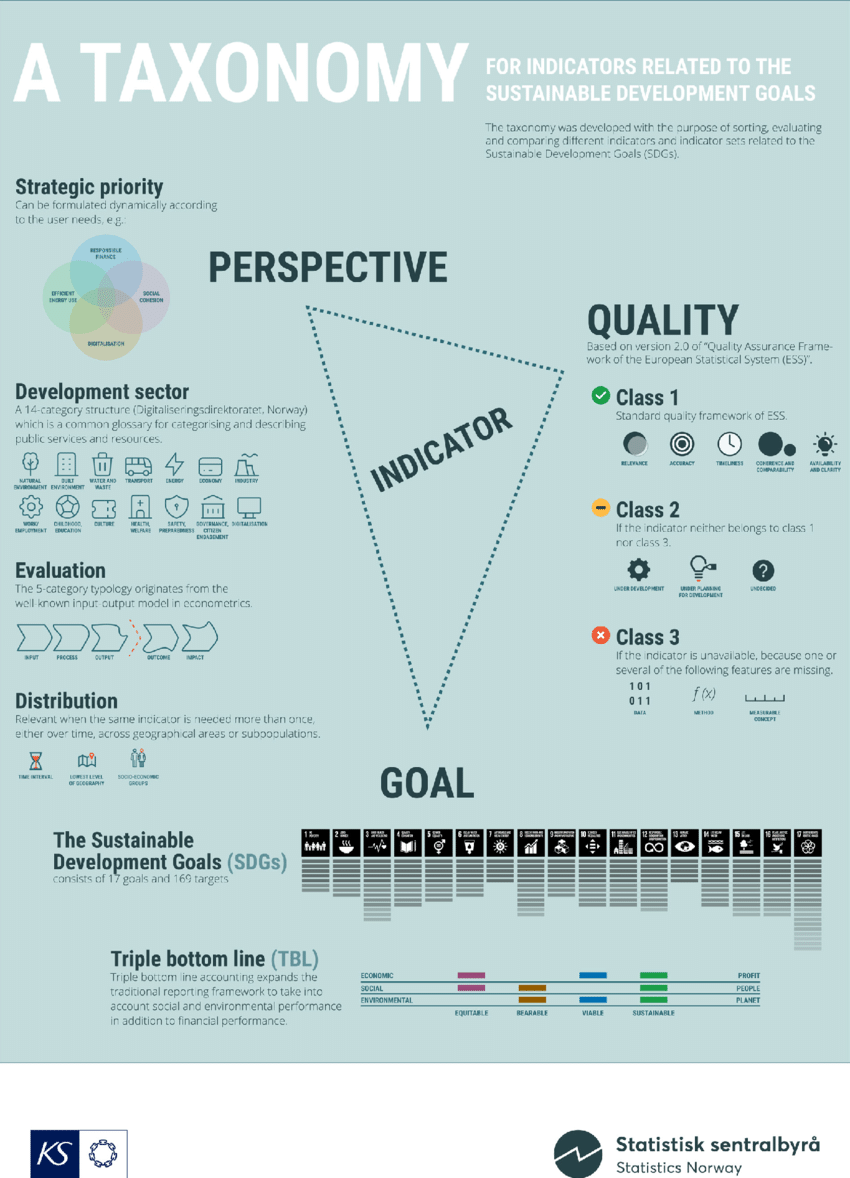
Figure 7. Taxonomy for the SDGs in Norway where the central properties and characteristics of an indicator or an indicator set have been identified to establish SDG relevance across three dimensions: goal, perspective, and quality.