Photo: Vaida Ražaitytė, Nordregio
Iceland
Overview and targets
Iceland submitted its first voluntary national review (VNR) to the UN High-level Political Forum in 2019 and the country’s second VNR is slated to be presented in 2023.
Iceland has not drawn up a separate national action plan for the 2030 Agenda. Instead, the country actively uses the 2030 Agenda and the Sustainable Development Goals (SDGs) as an umbrella platform for several national strategies and policy documents. A co-operation platform called Sustainable Iceland has also been established and work has begun on a new policy design for sustainable development in Iceland. At local level, Samband íslenskra sveitarfélaga (Samband), the Icelandic Association of Local Authorities actively engages its members in SDGs implementation.
Governance and multilevel coordination
In December 2022, the Prime Minister officially kick started a co-operation platform called Sustainable Iceland and a Sustainability Council. The aim of Sustainable Iceland is to accelerate the process of achieving the SDGs and the government’s well-being priorities. The platform is also tasked with redesigning Iceland’s policy for sustainable development to guide a just and fair green transition across all areas of society. The Prime Minister chairs the Sustainability Council, which includes other ministers, municipal representatives, employer associations, trade unions, parliamentary parties and NGOs. Work on Agenda 2030 and the SDGs will continue under the auspices of Sustainable Iceland.
Prior to this, an inter-ministerial working group led by the Prime Minister’s Office in close co-operation with the Ministry for Foreign Affairs has since 2017 managed the analysis, implementation and promotion of the SDGs. This group also included representatives from the Parliament, Samband, and Statistics Iceland, as well as observers from the Youth Council for the SDGs and the UN Association in Iceland.
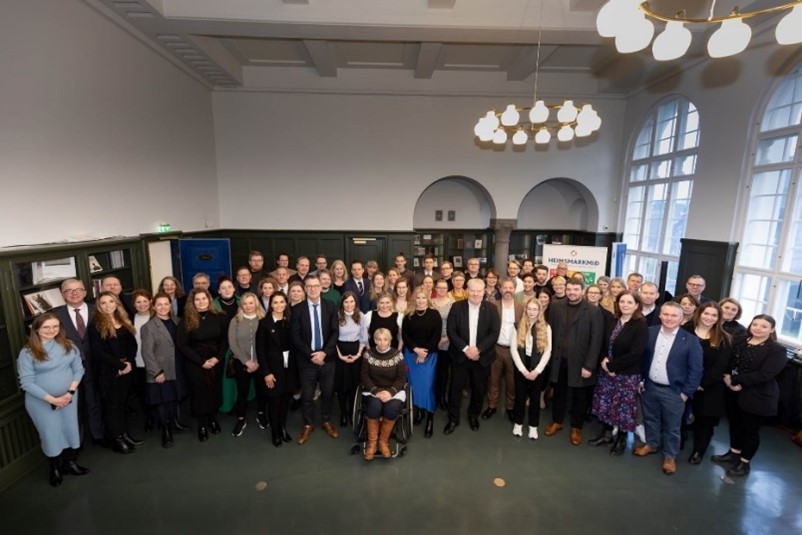
Picture: Sustainable Iceland kick-off meeting 1. December 2022. Photo credit: https://www.stjornarradid.is
National implementation of the 2030 Agenda
In addition to the establishment of the sustainable co-operation platform and council, the SDGs have also been taken into account in the Policy for Development Cooperation, a new education and innovation policy, and the Climate Action Plan. The latter is guided by the SDG framework and the Paris Agreement and came into effect in April 2019. It affirms that public institutions and state-owned companies should be forerunners in implementing and monitoring climate and emission targets. Other key activities include the publication of an individual environmental policy with indicators and targets for each SDG, jointly authored by 68 of 199 governmental agencies and state-owned companies, in June 2022. In November, 174 governmental agencies participated in the Green Steps Program, an SDGs inspired initiative overseen by the Environment Agency of Iceland. Participation in the programme requires certain sustainability initiatives, including Green Accounting.
Regional and local level implementation
Collaboration between local regional authorities and municipalities has been an important element for SDG localisation in Iceland. The Icelandic Association of Local Authorities, Samband, has played a key role in co-ordinating this work and has been directly involved in the national sustainability efforts from the beginning. Samband also participates actively in Agenda 2030 implementation co-ordination with its Nordic counterparts. SDG co-operation between the government and Icelandic municipalities now falls directly under the auspices of Sustainable Iceland.
Samband continues to support other Agenda 2030 efforts, and in its newly adopted strategy for the current election period 2022-2026, it states that the SDGs will be a ‘guiding light’ in the implementation of Samband´s policy during the current electoral period, as well as contributing to Agenda 2030’s strategic localisation work across Icelandic municipalities. Samband goes on to say that it is committed to supporting the municipalities in their SDG work and will continue to co-operate with the Prime Minister’s Office on an SDG toolbox and the development of relevant indicators. It has also emphasised the importance of strengthening advocacy and awareness of the SDGs across municipalities, as well as actively communicating information and advice on Agenda 2030 implementation.
Following OECD recommendations, a special SDG co-operation committee was established in January 2021 involving the government and Samband to strengthen support for local authorities, as well as promoting closer co-ordination and support from national level to the local level. The committee was led by the chair of the SDG inter-ministerial working group and joined by the Ministry of Local Government and the Statistical Bureau of Iceland. Through the committee, Samband received a grant from the Municipal Equalisation Fund to create an SDG toolbox for the municipalities. The aim of the project was to increase SDG uptake among municipalities and encourage co-operation and peer-to-peer learning at local level. Participating municipalities were divided into two groups based on progress toward SDG implementation. Samband was responsible for arranging meetings, events and seminars to target specific SDGs efforts, providing support and promoting knowledge sharing between municipalities. The SDG co-operation committee has also worked on developing indicators for the Icelandic municipalities.
In its SDG initiatives Samband has emphasised the importance of linking local policies and planning to the SDGs. The second biggest municipality in Iceland, Kópavogur, has been at the forefront of these efforts (see Figure 6). It was the first Icelandic municipality to formally adopt the SDGs and was one of the pilot areas in the OECD programme, ‘A Territorial Approach to the SDGs’.
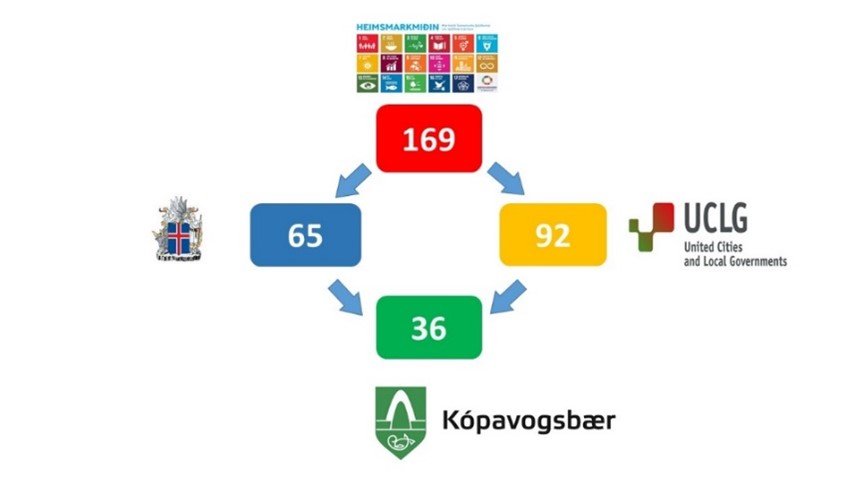
Figure 6. Kópavogur´s method of selecting prioritised SDGs and targets based on global and national priorities. Photo credit: https://www.kopavogur.is/sdg#sustainable-development-goal-17-partnerships-for-the-goals
In 2021, the capital city, Reykjavík, adopted the WCCD Standards ISO 37120, ISO 37122 and ISO 37123, and its strategic plan, the 2030 Reykjavík Green Deal, is guided by the SDGs. The Green Deal is measured against the three ISO standards, each standard consisting of metrics and categories linked to the sub-goals of Agenda 2030. The co-operation platform for the implementation of the SDGs in the Reykjanes peninsula is another noteworthy Agenda 2030 project. It involves four municipalities joining forces with important industrial actors in the region, including Isavia, Iceland’s ANSP and the operator of Keflavík international airport, the largest employer on the peninsula to work together on the SDGs and the circular economy.
Engagement of civil society and stakeholders
The Icelandic Government recognises that implementation of the 2030 Agenda requires the combined efforts of many different stakeholders and is, therefore, working actively to include national and international stakeholders. The Prime Minister’s Office has conducted five surveys on awareness of the SDGs in Iceland. The surveys report a clear increase in awareness in recent years, from 46.6% at the start of 2018 to 79.4% in 2020.
To support and encourage this positive trend, in December 2022 the Sustainability Council’s remit was broadened to include representatives from a wide range of civil society organisations and NGOs, including the Icelandic Older People´s Organisation, The National Queer Organisation of Iceland and The Icelandic Disability Alliance. The Ministry of Foreign Affairs has also established a Sustainable Development Goals Partnership Fund to encourage Icelandic businesses to support and promote value-creation in developing countries in line with the SDGs.
Prior to these initiatives, the government’s working group had initiated a co-operation agreement with the national umbrella organisation for civil society representatives, Almannaheill and UNA Iceland in 2021.
In 2021 the Icelandic State Broadcaster RÚV also produced HM30 – a series of short video films produced about the 2030 Agenda and the SDGs.Each episode was dedicated to a particular goal, and aired on RÚV. The production was a co-operation between RÚV, the Prime Minister’s Office and the Ministry of Foreign Affairs. As part of the initiative, educational material and exercises for primary and secondary schools on the 2030 Agenda and the SDGs were published and distributed to schools and libraries.
Iceland’s Youth Council for the SDGs, which is internationally recognised, is led by Iceland’s Children’s Ombudsman, and consists of 12 members from each Icelandic region. The Council holds several in person meetings per year, online meetings, and one joint meeting with the Cabinet at which it has the opportunity to present its priorities to the government.
Iceland’s official Agenda 2030 portal has been active since 2019. The portal offers an opportunity for individuals, NGOs, companies, institutions, municipalities, and other stakeholders to present projects and ideas that will help promote the SDGs and serves as an open public forum. The portal features an online dashboard that shows the current status of each goal and target in Iceland.
Follow-up mechanisms, reporting, and international comparisons
Statistics Iceland is responsible for collecting data and monitoring the country’s SDG indicators. Based on an in-depth methodological study, data has been collected for Iceland’s progress on the 169 of the 247 global indicators for sustainable development. Statistics Iceland is currently working on an additional three indicators while exploring data sources for the remining 75. Statistics Iceland has a website that publishes updates on the status of the SDGs in Iceland.
Iceland ranks 22nd globally in the international SDG comparison. Iceland is on track to achieving five goals (including Goal 1, Goal 10, and Goal 16), but challenges remain for four goals, with significant or major challenges for nine. Iceland’s index score for achieving the SDGs is 78.9/100 points, but the spillover effects of Iceland score
Countries are ranked by their spillover score. Each country's actions can have positive or negative effects on other countries' abilities to achieve the SDGs. The Spillover Index assesses such spillovers along three dimensions: environmental & social impacts embodied into trade, economy & finance, and security. A higher score means that a country causes more positive and fewer negative spillover effects.
(Source: https://dashboards.sdgindex.org/rankings/spillovers)