1. Introduction
The Nordic countries are widely recognised for their accessible and inclusive higher education systems, which are considered important drivers of innovation, equity and competitiveness in the knowledge economy.
While metropolitan and well-established traditional universities often benefit from strong institutional capacity, stable student numbers and robust research infrastructure, higher education institutions in regional centres and smaller towns operate under different conditions. These institutions are increasingly initiated, shaped by – and must respond to – complex structural pressures, such as rural population decline, regional disparities and growing demand for skilled labour. They are also affected more broadly by neoliberal policy reforms, which emphasise institutional consolidation, scale, efficiency and centralisation (Thiem, 2009).
The emergence and development of higher education institutions outside major urban areas represent a strategic, local response to the structural challenges and policy reforms. These institutions seek to strengthen territorial and social cohesion by improving access to education and supporting regional labour market needs. Moreover, they are increasingly positioned not only as education providers, but are also intended to be engines of regional development, supporting upskilling, public-private collaboration and the retention of young people in rural areas. While research indicates the potential of these institutions to meet such objectives, their actual impact remains to be fully assessed and confirmed (Mærsk et al., 2023; Rodríguez-Pose & Wang, 2025; Rossi & Goglio, 2020).
This report is an output of the EDYNORA project, funded by the Nordic Council of Ministers. It explores the role of higher education institutions located outside major cities in supporting local and regional development, with a particular focus on their impact on labour markets, youth attraction and retention and the overall attractiveness of the given area. Drawing on empirical material from six case studies across the Nordic countries (Map 1), the study aims to identify key lessons to guide policymakers and practitioners in establishing and developing appealing learning environments in small towns and rural areas across the Nordic Region.
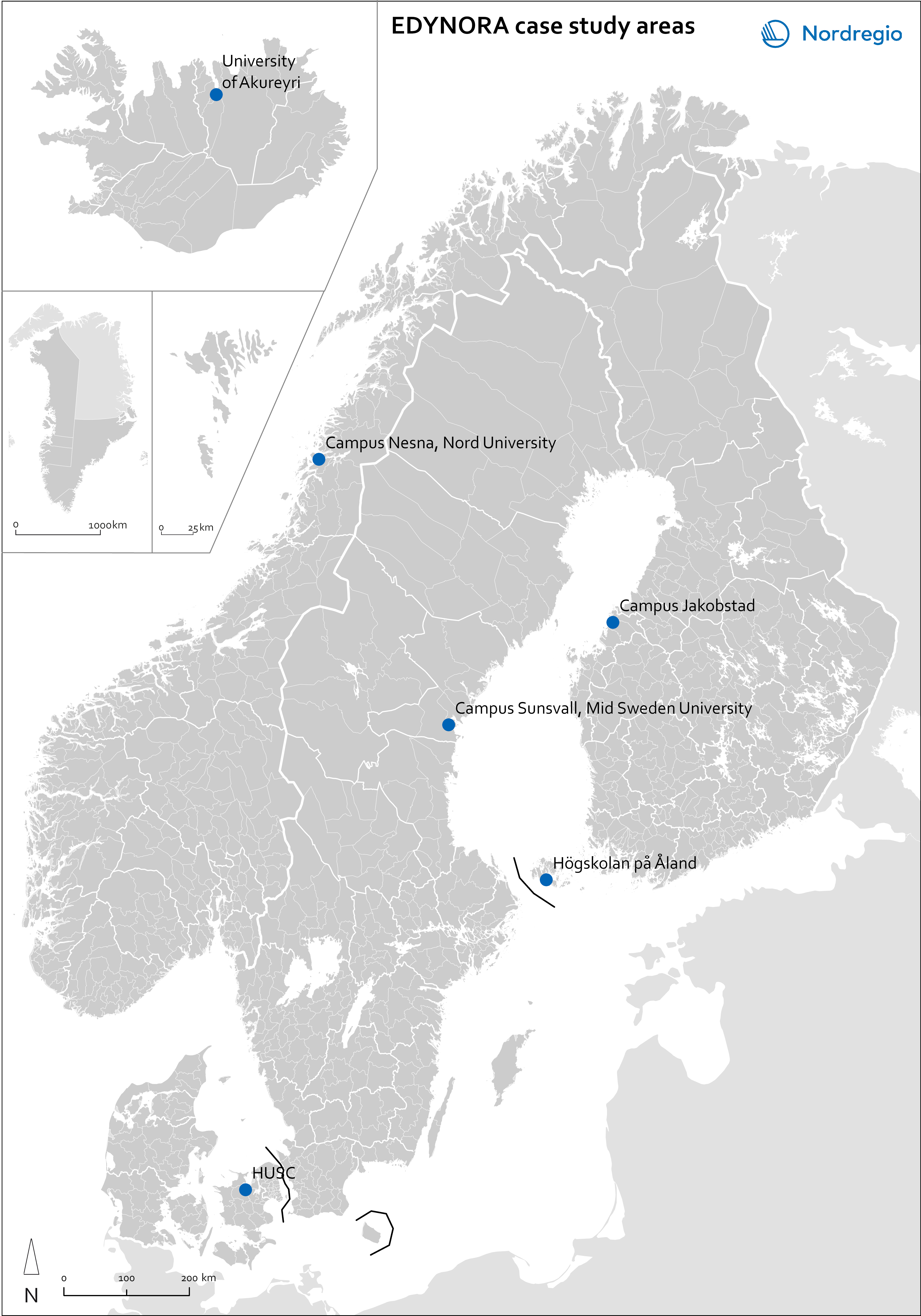
Map 1. The EDYNORA case study areas.
Cartographer: Maria Bobrinskaya
Cartographer: Maria Bobrinskaya
1.1 Exploring higher education outside major cities in the Nordics
There is no established term for higher education institutions outside major urban areas that is both acknowledged in academic literature and applicable across national contexts. This is partly due to the fact that concepts like institutional size and remoteness are relative — what is considered ‘large’ or ‘central’ in Denmark or Iceland may be seen as ‘mid-sized’ and ‘peripheral’ in Sweden. In this project we use the term ‘peripheral educational institutions’ (PHEIs) as an umbrella term encompassing the diverse array of higher education institutions and campuses situated in smaller cities and rural areas across the Nordics. This term is intended for analytical convenience, rather than as a proposal for a new academic concept.
In addition to the six case studies of PHEIs across the Nordic countries, this study draws on data collected through the EDYNORA Higher Education and VET Portal. The portal provides a visual and analytical overview of the diversity of campuses and independent institutions across the Nordic countries. It offers information on each campus’ or institution’s location (within municipal boundaries), the fields of education offered, and – where available – the number of students and year of establishment. Data are presented across different institutional types, classified according to the highest level of education provided at a given campus or institution (in the case of single-campus institutions).
The data for the portal were sourced primarily from institutional websites (e.g., “About Us” pages and annual reports), as well as statistical databases (the Vipunen database in Finland and the Database for Statistics on Higher Education (DBH) in Norway.
Based on the data collected, it is evident that the Nordic Region is home to a diverse and decentralised network of higher education institutions, spanning a variety of geographic locations and institutional types (see Map 2). The geographic distribution of higher educational institutions is especially evident in northern Norway and Denmark, with the compact geography of the latter further facilitating regional access.
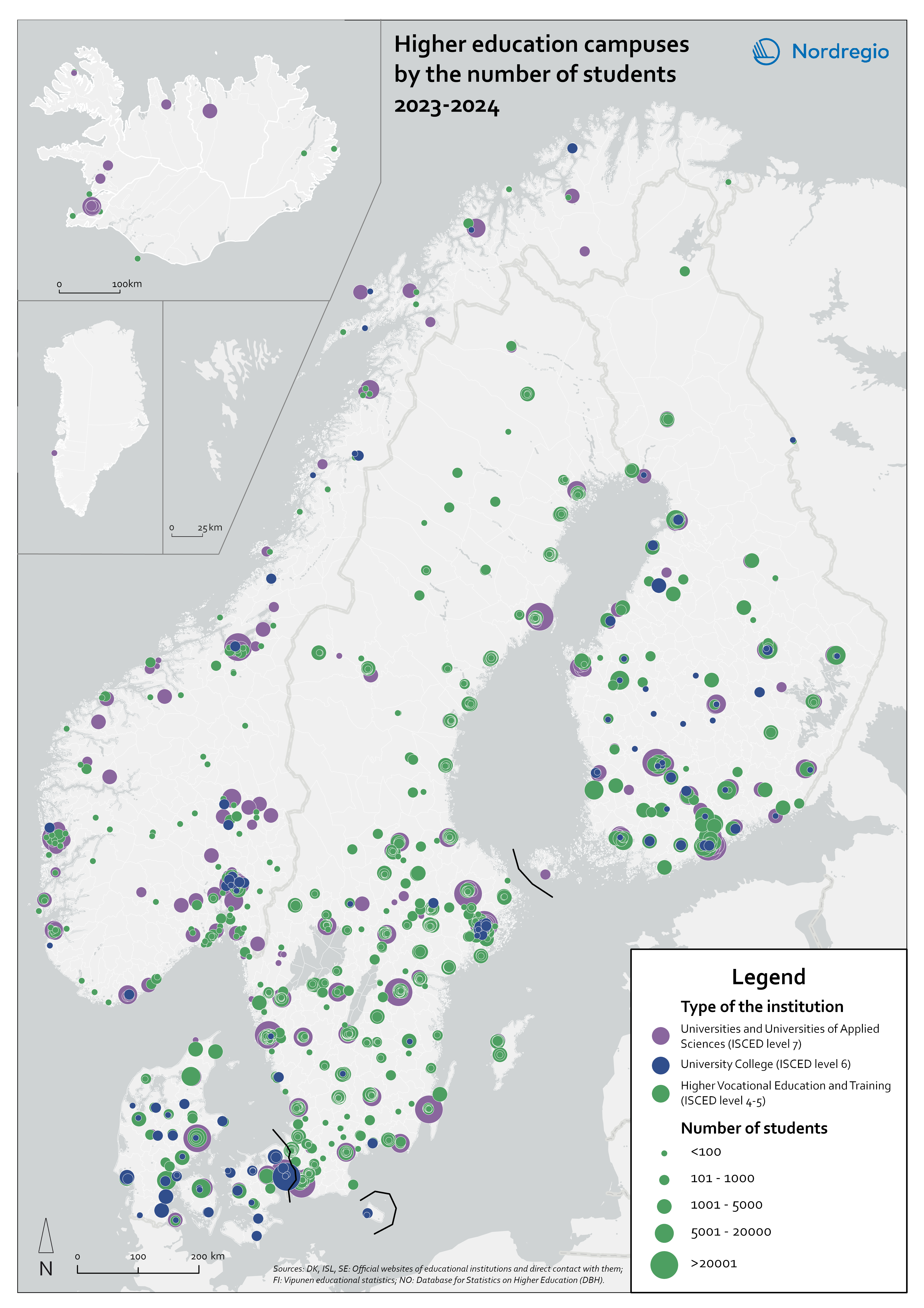
Map 2. Locations of higher education institutions and campuses by the number of students in the Nordic countries. Each dot on the map represents a single institution or campus, with separate dots shown for each campus in the case of multi-campus institutions.
Sources: DK, ISL, SE: Official websites of educational institutions and direct contact with them; FI: Vipunen educational statistics; NO: Database for Statistics on Higher Education (DBH).
Cartographer: Anna Vasilevskaya
Sources: DK, ISL, SE: Official websites of educational institutions and direct contact with them; FI: Vipunen educational statistics; NO: Database for Statistics on Higher Education (DBH).
Cartographer: Anna Vasilevskaya
While the largest campuses, typically located in metropolitan areas, can host over 50.000 students (e.g., Gothenburg), the student populations at PHEIs are often significantly smaller with some campuses enrolling fewer than 100 students. However, some universities, despite their geographic remoteness, host significant student populations – for example, Tromsø in Norway with approximately 11,000 students, and Umeå in Sweden with around 32,000. This may be attributed to several factors, including the strength of academic programmes offered, the relatively large catchment areas in northern regions, and the generally less competitive admission processes compared to universities in major urban centres in southern parts of the countries. Across all Nordic countries, approximately 29% of institutions (and their campuses) have fewer than 100 students, while only 1% have above 20,000 students (Table 1).
Student numbers at a campus or institution | Denmark | Finland | Iceland | Norway | Sweden | All Nordic |
<100 | 27 | 40 | 16 | 119 | 251 | 453 |
101-1,000 | 45 | 72 | 5 | 75 | 563 | 760 |
1,001-5,000 | 21 | 72 | 3 | 38 | 120 | 254 |
5,001-20,000 | 10 | 33 | 1 | 10 | 18 | 72 |
>20,001 | 3 | 3 | 0 | 3 | 8 | 17 |
Table 1. Distribution of higher education institutions in the Nordic countries by student population size. This table presents the number campuses or institutions in each Nordic country, grouped by student population size categories. It includes universities, universities of applied sciences, professional colleges, and higher VET.
The most common fields of education across all institutional types in the Nordic region are engineering and manufacturing; health and welfare; and business, administration and law. Country-specific variations in these distributions are shown in Table 2.
Top | Denmark | Finland | Iceland | Norway | Sweden | All Nordic |
1 | Education | Health and welfare | Arts and humanities | Health and welfare | Engineering, manufacturing and construction | Engineering, manufacturing and construction |
2 | Engineering, manufacturing and construction | Business, administration and law | Engineering, manufacturing and construction | Business, administration and law | Health and welfare | Health and welfare |
3 | Health and welfare | Arts and humanities | Business, administration and law | Education | Business, administration and law | Business, administration and law |
Table 2. The most common fields of education across universities, universities of applied sciences, professional colleges, and higher VET combined. For multi-campus institutions, each campus is counted separately. Fields of education are based on the International Standard Classification of Education (ISCED-F 2013) codes.