6. Cross-border vocational education and training
The border area between Innlandet in Norway and Dalarna in Sweden is currently facing labour shortages across a wide range of occupations, particularly in technical fields, healthcare and tourism. In addition, the area hosts an ageing population, with the number of working-age residents set to decrease by 2030.
In order to meet these challenges, the Innlandet–DalarnaDalarna cross-border committee is working to bring together Swedish and Norwegian educational actors, create new training courses, and coordinate efforts for a more integrated labour market.
Demography and skills supply
According to a study by Nordregio, the working-age populations of border municipalities in both Sweden and Norway will decline over the next ten years. Fewer people will therefore be available to do increasing amounts of work, necessitating greater efficiency and new forms of employment. At the same time, there is considerable untapped labour potential among immigrants, which could help fill skills gaps.
An example of a specific challenge facing border municipalities is the recruitment of snow technicians (persons responsible for production of snow) and piste machine operators – specialised professions that face growing skills gaps due to impending retirements. Another is the recruitment of restaurant staff and chefs to meet growing tourism needs. Several companies and municipalities are calling for more coordinated efforts to meet these skills shortcomings, prompting the cross-border committee to address the issue in a systematic way.
Expert study on cross-border training
The cross-border committee conducted a study investigating opportunities for making better use of the two countries’ education systems across the border area. The study concluded that there are no legal barriers to a Norwegian or Swedish citizen studying on the other side of the border, and that an active exchange between the two countries could provide important educational opportunities for the region’s young people.
Doing so, however, requires that the relevant programmes be sufficiently attractive to students, as well as widely known among the target populations. Thus far, this has proved to be a challenge. For example, restaurant and cooking courses in the tourism-heavy municipalities of Trysil and Malung-Sälen had to be closed down due to too few students signing up.
Cooperation between education and training actors
In 2023, the cross-border committee organised several workshops in which Swedish and Norwegian education providers, municipalities and business representatives discussed solutions to skills supply shortages. It became clear that neither country’s actors had much awareness of the education system and training opportunities on the other side of the border. As a result, participants highlighted the need for a mapping exercise. This in turn led to the idea of creating a cross-border career centre based on a model from Innlandet, with guidance focused on the border region’s specific needs.
Moreover, greater flexibility is needed in order to make the education system more relevant to the labour market. Given that seasonal work is especially common in tourism and hospitality, it would make sense to design more courses allowing students to work and study at the same time. In addition, ensuring educational opportunities are open to students across the border means a broader range of skills training will be available to young people.
One initiative that has been prioritised is establishing a new vocational cross-border education for operating staff at winter destinations, such as Sälen, Idre and Trysil. This training would cover the technical skills required to operate, among other facilities, lifts, snow groomers and snow cannons. Many current employees are approaching retirement, meaning these areas have a pressing need for trained staff.
Results
As touched on above, the cross-border committee’s work has yielded a number of concrete results. Specifically:
- A variety of training actors from Sweden and Norway have been brought together and several cross-border initiatives launched. Funds have been secured to establish a cross-border forum to plan, coordinate, and market educational offers across borders.
- Karriere Innlandet and Torsby municipalities have applied for an Interreg project to map vocational education facilities in the border area, as well as develop proposals for a cross-border career centre.
- In collaboration with industry and ‘Prosjekt Fagskole i Sør-Østerdal’, the cross-border committee is exploring the establishment of new Nordic vocational eduction program for operating staff in mountain destinations.
More generally, the demographic challenges faced by border region communities has been discussed in various meetings with municipal authorities.
The following film demonstrates several opportunities for solving skills shortages through cross-border cooperation: https://f.io/M9YAJsTp.
Ultimately, the cross-border committee’s work on skills supply relies on a structured, long-term approach based around knowledge building and the careful assembly of an inventory of needs.
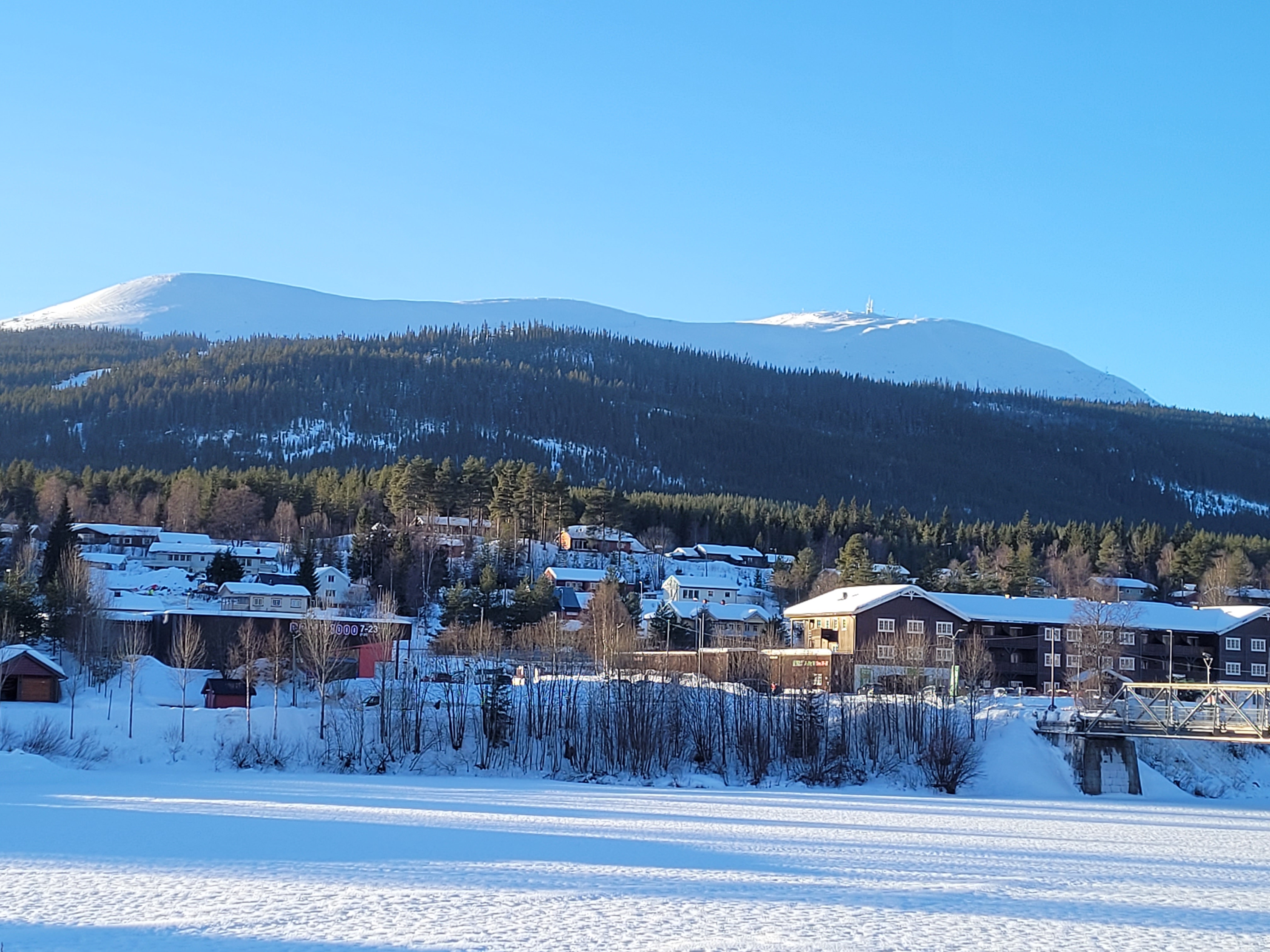
Snowy mountains, Trysil
Photo: Trysil municipality
Photo: Trysil municipality