5. Cross-border transport and strategic infrastructure development in the Kvarken region
The Kvarken Council
The Kvarken Council is a European Grouping for Territorial Cooperation (EGTC) – the first fully Nordic one of its kind. As a legal entity under EU legislation, headquartered in Vaasa (Finland) with an office unit in Umeå (Sweden), the organization combines legal mandate with democratic decision-making to enable effective cross-border cooperation.
Area of operation and mission
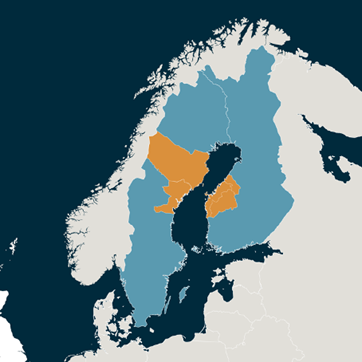
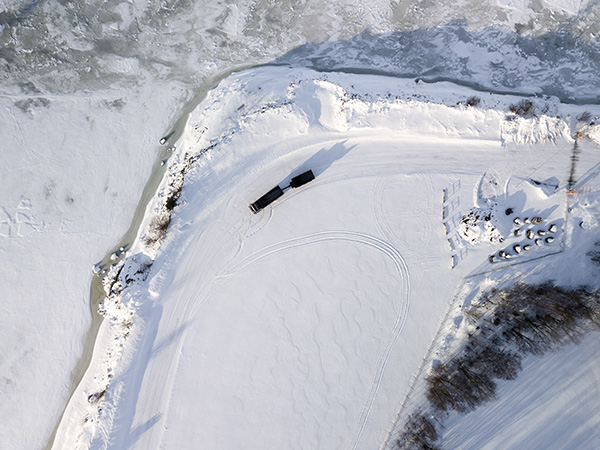
The Kvarken Council covers three Ostrobothnian counties in Finland and the regions of Västerbotten and Västernorrland in Sweden. Together they form the Kvarken region. The region is characterized by a long history of cooperation across the Bothnian Bay, where the narrowest part, the Kvarken Strait, is about 80 km wide between Vaasa and Umeå, but only 25 km between the outermost islands, Replot and Holmön. Historically, the Kvarken acted as a natural connection point via both ice roads and maritime routes. For over 50 years, the Kvarken Council has served as a neutral platform and enabler for cross-border cooperation. The organisation actively works to improve infrastructure, support economic growth and cultural exchange, and reduce cross-border obstacles between Finland and Sweden. The region has a strong industrial base in areas such as energy, technology, and the food industry, with a combined population of nearly one million inhabitants.
From Midway Alignment to Nordic Connector: Strategic transport projects in the Kvarken Region
The Kvarken Council has a strong track record of developing cross-border transport solutions for the Kvarken region, with the Midway Alignment project series showcasing how structured governance, strategic funding, and regional cooperation can enable major infrastructure investments. Building on this experience, the Nordic Connector initiative — which seeks to establish a fixed transport link across the Kvarken Strait, thereby strengthening regional ties and benefiting a wider area — is also supported by a series of projects. In autumn 2025, the FLINC project, funded by Interreg Aurora, will support the Nordic Connector initiative by exploring funding opportunities and assessing the wider impacts of improved cross-border infrastructure. The findings are intended to serve as a model for other border regions planning large-scale cross-border transport investments.
Midway Alignment and Aurora Botnia: A cross-border transport innovation
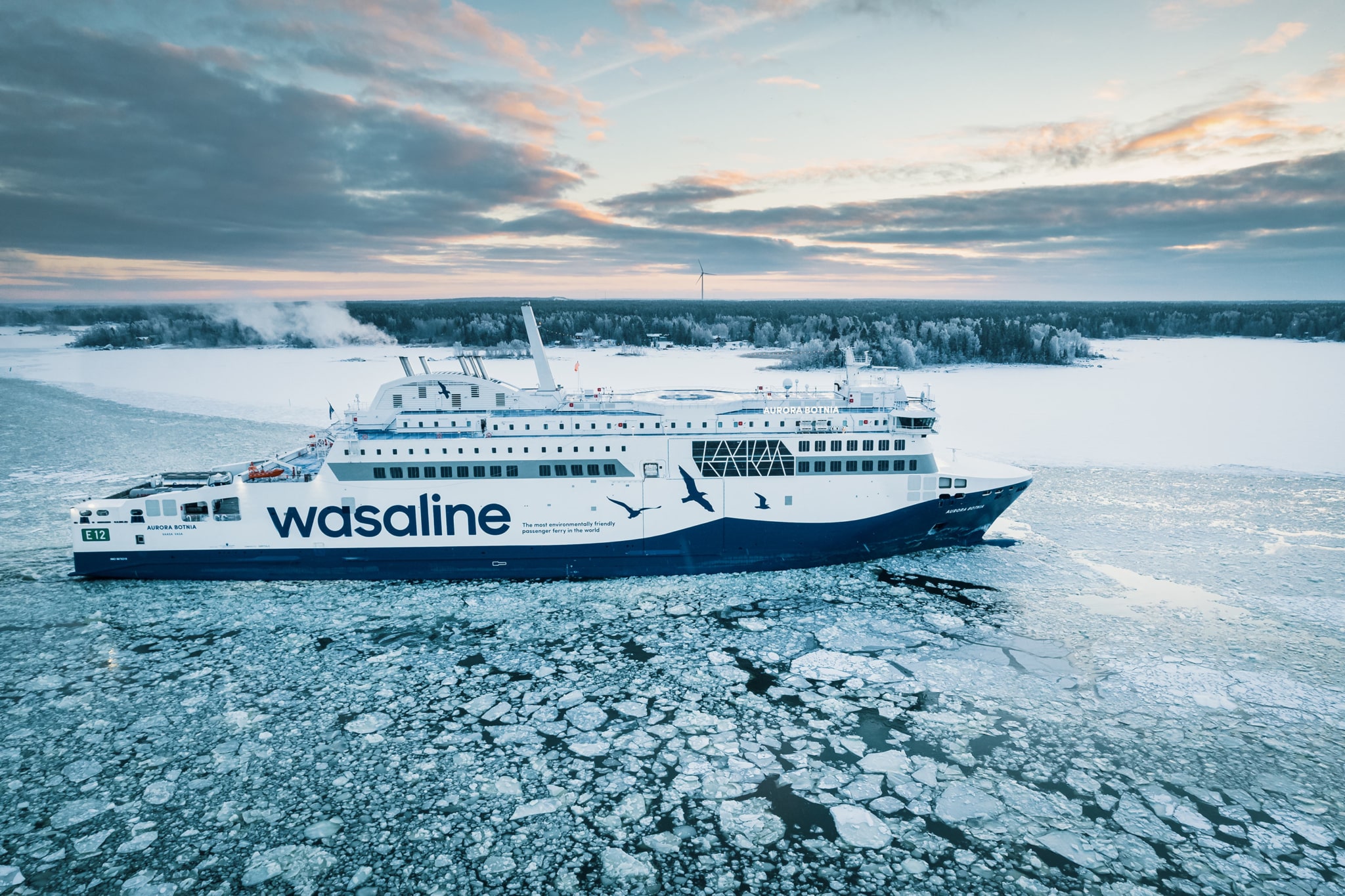
Midway Alignment is a key cross-border cooperation project that resulted in the development of the environmentally friendly Aurora Botnia ferry. When the previous ferry operator withdrew from the route between Vaasa (Finland) and Umeå (Sweden), local and regional authorities acted to maintain this crucial transport link.
The project series consisted of several projects that ultimately led to a concrete outcome – the acquisition of a new vessel, which is essential for maintaining cooperation between the two countries. To make this possible, the municipalities of Vaasa and Umeå established Kvarken Link, a jointly owned company through which they operate Wasaline (the ferry route between the two). Ownership of Kvarken Link is split equally between the City of Vaasa and Umeå Kommunföretag AB, a company fully owned by Umeå municipality. This solution ensured long-term political commitment to the route, as well as its financial sustainability.
The project was backed by extensive feasibility studies and economic assessments, ensuring data-driven decision-making. As a result, Aurora Botnia – the world’s most environmentally friendly passenger and cargo ferry, running on a combination of liquefied natural gas and battery power – was built. According to a recent press release, Wasaline has become the first carbon‑neutral shipping company in the Baltic Sea, achieving a climate goal set for 2030 ahead of schedule — and its Aurora Botnia route is now the first operational international green shipping corridor.
The collaborative governance model used by Midway Alignment and Aurora Botnia has attracted national- and EU-level attention as a showcase for how municipalities, regions and stakeholders can work across borders to secure critical infrastructure and achieve tangible results. The Midway Alignment project series – financed by, among other sources, the Motorways of the Sea programme under the Connecting Europe Facility (CEF ) and the Interreg Botnia-Atlantica programme – has strengthened the entire region’s connectivity and economic resilience, ensuring sustainable transport remains a central part of regional development. Crucially, the Midway Alignment/Aurora Botnia project has set a precedent for how long-term cooperation, strategic funding, and joint decision-making can lead to impactful infrastructure investments that benefit both national and local economies.
Beyond securing the continuity of ferry operations, Aurora Botnia has strengthened trade links, boosted tourism opportunities, and enhanced regional business competitiveness by providing a reliable, sustainable transport connection. The project has also provided environmental benefits through reducing emissions and serving as a model for green maritime innovation. In doing so, it aligns with national and EU climate objectives.
In addition, Aurora Botnia functions as a floating laboratory for regional technology companies, facilitating the development of sustainable maritime transport innovations. Finally, improved connectivity has reinforced cross-border labour mobility and access to services, benefiting communities on both sides of the Kvarken Strait.
The Kvarken Council has served as the coordinating body behind both the Midway Alignment and the Nordic Connector initiatives, facilitating cooperation between local, regional and national actors, and securing EU-level support.
This success laid the foundation for exploring a more permanent cross-border solution.
Nordic Connector: A vision for cross-border infrastructure
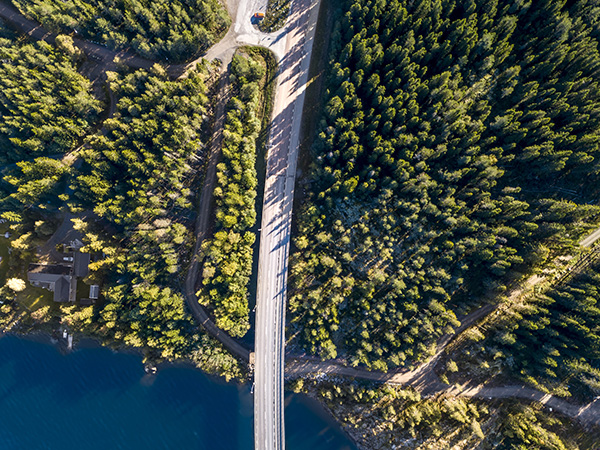
Nordic Connector represents the next phase of developing cross-border transport infrastructure in the Kvarken region. Like the earlier Midway Alignment, it will consist of a series of projects that gradually advance the decision-making process. Towards this end, the project aims to enhance long-term accessibility between Finland and Sweden, while also integrating concurrent energy, digital connectivity and economic development strategies.
A fixed connection would fundamentally reshape connectivity not only in the Kvarken region but across northern Europe. Establishing a permanent corridor between the two countries would significantly boost trade and investment opportunities, as well as strengthen supply line security on a broader scale. Although primarily planned for civilian and economic purposes, the initiative could also enhance regional resilience during times of crisis by ensuring critical infrastructure remains functional.
More generally, the project aligns with European green transport corridor discussions, helping ensure the Kvarken region remains competitive in terms of sustainable infrastructure planning, while also contributing to strategic preparedness and supporting cross-border business conditions.
Cross-border governance and policy innovation
These projects illustrate the role played by political innovation in overcoming cross-border challenges, with Kvarken Council’s governance model demonstrating how municipalities and regional authorities can achieve impactful results beyond national structures.
Both Midway Alignment and Nordic Connector point to the importance of structured, long-term cooperation based on data-driven decision-making, strategic planning and strong partnerships. They also highlight how regional transport can act as a catalyst for wider policy change, influencing infrastructure planning at a national and even European level.
In addition to these infrastructure projects, Kvarken Council has contributed to the Political Innovation Handbook, developed alongside Nordic cross-border organisations STRING and Mälardalsrådet. This initiative compiles governance and regional cooperation best practices, providing inspiration and guidance for decision-makers across the Nordics. Throughout, the Handbook emphasises that structured governance, long-term commitment and evidence-based policymaking are crucial for enhanced cross-border collaboration.
Lessons learned and policy impact
Kvarken Council gained a number of valuable insights into successful cross-border collaboration during implementation of the Regional Cooperation Programme 2021–2024. In particular:
- formalising governance structures enhances long-term cooperation;
- inclusive engagement and multi-level governance create broad ownership and political commitment;
- evidence-based advocacy helps integrate cross-border perspectives into national and EU strategies; and
- trust and personal networks are crucial for efficient decision-making and problem-solving.
Kvarken region’s approach to cross-border cooperation offers a replicable model for other Nordic regions facing similar infrastructural and administrative challenges. Through integrating the lessons from infrastructure projects into broader governance discussions – such as in the Political Innovation Handbook – Kvarken Council has helped strengthen cross-border collaboration at the regional, national and European levels.
Applying lessons to future policy development
Moving forward, Kvarken Council aims to strengthen its role as a policy adviser. As part of this, the council will continue testing and scaling governance models transferable to other Nordic cross-border regions. By fostering structured collaboration, evidence-based policymaking and long-term strategic planning, Kvarken Council offers proof that administrative boundaries need not hinder development.