10. The Moss–Karlstad Union Trails
The Moss–Karlstad Union Trail (Unionsleden) is a 350 km cycle route that runs from Norway to Sweden, starting in Moss (where the union between Norway and Sweden was established in 1814) and finishing in Karlstad (where the union was dissolved in 1905).
For further information about the Union Trail, see www.unionsleden.com.
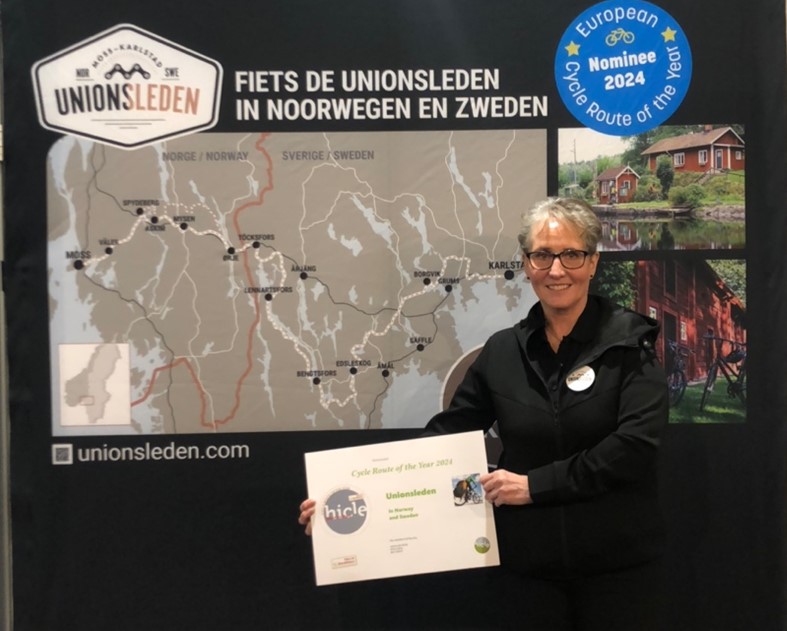
In total, the route – which in 2024 was nominated for the Newcomer of the Year in Europe award at the Fiets en Wandelboers cycling fair in Utrecht –passes through 11 municipalities, crossing the national border at Ørje/Töcksfors. The main coordinator for the route is the Värmland–Østfold Border Committee.
The route was developed over a ten-year period (2013–2023). Initially, it received funding as a preliminary project from the members of the border committee, before Interreg Sweden/Norway stepped in to fund the main project.
In 2024, the route was estimated to have resulted in Euro 2.7 million of added value creation. It now features in sales catalogues for cycling tourism in the Netherlands and in Scandinavia, with visitor numbers increasing every year. With this in mind, the current goal is to increase the value added figure to more than Euro 8.4 million per season.
The success of the Unionsleden brand offers a multitude of marketing opportunities for local businesses and communities – for instance, in promoting bicycle-friendly accommodation. It has also encouraged cross-border collaboration, with visitor organisations in Sweden and Norway working together to market the route. One concrete outcome has been a gravel race for competitive cyclists called the ‘Unonsrittet’.
More generally, the cycle route led to a renewed focus on public transport connections across and along the national border, particularly in terms of bicycle and bus/train combinations.
The Union Trail project now is being followed up by the 2024–2027 Interreg-funded Cross Border Biking project. This new project, which encompasses the entire central Scandinavian border area of Norway/Sweden, involves several cycling routes working together to make inroads into the European market – both in terms of cycling in general and gravel cycling more specifically.