the Nordic labour market from a labour force perspective
the Nordic labour market from a labour force perspective
Introduction
Seen from an international perspective, the Nordic labour market has several distinctive features. One of the most prominent is high employment, both as a central policy objective and as a core element of the Nordic welfare model (Alsos & Dølvik, 2021). Although the financial crisis of 2008 and the COVID-19 pandemic in 2021 left clear marks on the Nordic economies, the labour markets proved resilient and recovered through active policy measures (Jokinen & Norlén, 2022; Flam & Nordström Skans, 2022).
Other key features include an innovative and dynamic business sector, high levels of education, a large public sector providing welfare services, and generally high standards of living. The Nordic labour market model is also characterised by comparatively high levels of trade union membership (ranging from 52 to 84 % depending on the country) and by the strong commitment of the social partners (trade unions, employers and governments) in the labour market (Lundgren et al., 2024). The model has been widely recognised for its ability to facilitate structural change through a combination of stability and flexibility (Alsos & Dølvik, 2021; Rolandsson & Ilsöe, 2023).
However, the Nordic labour market also faces challenges related to demographic and technological change. While historically increasing the number of women in work has been a key driver of rising rates of employment, working at higher ages has recently become more important as retirement ages have been postponed in several Nordic countries. Technological change affects labour markets overall, but its impacts vary across regions and municipalities – a pattern that is also reflected in labour market outcomes at regional and local levels.
Good labour market conditions are crucial for local and regional development. This chapter examines the Nordic labour force, which consists of individuals who are either employed or unemployed. Those of working age who are neither employed nor unemployed are classified as outside the labour force (see Box 5.1).
The chapter uses a spatial perspective to analyse how employment, unemployment and the share of people outside the labour force vary across regions and municipalities in the Nordic Region. Together, these dimensions provide a baseline overview of labour-market outcomes, on which subsequent chapters build.
Box 5.1: Labour market statistics: Definitions and calculations
Employment data in the Nordic countries are available from two main sources: the Labour Force Survey (LFS) and register-based data.
Register-based data are available at the municipal level for all Nordic countries. These data are subject to delays of up to two years and are not fully comparable between countries.
LFS data are based on monthly surveys conducted by the National Statistical Institutes (NSIs). The surveys follow guidelines set by the International Labour Organization (ILO), which ensures cross-country comparability. In the official statistics, LFS covers the working-age population aged 15–74. In this chapter, the data have been harmonised to the 20–64 age group, to focus on the core working-age population.
Definitions of employed, unemployed and outside of labour force
An employed person is someone who worked for at least one hour during the reference week, or who was temporarily absent from a job they hold. An unemployed person is someone who was not employed during the reference week but is currently available for work (within two weeks), is actively seeking work (within four weeks), or has a job that will start within three months. A person outside of labour force is neither employed nor unemployed according to these definitions (Eurostat, n.d.). Employment and outside-of-labour-force rates are calculated as shares of the population aged 20–64, whereas unemployment rates are calculated as shares of the labour force (employed + unemployed) within the same age group.
An employed person is someone who worked for at least one hour during the reference week, or who was temporarily absent from a job they hold. An unemployed person is someone who was not employed during the reference week but is currently available for work (within two weeks), is actively seeking work (within four weeks), or has a job that will start within three months. A person outside of labour force is neither employed nor unemployed according to these definitions (Eurostat, n.d.). Employment and outside-of-labour-force rates are calculated as shares of the population aged 20–64, whereas unemployment rates are calculated as shares of the labour force (employed + unemployed) within the same age group.
The analysis uses register-based data to calculate the distribution of employment and unemployment within each municipality. These distributions have been harmonised to align the national totals with internationally comparable LFS figures. As a result, some margin of error may occur, particularly in very small municipalities (for example in Iceland).
Unless otherwise stated, the Nordic average is based on aggregated figures for the Nordic region as a whole. The EU average is based on data from Eurostat.

Employment
Over the last two decades, the employment rate (ages 20–64) has increased in all of the Nordic countries. On average, employment in the Nordic Region rose from 78.5% in 2005 to 81% in 2025.
The EU27 saw a larger increase over the same period, rising from 66.8% to 76.2%. This reflects a degree of convergence in employment levels between the Nordic countries and the EU, although the Nordic countries continue to record substantially higher overall employment rates.
Due to lack of data, the Nordic average includes Denmark, Finland, Iceland, Norway and Sweden.
Figure 5.1 shows that the downturn following the 2008 financial crisis was broadly similar across the Nordic Region. While employment levels recovered across all countries, the pace of recovery varied, reflecting differences in economic structures and labour-market institutions.
Figure 5.1: Employment rate in the Nordic countries, 2005-2025 (Q2). Source: Nordregio calculations based on data from Nordic Statistics database and Eurostat (LFS). The Nordic average is calculated as the average of national employment rates in Denmark, Finland, Iceland, Norway and Sweden. Lack of data for the Faroe Islands 2025, and Greenland and Åland in 2024 and 2025. The definition of employment changed in Greenland between 2015 and 2016. Consequently, values pre-2016 cannot be compared to later values (for Greenland). |
The downturn caused by the COVID-19 pandemic was sharper in some countries than others, with Åland and Iceland particularly strongly affected by the collapse in travel and transport-related activities. The subsequent recovery of employment levels illustrates that the furlough schemes and other temporary labour-market measures were effective in mitigating negative impacts (Jokinen & Norlén 2022; Flam & Nordström Skans, 2022). Overall, these developments indicate that the Nordic labour market is both stable and resilient, with consistently high levels of employment.
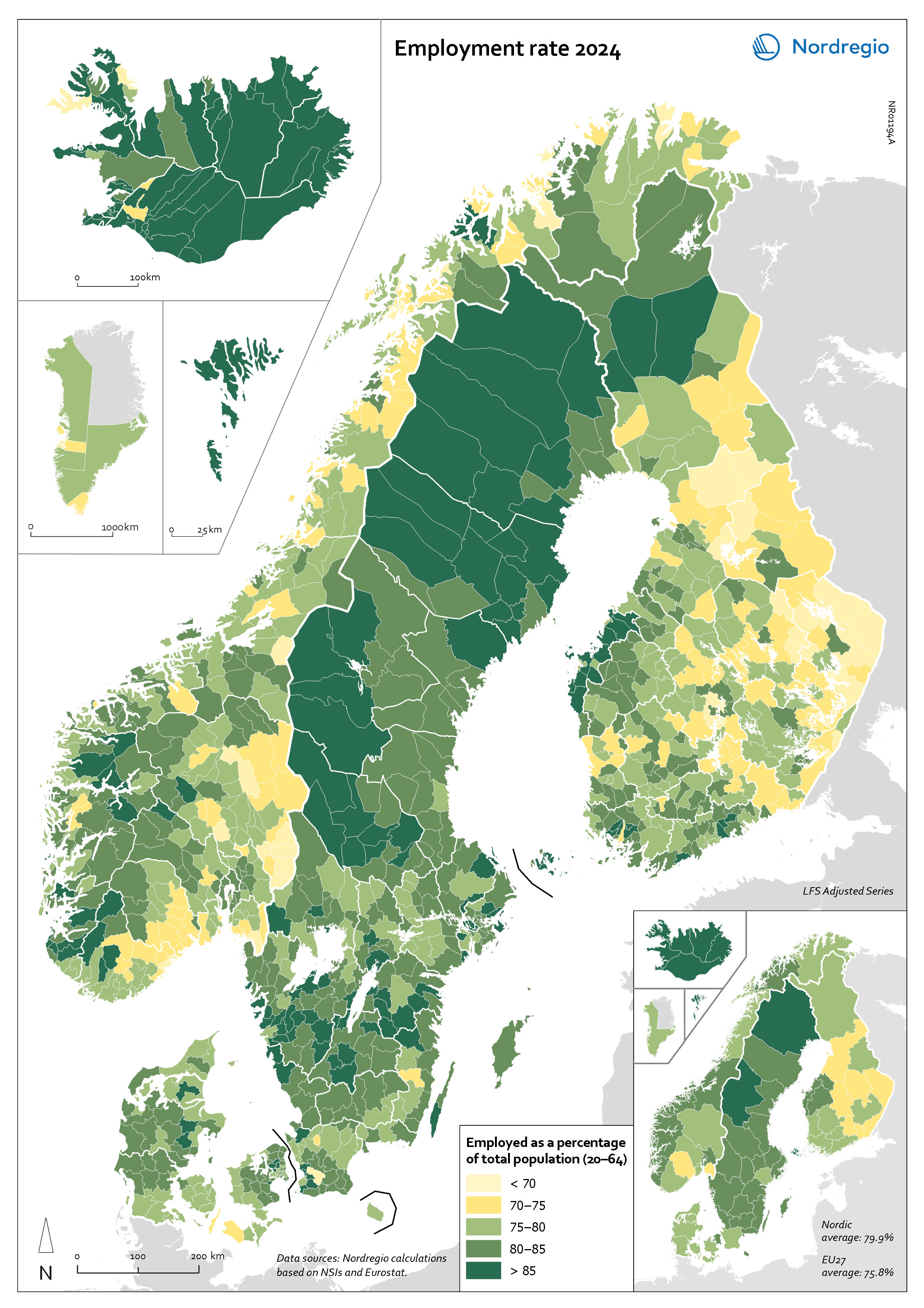
Map 5.1: Employment rate, 2024. Source: Nordregio calculations based on data from National Statistical Institutes (NSIs) and Eurostat. Labour Force Survey (LFS) adjusted series. Nordic average: 79.9% EU27 average: 75.8% |
See and download map in |
However, a closer look at the municipalities and regions reveals substantial spatial variation (2024 data). The highest employment rates are found in the Faroe Islands, Iceland and Åland, as well as in the northern parts of Sweden, where employment growth can partly be linked to investments associated with the green transition. By contrast, the lowest employment rates (below the EU average of 75,8%) are primarly concentrated in eastern and central Finland. One defining feature of the Nordic labour market is the high employment rate among women. As shown in Table 5.1, female employment rates range from 76.6% in Finland to 90.7% in the Faroe Islands, well above the EU average of 70.8% in 2024.
Country | Men | Women | Employment gap (pp) |
Denmark | 83.4 | 76.9 | -6.5 |
Finland | 77.3 | 76.6 | -0.7 |
Iceland | 90.2 | 83.4 | -6.8 |
Norway | 82.5 | 77.4 | -5.1 |
Sweden | 83.9 | 79.9 | -4.0 |
Faroe Islands* | 91.5 | 90.7 | -0.8 |
Greenland** | 76.9 | 77.3 | 0.4 |
Åland*** | 81.7 | 82.9 | 1.2 |
Nordic Region**** | 84.4 | 81.1 | -3.3 |
EU | 80.8 | 70.8 | -10.0 |
Table 5.1: National employment rates 2024: Men and women 20-64 years. Source: Nordic Statistics database. * The Faroe Islands: Displays values for the 15–64 age group. ** Greenland: 2023 data due to lack of 2024 data. Displays values for the 20–65 age group. *** Åland: 2023 data due to lack of 2024 data. **** Nordic Region: Average of all Nordic countries/territories, except Greenland. |
The high levels of female employment reflect strong social protection policies, including generous parental leave and subsidised childcare. At the same time, Nordic labour markets remain highly gender-segregated. Many female-dominated occupations are undervalued relative to male-dominated occupations with similar educational requirements. Despite equality being a core Nordic value and the existence of legislation aimed at addressing pay inequality, the gender pay gap
ranged from 9.8% in Iceland to 16.8% in Finland. It remained above the EU average of 12% in both Norway and Denmark (Eurostat, 2025).
Measured as the difference between average gross hourly earnings of male and female employees as a percentage of male gross earnings.
While unemployment rates among immigrants are often higher than for the native-born population, employment rates among migrants increased during the period 2014–2024, particularly among migrants from non-EU countries. This trend is most pronounced in Denmark, Finland and Sweden, while the highest employment rate among non-EU migrants was recorded in Iceland (83.2%) (Nordic Statistics database, 2025b). In an international comparison, internal migration is relatively high in the Nordic countries, although there is substantial variation across countries and regions (Sánchez Gassen & Stjernberg, 2024).
Beyond the core working-age population, several additional features of the Nordic employment stand out. One is the early integration of young people (ages 15–19) into the labour market, with employment rates ranging from 25.7% in Sweden to 69.8% in the Faroe Islands, compared to 16% in the EU (Nordic Statistics database, 2025c). Another, more recent characteristic is the tendency for people in the Nordic Region to stay in work until they are older (see Box 5.2), which also contributes to high overall employment levels.
Taken together, high employment rates are indicative of the Nordic economies’ strong labour demand and broad capacity to absorb labour. However, high employment at the national level coexists with persistent pockets of unemployment at the regional and local levels, which points to continued mismatches within Nordic labour markets.
Box 5.2: Employment at older ages
The pension system is a central element of the Nordic welfare model. However, the Nordic countries vary in terms of statutory retirement ages, effective labour market exit ages and pension system designs, and these differences shape labour market participation rates at older ages in distinct ways. Pension system design also influences how countries address challenges related to ageing populations, rising dependency ratios and long-term labour supply.
In recent years, most Nordic countries have undertaken pension reforms aimed at extending working lives. One key measure has been to link the statutory retirement age to life expectancy – a reform that has already been implemented in Sweden, Denmark and Finland, and is scheduled for introduction in Norway in 2026 (Andersen, 2023; Diermeier et al., 2024).
In parallel with this development, employment rates among older age groups have increased across the Nordic Region. Over the past two decades, employment rates among people aged 55–64 have risen by almost 20 percentage points in Finland, 15 percentage points in Denmark, and approximately 10 percentage points in Greenland, Åland, Norway and Sweden. In 2024, employment rates in this age group ranged from 72% in Finland to 90% in the Faroe Islands, compared to an EU average of 65%. The increased labour participation of older people has therefore made a substantial contribution to the overall high employment levels observed in the Nordic economies.
Beyond the core working-age population (20–64), all of the Nordic countries except Iceland have also seen a marked increase in employment among those aged 65–69. Since 2005, employment rates in this age group have more than doubled for both men and women. In 2024, female employment rates exceeded 20% in all Nordic countries except Finland. Among men, employment rates were above 40% in Denmark and Norway and reached 34% in Sweden. This compares with the EU averages of 20% for men and 13% for women in the same age group (Nordic Statistics database, 2025c).
In addition to pension reforms, favourable labour-market conditions and sustained economic growth have supported longer working lives. In addition, recent research suggests that digitalisation, along with the expansion of remote and flexible working arrangements following the COVID-19 pandemic, may have contributed to retirement being postponed in certain occupations (Komp-Leukkunen, 2024).
Despite common trends, differences remain in retirement behaviour across the Nordic countries. The statutory retirement age for accessing minimum pension benefits in the age-group currently retiring is 67 in Denmark, Iceland and Norway, 66 in Sweden, and 65 in Finland. However, early retirement schemes exist in all five countries. In Norway and Iceland, the gap between the effective retirement age and the labour-market exit age exceeds two years, which indicates that many individuals continue to work after drawing a pension. In Denmark, Finland and Sweden, this gap is closer to six months, which reflects a more abrupt transition from the labour market (Diermeier et al., 2024).

Unemployment
While employment rates provide a broad picture of labour-market inclusion, unemployment rates capture frictions between labour supply and demand across the Nordic Region. Unemployment not only reflects the absence of employment, but also highlights mismatches between skills and jobs, job-search dynamics, and the role of institutional settings and labour-market policies. In high-employment labour markets such as the Nordic ones, unemployment therefore provides complementary insight into how efficiently labour markets function.
Among the Nordic countries, Finland and Sweden stand out due to relatively high unemployment levels in the 20–64 age group. In both countries, most of the regions exceed the Nordic unemployment average of 4.5%, while the Faroe Islands records by far the lowest unemployment rate (1.5%). This contrast underscores the importance of national labour-market contexts in shaping unemployment outcomes.
In terms of the gender perspective, unemployment rates are generally higher among men than women in most of the Nordic countries and territories. In 2024, male unemployment rates exceeded female unemployment in all the Nordic countries except Denmark and Sweden, with the largest gender gap observed in Finland (8.7% for men compared to 6.7% for women). This pattern contrasts with the EU average and reflects differences in sectoral employment structures and gender segregation in the labour market.
Unemployment is particularly pronounced among young people. In all of the Nordic countries except the Faroe Islands, the unemployment rate among those aged 20–24 is about twice as high as the national unemployment rate for the 20–64 age group. In 2024, the highest levels of youth unemployment were seen in Sweden (16.3%) and Finland (14.5%), both of which exceeded the EU average of 13%. In all of the Nordic countries except Iceland, unemployment rates among young men were higher than among young women, which indicates gendered entry barriers into the labour market.
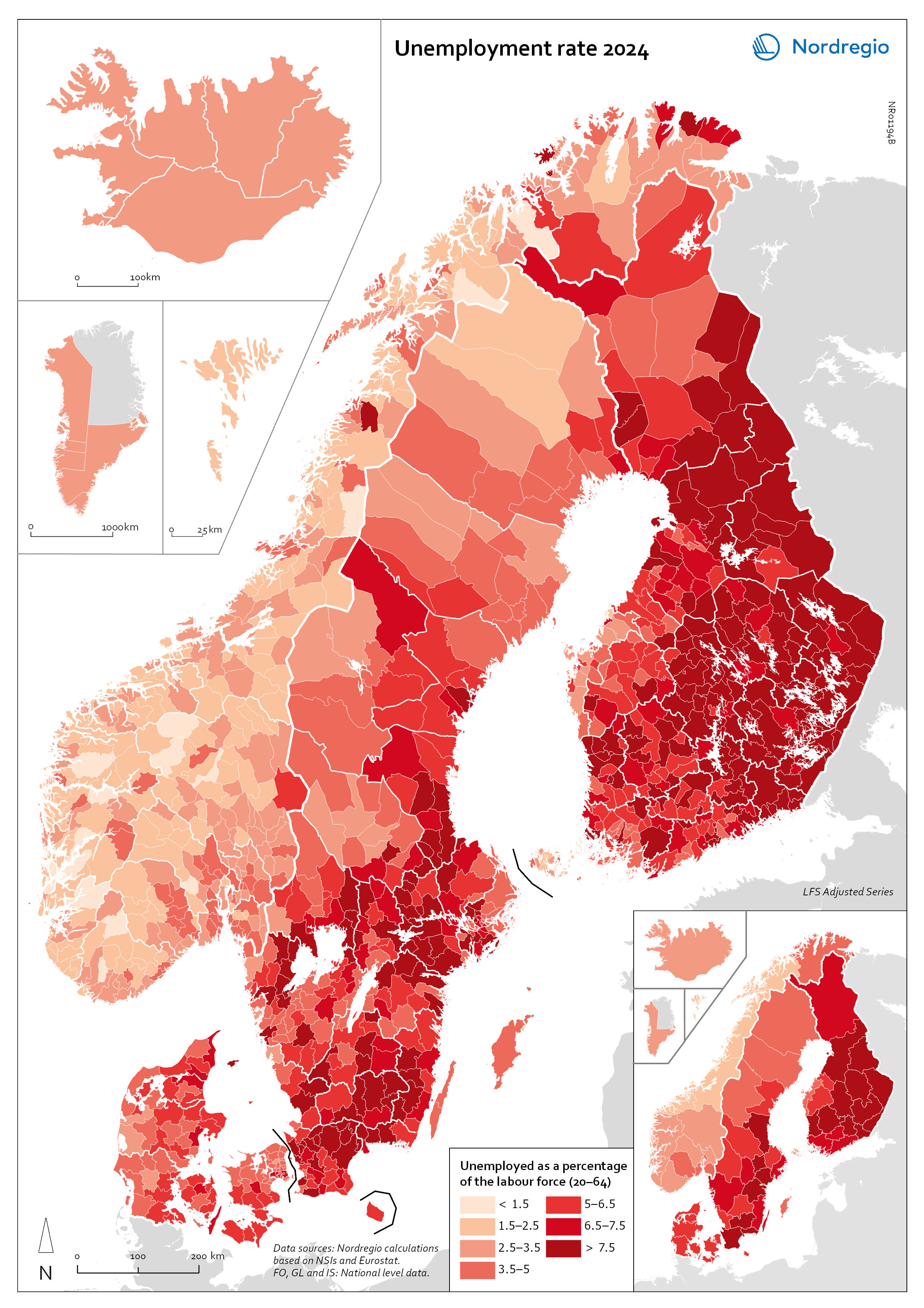
Map 5.2: Unemployment rate (20-64), 2024. Source: Nordregio calculations based on data from National Statistical Institutes (NSIs) and Eurostat. Labour Force Survey (LFS) adjusted series. National level data for the Faroe Islands, Greeland and Iceland. |
See and download map in |
The territorial perspective (Map 5.2) reveals substantial regional and local variation within the Nordic Region. Similar to the Faroe Islands, most Norwegian regions exhibit very low unemployment rates, in particular Troms (2.0% ), Nordland (2.4% ), Trøndelag (2.5% ) and Møre og Romsdal (2.5%). The figure for Iceland and Greenland is 3% and 3.1% respectively. By contrast, the highest unemployment rates are concentrated in Finland, such as North Karelia (10.7%), Kymenlaakso (9.9%) ,Päijät-Häme (9.8%) and South Karelia (9.7%), and in Sweden, including Sörmland (9.7%), Skåne (9.6%), Västmanland (8.9%) and Gävleborg (8.9%).
Despite these regional and local differences, national patterns remain the most salient feature of unemployment across the Nordic Region. This suggests that institutional factors at the national level play a key role. While all countries operate dual labour-market systems that combine income support with active labour-market measures (e.g., training, reskilling and upskilling), these systems vary considerably in terms of their design, generosity and targeting. As such, differences in labour-market institutions, activation policies and measurement practices may contribute to the observed cross-country variation in unemployment rates (Forslund, 2025).
Outside the labour force
Beyond employment and unemployment, labour force participation is also shaped by the proportion of the population outside the labour force, which consists of persons neither employed nor actively seeking work and therefore not captured in unemployment statistics.
People may be outside the labour force for a variety of reasons. Figure 5.2 presents the main categories in the five Nordic countries for which data is available, alongside the EU. Across the Nordic countries, the two most common reasons are own illness or disability, and education or training. The share of people outside the labour force due to own illness or disability is higher in the Nordic countries than the EU average, particularly in Iceland (48.6%) and Norway (46%). By contrast, the share of people outside the labour force due to family/caring responsibilities is lower than in the EU, which reflects strong social protection policies and high gender equality.
Figure 5.2: Population aged 15-64 outside the labour market by country and reason, 2023. Source: Nordic Statistics database, 2025a. No data was available for Greenland and the Faroe Islands. Finland includes Åland. |
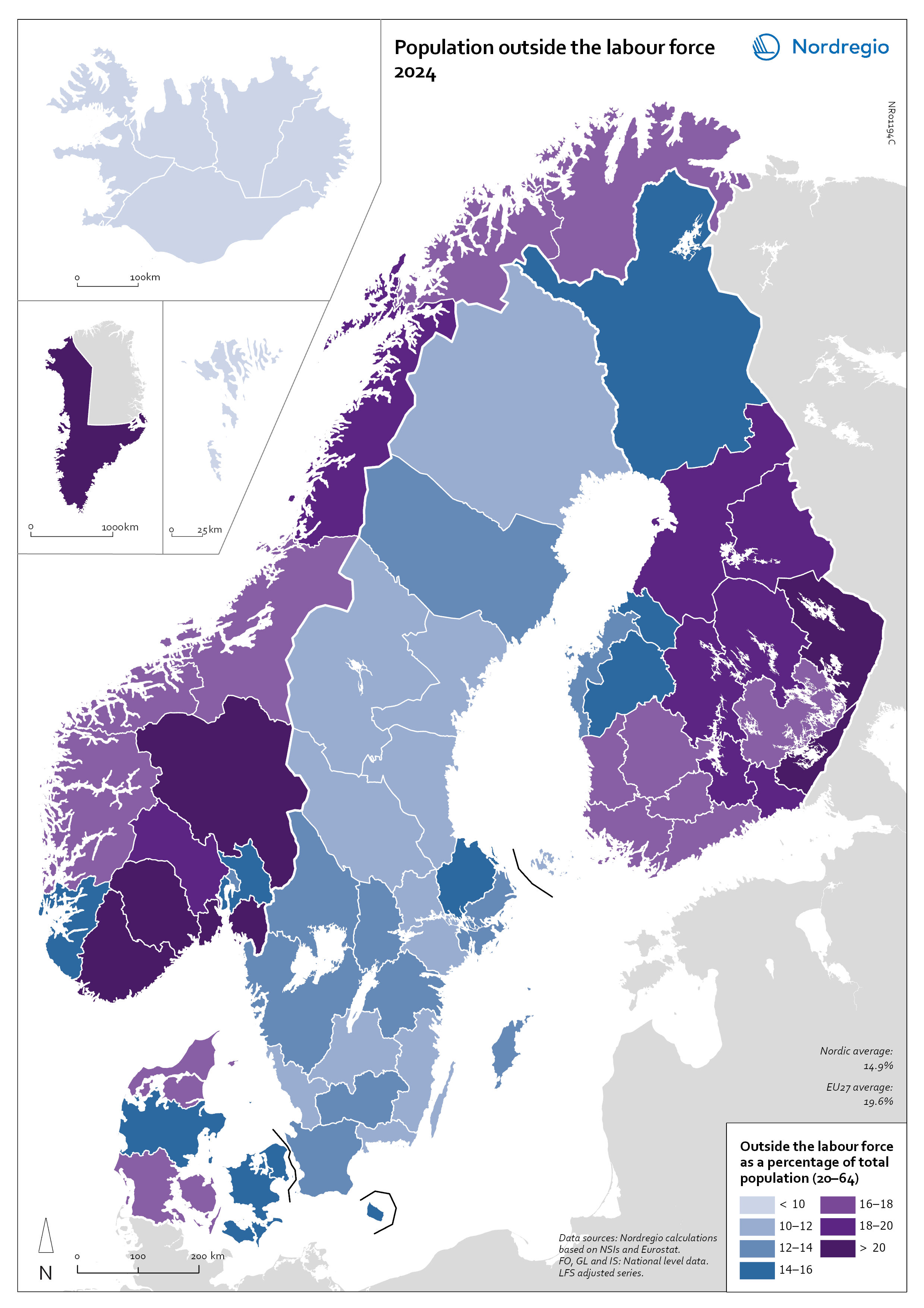
Map 5.3: Percentage of population (20–64) classified as outside the labour force, 2024. Source: Nordregio calculations based on data from National Statistical Institutes (NSIs) and Eurostat. Labour Force Survey (LFS) adjusted series. National level data for the Faroe Islands, Greenland and Iceland. Nordic average: 14.9% EU27 average: 19.6% |
See and download map in |
While Figure 5.2 highlights the reasons for being outside the labour force, Map 5.3 illustrates how the overall share of people outside it varies across countries and regions. Clear national differences emerge at the territorial level. Norway, Finland, and Greenland have higher shares of the population aged 20–64 outside the labour force than the Faroe Islands, Iceland, Sweden. Overall, the Faroe Islands have the lowest share (7.5%), followed by Iceland (9%) and the Swedish regions of Jämtland (10.2%) and Halland (10.4%). By contrast, nine Nordic regions in Norway and Finland, as well as Greenland, exceed the EU average of 19.6%.
Region | Country | Outside the labour force (rate) |
|---|---|---|
Østfold | Norway | 23.3% |
Telemark | Norway | 22.4% |
Agder | Norway | 21.6% |
Innlandet | Norway | 21.3% |
Vestfold | Norway | 21.2% |
North Karelia | Finland | 21.0% |
South Karelia | Finland | 21.0% |
Greenland* | Greenland (Denmark) | 21.0% |
Central Finland | Finland | 19.9% |
Nordland | Norway | 19.9% |
Table 5.2: Highest share of population outside the labour force (total), 20-64 years, 2024 Source: Nordregio calculations based on data from National Statistical Institutes (NSIs). EU average: 19.6% Nordic average: 14.9% *National level data for Greenland |
Region | Country | Outside the labour force (rate) |
|---|---|---|
Faroe Islands* | Faroe Islands (Denmark) | 7.5% |
Iceland* | Iceland | 9.0% |
Halland | Sweden | 10.2% |
Jämtland | Sweden | 10.4% |
Gävleborg | Sweden | 10.5% |
Åland* | Åland (Finland) | 10.7% |
Jönköping | Sweden | 10.9% |
Västernorrland | Sweden | 11.0% |
Dalarna | Sweden | 11.1% |
Västmanland | Sweden | 11.1% |
Table 5.3: Lowest share of population outside the labour force (total), 20-64 years, 2024 Source: Nordregio calculations based on data from National Statistical Institutes (NSIs). *National level data for the Faroe Islands, Iceland and Åland. |
One factor that contributes to these differences is the relatively high share of people engaged in education. Compared to the EU, the Nordic countries have higher levels of tertiary education enrolment among those aged 20–64. In 2024, Finland recorded the highest share (10.4%), followed by Norway (9.3%), Iceland (8.6%) and Denmark ( 8.3%), compared to an EU average of 5.9%. Enrolment is particularly concentrated in the youngest age-group (20–24 years), which indicates that a substantial share of those outside the labour force are temporarily outside it for educational or training reasons.
Figure 5.3: Share of population enrolled in tertiary education (ISCED 5-8), 2024. Sources: Nordregio calculations based on data from Eurostat and Nordic Statistics database. Iceland and EU: 2023 data |
At the same time, being outside the labour force also reflects labour-market exclusion. A recent report commissioned by the Nordic Council of Ministers shows that approximately 75% of individuals aged 18–64 who are outside the labour force in the Nordic Region belong to groups facing multiple employment barriers. These include persons with disabilities, immigrants from non-EU countries, young people aged 15–29 not in employment, education or training (NEET), and older workers aged 55–64 (Højbjerre et al., 2023; 2025). Taken together, these findings indicate that the population outside the labour force comprises both individuals in temporary life-course positions, most notably students, and groups who face structural barriers to employment. As a result, reducing the share of people outside the labour force requires targeted and flexible labour-market measures, including employment-focused programmes and stronger engagement with employers, with a view to making Nordic labour markets more inclusive (Højbjerre et al., 2023; 2025).
Conclusions
The analysis shows that, overall, the Nordic labour market is performing fairly well, characterised by high employment levels and a strong capacity to recover from economic downturns. At the same time, labour shortages constitute a growing challenge across all of the Nordic countries, particularly in health and social care, as well as parts of industry (Norlén & Maersk, 2024). While new technology and digitalisation can be assumed to compensate for some of the exits and replacements, the trend of extended working lives and further progress towards gender equality in employment, are also likely to play an important role.
Looking beyond employment data, the analysis of unemployment and of those outside the labour force reveals substantial national differences, indicating that national policies and institutional arrangements play a decisive role in shaping labour-market outcomes. Although regional and local variations exist, unemployment remains particularly high in Finland and Sweden, while Greenland, Norway and Finland record relatively high shares of the working-age population outside the labour force. Across the Nordic countries, the two most common reasons for being outside the labour force are education or training, and own illness or disability.
At the same time, the patterns differ markedly across countries, reflecting variation in educational and social policy systems, despite the shared foundations of the Nordic welfare model. Taken together, the findings underscore the continued importance of national-level institutions and policy choices in shaping labour-market participation across the Nordic Region.
The following chapters examine how underlying factors contribute to national, regional and local differences by examining how skills, productivity, and industry and business structures interact with labour-market outcomes, and in doing so, provide a deeper understanding of regional differences in the Nordic labour markets.
References
Andersen, T. M. (2023). Pensions and the Nordic Welfare Model. SSRN Electronic Journal. https://doi.org/10.2139/ssrn.4394846
Diermeier, M., Drees, M., Ilmakunnas, I., Kannisto, J., Nivalainen, S., Schüler, R. M. & Vidlund, M. (2024). Pension reforms in the Nordic countries and Germany: Conference proceedings of the 2024 Annual Meeting of the German Society for Demography (DGD) by the Working Group on Demographic and Social Developments (C. B. Wilke, Ed.). Deutsche Gesellschaft für Demographie, Essen. MA Akademie Verlags- und Druck-Gesellschaft mbH.
Eurostat. (n.d.). EU Labour Force Survey—New methodology from 2021 onwards. Retrieved 8 December 2025, from https://ec.europa.eu/eurostat/statistics-explained/index.php?title=EU_labour_force_survey
Eurostat. (2025). Gender pay gap statistics. https://ec.europa.eu/eurostat/statistics-explained/index.php?title=Gender_pay_gap_statistics
Flam, H. & Nordström Skans, O. (Eds). (2022). Nordic Economic Policy Review 2022: COVID-19 Effects on the Economy in the Nordics. Nordic Council of Ministers. https://doi.org/10.6027/nord2022-001
Forslund, A. (2025). Mismatch, long-term unemployment and post-COVID labour market programmes in the Nordic countries. Working Paper, No. 2025:5, Institute for Evaluation of Labour Market and Education Policy (IFAU).
Højbjerre, A., Jakobsen, V., Thuesen, F., Witt Rosenberg, A., Lang Thomsen, R., Stubkjær, L., Celine Hardonk, S., Einarsdóttir, M., Korpi, T., Saikku, P. & Mesiäislehto, M. (2025). Increasing employment among vulnerable groups. Nordic Council of Ministers. https://doi.org/10.6027/temanord2025-533
Højbjerre, A., Kildahl Nielsen, S., Jakobsen, V., Thuesen, F., Lang Thomsen, R., Saikku, P., Mesiäislehto, M., Korpi, T., Lorentzen, T. & Celine Hardonk, S. (2023). Barriers to employment for vulnerable groups in the Nordic countries. Nordic Council of Ministers. https://doi.org/10.6027/temanord2023-513
Jokinen, J. C. & Norlén, G. (2022). Labour market impacts of Covid-19. In Norlén, Gustaf, L. Randall, N. Sánchez Gassen, & C. Tapia (Eds.), State of the Nordic Region 2022. Nordregio. https://doi.org/10.6027/R2022:2.1403-2503
Komp-Leukkunen, K. (2024). Extended Working Lives in Denmark and Finland: Influences of Computerization. Nordic Journal of Working Life Studies. https://doi.org/10.18291/njwls.143480
Lundgren, A., Birgier, D. P., Sánchez Gassen, N. & Norlén, G. (2024). The Common Nordic Labour Market 70 Years and Beyond. Nordregio. https://doi.org/10.6027/R2024:14.1403-2503
Nordic Statistics database. (2025a). LABO05: Inactive population by reason, sex, reporting country and time [Data set].
Nordic Statistics database. (2025b). LABO11: Employment rate by reporting country, educational attainment level, citizenship, age, sex and time. PxWeb [Data set].
Nordic Statistics database. (2025c). WORK02: Employment and unemployment by reporting country and time. 65-69 years, Employment rate, %, Total. PxWeb [Data set].
Norlén, G. & Maersk, E. (2024). Challenges of Labour Shortages and Skills Provision. In G. Norlén, T. Heleniak & K. Refsgaard (Eds), State of the Nordic Region 2024. Nordregio. https://doi.org/10.6027/R2024:13.1403-2503
Sánchez Gassen, N. & Stjernberg, M. (2024). Population change beyond the pandemic. In G. Norlén, T. Heleniak & K. Refsgaard (Eds), State of the Nordic Region 2024. Nordregio. https://doi.org/10.6027/R2024:13.1403-2503