Photo: Astrakan/Scandinav/Imagebank.sweden.se
1. Introduction
1.1 Background and aims of the project
The aims of the project were to explore the moving patterns of Nordic people between the ages of 25-39, which is assumed to be an average household-creation age, or in other words, the age when people make long-term decisions on where to settle. In addition of examining how and why people in that age group have moved and are planning to move, the survey results put a special focus on opportunities related to urban-to-rural migration and new opportunities, such as remote work.
This report, alongside the survey it is based on, relies on the Nordregio working paper “Should I stay or should I go? Early career mobility and migration drivers” (Guðmundsdóttir et al. 2023). The working paper begins from the well-known starting point that urban areas have for long been more attractive in terms of migration for various reasons, while rural areas struggle with negative net migration, especially when it comes to people under 30 years of age. However, after turning 30, especially women appear to consider more rural municipalities for settling down, resulting in a counter-migration phenomenon. As this development has slightly accelerated after the COVID pandemic, it is possible that there are some lesser-known factors drawing people to more from urban to more sparsely populated areas. (Jensen & Randall 2022; Guðmundsdóttir et al. 2023).
While migration and increasing an area's attractiveness have always been important policy issues, their current relevance is strongly linked to the lack of labour in Nordic rural areas, especially in the North. The problems related to attracting a skilled workforce to more remote industrial areas pose a bottleneck for not only regional development but also the green industrial transition agenda. (Lapland Chamber of Commerce, 2023; Slätmo et al. 2024).
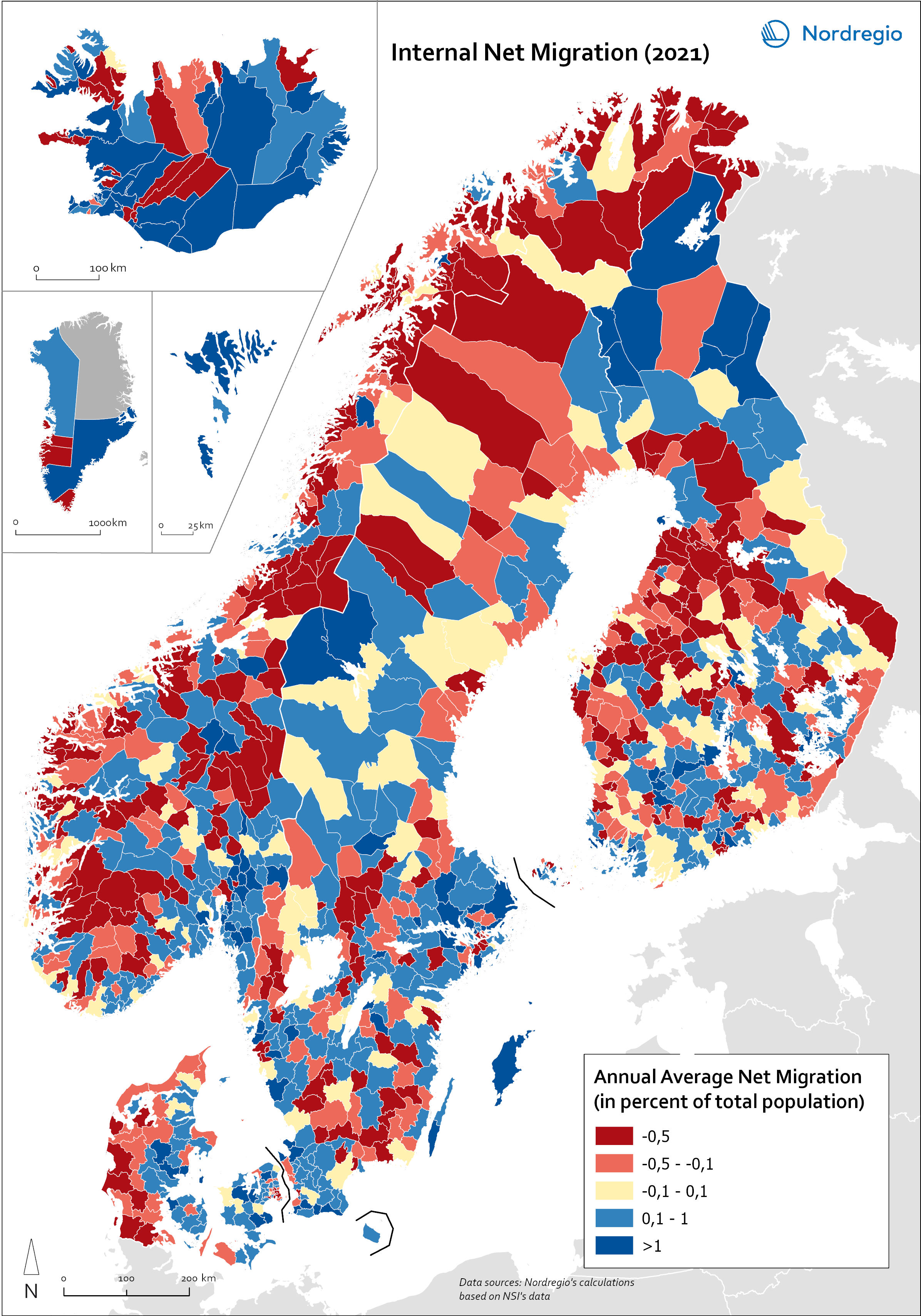
Figure 1. Internal net migration 2022. Source: Nordregio 2024.
1.2 Theoretical considerations: Drivers for moving and staying
Behind these migration fluctuations are various drivers, which the established discourse has named the push-and-pull effects: certain factors contribute to pushing people out of an area and others pull them towards another one. As people have individual, changing preferences to their homestead, each place has a combination of push-and-pull effects that have different impact in different circumstances. (Lee 1966). For example, a vibrant nightlife may work as a push factor for a family with young children, but a pull factor for a young student seeking for new friends.
The working paper by Guðmundsdóttir et al. (2023) categorises different push-and-pull factors, or migration drivers, into a list of moving for education, work, social networks, a strong personal bond, feeling of origin, lifestyle migration (seeking a different way of life), housing, public and private services, seeking for a more family-friendly area; and for people returning to a place, a personal bond, social bonds to a place, family ties, as well as financial problems. In addition to these, gender is an important and well-studied factor behind migration decisions insofar that cultural reasons, for example traditional gender norms and the insular characteristics of small communities, such as gossip, may constitute a push-out factor namely for women (Rauhut & Littke 2016; Jóhannesdóttir et al. 2021).
Analysing the literature on these drivers, the working paper concludes that although migration has traditionally been assumed to happen following rational and economic choices based on labour market conditions, further research has put more emphasis on personal characteristics, as well as a variety of other factors, as important factors at play. The literature analysed for the working paper thus points to the need to develop more understanding on the factors prompting people to leave their place of origin, and in many cases, continue moving. In other words, it is essential to consider also the influence of drivers that might fall more under preferences than needs and demands to reach a full overview of what makes a place attractive. (Niedomysl 2010; Guðmundsdóttir et al. 2023).
The need to go beyond purely rational reasons to grasp the dynamic complexity of reasons why people choose to migrate or stay where they are, is an essential context for these survey results. Previous research has discovered that people’s migration choices are not only impacted by their direct socio-economic circumstances, but also by the distance travelled insofar that more practical considerations such as housing have more weight in short-distance migration, while long-distance moves are typically motivated by life circumstance related reasons such as employment. (Niedomysl 2011a). Another study has focused on the relationship of experienced quality of life and internal migration in Finland discovered that people’s satisfaction with their quality of life and the economic development indicators often do not correlate. Even though growing urban centres rate high in most development indicators, the respondents were most content with their lives in sparsely populated rural areas. The survey also discovered that most people become more satisfied with their lives following a move that allows them to search for the lifestyle that suits them better, whether that is a calmer life closer to nature or seeking a more socially active life in an urban centre. (Hanell & Mattila 2024).
This report examines migration drivers from the perspective of empirical data (survey responses) and deepens the discussions it started from the viewpoint of place attachment, understood as the experiences of individual and collective identity building and belonging related to a specific place. (Ilovan & Markuszewska 2022). The results of this survey discuss how this concept may help Nordic municipalities interpret the early career migration drivers and trends and possibly use this information to support place attachment (“place-making”).