Left: In Österåker, Sweden, water quality in lakes and rivers is remotely monitored
Right: On the Swedish island of Gotland, drones are used to increase sustainability in agriculture
Right: On the Swedish island of Gotland, drones are used to increase sustainability in agriculture
2. Methodology
To address the first question, “What are the key characteristics of smart communities in a rural context?”, the approach of a narrative literature following the guidelines proposed by Baumeister and Leary was employed (Baumeister & Leary, 1997). This method allows for a comprehensive overview of key terms and their definitions, drawing on both peer-reviewed publications and grey literature (Chapter 4).
In response to the second question, “What indicators should be considered when conducting a social impact assessment of 5G and other connectivity-enabled technological transformations in rural smart communities in the Nordic and Baltic countries?”, the approach of a systematic literature review was selected. This method facilitates an exhaustive and systematic search of pertinent publications and ensures reproducibility of results, which is paramount for identifying relevant indicators for a social impact assessment and contributing to the scholarly debate on the societal implications of digitalisation. The adopted approach is based on the work of Higgins et al. as well as Tranfield, Denyer and Smart (Higgins et al., 2019; Tranfield et al., 2003).
Investigating the societal implications of enhanced connectivity involves a heightened risk of bias and the potential omission of critical aspects due to the complex and context-dependent nature of technology-induced societal changes. Synthesising existing literature based on predefined search terms and eligibility criteria facilitates the identification of consensus and gaps in the current literature. This process therefore supports selection of the most relevant and previously underrepresented indicators that offer substantial value for policymakers and communities.
However, it is important to note that the intricate societal dynamics shaping the framework and resulting from the integration of emerging technologies into everyday life are unlikely to be fully captured by a list of indicators confined to the scope of the present research project. Chapter 4 elaborates on the selection process used to narrow down the list of indicators identified through the literature review and elaborates on the reasoning behind the final selection of indicators while also exploring potential shortcomings and limitations.
2.1. Study selection and eligibility criteria
For the selection of relevant publications through the systematic literature review, several eligibility criteria were defined (see Table 1). To be included in the review, articles had to be published between 2020 and 2025. This is due to the fast-changing nature of smart technologies and the relatively recent rollout of 5G. The selected time frame further excludes the majority of literature published before the COVID-19 pandemic. Given that the pandemic altered many everyday practices, particularly in relation to technology use, it was essential to exclude literature published before 2020.
It was initially considered that the respective studies should focus on at least one Nordic or Baltic country to be included in the review. However, this eligibility criterion was expanded to include a global focus, as findings from beyond the Nordic-Baltic region were deemed relevant for informing the selection and discussion of societal analysis indicators. Studies also had to be published in English to ensure accessibility and comprehension for further analysis in the more advanced stages of the review process. Additionally, studies had to be peer-reviewed, leading to the exclusion of dissertations, books and similar sources. Lastly, overall relevance for the project was critically evaluated based on whether the study explored the societal consequences of improved digital connectivity.
Number | Theme | Inclusion criteria | Exclusion criteria |
1 | Time frame | Published between 2020 and 2025 | Published before and including 2019 |
2 | Language | Published in English | Non-English publications |
3 | Quality assessment | Peer-reviewed publications (with exceptions for conference proceedings* and reports from reputable organisations) | Non-peer-reviewed literature (dissertations etc.) |
4 | Relevance | Focus on societal implications of (technology linked to) improved digital connectivity | Societal implications not focal point of study |
Table 1: Inclusion and exclusion criteria for the selection of relevant publications for the systematic literature review. *While most conference proceedings undergo a comprehensive peer-review process, it was not within the scope of the present literature review to verify if this applies to all the conference papers included in the present review.
Based on these eligibility criteria and the overall objective of the project, a search query was developed to identify the most relevant publications exploring systematic approaches towards social impact assessment in the context of digital transformation. The resulting search query outlined in Table 2 was used in two bibliographic databases: Scopus and Web of Science. The search settings were configured to limit queries to titles, keywords and abstracts. Certain search operators had to be adapted to the specific requirements of each bibliographic database.
Overall, the search yielded 298 results.
The search was conducted multiple times per database to ensure accuracy and reproducibility. The search was re-entered in Scopus several weeks after the systematic literature review had commenced, yielding a more extensive list of results. As the search had been tested several times and the study was already underway, this anomaly was disregarded and might have been due to changes in the databases’ search algorithm.
Technology | Boolean operator | Impact | Boolean operator | Indicator | Boolean operator | Year range |
("digital connectivity" OR "digitalisation" OR "digital infrastructure" OR 5G OR “smart cit*” OR “smart village*” OR “IoT”) | AND | (("socie*" OR "socio*" ) W/5 ("impact*" OR "effect*" OR "implication*" )) | AND | (indicator* OR measure* OR metric*) | AND | PUBYEAR > 2019 AND PUBYEAR < 2026 |
Table 2: Search query used to identify relevant publications on Scopus. The Boolean operators were slightly adapted for the search of the Web of Science databases due to differences in the search engines. Titles, keywords and abstracts were searched. |
In the second screening stage, the remaining 165 articles were reviewed more thoroughly by one of the report’s authors in consultation with a second author. For that purpose, abstracts of the articles were reviewed with regard to criterion 4, i.e. the overall relevance of the respective study. Studies excluded at this stage included publications with an overly technical focus or those that merely referred to the importance of studying the societal implications of the technological intervention proposed. After this second screening phase, at total of 48 publications remained. However, 15 publications were not accessible in a full text format to the researchers and another eight publications were removed from the list after a more thorough review of the full text revealed an insufficient focus on the social scientific dimension of technology assessment studies. After removing both the inaccessible and the non-relevant publications, a final set of 25 peer-reviewed papers remained. These papers form the basis of the presented literature review as well as the selection of relevant indicators for the social impact assessment of improved digital connectivity in the more rural parts of the Nordic-Baltic region.
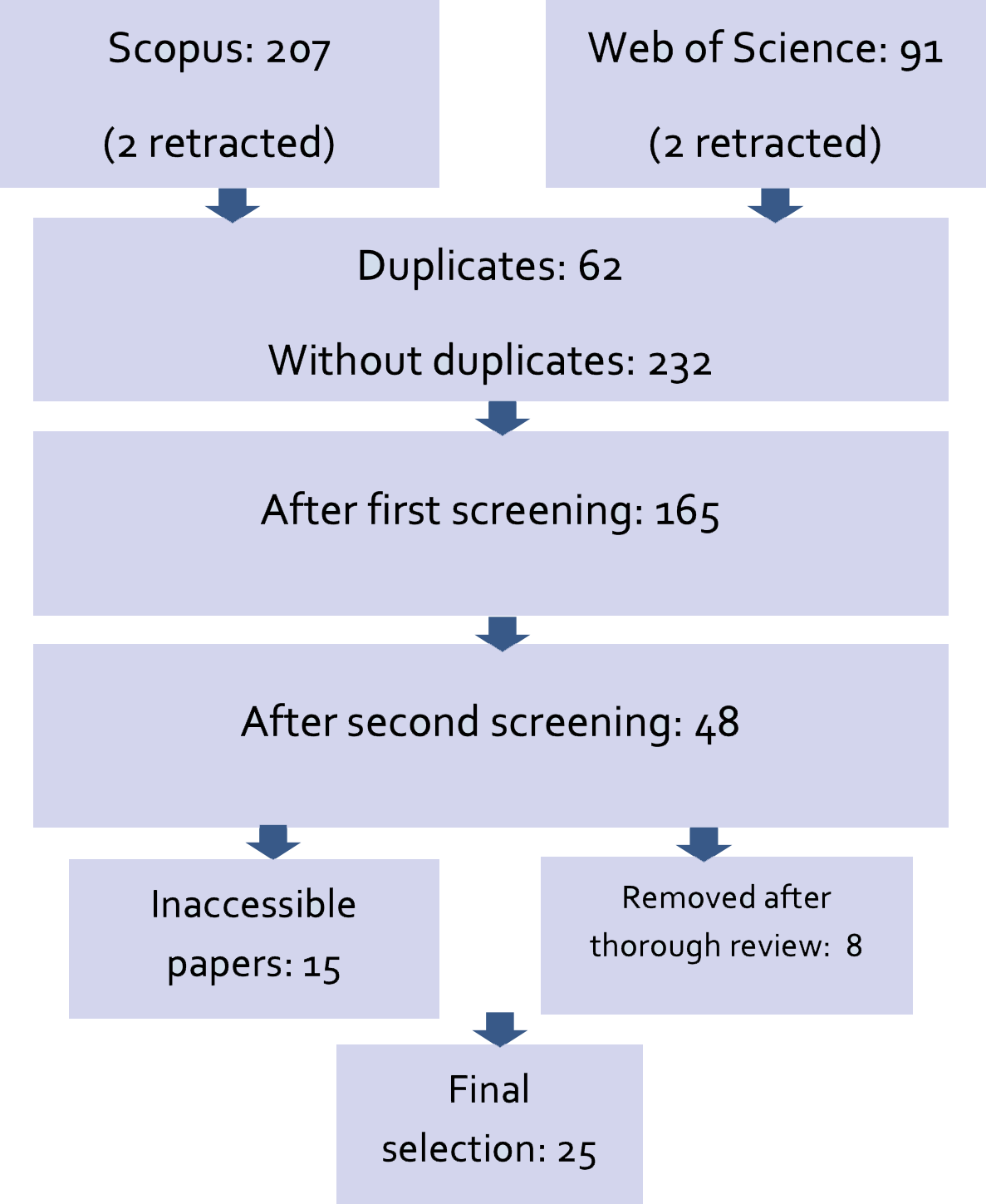
Figure 1: Overview of included and excluded studies based on findings from the two databases and application of eligibility criteria.
2.2. Indicator identification and scoring
The identification and selection of relevant indicators for further study of the societal implications of digital connectivity in a Nordic-Baltic context built on analysis of the selected 25 publications. Due to the inductive nature of the indicator identification and selection process, a content analysis based on an open coding approach inspired by the work of Clarke and Braun (Clarke & Braun, 2017), was chosen. Using a manual coding process, 20 categories of indicators could be identified (see Appendix A for the full table). These were further grouped together into seven overarching categories comprising (1) social, (2) economic, (3) political and (4) legal aspects, as well as (5) safety and security, (6) sustainability and (7) technology. Each category covered one to five associated broader indicator descriptions. As shown in the appendix, the individual indicators found in the literature were in most cases more precise, describing for instance the acquisition of advanced technical competencies. These were grouped under the subcategory of “human capital”, which was further associated with the overarching “social indicator” category.
To select a final and more refined set of indicators to be used in the next stage of analysis within the “N-B Connect” project, a scoring system was developed to assess the identified indicator subcategories. This scoring system assigned scores from 0 to 10 in the segments (1) frequency of appearance in the selected publications, (2) relevance for the analysis of societal implications of improved digital connectivity, particularly in a Nordic-Baltic context, (3) expected impact of related findings for future policy discussions, (4) expected data availability both in quantitative and qualitative terms and (5) expected ease of acquisition considering potential participants’ willingness and interest to discuss the topics in question and the likelihood of finding the relevant quantitative data for all countries covered by this study (see Table 3).
Theme | Subcategory | Frequency score | Relevance | Impact | Data availability | Ease of acquisition | Total | |
Social | Digital inclusion | 10 | 10 | 10 | 7 | 6 | 8 | |
Quality of life | 7 | 9 | 9 | 6 | 6 | 7 | ||
Culture | 3 | 6 | 6 | 4 | 5 | 5 | ||
Health and wellbeing | 6 | 8 | 9 | 6 | 6 | 7 | ||
Human capital | 7 | 8 | 8 | 7 | 6 | 7 | ||
Economic | Employment | 10 | 8 | 9 | 9 | 9 | 9 | |
Local economic impact | 8 | 8 | 9 | 7 | 7 | 8 | ||
Innovation for growth | 4 | 8 | 7 | 5 | 6 | 6 | ||
Political | Community engagement | 6 | 8 | 8 | 6 | 6 | 7 | |
Local governance | 6 | 7 | 7 | 6 | 6 | 6 | ||
Sustainability | Environmental sustainability | 7 | 7 | 7 | 6 | 6 | 6 | |
Safety and security | Public safety | 6 | 7 | 7 | 6 | 6 | 6 | |
Privacy and trust | 4 | 8 | 7 | 5 | 5 | 6 | ||
Information security | 7 | 8 | 7 | 5 | 5 | 6 | ||
Legal | Regulatory compliance | 1 | 7 | 6 | 5 | 5 | 5 | |
Technology | Connectivity | 1 | 9 | 10 | 8 | 8 | 7 | |
Transport | 4 | 6 | 7 | 7 | 7 | 6 | ||
Innovation | 2 | 6 | 7 | 6 | 5 | 5 | ||
Technology acceptance | 2 | 7 | 8 | 5 | 5 | 5 | ||
Energy | 3 | 6 | 8 | 6 | 6 | 6 | ||
Table 3: Scoring of identified indicators based on the systematic literature review. This table displays the average scores resulting from four independent reviews.
To avoid bias, the scoring was conducted independently by four researchers from the research team for all segments except for the first, i.e. frequency. The frequency of appearance was calculated based on the findings resulting from the thematic coding conducted in the previous step; as such, the score for this category was pre-determined and was not evaluated individually by the researchers. Subsequently, the average score was determined for each of the 20 categories (see Table 3), forming the foundation for the final selection of indicators.
Based on this scoring exercise, six indicator subcategories obtained a score of higher than seven, which was set as the threshold. These were employment (9), digital inclusion (8.35), local economic impact (7.70), quality of life (7.20), human capital (7.10) and connectivity (7.05). Further analysis and contextualisation of these findings can be found in Chapter 4.