2. Digital Inclusion in the Nordic-Baltic Region
The pre-study concluded that the Nordic-Baltic region was characterised by high digital maturity overall, with digital exclusion only affecting a relatively small proportion of the region’s population. However, the report also criticised the lack of national and cross-regional monitoring indicators specific to digital inclusion. While most of the countries in the Nordic and Baltic region follow and report to the DESI, it has been argued that DESI only covers certain aspects of digital exclusion. Furthermore, due to the fact that the countries in the Nordic and Baltic region are so highly digitalised, it is important to have strong national monitoring practices in place in order to combat digital exclusion. The absence of inclusion-specific monitoring standards, including evaluation practices, has limited thorough analysis and comparison of both the status and impact of digital inclusion on relatively small, but equally important population groups (Nordic Council of Ministers & Digital Europe, 2022). Central areas for improvement identified by the study relate to the lack of established inclusion-related monitoring mechanisms and definitions of digital inclusion. Both aspects pose a challenge to the advancement of political cooperation, research analyses and technological development of user-centric solutions in the Nordic-Baltic region based on a shared understanding of the term and harmonised indicators. It hence becomes apparent that more cross-border engagement with the topic is necessary on both a research level and policy level to facilitate and step up the setting of common standards and, eventually, stronger collaboration.
Despite the lack of cross-regional indicators specific to digital inclusion, there are other monitoring mechanisms in place which have served as a foundation for the evaluation of countries’ digitalisation trajectories. Most notably, the EU’s DESI has provided quantitative input on a yearly basis since 2014, facilitating comparisons and allowing developments to be tracked over time. The indicators are reviewed on a regular basis. While monitoring of digital inclusion is not the explicit emphasis of DESI, several dimensions relevant to digital inclusion are covered by the DESI. DESI has been updated annually since 2014 with minor variations between the various years. As of the end of September 2023, the DESI index is no longer published as an independent report, but instead incorporated into the State of the Digital Decade report. Overall, the DESI index of 2023 includes four main dimensions (1) Digital skills, (2) Digital infrastructure, (3) Digital transformation of businesses and (4) Digitalisation of public services. All four of the DESI dimensions relate to the topic of digital inclusion to some extent, but especially (1) Digital skills, (2) Digital infrastructure and (4) Digitalisation of public services, with the first measuring human capital in the various countries and the latter two providing important prerequisites for digital inclusion to a greater extent.
Questions of connectivity are touched upon in the second dimension, namely “Digital infrastructure”; here the status quo for the Nordic and Baltic region is rather more unclear, with varying results for the different indicators and different countries. In terms of the share of the population having access to at least 100 Mbps fixed broadband, Sweden, Denmark and Latvia rank above the European average, whereas Lithuania, Estonia and Finland score below the European average. However, when looking at the national levels of 5G coverage, the picture is almost reversed. Here, Denmark, Finland and Lithuania rank above the European average, while Estonia, Latvia and Sweden rank below the European average. The difference between the two indicators is perhaps most clear in the case of Sweden, which ranks second for the first indicator with 85.28% take-up, but ranks number 28 out of 28 European countries for 5G coverage (as a % of households) with the figure of 20.46%.
The fourth dimension, namely “Digitalisation of public services”, sheds light on the status of digitalisation in the public sector in the various countries, both in terms of digital users of public services and also the overall quality of those digital services, e.g. in terms of transparency and mobile-user friendliness. In general, the Nordic and Baltic countries perform well in comparison to other European countries in terms of digitalisation of public services. An example of that is the indicator measuring the share of e-government users as displayed in Figure 1. Here it is also evident that the Nordic and Baltic countries are among the highest-scoring countries in Europe. Denmark, Finland, Sweden and Estonia rank in first, third, fifth and sixth place respectively. Lithuania and Latvia rank somewhat lower, but still above the European average, in 13th and 21st place respectively.
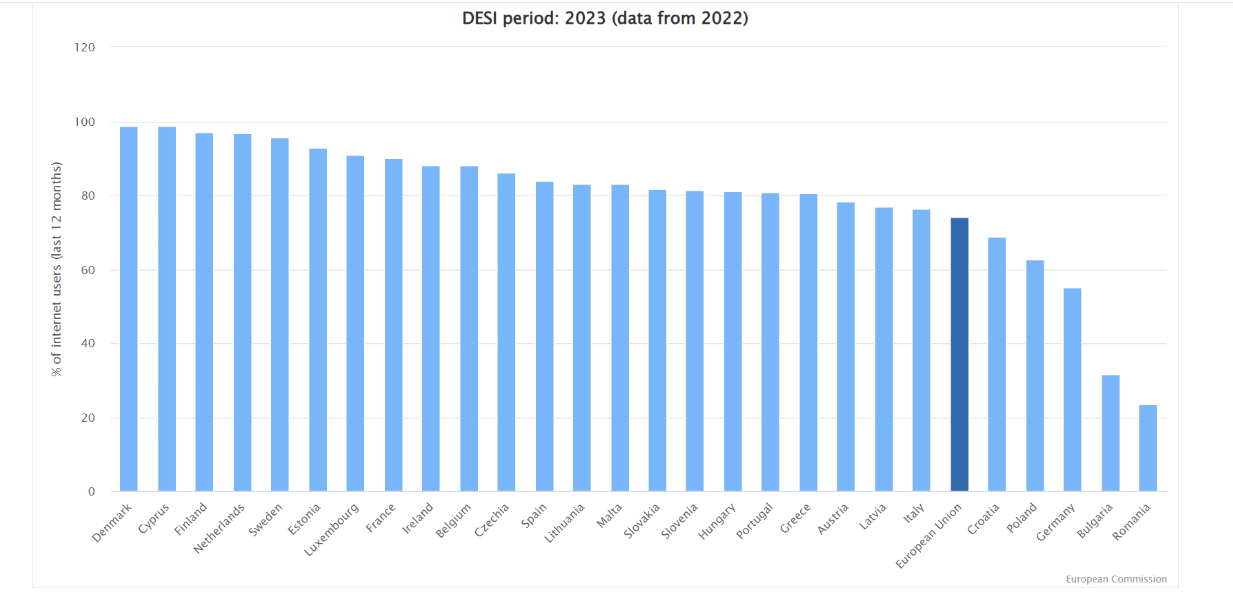
Figure 1: Overview displaying e-government users (as a % of all individuals aged between 16 and 74) per country as monitored within the scope of the DESI's “Digitalisation of public services” dimension. (European Commission, 2023a).
While the second and fourth dimensions (“Digital infrastructure” and “Digitalisation of public services”) provide important insight into the availability of digital connectivity and public services, the first dimension (“Digital skills”) focuses on digital skills. That dimension includes the percentage of individuals with basic and above basic skills and the percentage of internet use in the population (European Commission; 2023a) and gives an indication of a country’s general digital literacy rates. Except for Lithuania and Latvia, the Nordic and Baltic countries attain scores above the EU average in the indicator measuring the percentage of individuals with at least basic digital skills in the 2023 index (see Figure 2). The same is true for the indicator measuring overall internet use in the population. Here it is only Lithuania that ranks below the European average.
While providing a general overview of a country’s current status in terms of digitalisation and competence levels, such rankings do not provide any insight into groups lacking advanced and especially basic IT skills – i.e. who are the members of such groups, why have they not acquired the same skills as many of their fellow residents and how is this affecting their everyday life? In particular, minority and marginalised groups are at risk of being overlooked in quantitative studies that focus on the identification of general trends. As the “digital by default” assumption becomes more omnipresent in highly digitised societies like the Nordic and Baltic countries, this trend risks being reinforced (Schou & Pors, 2019). Several scholars have explored various aspects of digital inclusion and exclusion in a Nordic-Baltic context. Johansson et al. looked at the use of digital devices and the internet amongst various disability groups in Sweden (Johansson et al., 2021) while Heponiemi et al. (2022) explored the effect of older adults aiming to access digital healthcare solutions in Finland. Leppiman et al. (2021) investigated older adults and digital exclusion in Finland and Estonia. Looking at the Swedish case, Jensen et al. (2020) note that everyday practices of minority groups, such as immigrants, are only considered to a limited extent when designing public services, exacerbating access restrictions in “transitional phases of citizenry” (Jensen et al., 2020, p. 1). Rohatgi et al. (2020) investigated the determinants for digital inclusion in Danish and Norwegian schools. They found that the availability of digital tools and digital technologies had a significant effect on development of ICT skills among pupils. While the factors causing individuals to be at risk of digital exclusion are relatively well-described, the literature on solutions is sparser. Exceptions to that include the role of education/training and other types of civil society involvement. For example, Hechavarria et al. (2017), Ayoung et al. (2020) and Manžuch & Macevičiūtė (2020) showed the role of libraries in Estonia, Latvia and Lithuania respectively.
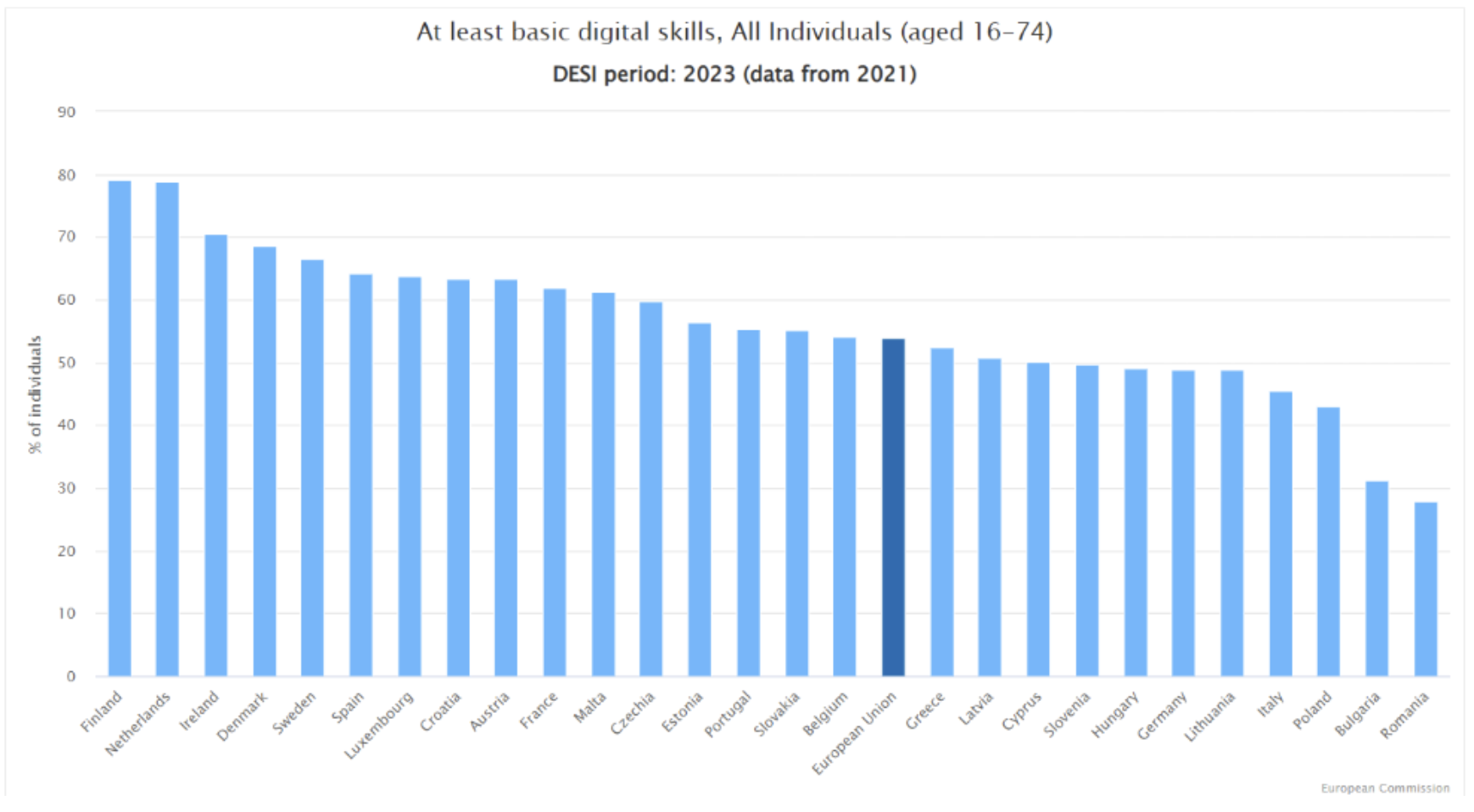
Figure 2: Overview displaying basic digital skills per country as monitored within the scope of the DESI’s “Digital skills” dimension. (European Commission, 2023a).
The work of these researchers underlines the remaining discrepancies between various population groups in terms of digital skills and inclusion in general, insights which might be counterintuitive seen against the backdrop of overall relatively high levels of trust in the public sector and comparably egalitarian societies (Gulliksen, 2021). The literature agrees that more research into the causes of digital exclusion, and especially potential solutions to reduce digital exclusion, is required for the countries of the Nordic-Baltic region to remain leaders of the digital transition (ibid). The following chapter will discuss commonly adopted definitions of digital inclusion.