Photo: Anne Katrine Ebbesen, Nordregio
A systems perspective on regional green innovation
One of the goals of the Nordic Council of Ministers is a competitive Nordic Region, which is crucial for ensuring business development and society’s welfare. The thematic group for green, innovative and resilient regions picked up on this goal, by engaging in discussions about how innovations can contribute to a competitive Nordic Region and launching two research projects on innovation systems in the Nordic Region.
The two research projects are complimentary and have increased knowledge about which role innovation policies, including different types of innovation polices, have in the implementation of place-based regional innovation systems.
The first project, Green Innovation Systems in the Nordic Region (GRINGO I), focused on the link between agency and innovation. The study sheds lights on the role of different agents and actors in driving transition processes, and the way in which policies and framework conditions impact green transition changes in sectors/businesses across the Nordic Region. From the impact of policies to the dynamics of business ecosystems across the Nordic countries, we took a deep dive into how change is instigated. Building on GRINGO I, the second, Missions-approach & Green Innovation Policy (GRINGO II), focused on innovation policy integration from supra-national, national and sub-national levels. Emphasis was placed on mission-oriented approaches, which are gaining attention as a means to provide directionality to innovation policy, in alignment with SDGs and the green transition. We studied the potential of mission-oriented approaches to offer novel and impactful policy tools. Furthermore, the project investigated how missions can be operationalised within Regional Innovation Systems (RIS) in Denmark, Finland and Sweden.
Releasing the potentials and creating effective measures and support systems for local, regional and national green innovation is a key factor for the Nordic countries to continue to thrive in the global economy. Learning from the Nordic countries can help policy makers move quicker and smarter.- Daniel Ravn Paaske Jakobsen, national representative Denmark
Photo: Copenhagen, 2024
BOX: Empirical studies
- Innovation dynamics in wood construction of multi-storey buildings in Sweden and Finland, with particular focus on Västerbotten, Skellefteå, Växjö, and Helsinki
- Innovation systems dynamics in the protein shift in the Nordic countries
- Mission-oriented innovation policies at national level: Denmark, Finland and Sweden
- Mission-oriented innovation policy approaches at regional level: Northern Jutland, Denmark, Ostrobothnia, Finland, & Västerbotten, Sweden.
By engaging in webinars and outreach activities, both researchers and stakeholders have increased their understanding of how the answer to the question of “Who drives innovation” is a matter of path dependence, multiple actors and a mix of institutional, financial and policy decisions. Zooming into micro-level processes leading to individual innovations, sectoral transformations and value chains re-arrangements, reveal a much more complex and chaotic picture of the drivers, the roles of different actors and their interactions. Therefore, systems change results from the sum of both coordinated and uncoordinated actions by a multitude of actors (Figure 1).
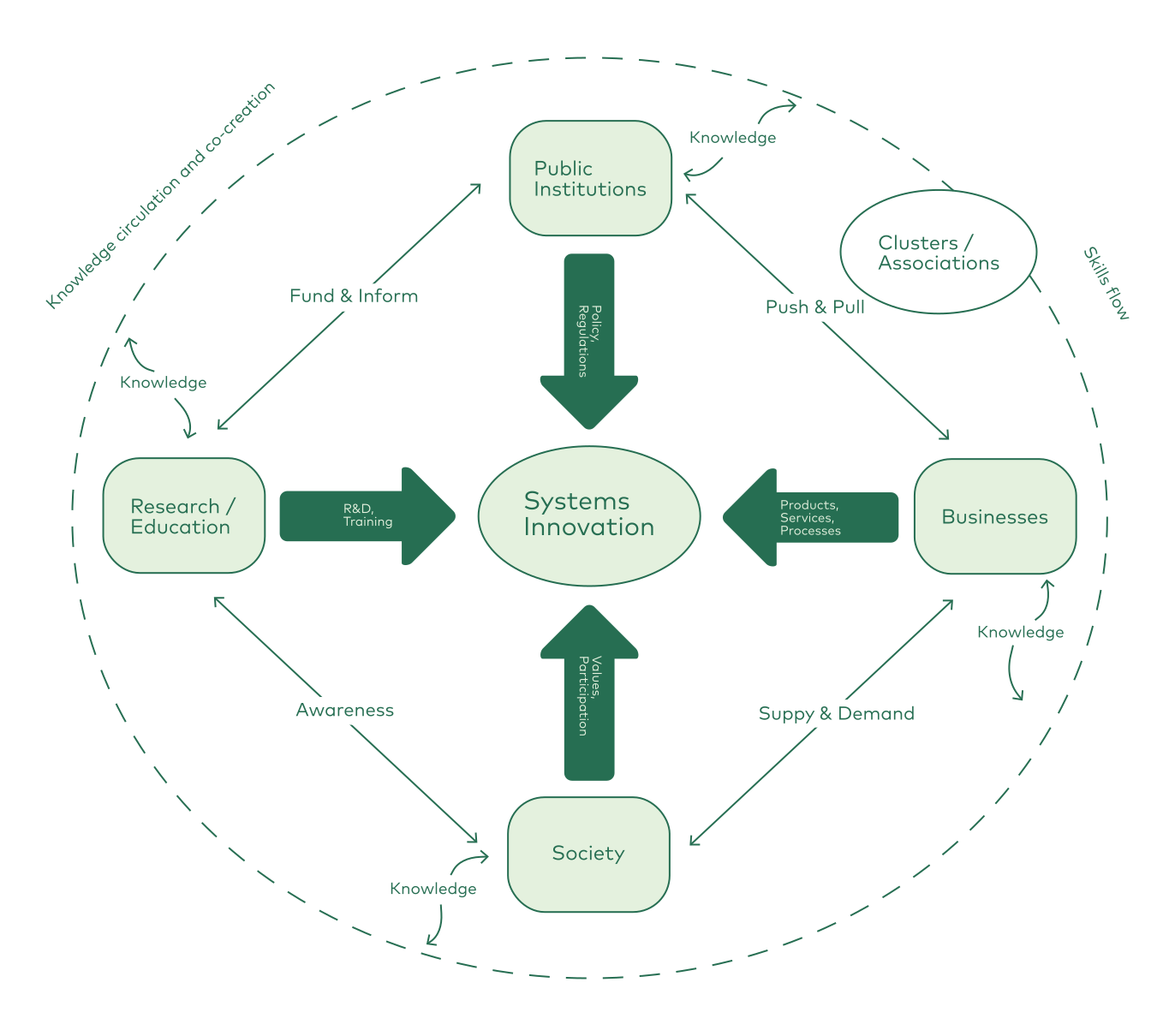
Figure 1: Systems’ innovation as a product of multiple agents' simultaneous actions. Source: Giacometti et al. (2024) re-interpretation of existing frameworks in innovation systems literature.
By understanding these processes, policymakers can be better equipped to design policies that more explicitly aim at instigating change, such as Transformative Innovation Policies and Missions. However, one finding from our studies is that mission-oriented policies were often formulated in dialogue by stakeholders with strong element of path dependence, building on previous innovation strategies such as Regional Innovation Systems (RIS), Smart Specialisation Strategies (S3) and regional development strategies, as well on established governance structures. As a result, this presents a potential risk of re-labelling previous ways of working with innovation systems, rather than bringing novelty. However, if used strategically, missions offer the potential to mobilise actors towards speedy transformations and embarking into new promising development paths.
Further reading:
- Final report to be published in 2025