Photo: Hans-Olof Utsi/imagebank.sweden.se
Regional collaborative leadership
Collaborative regional leadership is essential for promoting regional development and implementing effective regional strategies, policies, and projects. Regular collaboration between regional public and private actors is also crucial for overcoming regional socio-economic challenges, promoting innovation and economic diversification, delivering high-quality public services, overcoming crises, building regional resilience, and implementing sustainable green, social, and smart transitions.
The project examined how Nordic regional institutions (e.g. regional and municipal authorities) and other public and private stakeholders (e.g. industries, businesses, universities, NGOs and societal groups) collaborate to drive policy change, overcome socio-economic challenges, and maximise opportunities at the regional level. The report highlights the main drivers, challenges, enablers, and benefits of collaborative regional leadership processes in a Nordic setting. This is not only a cross-cutting theme with strong impacts on working with different policy areas, but it has also been a cross-cutting theme by involving examples, good practice and stakeholders from the different thematic groups, i.e. the urban, rural and regional development groups. The study was based on a Nordic collaborative regional leadership survey and 4 best practice example collaborative regional leadership case studies.
Having a place-based perspective is fundamental when working with regional development and policy. To cope with regional challenges, we have to work effectively, both horizontally and vertically.- Laura Peuhkuri, regional representative Finland
BOX: Empirical case studies
- Coast to Coast Climate Challenge in Denmark
- Greenreality Network in Finland
- Grit:Lab in Åland
- Telemedicine for healthcare accessibility in remote rural areas in Iceland
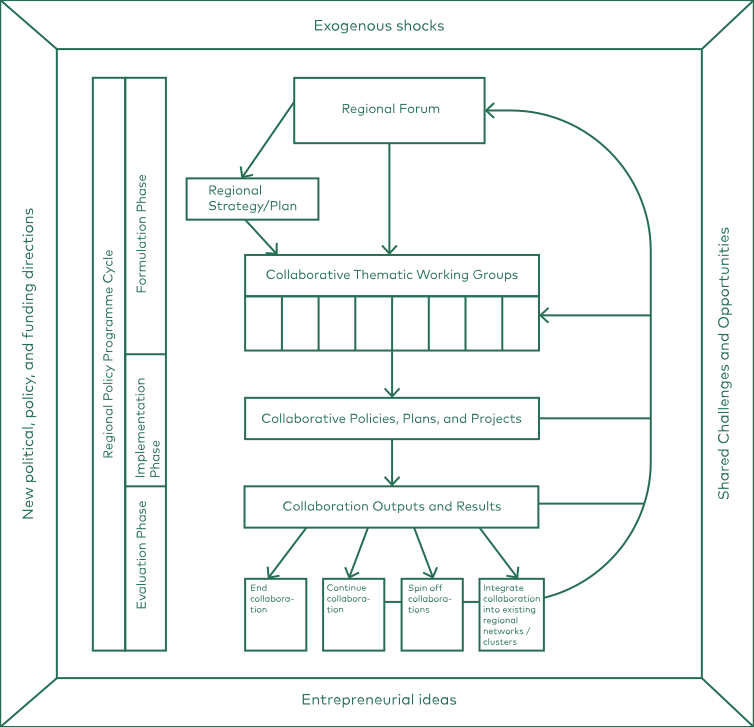
The key findings, show that place leaders are vital for successful collaborations, and it is crucial that they possess certain qualities including wide ranging regional networks and ability to facilitate dialogue between actors with different interests. Collaboration also needs to be based on a sectoral/thematic approach in which collaborative partners clearly understand their roles and responsibilities. An important overarching conclusion from the project is that long-term platforms are required. In response to this, the report outlines a holistic model of collaborative regional leadership designed to foster collaboration at different stages supported by practical recommendations targeted at regional-level public and private institutions and stakeholders to help them build successful regional collaborations.