2.3. Commuting on the Nordic labour market
In addition to facilitating migration across the Nordic borders, the common Nordic labour market also sets out to facilitate cross-border commuting. The extent of cross-border commuting between the Nordic countries and trends over time are difficult to assess since comparable and relevant long data series are not available.
Over the years, however, various projects have attempted to fill that gap and have produced cross-border commuting statistics for specific periods of time. Those include, for example, the Nordic Map of Commuting, several editions of which were published between 2004 and 2013 (Nordisk Pendlingskarta, see, for example, Nordic Council of Ministers, 2005 and 2013). The project involved a collaboration between the national statistical institutes of the four big Nordic countries and made it possible to identify Nordic citizens who had their regular residence in one Nordic country but received income from an employer in another Nordic country. It showed that a fairly small group of around 25,400 people commuted to another Nordic country in 2001.
Considered were commuters between Sweden and Norway, Sweden and Denmark, Sweden and Finland and Norway and Denmark.
More recently, a Nordic project collected and harmonised Nordic commuting data for the years 2015-2018, including persons who regularly cross country borders to go to their workplace and digital commuters who do most of their work in their place of residence (Brun et al., 2021). Approximately 51,200 people worked in another Nordic country during this period, corresponding to 0.2% of the working age population. Swedes were particularly likely to commute, with Denmark and Norway being the preferred destinations. During the studied period of 2015 to 2017, commuting numbers declined markedly. That may be attributed to various factors, including declining levels of youth unemployment in Sweden and a weaker Norwegian currency, which reduced incentives for young Swedes to look for a job in Norway (Nordic Council of Ministers, 2021).
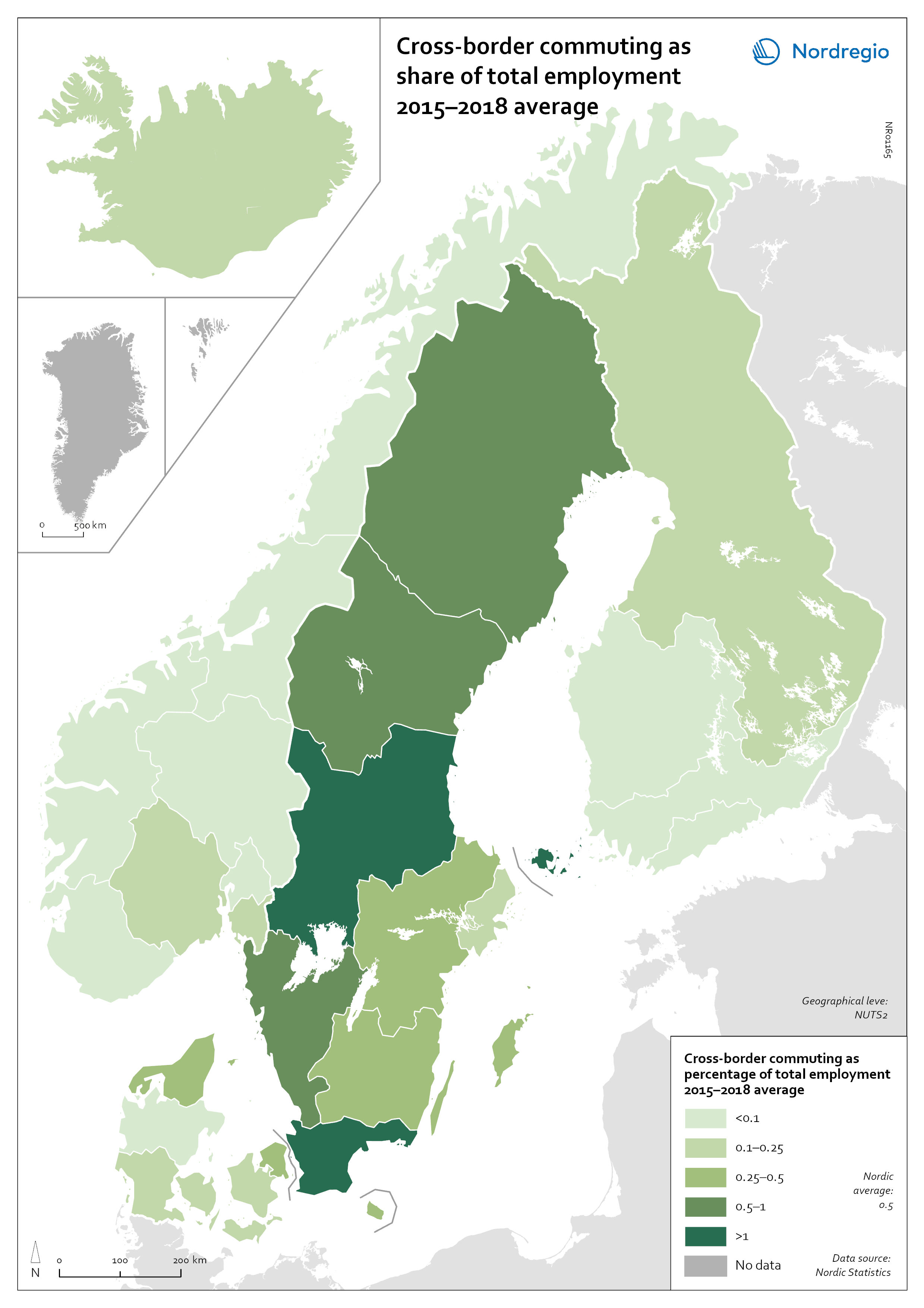
The harmonised Nordic commuting data also suggest that commuting plays a differing role for various regions and municipalities (Map 2). For example, in some regions in southern and central Sweden and in Åland, over one percent of the total workforce commuted to a job in another Nordic country in the period 2015-2018, while the equivalent percentage is much lower in large parts of Norway and Finland. In some municipalities, commuters may make a strong contribution to the local labour market, with cross-border workers representing over 10% of the working age population (Nordic Council of Ministers, 2021).
Map 2: Cross-border commuting as share of total employment in NUTS 2 regions, 2015-2018 average
As documented in several studies, border restrictions – such as during the Covid-19 pandemic and the migration crisis in 2016/2017 – had a heavy impact on cross-border commuters, who could not always reach their workplaces (Giacometti & Wøien Meijer, 2021; Creutz et al., 2021; Lundgren & Wøien Meijer, 2022; Region Värmland, 2023). For example, only commuters working in key sectors (e.g. healthcare) were allowed to cross the Norwegian-Swedish border during certain periods of the pandemic. Furthermore, administrative hurdles such as an increase in required documents, different testing regimes and often unclear and changing information made it more difficult to commute. During interviews, commuters also reported that they were viewed with suspicion and as possible carriers of infection, both in their communities of residence and at their workplaces. Such experiences may have affected the trust and willingness of people in border regions to work across borders, at least in the short term. Indeed, during the pandemic the number of cross-border workers in Värmland (Sweden) who work abroad – mostly in Norway – decreased from an estimated 4,625 persons in 2020 to 3,789 in 2021 (Region Värmland, 2023).
Case studies of cross-border commuting
While there is a lack of up-to-date harmonised Nordic statistics on cross-border commuting, we will draw from statistics published by Ørestat, Statistics Norway, Region Värmland and Statistics Åland to shed further light on specific aspects of cross-border commuting.
Commuting in the Öresund region
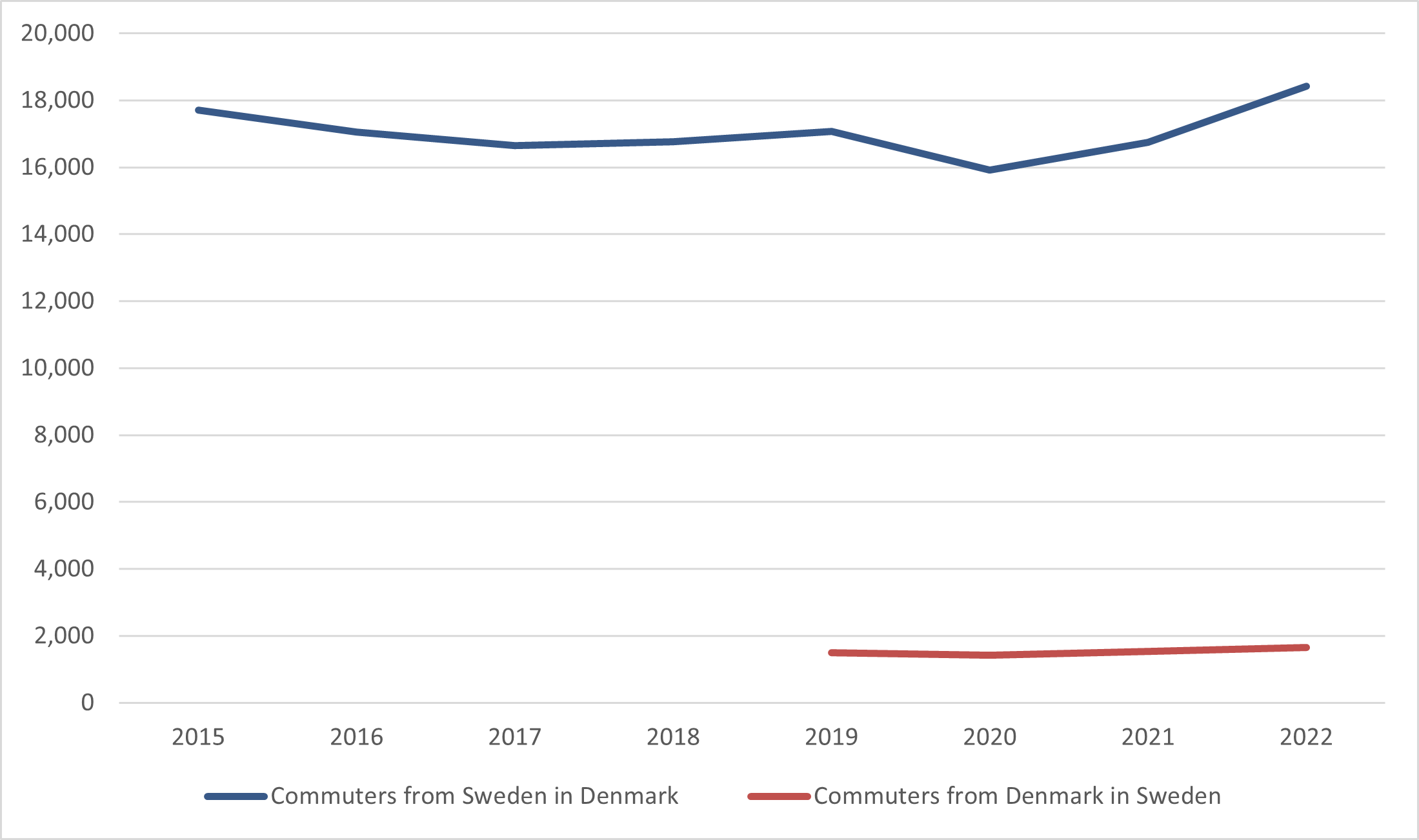
Since the Öresund Bridge opened in 2000, cross-border commuting between Sweden and Denmark increased rapidly, in particular from Skåne to Själland (Region Skåne, 2022). The bridge has thereby become a vital part of integration between Sweden and Denmark. Data from Ørestat show how the number of cross-border commuters between Denmark and Sweden has developed since 2015 (Figure 29). The number of Swedish residents who work in Denmark has been consistently higher than the number of Danish people working in Sweden. Prior to the pandemic, between 17,000 and 18,000 Swedes commuted to Denmark for work, with the majority working in Copenhagen and Tårnby. Copenhagen Airport is located in the latter municipality and provides jobs for many commuters from Sweden (Bogason & Norlén, forthcoming). With the onset of the pandemic, that number dropped to just below 16,000 people. Since then, however, the number of commuters has recovered and indeed surpassed pre-pandemic levels. In 2022, 18,400 persons commuted from Sweden to Denmark. Preliminary statistics from 2023 and 2024 suggest that the number of commuters has increased still further since then (Øresundsinstitutet, 2023). Data for the years 2019 to 2022 suggest that a much smaller number – around 1,500 to 1,600 persons – commute from Denmark to Sweden. Many of those commuters work in Malmö and Lund.
Figure 29: Commuting between Denmark and Sweden across the Öresund (2015-2022)
Source: Ørestat, 2024.
Source: Ørestat, 2024.
Statistics from Ørestat also show that around 63% of commuters between Denmark and Sweden are men, considering flows in both directions (Ørestat, 2024; Region Skåne, 2022). Men are also the dominant group in other cross-border areas with higher levels of commuting, such as Värmland (Region Värmland, 2023).
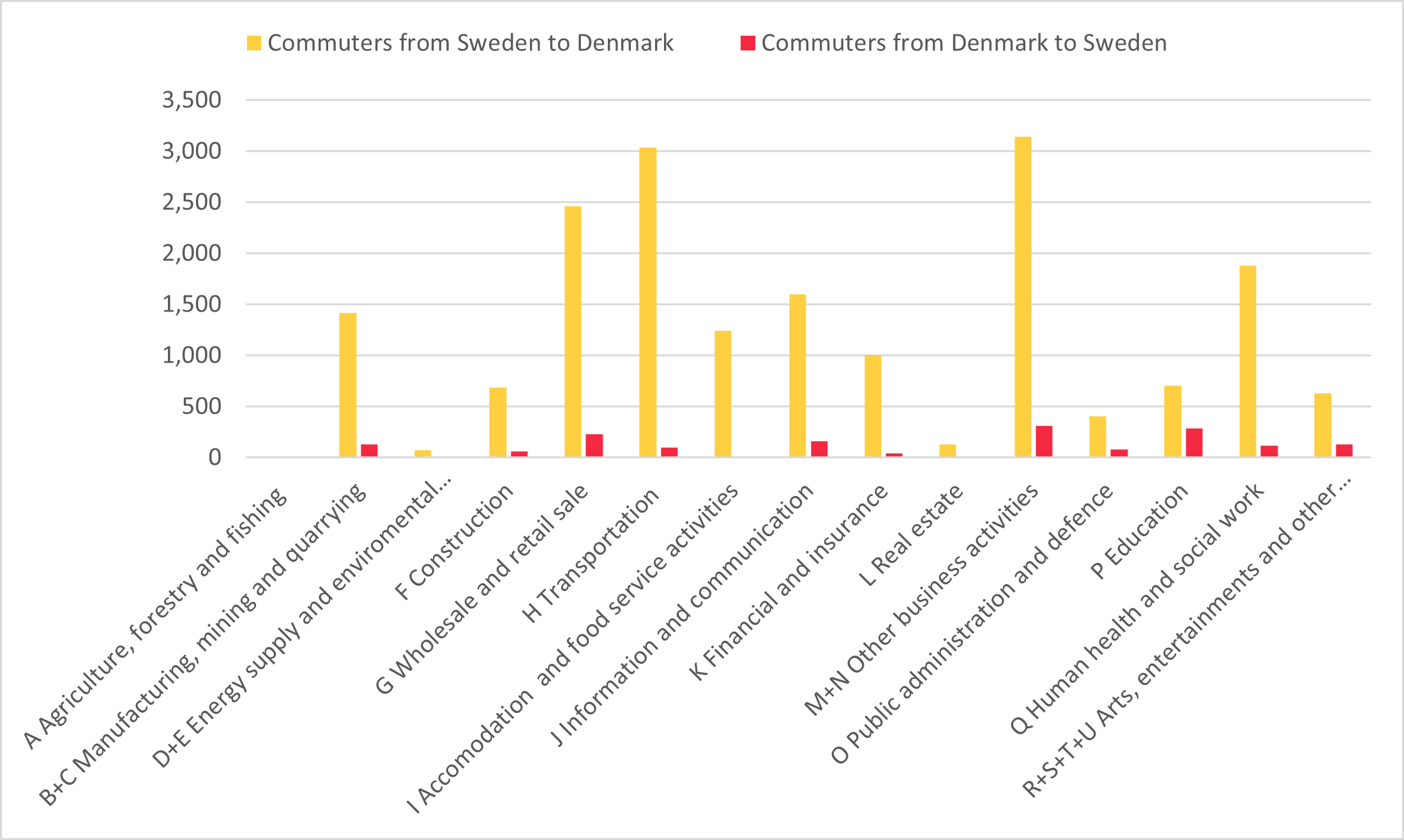
Among Swedish commuters to Denmark, many worked in various business activities, transportation as well as wholesale and retail sales during 2022 (Figure 30). Wholesale and retail sales, as well as other business activities, were also popular sectors for Danish commuters in Sweden. In addition, a relatively large group among the commuters from Denmark in Sweden worked in education in 2022.
Figure 30: Commuters between Sweden and Denmark by sector (NACE 2.0), 2022
Source: Ørestat (2024)
Despite the post-pandemic increase in commuting numbers, it seems only a minority of residents in the Öresund region consider commuting an attractive option. In a survey on attitudes towards cross-border commuting in the Öresund region, only 17% of the respondents from the Swedish side said that they were likely to look for a job in Denmark and even fewer respondents in Denmark – just 10% – were likely to look for a job in Sweden. The main reason mentioned for taking up a job in Denmark was higher pay, while issues relating to the commute (distance, time, cost and frequency of transport) as well as respondents’ happiness with their current job were main reasons for not taking up a job in Denmark. Commuting distance and happiness with their current job were also mentioned by Danes as reasons for not taking up a job in Sweden. In addition, around 40% of respondents answered that they had simply “never thought about it”. For those considering taking up a job on the Swedish side, the main motivating factors were higher pay, a larger number of exciting job options and an international environment (Greater Copenhagen, 2023).
Commuting in Norway
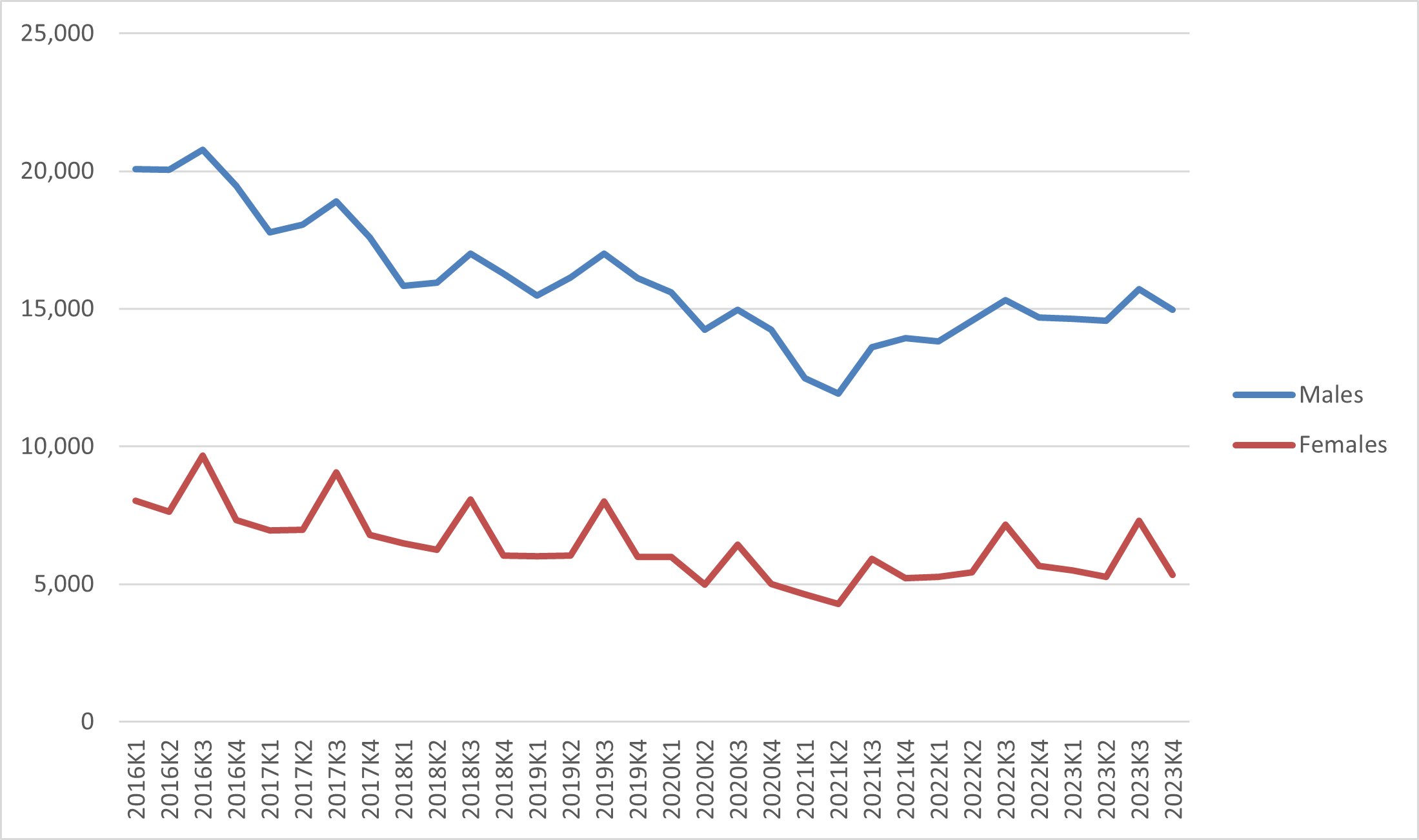
Statistics Norway also offers some datasets on non-resident employees from the other Nordic countries on the Norwegian labour market. Figure 31 shows that the number of men surpassed the number of female commuters to Norway throughout the time period shown. According to Statistics Norway (2024), several sectors which employed larger numbers of commuters in 2023 are male-dominated, such as construction, manufacturing and transportation.
Figure 31 also suggests that commuting to Norway is subject to seasonal fluctuations, with peaks in employment during the third quarter (July-September) of each year. Over time, the number of Nordic commuters in Norway has gradually declined, with an additional dip during the Covid-19 pandemic. Since then, the number of male commuters has picked up again, although it remains at a level well below that of 2016. Among women, the number of commuters has stagnated at around 6,000 people.
Figure 31: Employees in Norway who live in the other Nordic countries by quarter of the year (2016-2023)
Source: Statistics Norway
Source: Statistics Norway
One sector in Norway that has traditionally attracted many commuters, particularly from Sweden, is the healthcare sector (see also Pedersen et al., 2008).
Commuting also seems to be popular among Icelandic healthcare professionals. It often takes the form of temporary stays abroad, after which the commuters return to their workplaces in Iceland. Others hold parallel part-time positions in Iceland and one of the other Nordic countries (Sigurðardóttir, 2012).
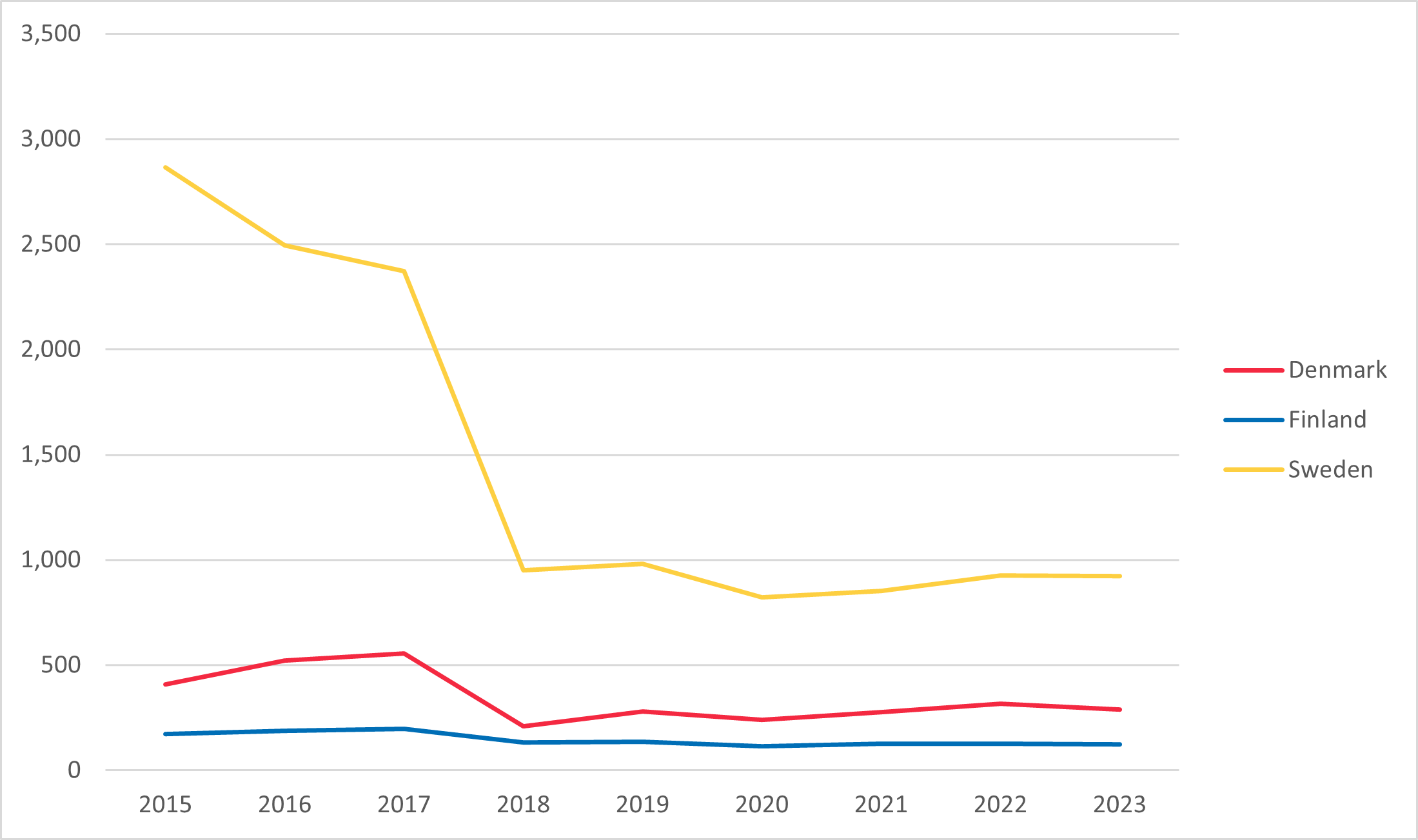
Figure 32: Commuters from Denmark, Finland and Sweden to Norway trained in health care (2015-2023)
Source: Statistics Norway
Source: Statistics Norway
One area with high levels of commuting is the Värmland region in Sweden. In 2020, 4,600 residents in Värmland received a salary from a neighbouring country.
It is important to note that the available statistics do not cover all residents of Värmland who receive a salary from a neighbouring country. The de facto number of cross-border commuters is therefore likely to be even higher than the available data suggest. For a discussion of such limitations, see Region Värmland (2023).
In 2021, the number of Värmland residents who received a salary from abroad decreased to around 3,800, likely reflecting the difficulties of commuting across the border during the pandemic (Region Värmland, 2023). Looking ahead, an improved railway connection between Stockholm and Oslo is expected to reduce the commuting time – for example, between the municipality of Arvika and Oslo – by more than half, which may make commuting to Norway more attractive for a larger number of residents in Värmland (Region Värmland, 2023).
Commuting in Åland
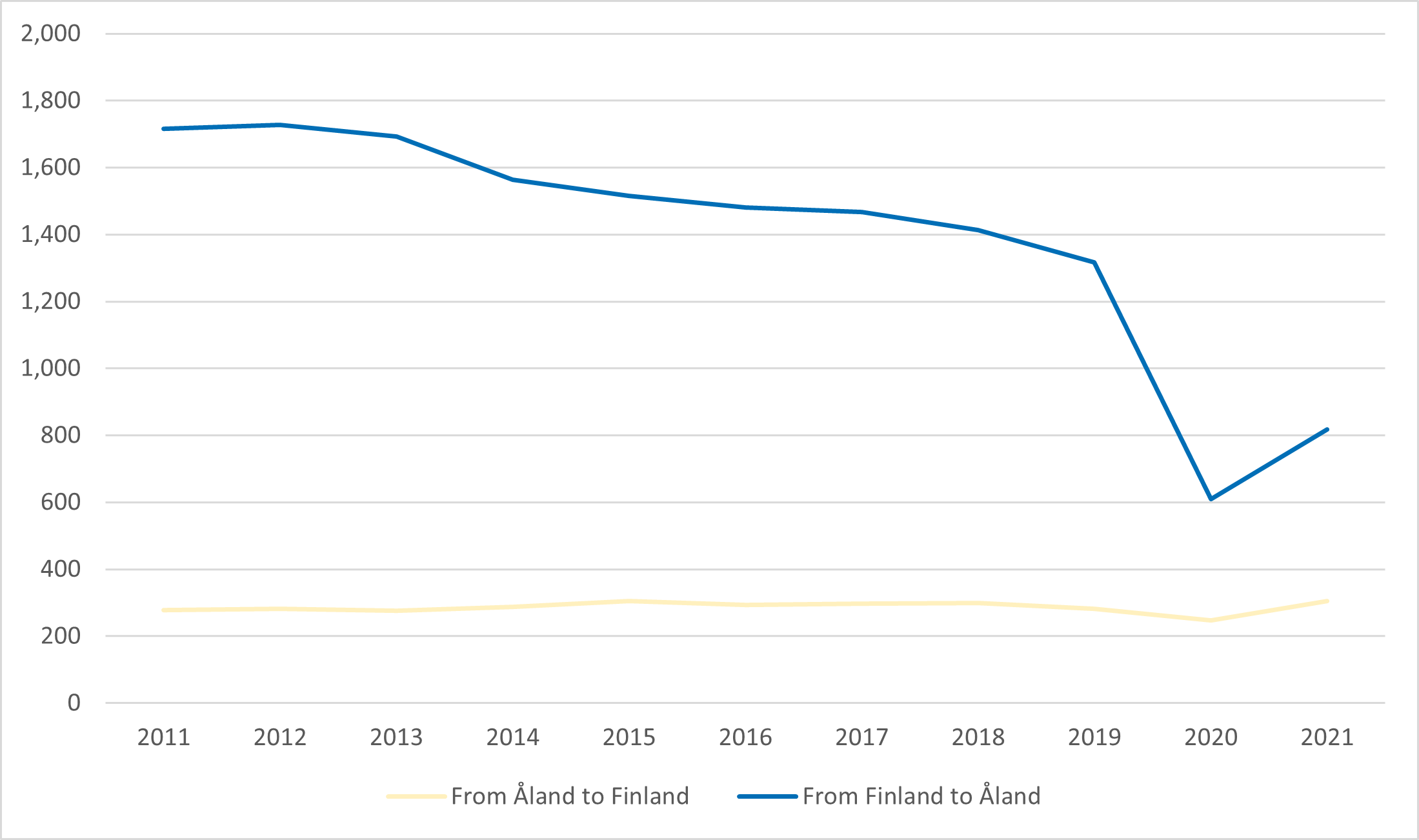
Finally, Statistics Åland shows that the number of commuters who live in mainland Finland and work in Åland is much higher than the number of Åland residents who work in Finland (Figure 33). Over time, the number of commuters from mainland Finland to Åland has, however, declined from around 1,700 in 2011 to around 1,300 people in 2019. With the onset of the pandemic, the number of commuters dropped further to around 600 people. In 2021, the number of commuters somewhat recovered, but remained well below pre-pandemic levels. Among commuters from Finland to Åland, the majority (73%) worked in the transportation and storage sector in 2021, with human health and social work (6%) and public administration and defence (5%) coming in second and third place (Statistics Åland, 2024a). In contrast to commuting trends from Finland to Åland, the number of commuters who live in Åland and work in mainland Finland has remained comparatively stable during the time period considered in Figure 33, fluctuating between 250 and 300 persons. Among those commuters, transportation and storage were popular sectors (24%), as well as professional, scientific and technical activities (11%) and education (11%).
Figure 33: Commuting between mainland Finland and Åland (2011-2021)
In addition to Finland, Åland also has strong links to Sweden (ÅSUB, 2024). A recent analysis shows that 810 young people from Åland were studying in Sweden in 2022 (Statistics Åland, 2024b). That makes Sweden the most popular destination to move to for studies, ahead of Finland, where 559 were studying in the same year.
Overall, the statistics on commuting in selected cross-border regions presented in this section paint a mixed picture. It appears that the number of commuters was on the decline during the 2010s, a trend which accelerated during the pandemic. Since the end of the pandemic, the number of commuters has increased again, with a particularly rapid rise in the Öresund region.