Photo: Fredrik Ohland, Unsplash.com
2. The common Nordic labour market 1954–2024
In this section we will delve into the development of the Nordic labour market since the agreement on the common Nordic labour market was adopted in 1954. How has it evolved over time? What flows of migrants and commuters across the Nordic borders have there been and who are those who have taken the opportunity to work in another Nordic country? We will look into statistics on migration and commuting stocks and flows and will discuss the key elements of the common Nordic labour market. However, we will start by presenting a short background and to the common Nordic labour market.
2.1. The context of the common Nordic Labour market
Nordic common history goes far back, for example, to the Kalmar Union in the 14th century. And while Finland was a part of Sweden until 1809, Norway and Sweden formed a union until 1905. The Scandinavianism was promoted in the 19th century and followed by a wave of Nordism after the Second World War, based on political and cultural collaboration between the sovereign Nordic countries. It resulted in a range of common Nordic agreements and institutions, such as the Nordic Council (1952), passport free Nordic travels (1952) and the Common Nordic labour market (1954) aimed at supporting and facilitating Nordic cooperation and mobility. The Helsinki Treaty in the 1960s and the establishment of a Nordic Council of Ministers in 1971 further deepened Nordic collaboration (Hilson, 2008). The aim of the Helsinki Treaty is to maintain and enhance cooperation between the Nordic countries in the legal, cultural, social and economic fields, as well as transport infrastructure and environmental protection. The signatory Nordic countries have also undertaken to consult one another on matters of common interest that are raised in European or other international organisations and conferences.
However, the golden days of Nordic cooperation in the 1950-1960s were followed by a decline in interest among the Nordic countries as other territorial frameworks for international collaboration competed for political attention. Those include the European Community (EC) established in 1958 and later transformed into the European Union, the European Free Trade Association (EFTA) established in 1960. Due to differing geopolitical contexts and historical experiences, the Nordic countries took different paths (Hilson, 2008; Lindroth, 2021); Denmark became a member of the European Union in 1973, while Sweden and Finland did not join until 1995. Norway and Iceland are members of the European Economic Area (EEA). While Åland is a member of the EU, the self-governing territories of Greenland and the Faroe Islands are not members of the EU or EEA. As of 2024, all Nordic countries are also members of NATO. However, while the EU/EES has legislative power, Nordic cooperation through the Helsinki Treaty is intergovernmental and cannot make legally binding decisions for the Nordic countries. Yet another major difference between Nordic cooperation and the EU pertains to the financial resources allocated to such cooperation. The legislative cooperation within the EU has proven effective and has over time replaced some of voluntary Nordic cooperation (Letto-Vanamo and Tamm, 2015), and Nordic agreements have to a large extent been aligned with European legislation, although it has also been possible to make Nordic exceptions (Leino-Sandberg, Leppävirta & Miettinen, 2016).
The Nordic countries are strong economies with a highly educated population and with innovative and competitive business and industry sectors which put the Nordic countries high in international rankings. The interaction between the Nordic countries is strong; they have a long tradition of being trading partners. Despite the EU single market and increased globalisation, the Nordic countries remain among one another’s top three trading partners.
The vision adopted by the Nordic Council of Ministers in 2019 for its future work, namely that the Nordic Region will become the most sustainable and integrated region in the world (Nordic Council of Ministers, n.d.), the Nordic way of addressing the financial crises (Borring Olesen & Strang, 2015) and the changing geopolitical situation seems to have sparked increased political interest in the Nordic cooperation (e.g. Regeringen, 2021; Regeringen, 2023; Finnish Government, 2024).
One important aspect is the Scandinavian languages which have common features and can be understood across the national borders to some extent. While Swedish is also an official language in Finland, Åland is Swedish-speaking and Danish is taught in Icelandic schools. The Nordic countries also have many other cultural similarities, not least in terms of how society is organised, which is often referred to as the Nordic model of welfare states (see e.g. Petersen, 2019).
Key features of the Nordic labour market
Development of the Nordic welfare states, based on a common set of values such as equality, universality of political and social rights, and popular participation, has resulted in shared characteristics between the countries. This includes internationally high standards of living, a large public sector mainly financed by taxation, a comprehensive system of cash benefits and services in the case of unemployment, and a labour market model based on a high level of organisation in trade unions and employers’ organisations, tripartite agreements between the social partners and collective bargaining. It is also a model that has proven to support stability and structural change (Alsos and Dølvik, 2021; Rolandsson and Ilsøe, 2023).
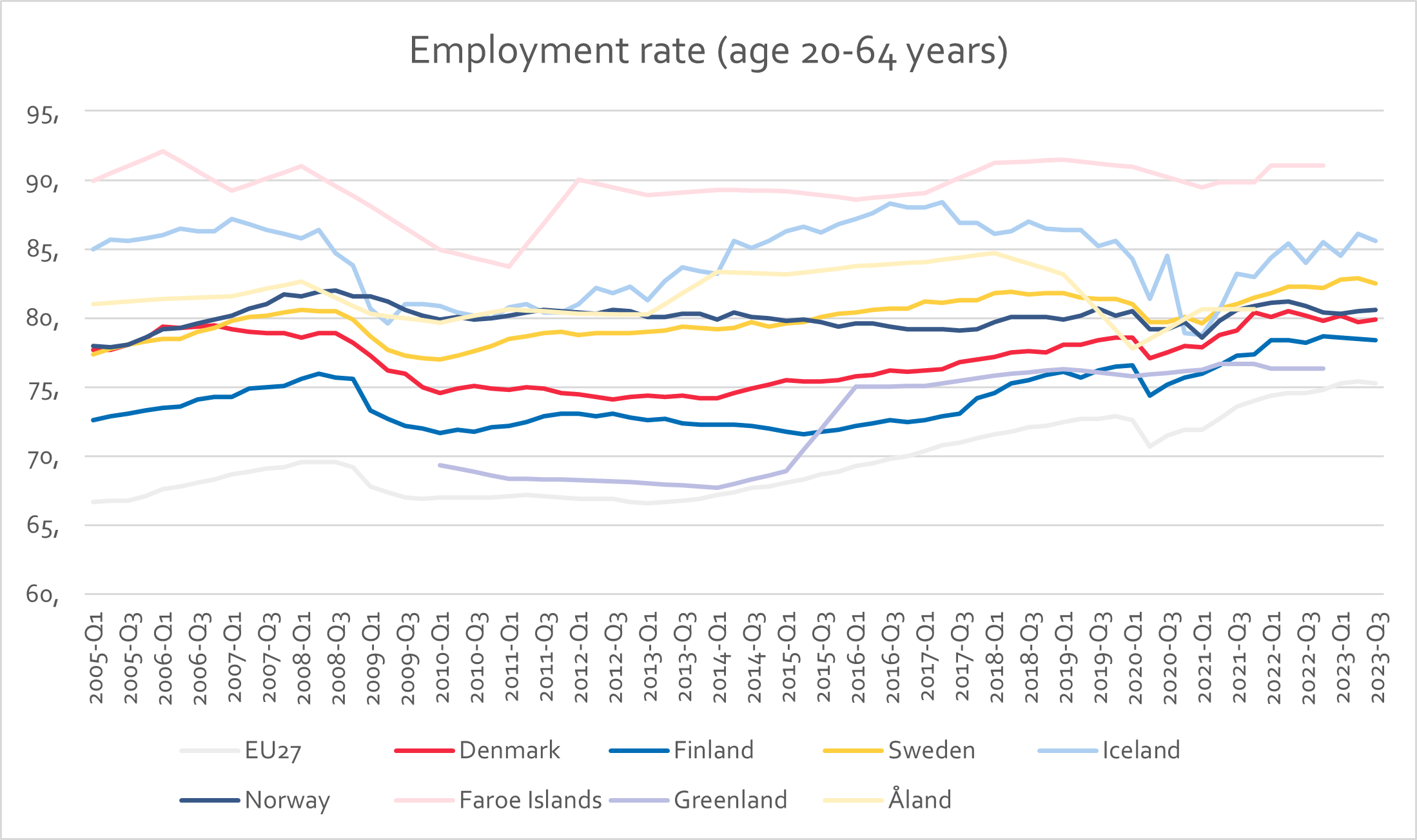
One important element of the Nordic welfare states is high labour market participation, which is also important in terms of sustaining financing of the Nordic welfare state model. Labour market participation has increased during the period examined in this report, partly due to women entering the labour force and increasing numbers of people aged over 65 years working.
Figure 1. Employment rate (20–64 years), Q1 2005–Q3 2023.
Data source: Eurostat and NSIs (Labour Force Survey, except GL and AX).
Data source: Eurostat and NSIs (Labour Force Survey, except GL and AX).
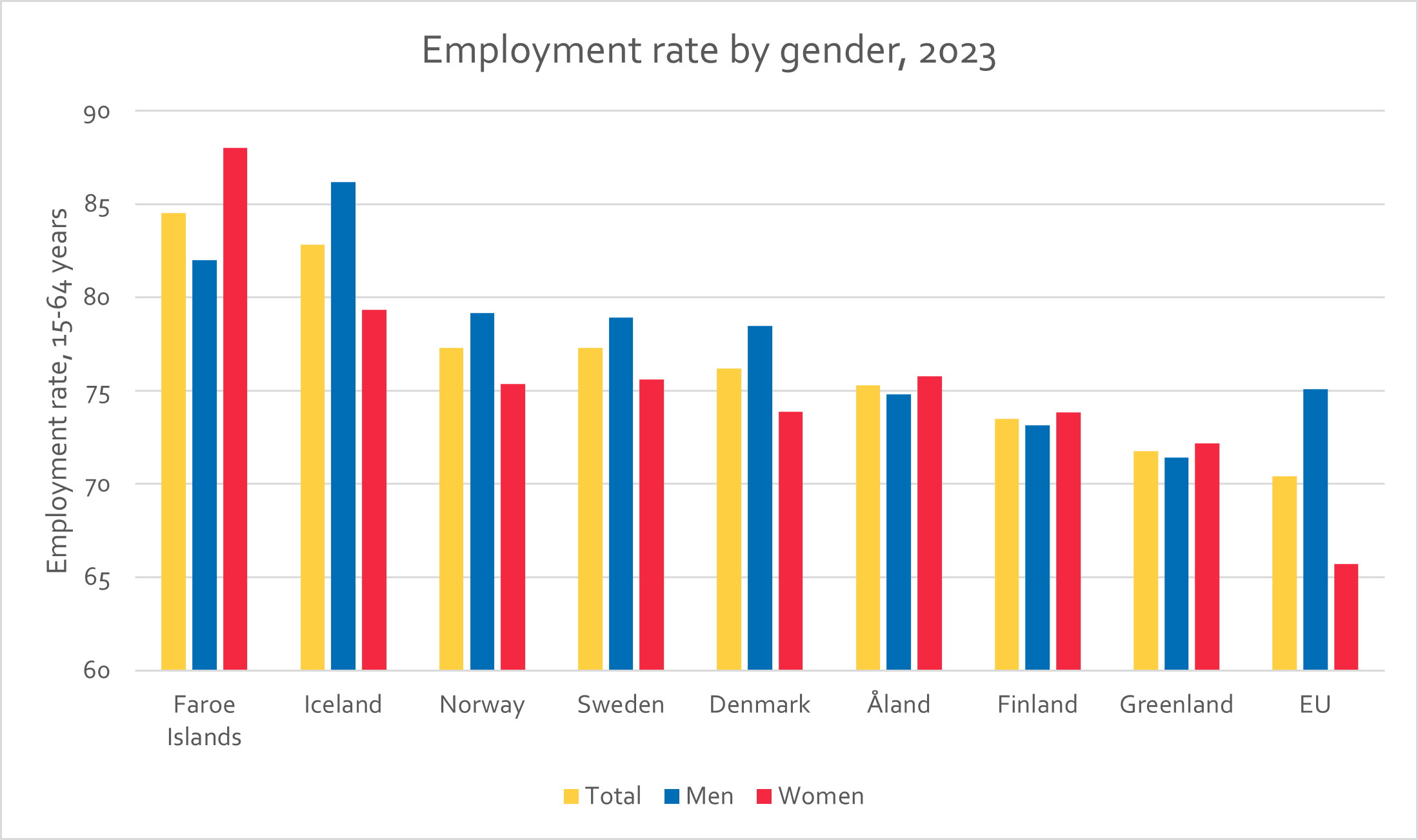
Another key characteristic of the Nordic labour market is a strong gender balance on the labour market. Nonetheless, while Nordic countries are leading in many aspects of gender equality – as is most evident in terms of employment – remaining inequalities such as gender segregation on the labour market seem difficult to tackle (OECD 2018; Andréasson, Randall and Norlén, 2020).
Figure 2. Employment rate by gender 2021 (November).
Data source: Nordic Statistics. Åland: ÅSUB
Data source: Nordic Statistics. Åland: ÅSUB
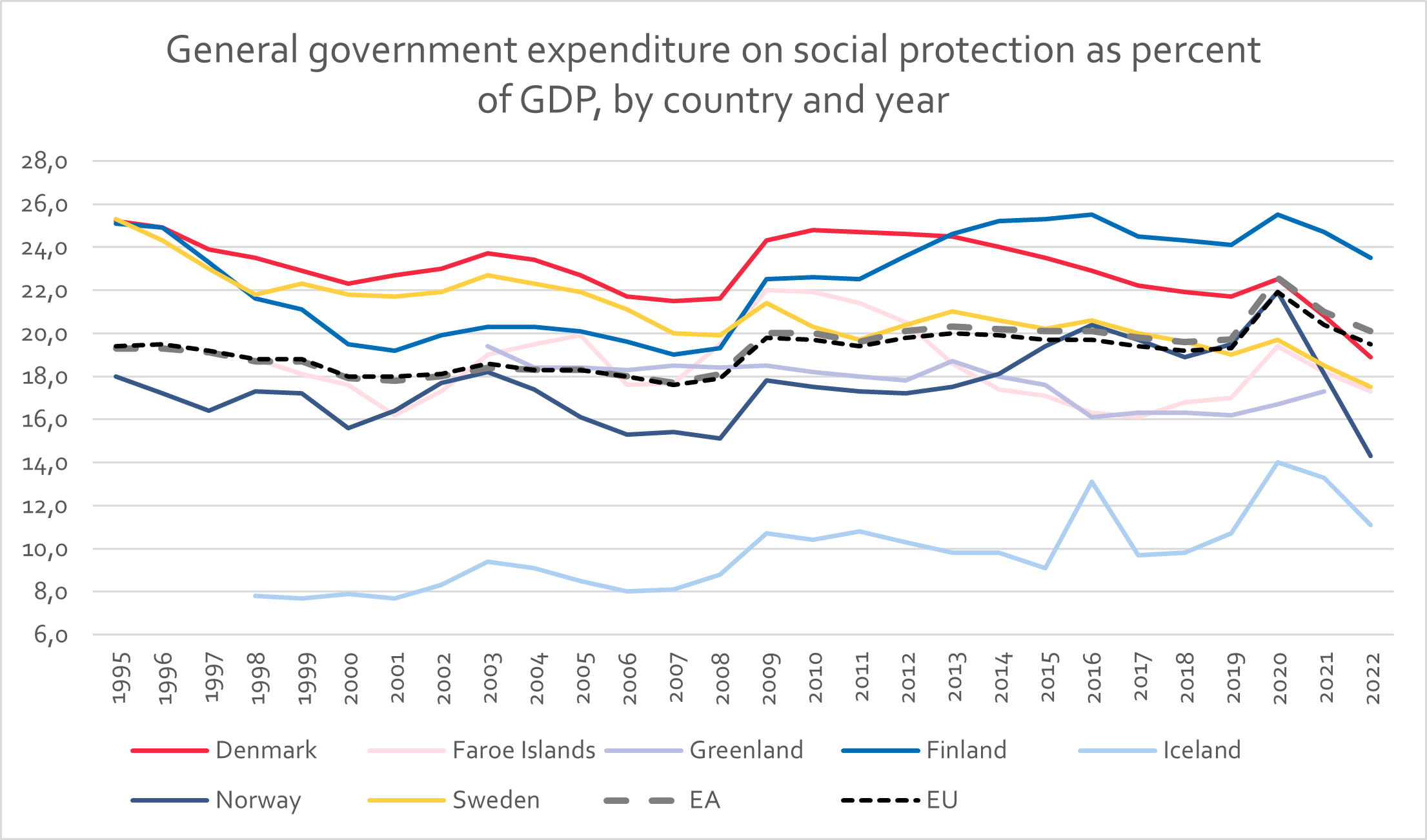
The successive development of social legislation and measures to support development of the Nordic welfare states started at the turn of the 20th century with social legislation – including insurance for industrial accidents, as well as sickness, pension and unemployment insurance. Nonetheless, while the Nordic countries share basic values and have many shared features in terms of the labour market, they have also developed independently and at different pace, for example as regards policies in the labour market and the financing of the welfare sector. Social expenditures, measured as a share of GDP (which is sometimes used as an indicator for the level of development of the welfare state) increased in all Nordic countries from 1950, and particularly during the period 1970-1980 (Petersen, 2019). However, since 1995, social expenditure as a share of GDP has shown a more diverse pattern across the Nordic territory (Nordic Statistics, 2024).
Figure 3. General government expenditure on social protection as percent of GDP, by country and year.
Source: Nordic Statistics, 2024, https://pxweb.nordicstatistics.org:443/sq/5acc5342-aa8f-4db1-a590-9e753d7c48b7).
Source: Nordic Statistics, 2024, https://pxweb.nordicstatistics.org:443/sq/5acc5342-aa8f-4db1-a590-9e753d7c48b7).
The Nordic model in the labour market area, which includes macroeconomic policies aimed at full employment, fostering of collective bargaining and universal welfare systems, including access to re-skilling and up-skilling, has played a significant role in previous transitions and is considered to be a critical factor also for the future of work in the Nordic Region (Alsos and Dølvik, 2021; Jesnes et al. 2020). The Nordic countries show many similarities with regard to promoting active labour market policy, which implies a combination of institutional support and benefits and in-cash government benefits. The institutional set-up and the type and levels of support, however, vary between the Nordic countries (Petersen, 2019; Nordic Health and Welfare Statistics, n.d.).
To address the current challenges of the green transition and its impact on the labour market, various initiatives have been taken at differing levels of government, including at the Nordic level, as well as by the business sector, employers’ organisations and trade unions, to map out future educational and skills needs, organise collaboration and implement measures and roadmaps, (Lundgren et al., 2023; Nordic Council of Ministers, n.d.).
A key feature of the Nordic labour market, is the application of collective agreements to regulate wages and working conditions between the social partners (i.e. trade unions, employers' organisations and to a limited extent the government) compared to the European continental law-based model (Kristiansen, 2019). The OECD has suggested that the high economic performance and standards of living in the Nordic countries can partly be attributed to the system of collective bargaining and strong social partners (Høgedahl, Nergaard and Alsos, 2022).
Despite an internationally downward trend of unionisation, in international comparison the Nordic countries have a high union density: in 2016 the figure was around 65% in Denmark, Finland and Sweden, 84% in Iceland and 52% in Norway. As many as 80-90% of employees are covered by collective bargaining agreements (Logue, 2019). However, within the Nordic Region, there are also substantial differences between the countries with regard to the implementation of collective agreements and aspects such as working conditions, settlement of disputes, systems for financing unemployment insurance and the role of the trade unions (Petersen, 2019; Høgedahl, Nergaard and Alsos, 2022). As a result of European Union membership and implementation of EU regulations such as employment law, in recent years European courts and EU legislation has however become more prominent in the Nordic countries (and as members of the European Economic Area, Norway and Iceland are bound by the same EU legislation as the EU members Denmark, Finland and Sweden) (Kristiansen, 2019).
Nordic agreements and institutions – paving the way for a joint labour market
Nordic cooperation is based on several common agreements and declarations. The Helsinki Treaty forms the basis for Nordic cooperation in the Nordic Council and Nordic Council of Ministers. It was signed by Denmark, Finland, Iceland, Norway and Sweden in 1962 and has since been amended several times, with the latest amendments being in 1995 (Nordic Council of Ministers, n.d.)
The Treaty mainly covers legal, cultural, economic and social cooperation. That includes cooperation on the labour market, transport, communications and environmental protection. While all the articles of the Treaty aim to enhance Nordic cooperation and increase mobility and interaction in various areas – for example through the removal of barriers to trade and consultation on economic policy and cross-border transport – there are two articles in particular relating to mobility on the common labour market:
“The High Contracting Parties shall seek to preserve and develop further the common Nordic labour market in accordance with the guidelines drawn up in previous Agreements. Employment services and vocational guidance shall be co-ordinated. There shall be a free exchange of trainees (…)”. (Article 14, Helsinki Treaty).
“The High Contracting Parties shall seek to preserve and develop further the common Nordic labour market in accordance with the guidelines drawn up in previous Agreements. Employment services and vocational guidance shall be co-ordinated. There shall be a free exchange of trainees (…)”. (Article 14, Helsinki Treaty).
Article 15 concerns social benefits for citizens residing in another Nordic country:
“The High Contracting Parties shall endeavour to ensure that the citizens of each Nordic country, when resident in another Nordic country, shall, as far as possible, enjoy the same social benefits as are provided for the citizens of the country of residence.” (Article 15, Helsinki Treaty).
“The High Contracting Parties shall endeavour to ensure that the citizens of each Nordic country, when resident in another Nordic country, shall, as far as possible, enjoy the same social benefits as are provided for the citizens of the country of residence.” (Article 15, Helsinki Treaty).
To complement the Helsinki Treaty and further support Nordic integration, other agreements and joint declarations have been adopted, such as the agreement on a common Nordic labour market (1954) (which will be described in more detail below), passport-free travel (1952) and the Nordic Passport Control Agreement (1958), the Nordic convention on social security (1955) the agreements on the legal status of Nordic institutions and their staff (1987/1988) and the right to use another Nordic language in the Language Convention (1981) (Nordic Council of Ministers, n.d.).
The first agreement on a common Nordic labour market was signed in 1954. The current agreement was updated in 1982 and includes a protocol signed by the five Nordic countries (Nordic Council of Ministers, n.d.). Under the agreement, nationals in the Nordic countries have the fundamental right to take up a job in another Nordic country. The preamble states, inter alia, that the countries shall support a balanced labour market and equality in working life between women and men. The first articles state the right to work in another Nordic country without a work permit and the obligation to treat other Nordic nationals the same way as national employees. National public employment services shall support persons seeking employment in another Nordic country, as well as employers seeking employees from another Nordic country. Information between the countries on employment, vacancies, unemployment, forecasts and anticipated trends on the labour market, information on planned measures to maintain or achieve full employment and information on working and living conditions shall be exchanged by the national authorities regularly. Furthermore, the authorities shall provide information on regional and national development plans that could imply major changes in the demand for labour from another Nordic country (Article 4, Agreement on Common Labour Market).
To further support a common Nordic labour market, that agreement was followed by other conventions and declarations from the 1960s and onwards, such as on validation of credentials for public sector occupations in the field of healthcare (Pedersen, Røed & Wadensjö, 2008), the Nordic agreement on taxation (1996), and in the 2020s declarations with regard to changing labour relations and life-long learning in response to digitalisation and the green transition (Nordic Council of Ministers, n.d.)
To implement the agreement, a Nordic Labour Market Committee was appointed. According to the agreement, the committee shall be constituted of two representatives from each country and report to the Nordic Council of Ministers for Labour. The main function of the committee is to observe trends on the Nordic labour market and discuss labour market policy measures, submit proposals for measures of common Nordic interest, follow migration patterns between the Nordic countries and suggest policy measures for cooperation between the national labour market authorities. Furthermore, it shall support exchange of information, promote Nordic comparability of national labour market statistics and maintain contact between the social partners in the Nordic Region.
The Nordic Council of Ministers for Labour (MR-A) outlines the priorities for the cooperation in the Nordic Councils of Ministers in the field of the labour market. Taking the previously mentioned Nordic vision as a point of departure, the program for the period 2020-2024 focuses on long term challenges related to technological developments and digitalisation and the green transition with the aim of sharing knowledge, best practice and contributing to development of labour market policies in the Nordic countries. The Nordic Councils of Ministers for Labour is supported by the Nordic Council of Ministers Committee of Senior Officials for Labour (EK-A) which observe trends and discuss labour market policy measures, and by the previously mentioned Nordic Labour Market Committee. Finally, there is also an informal Nordic cooperation between the national public labour authorities in the Nordic countries.
Nordic organisations and institutions supporting the common labour market
Apart from joint Nordic institutions targeting Nordic labour market issues such as the previously mentioned Nordic Council of Ministers for Labour, the Committee of Senior Officials for Labour, and the Nordic Labour Market Committee, Nordic cooperation benefits from several other institutions aimed at facilitating interaction and mobility across the Nordic borders, of which a few of the most important are mentioned here.
The Nordic Council, the official body for inter-parliamentary cooperation between the Nordic countries was established in 1952. With its 87 members, its advisory role to the Nordic Council of Ministers and the right to hear the national Nordic governments, the issues of Nordic mobility and integration in various fields are recurrent themes on the agenda of the Nordic Council.
The Freedom of Movement Council (Gränshinderrådet) is composed of ten members representing the Nordic countries and self-governing territories, the secretariat of the Nordic Council of Ministers and the Nordic Council. It was established in 2014 with the aim of identifying and helping to eliminate cross-border mobility obstacles. It currently focuses on five areas; digitalisation, validation of skills and education, cross-border statistics, census and tax-related cross-border barriers. An analysis of how the council’s work can be further improved is expected to be presented and further discussed by the Nordic Council of Ministers in the second half of 2024 (Nordiska ministerrådet, n.d.).
The Freedom of Movement Council administers a database of cross-border obstacles, which are reported on by Info Norden and the cross-border information services, offices serving to share information and assist individuals and firms that wish to study, work or do business in another Nordic country. According to the latest annual report from the Freedom of Movement Council, five cross-border obstacles in different areas were resolved in 2023 (Nordiska ministerrådet, 2024), and further analyses of obstacles related to taxation (which is often mentioned as a key area for increasing cross-border mobility) have been conducted (Lundgren & Rasborg, 2023).
Nordic Statistics is a database with statistics from the national statistical offices. It is regularly updated in collaboration between the Nordic countries and the Nordic medical and social statistical committee (Nomesco-Nososoco), which is a permanent committee under the Nordic Council of Ministers and the Nordic Committee on Social Policy. It was set up to coordinate the social statistics of the Nordic countries and to make comparative analyses and descriptions of the scope and content of social welfare measures. The Committee is composed of three representatives from each country, as well as a number of substitutes.
While Nordplus co-finances Nordic exchange and cooperation in the field of education, Nordjobb works to increase mobility and knowledge about Nordic languages and culture by providing information and supporting young people taking up a job in another Nordic country.
However, EU-funded institutions and initiatives aimed at removing barriers to trade and free movement, such as Solvit and b-solutions, and the European Labour Authority (ELA) also contribute to solving cross-border obstacles between the Nordic countries (Europeiska kommissionen, n.d.; Association of European Border Regions, n.d; European Labour Authority, n.d.). In 2022, the Swedish National Board of Trade identified five key areas for further Nordic cooperation to remove barriers, namely mutual recognition of goods, European standardisation, implementation of the EU Services Directive and of EU law, and increased cooperation between the national Solvit organisations, including regular exchange of information with the Nordic Freedom of Movement Council (National Board of Trade Sweden, 2022).
While the European Labour Authority (ELA) works to enable businesses and citizens to reap the benefits of the internal market by ensuring the enforcement of EU rules regarding labour mobility and the coordination of social security, the European Employment Services (EURES) is a network of employment services in the EU and EES area that works to facilitate free movement by providing information and employment support services to employers and workers across Europe (European Labour Authority, n.d.).
Finally, in this context should also be mentioned the Nordic Council of Ministers’ vision which was adopted in 2019, aiming at becoming the most integrated and sustainable region in the world by creating a green, competitive and socially sustainable Nordic Region in 2030. The vision guides the work of the institutions of the Nordic Council of Ministers. It is frequently referred to by other organisations and stakeholders involved in Nordic cooperation, and its progress is evaluated on a yearly basis, including indicators pertaining to the common Nordic labour market focusing on migration, commuting and international trade (Nordic Council of Ministers, 2023).
To sum up, despite differences between the Nordic countries in the labour market field, they share many key features and are supported by a rich array of institutions and initiatives, which – as part of their agenda or as their chief mission – aim to facilitate the mobility of workers and integration of the Nordic labour market.