Relocate was a project aiming to identify ways of attracting workers beyond commuting distance. The project targeted long-term unemployed, newly arrived immigrants and people with disabilities. (Photos: iStock)
8. SWEDEN
Introduction
There is broad agreement that the issue of skills supply – that is, problems associated with finding employees who match the requirements of available jobs – is an acute and increasing concern across all regions and sectors of the Swedish economy (e.g. Berström et al. 2023; SKR 2022; Tillväxtanalys 2024). Indeed, it has been cited as the single greatest barrier to the growth of firms (Företagarna 2022).
While there is a general macroeconomic tendency in Sweden towards increased vacancies coupled with high unemployment, mirroring the discrepancy between skills demand and skills supply (Forslund 2024), such challenges are often accentuated in rural regions, which generally have thinner labour markets (fewer workers and a less diverse industry mix), ageing populations and low net migration rates. This trend has been exacerbated by demand shocks in municipalities such as Skellefteå, Mariestad, Boden and Gällivare caused by large investments in battery factories and low CO2-emission steel plants.
Rikard H. Eriksson
Department of Geography, Centre for Regional Science (CERUM), Umeå University
Department of Geography, Centre for Regional Science (CERUM), Umeå University
In Norr- and Västerbotten counties alone, predictions have been made that around 20,000 direct jobs will be created, with further indirect jobs to follow in response to demand in related activities and welfare (Larsson 2022). Although these are perhaps extreme cases, they nevertheless highlight the labour market’s geographically disparate nature, with both demand and supply dependent on functional specialisation and existing labour market structures (e.g. Elekes et al. 2023; Hane-Weijman et al. 2022).
Against the above backdrop, the following sections expand on the situation facing Sweden’s rural regions. Following a brief overview of rural variations in labour supply, the chapter presents a number of concrete examples of how relevant actors are attempting to address the challenges faced in this regard, before concluding with a call for better coordination and knowledge gathering.
Skills supply in rural Sweden
Increasing unemployment and vacancies
Discussions around skills supply often focus on the difficulties rural areas face in retaining and/or attracting highly educated (‘high-skill’) workers. This partly relates to the privileging of high education (university) in Sweden, in contrast to the greater emphasis placed on vocational training in, for example, Denmark and Finland (Forslund 2024). Reducing the skills-supply question to a high-skilled/urban vs low-skill/rural mismatch is, however, overly simplistic, as high-educated couples working in education, health and care are over-represented among those migrating from large urban regions to smaller (rural) regions in Sweden (Sandow & Lundholm 2021).
The reason for this is twofold. On the one hand, jobs in these sectors – as well as public administration – are relatively evenly distributed geographically. On the other hand, such workers seldom receive an urban wage premium, which can help mitigate the difficulties of finding affording housing in larger urban areas. Thus, given the scarcity of job opportunities in other sectors, rural to urban moves are made more attractive (Hansen & Eriksson 2023).
Moreover, while educational attainment in Sweden is relatively high, the country’s sizeable demand for workers applies to all skill levels, meaning possession of a university degree is not always relevant to meeting skills demands. This perhaps partly explains why, compared to its Nordic neighbours, Sweden fares less well on the Beveridge curve, displaying a concurrent increase in both unemployment and vacancies (Forslund 2024). In the case of Skellefteå municipality, for example, increased skills demand generated by the Northvolt establishment directly, as well as indirectly in other local sectors, predominantly concerns workers with either a gymnasium or a short post-gymnasial (vocational) education. Consequently, there is a clear tendency towards over-education, with university graduates increasingly taking on jobs that have no specific skills requirements beyond brief introductory training (see e.g. Blombäck et al. 2024).
Lack of skills or shortage of workers?
As discussed by Tillväxtanalys (2024), it is often difficult to assess whether the skills shortages professed by employers are the result of a shortfall of skills in the workforce (current and prospective employees) or, in fact, a shortage of workers. While the former concerns potential mismatches in education and demand, the latter stems from a shortage of workers in absolute terms, exacerbated by an ageing population. The latter therefore has less to do with skills per se, but rather an underlying demographic situation in which smaller numbers of people are entering the workforce compared to those leaving due to retirement. SKR (2022), for example, estimates that the number of people in Sweden aged over 80 will rise by 50% during the coming decade, increasing the demand for both welfare services and new workers to replace retirees.
To successfully manage this generational shift, the number of employees involved in elderly care alone will have to increase by 30%. In effect, around 410,000 additional people will be required in Sweden’s municipalities and regions (including private actors in welfare sectors), which corresponds to roughly half of everyone entering the labour market over the next decade having to work in either care (municipalities) or health (regions). This comes at a time when high retirement rates are also expected in other sectors, such as manufacturing (Berström et al. 2023).
Impact of a ‘new productive narrative’
Given that Sweden’s rural regions generally have older populations than large urban (university) regions, securing the skills required for maintaining welfare, as well as those demanded by the private sector, is particularly problematic. This is especially so in regions that are also experiencing demand shocks due to rapid re-industrialisation. Adjei et al. (2024) predict that, based on previous flows of workers following expansions in manufacturing and mining, about 8% of the current public sector workforce may be lost to these sectors in Norr- and Västerbotten. The authors attribute this not only to wage differences and employment conditions, but changes in attitude and policy discourses regarding desirable futures (see e.g. Valestrand 2018).
Thus, while rapid growth in manufacturing and strong local mobilisation around a ‘new productive narrative’ does not primarily affect higher-skilled public sector workers (teachers, nurses or medical doctors), it nevertheless shapes the local supply of workers by affecting school choices and labour market entries. Rönnlund and Tollefsen (2023), in interviewing young adults in a couple of northern municipalities making the transition from school to work, find that an increasing share of them are being swayed by such narratives to opt for careers in manufacturing or related activities. This in turn limits the supply of workers for local welfare jobs.
The urban–rural divide in job market transitions
When it comes to labour market supply and demand in Sweden, there are considerable regional – especially rural – variations. As Figure 1 demonstrates, the population of the country’s metropolitan municipalities and their environs has almost doubled since 1950, growing at almost twice the national rate. Over the same period, the population of larger urban regions (typically housing a university) and their environs has grown close to the national average, while that of small urban areas has largely stagnated. Rural regions, by contrast, have undergone a steady decline in population. Given Sweden’s persistently low inter-regional migration rates – beyond migration to and from higher education – these variations strongly condition the local supply of labour (Lundholm 2007).
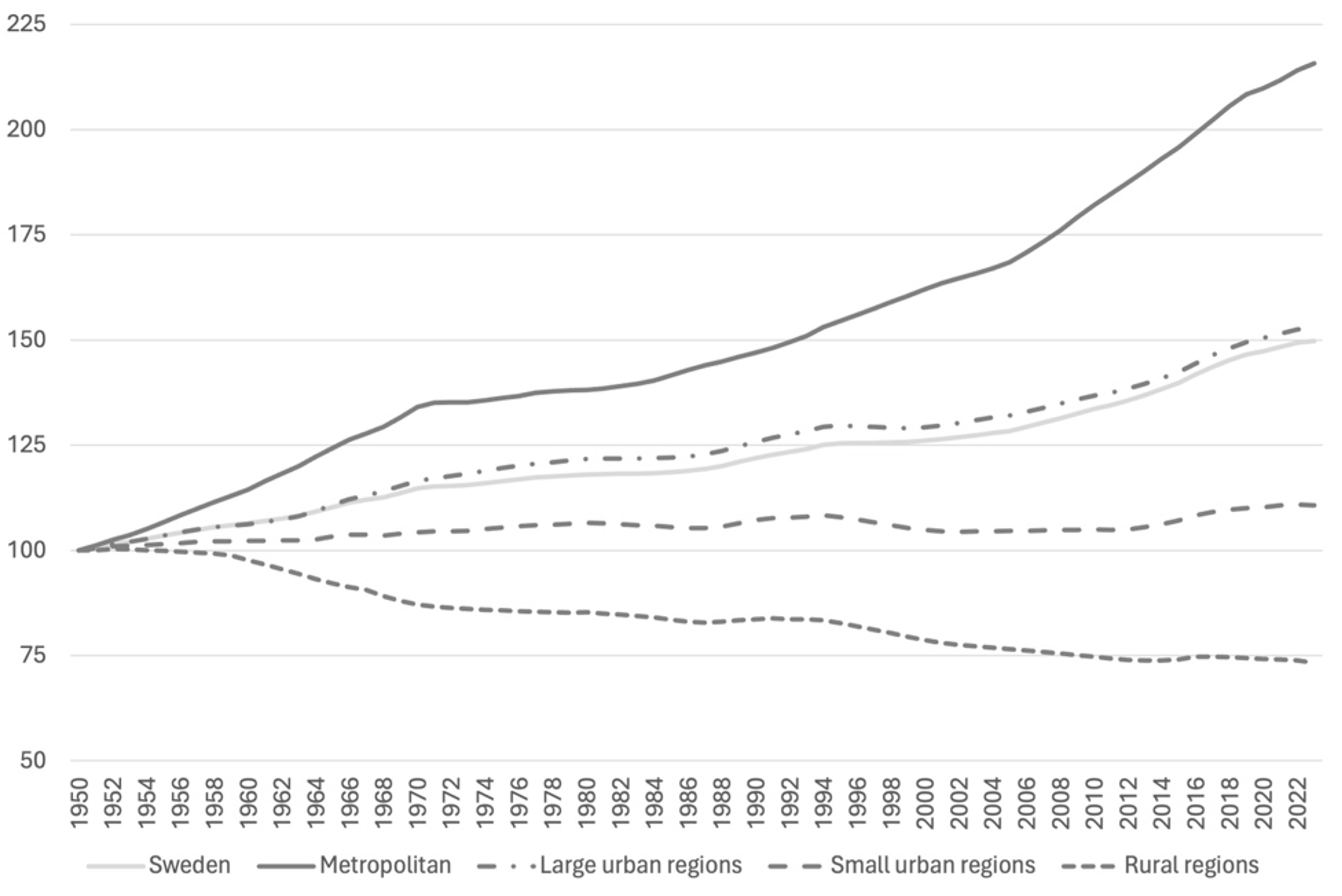
Figure 8.1. Population growth in Sweden 1950–2022 (national average, metropolitan, large urban, small urban and rural municipalities).
Source: Statistics Sweden (population data).
Source: Statistics Sweden (population data).
Note: Indexed (100) on 1950. Metropolitan regions consist of the municipalities of Stockholm, Göteborg and Malmö, as well as their commuting areas (A1 and A2, N=46); large urban areas consist of large cities (40,000–200,000 people), as well as their commuting areas (B3, B4 & B5, N=120); small urban areas consists of smaller cities (15,000–40,000 people), as well as their commuting areas (C6 & C7, N=78); rural regions consists of small rural areas with limited commuting (C8 & C9, N=56), as defined by SKR (2023).
The divergence between urban and rural regions is particularly evident during the period of recovery from the early 1990s recession onwards. Andersson et al. (2018), in deconstructing the geographies of job creation and destruction during this time, show that the structural shift from manufacturing to service created roughly 1.5 service jobs for every destroyed manufacturing job across Sweden as whole. However, in the country’s rural regions, this figure shrank to just 0.5, compared to 2 in the largest urban regions. Over time – coupled with higher university enrolment (and thus migration to such areas), alongside a tendency towards centralisation among governmental agencies over recent decades (Hansen & Eriksson 2023) – this has led to clear regional divides in terms of skills supply and demand. More specifically, the skill levels of rural labour markets have become less diversified (see also Eriksson & Hansen 2013).
It should be noted that variations in unemployment and age structure vary both between and within different region types. Such variations condition what types of labour market supply challenges are present in a given environment. At a county level, unemployment in 2023 (Swedish mean of 6.4%) was highest in Skåne (8.5%), Södermanland (8.5%) and Gävleborg (8.4%), and lowest in Västerbotten (3.8%), Norrbotten (4.2%), Gotland (4.3%) and Jämtland (4.4%). These figures emphasise the spatial mismatch in labour supply and demand: while there is high demand for workers in northern Sweden, supply is restricted due to low unemployment rates and an ageing population. Bridging the geographical divide in labour supply and demand is made even more difficult by the relatively low propensity of unemployed people to migrate between regions, with social networks (friends, family etc.) often assuming greater importance when it comes to relative labour market marginalisation (Andersson et al. 2020).
Figure 8.2 highlights these differences by – akin to the Beveridge curve – comparing unemployment with vacancies in Swedish municipalities. Separating the different groups of municipalities reveals the heterogeneity within each municipality type, thereby underscoring the diverse regional challenges faced in relation to matching and skills supply.
Comparing the larger regions in the upper panels with the smaller and/or rural regions in the lower panels, it can be seen that the larger cores (especially Malmö) tend to cluster towards the right (high unemployment). In most of the core regions (blue), this is coupled with high vacancies, the exceptions being northern cores such as Umeå, Östersund and Luleå, which have relatively high vacancies and relatively low unemployment. There are also a number of commuting regions (red) with high unemployment and low vacancies, which can be explained by the fact that although such regions host a relatively large number of residents, a sizeable proportion of jobs are located in the respective core. Thus, the fitted line for larger urban regions indicates a situation of low vacancies and low unemployment in their residential vicinities, together with a skills mismatch (high unemployment and vacancies) in urban core regions.
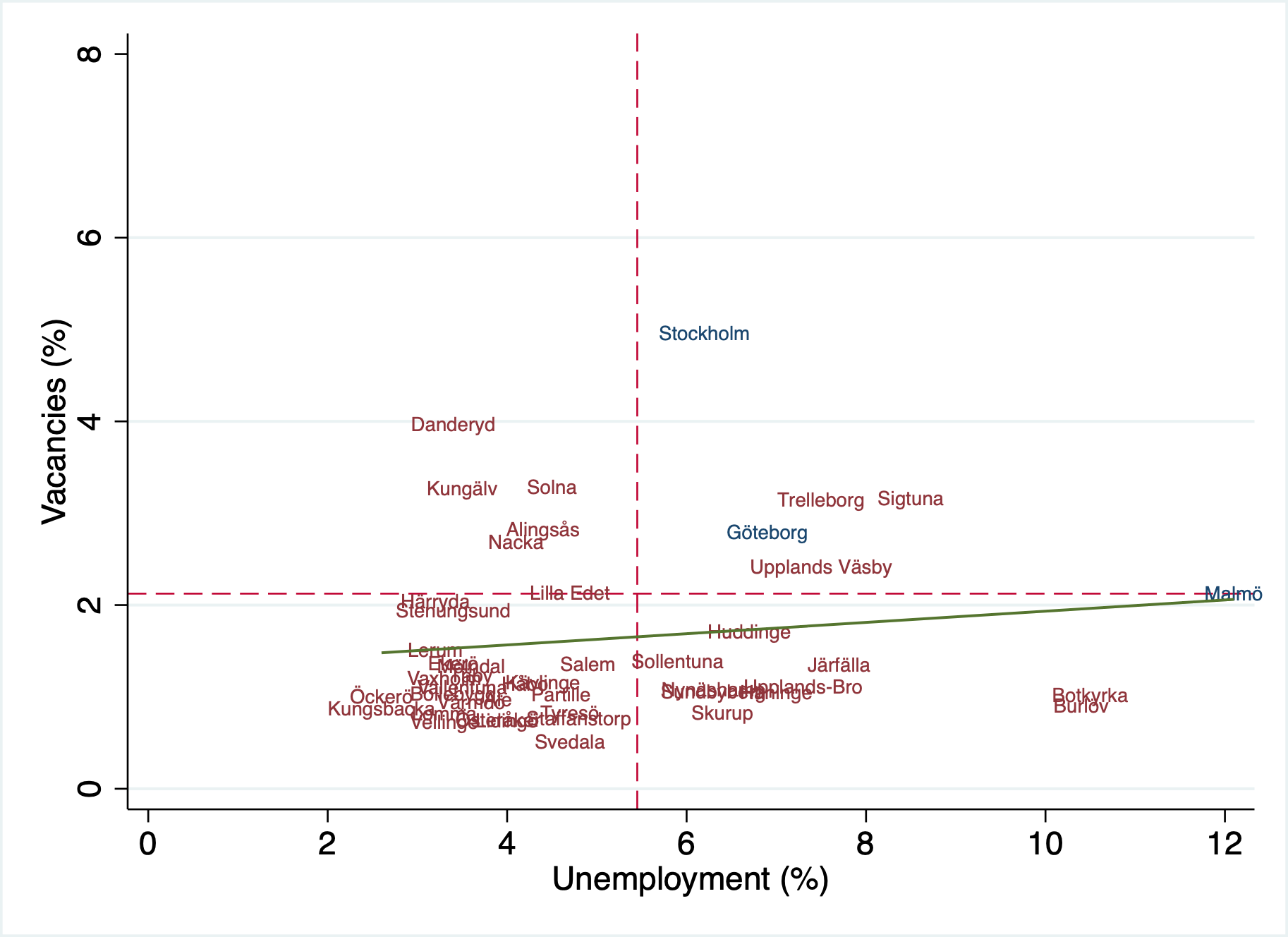
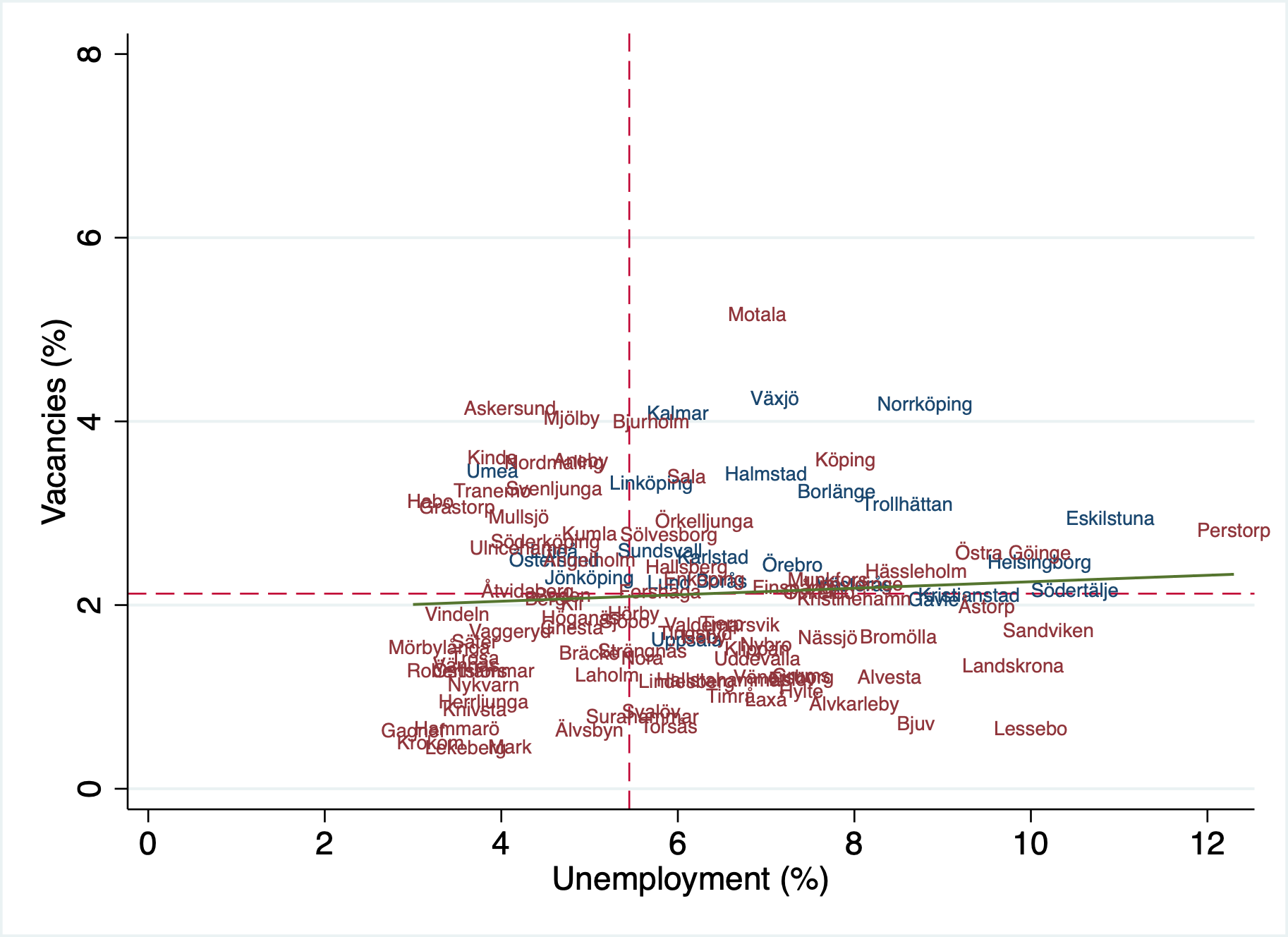
Figure 8.2. Unemployment rate (x-axis) and vacancy rate as share of population aged 20–68 (y-axis) in metropolitan (upper-left), large urban (upper-right), small urban (lower-left) and rural (lower-right), 2023.
Sources: Platsbanken and Arbetsförmedlingen.
Sources: Platsbanken and Arbetsförmedlingen.
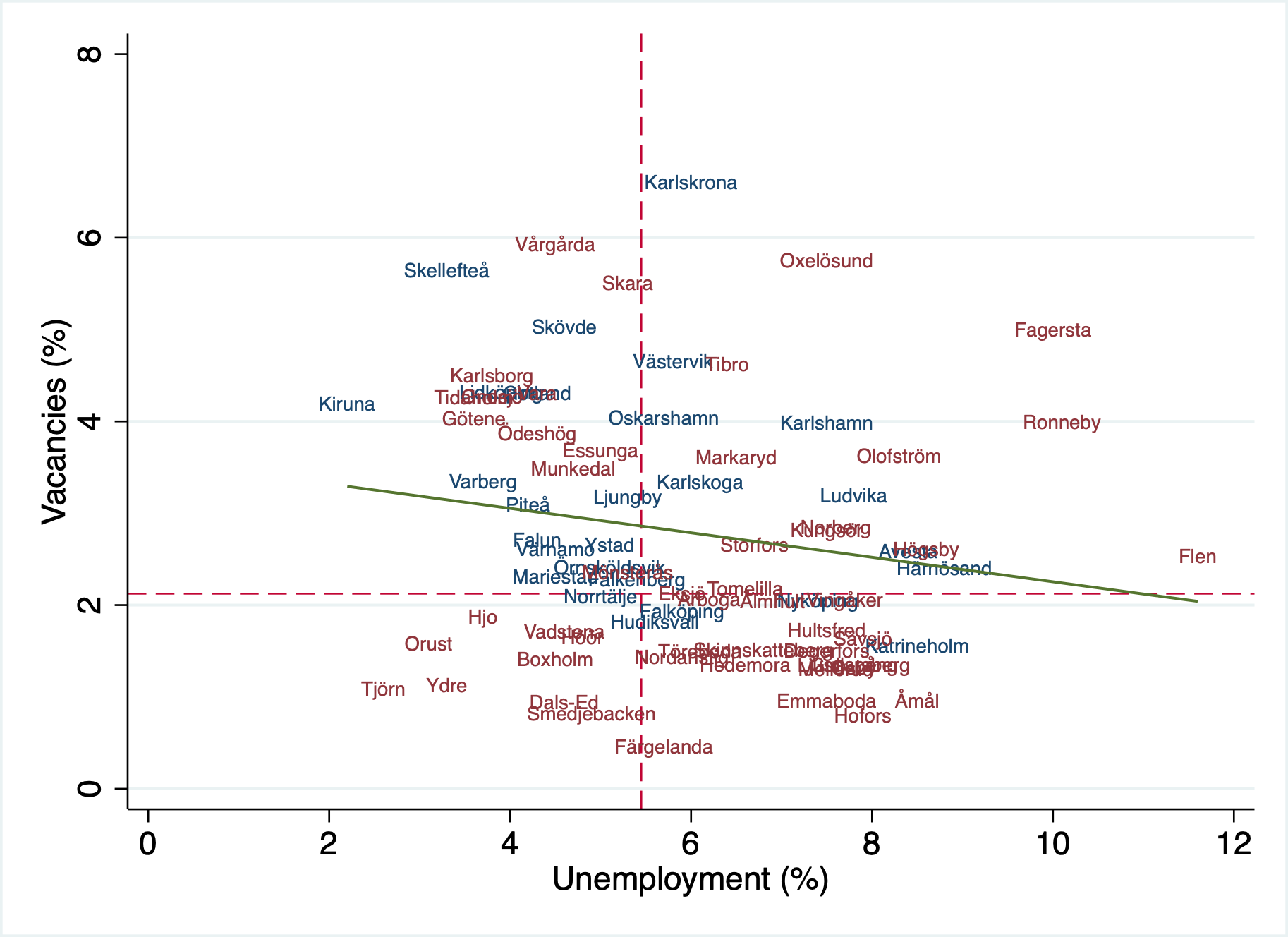
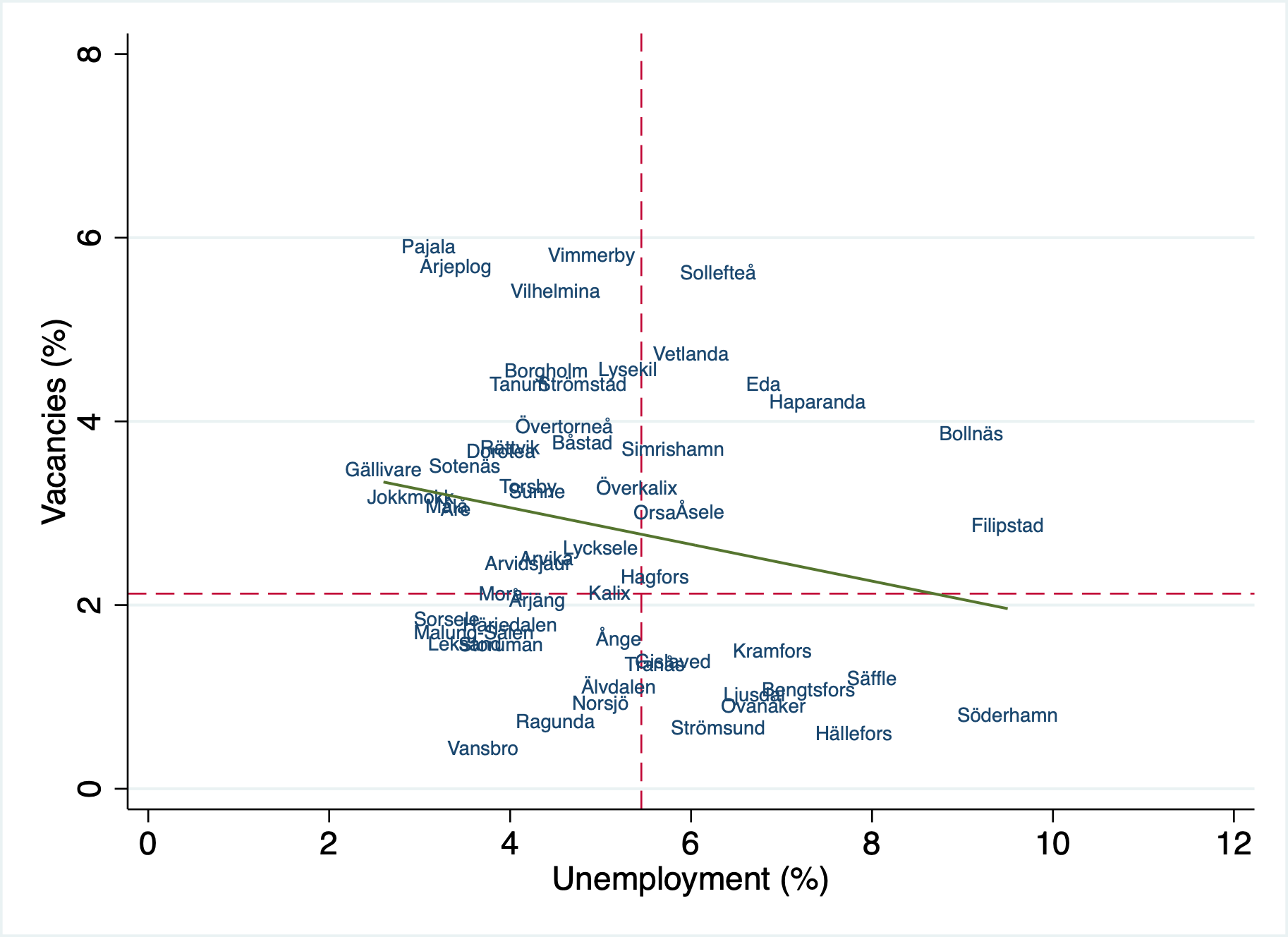
Notes: Blue represents core regions and red commuting vicinities. Dotted lines represent median values on the respective axis and the green line fitted values. Same regional division as in Figure 1. Vacancies defined as number of vacancies in relation to number of working age persons (16–64 years old) as of February 2023. Unemployment defined as share of the register-based workforce classified as unemployed or in active labour market programme
Moreover, although local pockets of potential skills mismatch can be found in small urban and rural regions (e.g. Fagersta, Ronneby and Bollnäs), the fitted lines of these regions suggest a reverse polarised tendency compared to the larger urban regions, as they are clustered in either the upper-left (low unemployment and many vacancies) or lower-right (high unemployment and few vacancies) quadrant. In terms of small urban regions, low vacancy numbers are particularly apparent in the commuting vicinities of the smaller cores. However, the polarised tendency of either high unemployment or many vacancies is also evident in rural regions, which tend to have more local labour markets (i.e. low commuting).
Thus, while mismatches between unemployment and available jobs can be viewed as an internal urban phenomenon partly connected to concentrations of, on the one hand, dwellings and, on the other, jobs, a more diverse pattern is evident when it comes to (small) rural regions. In the latter case, there tends to be either high numbers of vacancies but few available workers (e.g. Skellefteå, Kiruna, Pajala, Gällivare and Vimmerby), or high unemployment with few vacancies (e.g. Söderhamn, Säffle, Hällefors, Åmål and Katrineholm). In other words, Sweden’s skills mismatch contains stark regional variations, with vacancies concentrated in some regions (e.g. northern Sweden) and unemployment in others.
In sum, the skills supply challenge facing Sweden encompasses both skills mismatches and an absolute shortage of skills. While the former (proxied by high unemployment amidst generally high skills demand) appears to be more of an urban characteristic, the latter (i.e. lack of people of working age) is generally more prominent in rural areas. This spatial mismatch is the main obstacle that must be overcome in relation to Sweden’s overall skills supply and the functioning of its labour market.
Strategies and solutions
There is no single reason underlying why both private and public employers are experiencing difficulties in finding the right competences. This is because the regional variations in skills supply and demand have changed over time. Currently, there is a spatial mismatch connected to the high demand for workers in northern Sweden needed to both manage retirements and fill positions arising from the ongoing re-industrialisation, coupled with high labour supply (unemployment) in other parts of the country. Prior to the past couple of decades, mobility from stagnating to expanding regions was stimulated through subsidies and the expansion of higher education, which in turn privileged regions with higher education institutions (Eriksson & Hane-Weijman 2022). Today, however, much of the skills demand is not directly connected to skills acquired from universities (Blombäck et al. 2024; Parding et al. 2023), and is not primarily the preserve of the largest urban regions.
Several initiatives have been launched by the national government to counteract shortages of labour and skills, alongside several regional initiatives related to the skills supply shortfall in northern Sweden specifically. Some of these are explored below.
National government policy
Student Finance for Transition and Retraining (‘Omställningsstudiestödet’ in Swedish), launched at the end of 2022, aims to provide student finance for employees in need of transition or retraining. It is only granted in cases where there is a perceived shortage in the relevant labour market. The grant, which is available to individuals aged 27–62 years old who have been employed for an extended period and could benefit from re-skilling, covers up to 80% of the employee’s previous salary (maximum of SEK 5,275 per week as of 2024) for up to 44 weeks, and can be coupled with a student loan. About 30,000 people applied for support in 2022, of whom about 10% were successful.
The governmental agency responsible reports that applicants mainly wished to enrol in general education – both single courses at university and komvux – although a significant share intended to study business and administration and human resources at universities (CSN 2023). About 90% of applicants were planning to pursue either vocational training (‘Yrkeshögskola’ in Swedish) or university. While the latter option is more common among female applicants, there is a relatively equal distribution between men and women when it comes to the former. Moreover, the typical applicant lives in one of Sweden’s three metropolitan regions (Stockholm, Göteborg and Malmö), and has a relatively high income (SEK 400,000 or more per year).
Introduction Jobs (‘Etableringsstöd’ in Swedish) is a subsidised employment policy introduced in spring 2024 aimed at improving skills supply by facilitating labour market entry for newly arrived immigrants and the long-term unemployed. The programme combines individually tailored interventions and support with active job seeking. Participants are given assistance to learn Swedish, find employment and support themselves financially.
Should a participant require education to secure employment, studies can be conducted through adult education (‘komvux’ in Swedish), residential colleges for adult education (‘folkhögskola’), vocational colleges (‘yrkeshögskola’) or universities, with interpreter support provided if needed. Only employers that have collective agreements and are free of business restrictions or debts can be included in the scheme, with the full-time employment of participants time-limited up to a maximum of two years. While such employment does not automatically transition into a permanent position, employers are expected to hold this intention.
Given how recently the two schemes were launched, it is not yet possible to evaluate their effectiveness. Although Student Finance for Transition and Retraining aims to promote better skills matching across the labour market as a whole, it contains no specific provisions that would address the country’s spatial mismatch by encouraging people to move to regions where skills supply challenges are greatest (Berström et al. 2023).
Tillväxtanalys (2024) summaries a number of other general policies designed to counteract worker and skills shortages, concluding that their effectiveness is largely dependent on the extent to which programmes are tailored to specific demands. In this sense, vocational training – which is often closely tied to demand – tends to be effective for matching and individual career development (Eliasson & Stenberg 2021). The same applies to general labour market programmes that are closely connected to specific employers or sectors (e.g. Dahlberg et al. 2021), as well as labour market intermediaries and matching support programmes (e.g. Engdahl et al. 2023), although in both cases such programmes mainly serve unemployed people and focus largely on immigrants. Moreover, matching intermediaries does not tend to mitigate spatial mismatches in supply and demand, as it does not explicitly encourage occupational or spatial mobility (Cheung et al. 2019).
For highly educated and especially older workers who require re-skilling, Fredriksson et al. (2023) argue that increasing the supply of standalone courses and distance education could prove an effective way of mitigating adjustment costs related to structural change, as it provides a means for existing workers to broaden their skills within their existing trade. This is particularly relevant for groups that cannot enrol in full-time education due to their life circumstances or geographical distance to higher education institutions (e.g. in rural areas).
Given the general shortage of workers in Sweden, international labour migration is often mentioned as a way of increasing supply, especially in occupations facing shortages. High-skilled workers entering the country in this way are, however, tied to a single employer, which limits their mobility within Sweden. In addition, work permits have a two-year cap, which limits the possibility of achieving long-term solutions. Tillväxtanalys (2018) therefore suggest that the two-year limit be abandoned, and that employers with weak international networks receive some form of state support in order to help them source foreign workers. The same report also argues that foreign students and researchers should be granted shorter deadlines in which to find employment after graduation in Sweden compared to other European Union (EU) countries, which could adversely affect Sweden’s reputation as a viable higher educational destination.
The research and development (R&D) tax relief introduced in 2014 – which offers employers a payroll tax reduction for employees within R&D – has had a positive effect on R&D employment, especially in small- and medium-sized firms (Tillväxtanalys 2022). Given this, similar directed tax incentives could be implemented to address shortages of high-skilled workers more generally.
Finally, not all labour migrants are high skilled. For example, the most common occupation fulfilled by international labour migrants is berry-picking in rural areas, which has prompted frequent reports of exploitation connected to salaries and working conditions (e.g. Eriksson et al. 2019). Higher income criterions were introduced from 1 November 2023 (80% of median income) in order to strengthen the position of migrant workers and instead mobilise unemployed people in Sweden to take up occupations falling below the income threshold. While it is too early to properly evaluate the effects of this new regulation, it is estimated that about 15,000 migrants have incomes below the threshold. This has the potential to make rural labour shortages even more acute, especially as labour migrants are typically recruited into occupations where there are large shortages of workers (Tillväxtanalys 2024). The income threshold is also higher than what has been agreed in some collective agreements, which may influence negotiations between unions and employers.
In sum, a plethora of different policies and actions are available to counteract labour market shortages and incentivise mobility to high-demand jobs and regions. Given Sweden’s relatively low inter-regional mobility, the effectiveness of a policy is highly contingent on the degree to which it meets local skills demand. Thus, general supply-side policies (e.g. education and training) often fail to account for spatial mismatches. This echoes the longstanding argument made in the regional sciences that general supply-side incentives focussing on increasing levels of training (including compelling people to train) often fall short of their objectives if not tailored to local demands (see e.g. Shuttleworth et al. 2005 and Sunley et al. 2001 for the UK; and Jensen & Chitose 1997 and Solow 2009 for the US). When it comes to Sweden, both Nyström (2021) and Forsberg (2024) argue that the connection between national initiatives and regional specificities tends to be weak.
Regional initiatives in northern Sweden
Relocate – a collaboration between Region Västerbotten, the employment agency, Skellefteå municipality and Northvolt, and co-financed by the EU and the European Social Fund – was a 2-year method development project initiated in 2021, designed to identify ways of attracting workers living beyond commuting distance to Skellefteå in Västerbotten. The project, which targeted the long-term unemployed, newly arrived immigrants and people with disabilities, looked to find general ways of dealing with spatial mismatches and encourage migration within Sweden. Given the project’s aim of inducing mobility, participation was voluntarily rather than mandated by the employment agency. Participants were therefore contacted by drawing on the contacts and networks of local actors (e.g. the Labour Market Administrations in Stockholm and Malmö, and the International Women’s Association in Malmö).
The project was depicted as a high-cost failure in the media (Dagens Nyheter 2023): despite a total budget of SEK 70 million, it only succeeding in attract 38 workers to Skellefteå and no unemployed women at all from Malmö. Nevertheless, several institutional bottlenecks were identified (Relocate 2023).
First, there is no national system in place to provide internal migration incentives, despite the acute need for coordination between different policy areas. In particular, a coordination body present at both the place of origin and the intended destination is a prerequisite for facilitating migration. When it came to Relocate, the national employment agency’s changed mission, with less responsibility of matching, coupled with the presence of several standalone (private) employment agencies, made coordination difficult. Ultimately, it was concluded that although private actors could potentially take on a coordinating role, they currently have no incentive to encourage mobility to another municipality, only to direct the unemployed towards either education or work in the relevant vicinity.
Second, the current adult training regulations (especially concerning adult education like komvux, but also vocational training) make migration difficult, with approval from the relevant national agency and municipality necessary in order to migrate for the purposes of undertaking training.
Third, the current subsidies do not cover the actual monetary costs associated with long-distance migration, further reducing the propensity to migrate, especially for those in more peripheral labour market positions.
Finally, and relatedly, migration is made less attractive by the lack of affordable housing in expanding areas with housing shortages.
The project concludes that these various obstacles and institutional barriers make it almost impossible to address the spatial mismatch of vacancies and unemployment. As such, policy adjustments are required to make inter-regional migration more appealing.
Akademi Norr (2024) has coordinated a local supply/demand mapping initiative funded by the European Social Fund and the initiative members (municipalities and Västerbotten and Norrbotten counties) designed to provide local prognoses on future labour demand in northern Sweden. This is in response to the insufficient detail on rural areas provided by the employment agency’s occupational prognoses as, typically, too few rural workers are engaged in the occupation under scrutiny. For example, only a single occupation is given a prognosis in the rural municipalities of Jokkmokk and Arjeplog. Such regions must therefore either conduct their own mapping or rely on the national forecast.
Given the diverse occupational structures present across Sweden’s regions (Hane-Weijman et al. 2022), national forecasts seldom match current or future labour demands in small rural areas. Thus, rather than each municipality funding its own forecast, the Akademi Norr-coordinated project will help identify common needs among adjacent municipalities. This in turn means education and training can be tailored and jointly coordinated according to the region’s broader demands, allowing project costs related to vocational training and high-school education to be shared.
Both Skellefteå municipality (Welcome House) and several municipalities in Norrbotten (e.g. Boden and Piteå) have established relocation service hubs aimed at assisting prospective and newly arrived migrants to find jobs and housing, as well as help accompanying spouses settle in. Given that moving to a new place is often fraught with uncertainty, especially if the incomer is coming from another country, such hubs have been tasked with limiting perceived bureaucratic obstacles and facilitating contact with the authorities. As discussed by Nyström (2021), this is one of many local services that could encourage inward migration, especially in the case of dual career households.
Overall, such initiatives point to the need for local flexibility in addressing challenges, as successful recruitment hinges on the challenging task of being willing to experiment while also being effective.
Conclusions
Neither the causes of, nor solutions to, rural skills shortages can be easily summarised. Shortages may be the result of an absolute shortage of working age people, shortfalls in the types of skills sought be employers, or preconceptions of who possesses the ‘right’ type of skills. The latter encompasses discriminatory structures related to, for example, gender, ethnicity and disability, which although not explicitly discussed in this chapter can influence perceptions of skills supply (e.g. Berlina & Cavicchia 2024; Grip & Jansson 2022) and shape narratives around skills mismatches and corresponding policy interventions (Tillväxtanalys 2024).
In discussing the regional dimensions of skills supply, this chapter has sought to demonstrate that the local reasons behind skills shortages vary. The key challenge facing many of Sweden’s rural regions is an absolute shortage of workers, which has been exacerbated in some regions by demand shocks related to rapid re-industrialisation. At the same time, there are municipalities (rural and particularly urban) with varying vacancy rates that are also experiencing high unemployment. This indicates local pockets of mismatch, with vacancies not matching the skills of the unemployed both in broader functional regions around urban cores and in relatively solitary rural regions. Moreover, it points to a spatial mismatch between vacancies on the one hand and the unemployed on the other.
Local variations, and spatial mismatches arising from this, present a key policy challenge. As exemplified by the case of Skellefteå, several obstacles stand in the way of realising migration from southern Sweden. In particular, the experiences of the Relocate project demonstrate that some form of coordinating body is needed. The previous section’s survey of recent policy initiatives reveals that general incentives aimed at overcoming barriers to the labour market seldom consider local specificities, limiting their ability to solve the mismatch puzzle. Given that consideration of local demand helps increase the efficiency of an intervention, more regional wisdom is needed. In light of this, the initiative taken in Norr- and Västerbotten to coordinate a thorough skills survey and then tailor training and education accordingly appears highly promising, as otherwise many rural municipalities would need to conduct surveys independently or rely on national forecasts. While national forecasts are valuable, they presume almost frictionless mobility and are unlikely to mirror the demands of those places most in need of support.
Although skills supply is seen as a key challenge by both business and the public sector, there remains a lack of clarity when it comes to responsibility and mandate. As Forslund (2024) shows, this is particularly evident at the state and regional levels. Consequently, while everyone considers skills supply to be a problem, no one is actually responsible for the issue, be it employers, municipalities and regions, various intermediary actors or the state. The Relocate project’s failure to attract people from Stockholm and Malmö to Skellefteå is illustrative of how the changed mandate of the employment agency since 2021, together with the fragmented service provided by private agencies, has helped create this void in responsibility. To address this, there must be a clearly designated actor tasked with coordinating both the areas receiving and sending workers. In doing so, the actor should work to mitigate bureaucratic obstacles around migration, education and housing.
The policy of public administration centralisation pursued in Sweden over recent decades has had a negative impact on the ability of rural regions to deal with skills supply. For example, the employment agency has stepped back from many locales, either completely disappearing from rural municipalities or providing reduced resources. This has meant municipalities taking on greater responsibility for meeting the needs of those furthest from the labour market via livelihood support, as well as providing the tools needed to facilitate skills matching and knowledge building through education and skills development. At the same time, the budgets available to municipalities – especially many rural municipalities – are limited, with a relatively small group of officials responsible for making strategic and impactful decisions. Given the varying resources and capacities of municipalities, it is questionable whether they should be burdened with this responsibility, as success in dealing with skills supply issues may come down to the capacity for innovation shown by individual municipality officials, together with their ability to mobilise relevant actors.
A stronger presence by authorities contributes to better community services and in turn relevant job opportunities. This means the ways in which the state distributes its functions has a direct impact on skills supply, potentially allowing it to serve as a positive agent of change (Hansen & Eriksson 2023). Studies from both Denmark (Hansen & Aner 2017) and Sweden (Sandow & Lundholm 2021), for example, show that the public sector contributes to a more even geographic distribution of human capital and increases the likelihood of highly educated workers immigrating. Increasing centralisation, however, risks further eroding local services to firms and citizens, thereby – among other things – hampering private sector growth.
References
Adjei, E. K., Eriksson, R.H. & Lundberg, J. (2024). ‘Labour market effects of expansion in mining and manufacturing on public sector employment’. In: N. Sanchez-Gassen, N. & Flam, H. (eds), Regional Economic Effects of the Green Transition in the Nordics. Nordregio.
Akademi Norr (2024). ‘Norrlandskommuner tar krafttag mot arbetskraftsbristen’. 1 March. www.akademinorr.se/post/norrlandskommuner-tar-krafttag-mot-arbetskraftsbristen.
Andersson, L. F., Danley, T., Eriksson, R. & Henning, M. (2020). ‘Workers’ participation in regional economic change following establishment closure’. Small Business Economics 54: 589–604.
Andersson, L. F., Eriksson, R. & Hane-Weijman, E. (2018). ‘Växande regionala obalanser’. Ekonomisk debatt 46(8): 52–63.
Berlina, A. & Cavicchia, R. (2024). ‘Employers’ Perspectives on Hiring Immigrants: Experiences from the Nordic Countries’. Nordregio. https://nordregio.org/publications/employers-perspectives-on-hiring-immigrants-experiences-from-the-nordic-countries/.
Berström, O., Hjelm, G., Nyström, K. & Sellgren, L. (2023). Klimatomställning på lika villkor? – vägval för Sverige och svensk industri. Industrins ekonomiska råd. www.industriradet.se/wp-content/uploads/IER_rapport_2023.pdf.
Blombäck, W., Eriksson, R. & Lundberg, J. (2024). ‘Skellefteå under omvandling. En studie av yrkesstruktur och flyttmönster under etableringsfasen av Northvolt’. Cerum reports 2024:79.
Cheung, M., Egebark, J., Forslund, A., Laun, L., Rödin, M. & Vikström, J. (2019). ‘Does job search assistance reduce unemployment? Experimental evidence on displacement effects and mechanisms’. IFAU Working Paper 2019:25. www.ifau.se/globalassets/pdf/se/2019/wp-2019-25-does-job-search-assistance-reduce-unemployment.pdf.
CSN (2023). ‘Ny statistik för omställningsstudiestödet’. 24 May. www.csn.se/om-csn/aktuellt/nyhetsflode/2023-05-24-ny-statistik-for-omstallningsstudiestodet.html.
Dagens Nyheter (2023). ‘Arbetslösa i Malmö skulle lockas till norr – ingen fick jobb’. 23 February. www.dn.se/sverige/lockade-arbetslosa-malmokvinnor-till-skelleftea-ingen-fick-jobb/.
Dahlberg, M., Egebark, J., Vikman, U. & Özcan, G. (2021). ‘Arbetsmarknadsetablering av nyanlända lågutbildade flyktingar – resultat från en experimentell studie’. Ekonomisk Debatt 49(5): 6–17.
Elekes, Z., Baranowska-Rataj, A. & Eriksson, R. (2023). ‘Regional diversification and labour market upgrading: Local access to skill-related high-income jobs helps workers escaping low-wage employment’. Cambridge Journal of Regions, Economy and Society 16(3): 417–430.
Eliasson, K. & Stenberg, A. (2021). ‘Evaluating the Impact on Labor Earnings of Higher Vocational Education’. WP 2021:03. Tillväxtanalys. www.tillvaxtanalys.se/in-english/publications/wp/wp/2021-12-16-evaluating-the-impact-on-labor-earnings-of-higher-vocational-education.html.
Engdahl, M., Forslund, A. & Vikman, U. (2023). ‘(Kommunala) insatser för att underlätta arbetsmarknadsinträdet för flyktingar och deras anhöriga’. IFAU rapport 2023:8. www.ifau.se/globalassets/pdf/se/2023/2023-8-kommunala-insatser-for-att-underlatta-arbetsmarknadsintradet-for-flyktingar-och-deras-anhoriga-webb.pdf.
Eriksson, R. H. & Hane-Weijman, E. (2022). ‘Jobbens geografi’. In: Grundel, I. (ed.), Regioner och regional utveckling i en föränderlig tid. Ymers årsbok 81.
Eriksson, R. H. & Hansen, H. K. (2013). ‘Industries, skills, and human capital: How does regional size affect uneven development?’. Environment and Planning A 45(3): 593–613.
Eriksson, M., Tollefsen, A. & Lundgren, A. S. (2019). ‘From blueberry cakes to labor strikes: Negotiating “legitimate labor” and “ethical food” in supply chains’. Geoforum 105: 43–53.
Forslund, A. (2024). ‘Mismatch, long-term unemployment and post-COVID labour market programmes in the Nordic countries’. In: Calmfors, L. & Gassen, N. S. (eds.). Economic Policy Beyond the Pandemic in the Nordic Countries. Report 2024:12. Stockholm: Nordregio.
Fredriksson, P., Graetz, G., Hensvik, L. & Seim, D. (2023). Konjunkturrådets rapport 2023: Strukturomvandling på svensk arbetsmarknad: konsekvenser och policyåtgärder. Stockholm: SNS.
Företagarna. (2022). ‘Småföretagsbarometern 2022’. www.foretagarna.se/politik-paverkan/rapporter/smaforetagsbarometern/smaforetagsbarometern-2022/.
Grip, L. & Jansson, U. (2022). ‘“The right man in the right place” – the consequences of gender-coding of place and occupation in collaboration processes’. European Journal of Women’s Studies 29(2): 250–265.
Hane-Weijman, E., Eriksson, R. H. & Rigby, D. (2022). ‘How do occupational relatedness and complexity condition employment dynamics in periods of growth and recession?’. Regional Studies 56(7): 1176–1189.
Hansen, H. K. & Aner, L. G. (2017). ‘On the location dynamics of highly educated people migrating to peripheral regions of Denmark’. Population, Space and Place 23(8).
Hansen, H. K. & Eriksson, R. (2023). ‘The public sector and regional development: Why public sector employment remains a black box in economic geography, and how should we open it?’. Progress in Human Geography 47(6): 833–849.
Jensen, L. & Chitose, Y. (1997). ‘Will workfare work? Job availability for welfare recipients in rural and urban America’. Population Research and Policy Review 16(4): 383–395.
Larsson, P. (2022). ‘Rapport från samordnaren för samhällsomställning vid större företagsetableringar och företagsexpansioner i Norrbotten och Västerbotten’. Regeringskansliet. www.regeringen.se/rattsliga-dokument/departementsserien-och-promemorior/2022/12/rapport-fran-samordnaren-for-samhallsomstallning-vid-storre-foretagsetableringar-och-foretagsexp-i-norrbotten-och-vasterbotten/.
Lundholm, E. (2007). ‘Are movers still the same? Characteristics of interregional migrants in Sweden 1970–2001’. Tijdschrift voor economische en sociale geografie 98(3): 336–348.
Nyström, K. (2021). ‘Recruitment of scarce competences to rural regions: Policy perspectives’. Review of Regional Research 41(2): 211–227.
Parding, K., Lindberg, L. & Ejdemo, T. (2023). Kompetensinventering Boden-Luleå-arbetsmarknadsregion – Utmaningar och potentiella lösningar. Luleå tekniska universitet.
Relocate (2023). ‘Relocate’. https://skelleftea.se/download/18.3d4a511a188bd9ee1362a3d9/1692001839076/Relocate%20-%20slutrapport.pdf.
Rönnlund, M. & Tollefsen, A. (2023). ‘School-to-work transitions in rural North Sweden: Staying on in a reviving local labor market’. Journal of Youth Studies, 1–18.
Sandow, E. & Lundholm, E. (2020). ‘Which families move out from metropolitan areas? Counterurban migration and professions in Sweden’. European Urban and Regional Studies 27(3): 276–289.
Shuttleworth, I., Tyler, P. & McKinstry, D. (2005). ‘Redundancy, readjustment, and employability: What can we learn from the 2000 Harland & Wolff redundancy?’. Environment and Planning A 37(9): 1651–1668.
SKR (2022). ‘Välfärdens kompetensförsörjning: Personalprognos 2021–2031 och hur välfärden kan möte kompetensutmaningen’. Sveriges Kommuner och Regioner. https://skr.se/download/18.1eb2584e1850542abfaac29/1670940688212/Valfardens-kompetensforsorjning.pdf.
SKR (2023). ‘Kommungruppsindelning: Sveriges Kommuner och Regioners kommungruppsindelning 2023’. Sveriges Kommuner och Regioner. https://skr.se/download/18.ef4ba7d1849a2f55db2898a/1669978414789/Kommungruppsindelning-2023.pdf.
Solow, R. M. (2009). Work and Welfare (vol. 18). Princeton University Press.
Sunley, P., Martin, R. & Nativel, C. (2001). ‘Mapping the New Deal: Local disparities in the performance of Welfare‐to‐Work’. Transactions of the Institute of British Geographers 26(4): 484–512.
Tillväxtanalys (2018). ‘Den globala jakten på kompetens – statens roll’. Rapport 2018:03. www.tillvaxtanalys.se/download/18.62dd45451715a00666f1cd8c/1586366171601/Rapport_2018_03_Den_globala_%20jakten_pa_%20kompetens_statens_roll.pdf.
Tillväxtanalys (2022). ‘Evaluation of the R&D Tax Incentives in Sweden’. WP 2022:01. www.ifn.se/media/fmqlsrlo/2022-stavl%C3%B6v-svensson-evaluation-of-the-r-d-tax-incentives-in-sweden.pdf.
Tillväxtanalys (2024). ‘Arbetskrafts- och kompetensbrist: En kunskapsöversikt’. Rapport 2024:01. www.growthanalysis.se/download/18.190a5bc218d872d167275183/1709114797956/2024_01_Arbetskraft_och_%20kompetensbrist_AG.pdf.
Valestrand, H. (2018). ‘Remasculinization and mobilities in a reindustrializing community in Northern Norway’. Gender, Place & Culture 25(8): 1121–1137.