1. Introduction
The aim of this background working paper is to contextualise and map local labour markets in remote areas based on descriptive and public data, primarily from the relevant national statistical offices. The mapping is conducted at a pan-Nordic level, drawing on municipal-level data to show status and trends at a detailed geographical scale. It builds on the topics and a conceptual model (further elaborated in Section 2 of this paper) which was developed based an initial literature overview conducted within the SUNREM project.
The selection of indicators includes measures related to demography, the labour market, education and the economy. Following the collection of statistics, harmonisation was performed to ensure the comparability of data across the Nordic countries. Further details on this process can be found in Appendix 1. The indicators were analysed and visualised using maps and figures.
The SUNREM project (Sustainable Remote Nordic Labour Markets) (2023-2027) is a research project conducted by Nordregio, University of Akureyri, Fafo and Åland Statistical Offices (ÅSUB), with funding from NordForsk. The main research question in the SUNREM project is: “How can Nordic local labour markets in remote areas adapt to changes caused by global megatrends and achieve sustainable labour force participation?” (SUNREM Research Plan, 2023). This overview sets out to enhance understanding of the effects of factors influencing local labour market participation, as identified in the literature review, in the Nordic context. This overview also seeks to provide working definitions of the terms “local labour market” and “remote labour market”.
The next chapters will give a background and context for the case studies examining seven local labour markets in Iceland, Norway, Sweden and Åland – with the aim of gaining in-depth insights of local labour market participation in the Nordic Region.
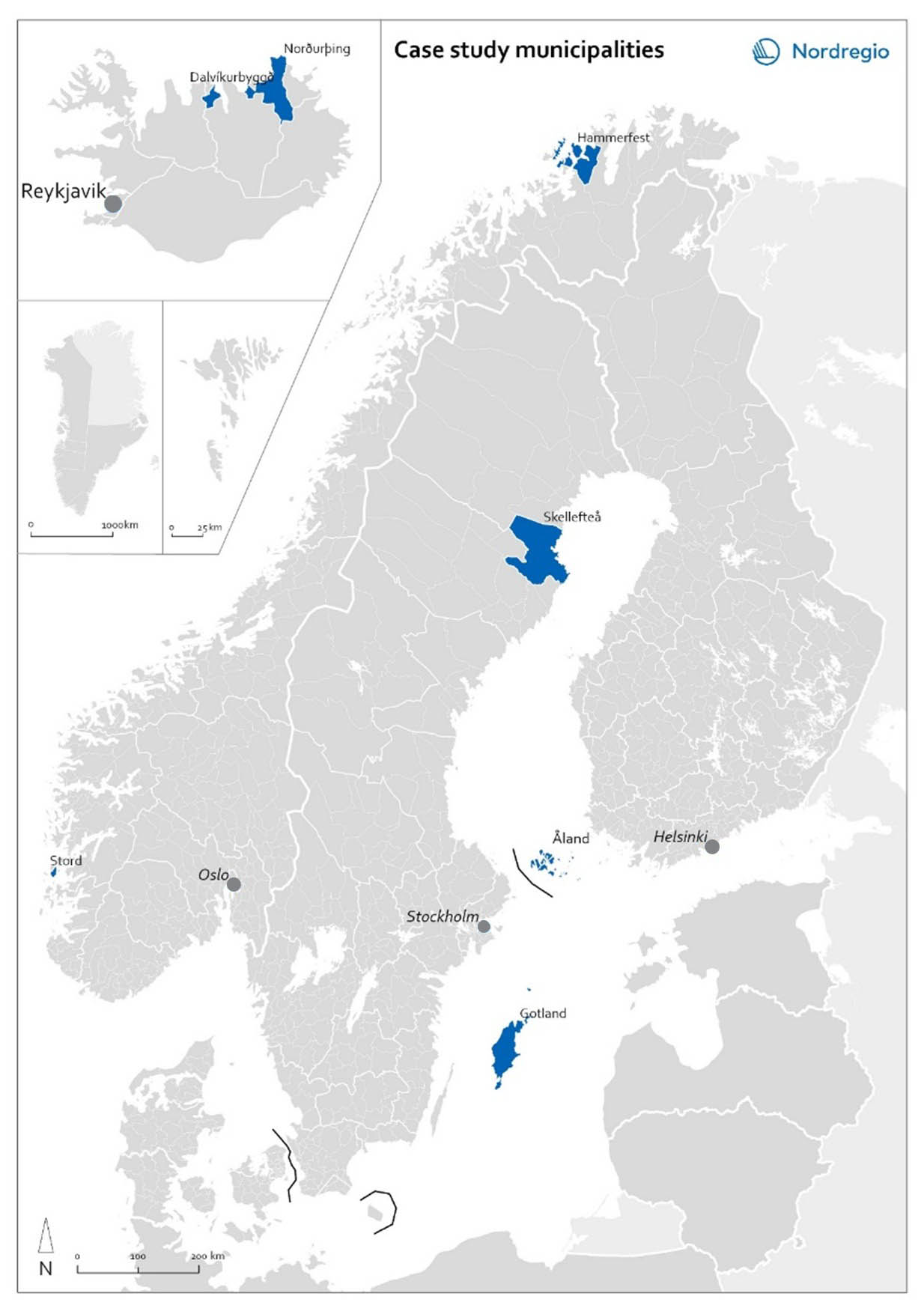
Map 1. SUNREM project case study areas (municipalities and regions): Norðurþing and Dalvíkurbyggð in Iceland, Stord and Hammerfest in Norway, Skellefteå and Gotland in Sweden, and Åland.
The table below is based on an initial review of the literature on sustainable labour markets in remote areas. It highlights key themes from the review and illustrates the relationship between sustainable labour markets and megatrends. These connections are further linked to the statistical indicators presented in this paper.
Topics in the literature review | |
|---|---|
Demographic change | Ageing population |
Burdens on younger generations | |
Labour shortages | |
Age discrimination | |
Increasing inequalities between urban and rural areas | |
Technological change | Labour shortages |
Urban-rural competition/ regional disparities | |
Shrinking rural areas | |
Job displacement | |
Opportunities for remote working | |
Globalisation | Migration and labour mobility |
Wage pressure and job insecurity | |
Rural poverty | |
Increased tourism | |
Climate change and the green transition | Labour market disruptions and job losses / reallocation / displacement of labour |
Declining agricultural productivity | |
Emergence of new jobs and economic opportunities / transition to an environmentally friendly labour market | |
Skill disparities | |
Job polarisation | |
Gender disparities | |
Regional economic gaps | |
Industrial structure and regional transition | |
Table 1. Topics highlighted in the initial literature review on sustainable remote labour markets.
Chapter 2 presents an overview of the common characteristics of the Nordic labour market and the Nordic model. This is followed by Chapter 3 outlining key aspects of a sustainable labour market, including labour force participation and the balance between supply and demand. Chapter 4 introduces a working definition of remote local labour markets, which will be applied throughout this paper and in other sections of the SUNREM project involving quantitative data. Finally, Chapter 5 explores megatrends affecting the labour market and assesses their potential impacts and Chapter 6 concludes with final remarks.