4. Remote local labour markets in the Nordic Region
The SUNREM project focuses on sustainable labour force participation in remote local labour markets. This chapter explores and defines the concept of remote local labour markets in greater detail. The first section considers definitions of local labour markets, while the second section addresses definitions of remote labour markets.
Local labour markets
First, it is important to acknowledge that all labour markets are inherently local or regional, i.e. functional areas below the national level where labour supply and demand meet. Each labour market consists of a core area (or sometimes multiple core areas) and a commuting zone (Aguiar Borges, 2020). Although it is widely recognised that the geographical area of labour markets does not neatly align with administrative boundaries, there are various ways to define local labour markets.
In this project, we use the Nordic definition of Local Labour Markets (LLMs) developed by Nordregio (Aguiar Borges, 2020). This method defines local labour markets based on employment data for both the day population (where people work) and the night population (where people live) and commuting data. Using these data, it is possible to identify local labour market centres and their commuting zone
For more information about the definition and limitations, see https://norden.diva-portal.org/smash/get/diva2:1385537/FULLTEXT02.pdf, p. 67
According to this definition, the Nordic Region has 365 local labour markets. These vary significantly in size, ranging from large metropolitan areas, such as Stockholm, with over 1.5 million workers, to small and more isolated labour markets comprising as few as 100 workers (Lundgren et al., 2024).
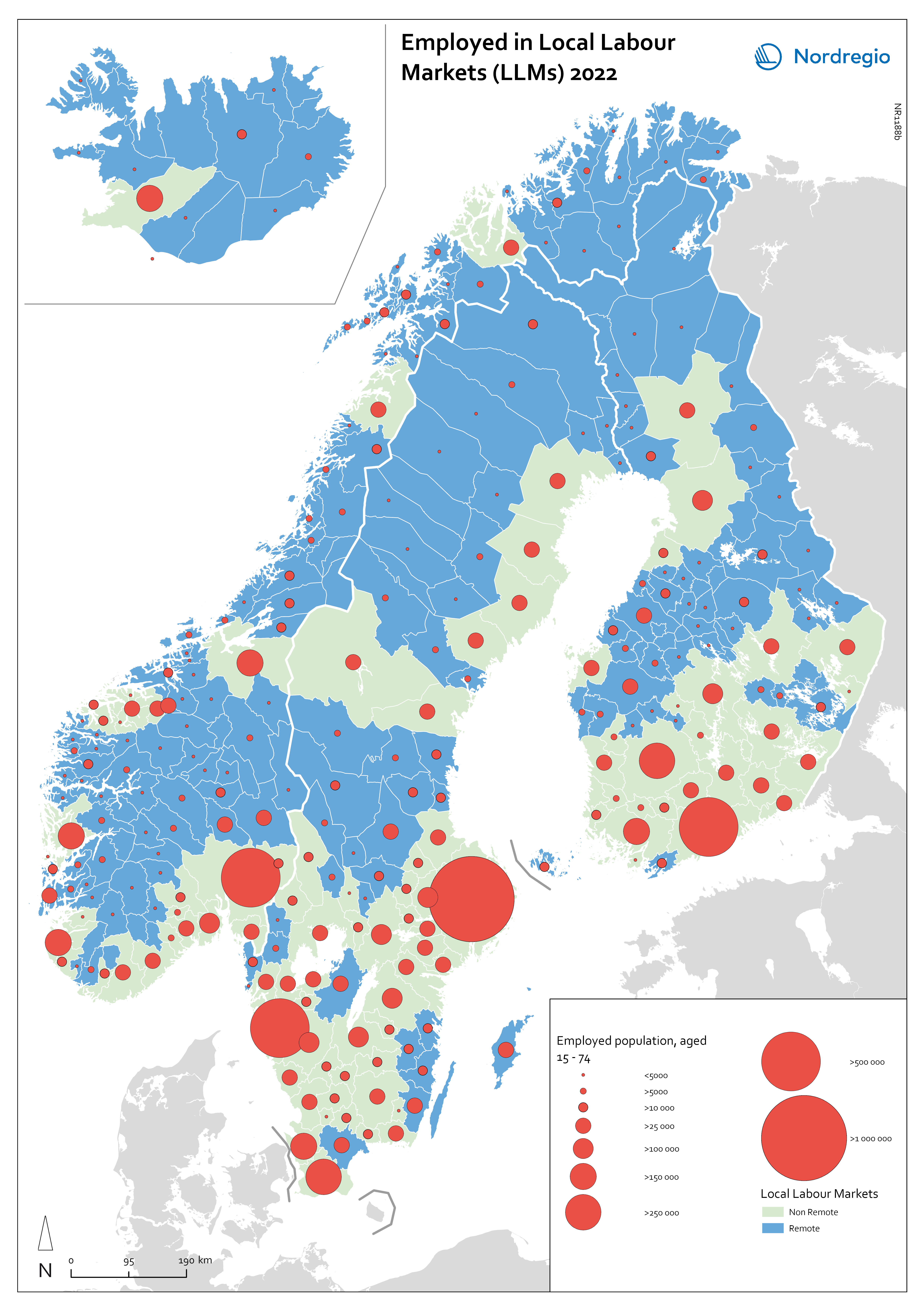
Map 6. Employment in local labour markets, 2022.
According to this definition of local labour markets, most of the case study areas belong to a local labour market consisting of more than one municipality, with the only exceptions being Gotland in Sweden and Hammerfest in Norway. It should, however, be noted that the sizes of the municipalities vary across the Nordic countries. The labour markets of Stord, Norðurþing, Dalvíkurbyggð, Skellefteå and Åland consist of more than one municipality.
Norðurþing | Dalvík-urbyggð | Stord | Hamm-erfest | Skellefteå | Gotland | Åland | |
Number of municipalities in the local labour market | 2 Húsavik-Kópasker (Norðurþing and Tjörnesh-reppur) | 7 Akureyri-Síglu-fjörður | 3 Stord (plus Bømlo and Fitjar) | 1 Hamm-erfest | 2 Skellefteå (and Norsjö) | 1 | 16 Mariehamn-Jomala |
Persons employed in the local labour market | ~1,700 | ~13,000 | ~17,000 | ~6,000 | ~40,000 | ~30,000 | ~15,000 |
National average employment per LLM | ~9,500 | ~19,000 | ~60,000 | ~29,000 | |||
Nordic average | ~38,000 | ||||||
Table 5. Number of municipalities and persons employed in the local labour markets of the case study areas.
The size of a local labour market varies depending on factors such as geography, infrastructure and the size of municipalities. Norway has more local labour markets than Sweden and Denmark, but they tend to be smaller.
Of the case studies, the local labour markets of Gotland and Hammerfest each consist of only one municipality. Åland, with 16 municipalities, functions as a single, integrated labour market. Skellefteå's local labour market includes the municipality of Norsjö, while Stord's encompasses the municipalities of Bømlo and Fitjar. Dalvík stands out since it belongs to the local labour market of Akureyri, whereas Húsavik (Norðurþing) forms a joint labour market with the neighbouring municipality of Tjörneshreppur. Notably, Dalvík is the only case study belonging to a local labour market larger than the national average.
While all labour markets are local and are a geographical area where labour supply and demand meet, exceptions do exist. For instance, fly-in, fly-out workers commute regularly and remote workers may live in a different location from where they work. These factors can influence the dynamics of local labour markets.
Defining remote labour markets
Second, we need to define what constitutes a remote local labour market. Based on the existing literature, several key characteristics of a remote labour market emerge: they typically have small populations and are in peripheral locations, often at a considerable distance from major markets. Additionally, remote labour markets tend to have a less diverse industrial composition and are frequently reliant on a single or a limited number of industries and employers. Collectively, these factors contribute to increased vulnerability to shifts in various industry sectors, skill mismatches and greater exposure to megatrends when compared to more diversified labour markets.
A 2023 literature search on SCOPUS yielded limited results for the term “remote labour markets” or “remote areas”, suggesting that studies using these concepts often imply their meaning without providing an explicit definition (e.g. Adjei, Erikson, Lundberg, 2023). Related terms include “insular,” “peripheral,” “sparsely populated,” and “marginalised” labour markets, all of which incorporate a geographical dimension, though not exclusively. For instance, Pileček & Janačák (2011) examine the geography of peripheral and marginalised areas. Theories such as Christaller’s centrality theory describe a core-periphery dynamic, where the core possesses greater capacity for intervention and adaptation, while the periphery is more constrained. This relationship exists along a continuum and evolves over time (ibid.).
While scientific literature offers few, if any, definitions of remote labour markets, such definitions are more commonly found in grey literature. The most recognised definition comes from Dijkstra and Poelman (2008), who expanded the EU/OECD urban-rural typology by distinguishing between rural areas near cities and remote rural regions. This distinction later informed the DEGURBA classification, which categorises areas based on population size and density. It also aligns with the concept of a functional urban area as comprising a densely populated city and a surrounding commuting zone with a highly integrated labour market (Brezzi et al., 2011).
Dijkstra and Poelman (2008) define remoteness based on distance and access to jobs and services. A region is considered close to a city if over half its residents can drive to a city centre with at least 50,000 inhabitants within 45 minutes; otherwise, it is classified as remote. The 50,000-inhabitant threshold is meaningful in sparsely populated countries, where such cities typically provide essential services and may host universities. The 45-minute drive time was chosen based on commuting surveys. This definition was later adopted by the OECD (Brezzi et al., 2011) and incorporated into Sweden’s urban-rural typology (Tillväxtanalys, 2014). It also serves as our starting point for defining local labour markets in remote areas in the Nordic Region.
As a first step, we applied the Dijkstra and Poelman definition to the Nordic Region based on the finer-grained data available to us. The results are displayed in Map 7, which shows cities with at least 50,000 inhabitants and the surrounding areas where at least half of the population can reach each city centre within a 45-minute drive (taking into account existing road networks, including ferries). The map shows that, even disregarding population density, a vast part of the Nordic Region can be considered remote.
The map shows that both the Icelandic and Norwegian case study areas, as well as the islands of Gotland and Åland, lie outside of a 45-minute radius around a city with at least 50,000 inhabitants, while the municipality of Skellefteå is partially accessible (not all parts of Skellefteå municipality can reach the city within a 45-minute drive).
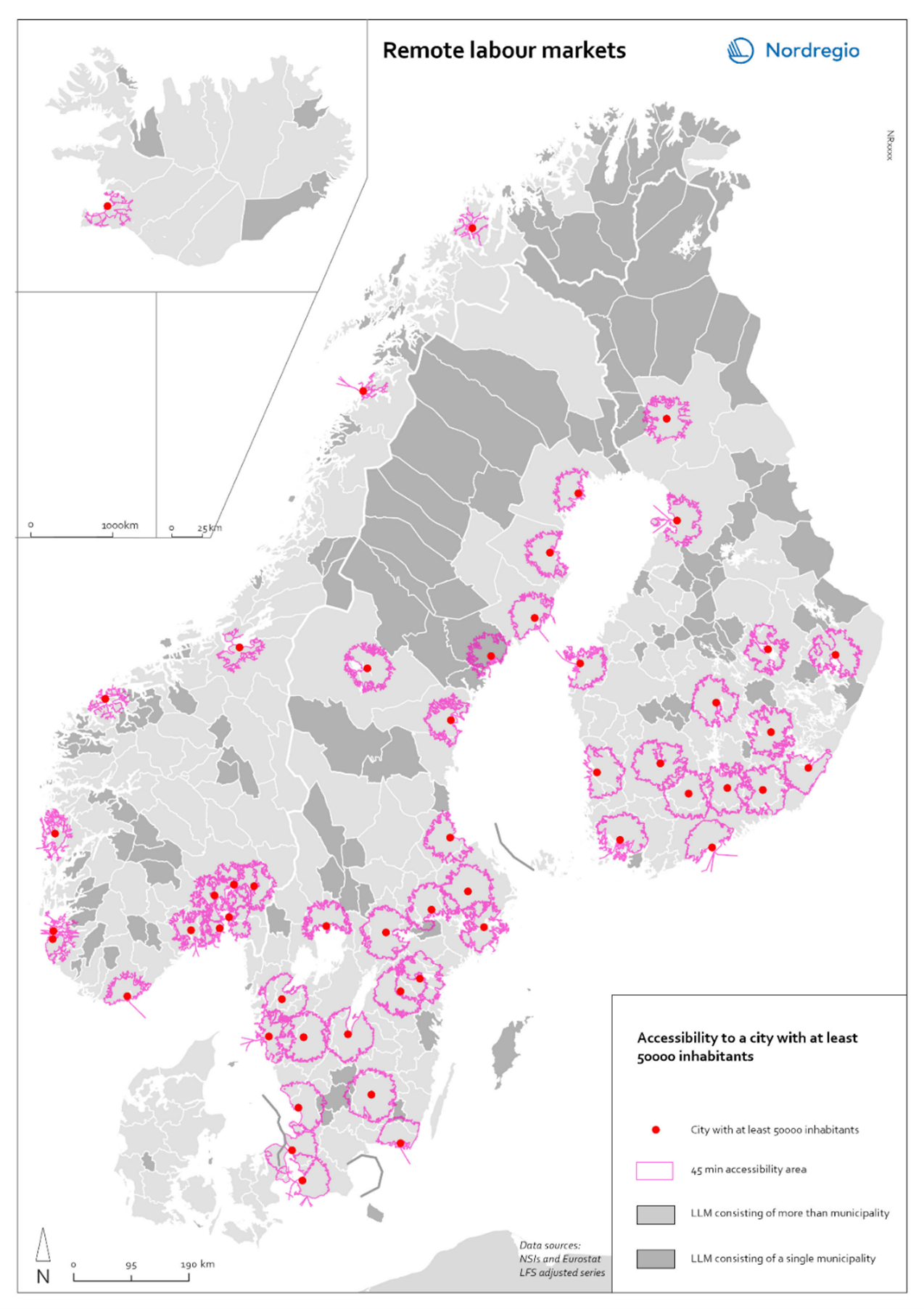
Map 7. Application of Dijkstra and Poelman’s definition (2008) to Nordic local labour markets (LLM): areas within a 45-minute drive of cities with at least 50,000 inhabitants.
As a very large part of the Nordic Region would be considered remote according to this definition and because residents of sparsely populated areas may be more tolerant of longer driving distances, we tested how the results change when allowing for a longer driving time. We ran the same analysis applying a 90-minute and a 60-minute drive time from the city centre.
A 90-minute drive time yields a big overlap of labour market areas in the southern parts of Finland and Sweden and was deemed too long even in sparsely populated areas
See Appendix 3 for the results with a 90-minute drive.
To identify more precisely which municipalities fall under Dijkstra and Poelman’s definition of remote, the percentage of municipalities’ inhabitants living within access to a city was calculated using 1x1 km grid population data. Municipalities that overlap with the 45-minute access area were classified by the percentage of their population living within this area. Municipalities with more than 50% of the population living within the 45-minute zone are considered non-remote
A visualisation of this step, for a 45-minute drive time, can be found in Appendix 3
The final results, based on a 60-minute drive time, can be found in Maps 8a and 8b. Map 8b shows cities with more than 50,000 inhabitants (points) and municipalities where a majority of the population can reach a city with 50,000 inhabitants within 60 minutes. All the areas except those in pink/red hues are considered remote. This yields a total of 507 remote municipalities in the Nordic Region (excluding Denmark). When zooming in on our case study areas, this map shows that Dalvíkurbyggð, Norðurþing, Hammerfest, Gotland and Åland are still considered remote, while Skellefteå is considered non-remote. It should be noted, however, that remoteness also encompasses other aspects, such as distance to the capital.
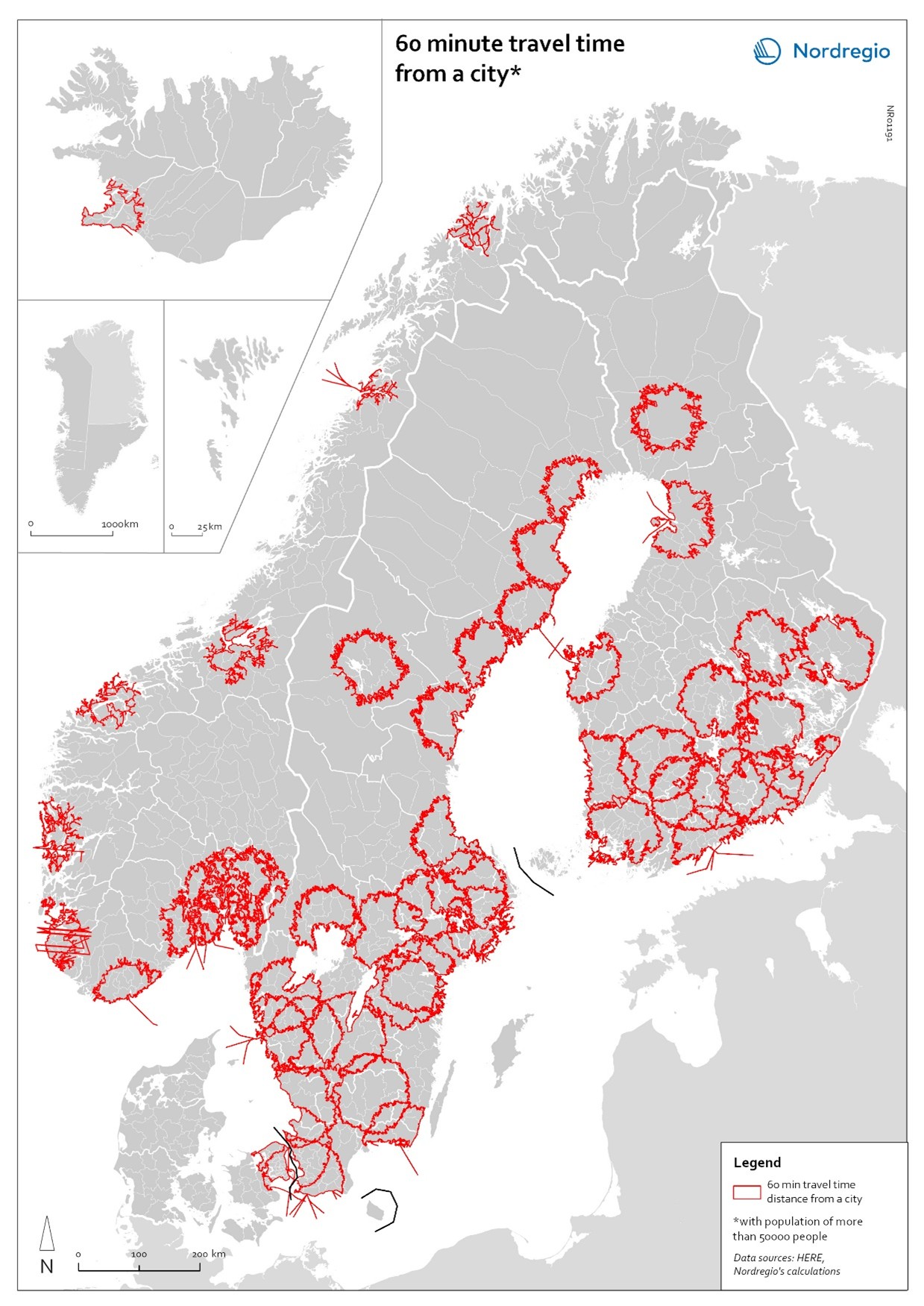
Map 8a. Application of Dijkstra and Poelman’s definition (2008) to Nordic local labour markets (LLM): areas within a 60-minute drive of cities with at least 50,000 inhabitants.
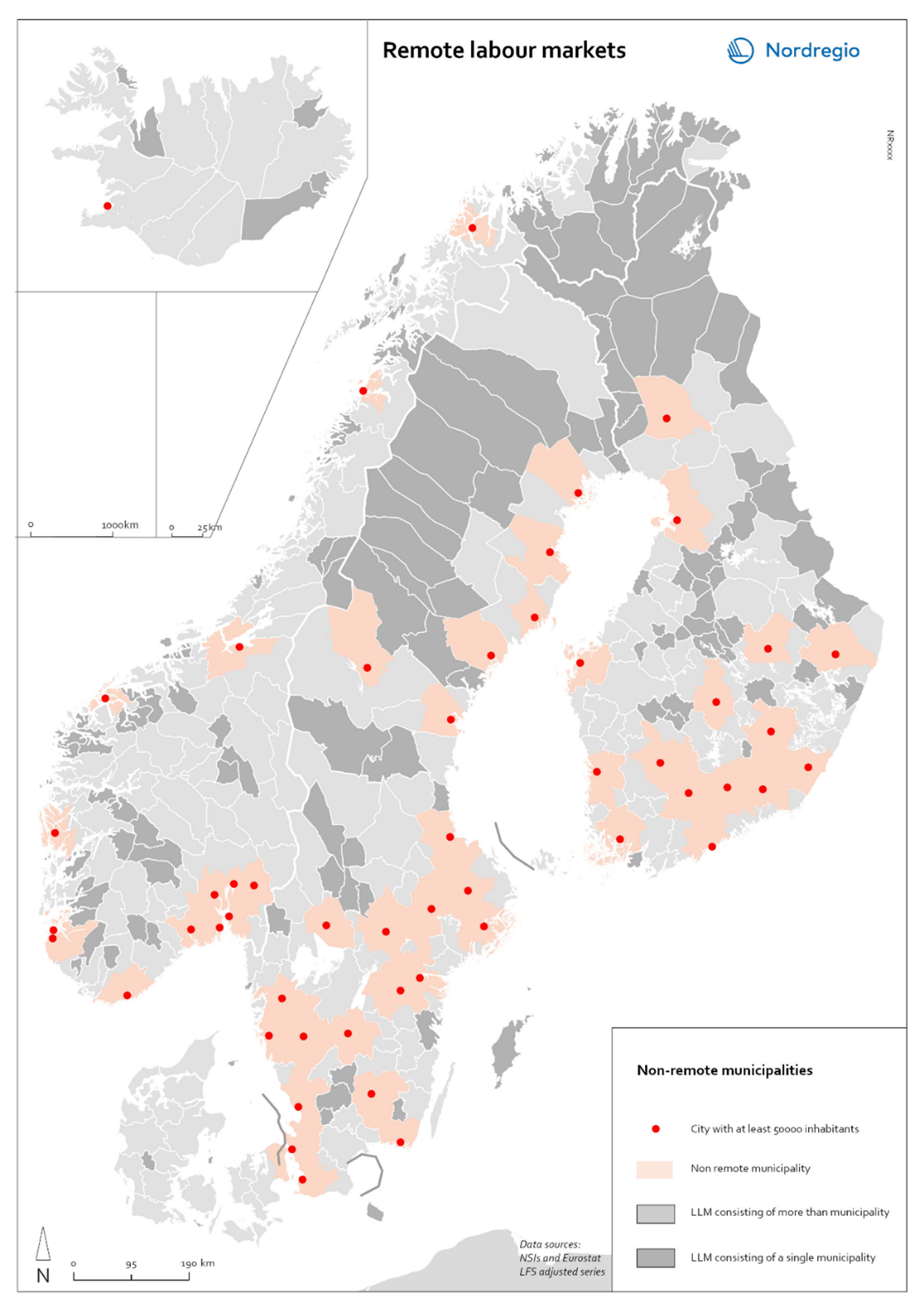
Map 8b. Application of Dijkstra and Poelman’s definition (2008) to Nordic local labour markets.