Finland. Kuusamo – Kajaani – Oulu
Kuusamo – Kajaani – Oulu | ||
Distance between the airports | Kajaani-Kuusamo | 205 km |
Oulu-Kuusamo | 183 km | |
Oulu-Kajaani | 138 km | |
Travel time by electric airplane | Kajaani-Kuusamo | 41 min |
Oulu-Kuusamo | 37 min | |
Oulu-Kajaani | 28 min | |
Table 3: Distance and travel time between the airports.
The Finnish case study concerns a triangle between the cities of Oulu, Kajaani and Kuusamo. This differs from the results of the accessibility study (Lundberg, 2022), which mainly suggests oversea connections as having the greatest potential for electric aviation in Finland. Our aim in choosing the inland connections between those three cities is to supplement the results of statistical analysis with qualitative data to see whether drivers and open questions may be revealed that would otherwise not be evident. The estimated flight time between the destinations by electric airplane is as follows: Kajaani-Kuusamo approx. 41 min, Oulu-Kuusamo approx. 37 min, Oulu-Kajaani approx. 28 min.
The cities of Oulu, Kajaani and Kuusamo were chosen after being flagged as potentially interesting cases by our expert working on aviation issues in the council of the Oulu region. The triangle formed between them has a growing number of new transport connections and people arriving for work and education (Oulu), as well as new bioindustry projects, active demand for business travel connections (Kajaani) and the busiest tourism area in the country (Kuusamo). In addition, there has been growing political interest in the region in keeping the positive impact of aviation on the regional economy on the national agenda. Such political support and local activity may suggest that there are drivers supporting electric aviation in the region that can be activated when the time is right.
Regional context
Geography and demography
Kajaani belongs to the Kainuu region, while Oulu and Kuusamo are situated in Northern Ostrobothnia (Pohjois-Pohjanmaa, 2021). There are 212,000 people and approx. 50,000 jobs within a 20 km radius of the city of Oulu and 318,000 people and 64,000 jobs within a 100 km radius (Pohjois-Pohjanmaan ELY-keskus, 2019). Kajaani has a population of 36,000, while the surrounding Kainuu region is home to 70,500 people and 27,800 jobs. The unemployment rate is relatively low but due to a decade-long trend of population decrease, companies are experiencing recruitment problems throughout the region (Kainuun liitto, 2023).
From Oulu, Kuusamo can be reached by bus several times a day, with a travel time of three hours. From Kajaani, the travel time is approximately 3.5 hours and there is only one connection outside the high tourist season. There are three daily bus connections between Oulu and Kajaani with a travel time of 2.5 hours and four train connections with a travel time of two hours.
Regional economy
The Finnish regional flight network is heavily subsidised by the state (in the amount of 40 million EUR during 2021-2023); the same also applies to the Helsinki-Kajaani connection and Kajaani Airport. In 2023, the Parliament decided to continue supporting the regional routes by providing an additional 17 million EUR until at least April 2024. Without the national subsidies, Finnair would not continue operating those routes. The route to Kajaani is the busiest of the five subsidised regional routes, even though the airplanes have a 52% passenger/capacity rate. Currently the state is hoping that regional actors will themselves find ways to make these routes financially viable. Under the previous government, the main emphasis was on reforming the railway network instead of investing in air traffic to align with national climate goals. (Holopainen, 2023; Tolpo, 2023).
The regional council of Northern Ostrobothnia conducted a study on the impact of aviation on the regional economy, with particular emphasis on the cities of Oulu, Kajaani and Kuusamo. The report states that the impact of aviation is much larger in the case of regional airports (meaning all airports other than that of Helsinki) and the more remote an area is, the greater the importance of having an airport. Indirect impacts are three times larger than the direct impacts on the regional economy. The report details that 51% (26 billion EUR) of revenue and 11,000 jobs in the impact area of the airports in Oulu, Kajaani and Kuusamo are dependent on aviation, with 59% of that business being international sales. A total of 49% of regional businesses considered on-site meetings with clients and stakeholders to be necessary, while 32% saw them as important. Furthermore, the report found that one in three companies in the region had made significant investments that rely on regular flight connections. (Council of Oulu Region et al., 2023).
The survey estimated that better connections would help 50% of companies to increase their revenue in Oulu, 48% of companies in Kajaani and 49% in Kuusamo. Of industries that would benefit the most, 97% of companies in tourism could increase their revenues, 78% of companies in the fields of entertainment and art, 70% of IT companies and 54% of companies in heavy industries and mining. (Council of Oulu Region et al., 2023).
In all three case study locations – Oulu, Kajaani (especially near Kajaani in Paltamo) and Kuusamo – there are large pulp, board or paper mills or sawmills and related transport flows. In addition, there are several bio-industry projects that are under development or have already been completed in the wider region. (Liikennevirasto, 2017).
The main economic strengths of the Oulu region are electronic industries and education (Pohjois-Pohjanmaan ELY-keskus, 2019). In a scenario developed by the Finnish Transport Infrastructure Agency, it was estimated that an increase in air traffic in the Oulu region in the future could be prompted by a) multinational enterprises establishing knowledge centres in the Oulu region, b) increased work travel by researchers due to a rise in research and development activity c) the further development of a common Nordic employment market and d) new tourism approaches making the Oulu region a more attractive destination. It is also estimated that air traffic via Oulu to Lapland will increase in the coming decades. (Herneoja et al., 2019).
As far as Kainuu is concerned, the CEO of the Association of Entrepreneurs of Kainuu commented that regular flight connections are of great importance to regional entrepreneurs. That includes local microenterprises and medium-sized companies, the mining industry, tourism and the forestry industry, which all trade internationally. (Kinnunen, 2022). In the regional plan for developing the transport systems, the region estimates that the regional economy will benefit in the future from the global growth in tourism and the development of the bioindustry, technological and mining industries. The region’s strong points in terms of transport system investments are the existing infrastructure and topical knowledge about the important economic actors. Weaknesses hampering development of the current transport structure are long distances, sparse population and thin personal transport flows. Those weaknesses mean that there are considerable challenges in terms of maintaining the road network and organising public transport. The region has estimated that all possible future driving forces would require reliable flight connections to enable efficient work travel or visits by stakeholders, for example. (Kainuun liitto, 2018).
Kuusamo is the third largest travel destination in Finland owing to its status as a ski holiday destination. The number of overnight stays has increased more strongly than the national average and the travel industry of Kuusamo has set itself the goal of 185,000 air passengers by 2026. However, travel entrepreneurs have expressed concerns regarding Kuusamo Airport and the frequency of flight connections, given that they are necessary for tourism in the area. There is also a new bio-park focused on circular economy activities in Kuusamo (Karjalainen, 2022; Karjalainen & Ukkonen, 2022; Kuusamon kaupunki, 2023; Loukkola, 2023).
Regional policies and initiatives relevant to electric aviation
The transport and logistics strategy for northern Finland of 2017 states that problems with accessibility should be managed by prioritising the transport needs of business, industry and tourism actors, as well as the Ostrobothnian coast. In the future, long-distance journeys, economic activities, industries and international cooperation are expected to focus to an increasing extent on certain “development corridors”. Of the case study locations, Oulu and Kajaani are situated along those development corridors, while Kuusamo is at the heart of tourism activities. New political solutions are needed to ensure public transport in the very sparsely populated regions of northern Finland. (Liikennevirasto, 2017).
In the Northern Agenda, which was drafted by a group of stakeholders in northern Finland (regional councils, cities, universities, chambers of commerce and entrepreneurial associations), it is recommended that the new government emphasises transport connections to create a more unified Northern area, with Oulu as a key growing transport node.
Transport infrastructure
The airport network of northern Finland is relatively extensive and is of great importance for the regional economy and industries. Of the three case study locations, Kajaani Airport and Kuusamo Airport are especially important for tourism and Oulu Airport for business. (Liikennevirasto, 2017).
Oulu Airport is Finland's second busiest airport with over 630,000 passengers. (Degerman, 2023b). The airport is used to a far lesser extent for cargo traffic as most cargo is carried by road. However, the cargo carried by air is relatively valuable. (Pohjois-Pohjanmaan ELY-keskus, 2019). The 2019 national evaluation of significant transport nodes listed Oulu among important nodes for personal transport, noting that air traffic is of greater importance than rail and road traffic in this context. The importance of Oulu Airport is heightened by the fact that the distance to Helsinki is over three hours by rail or road. The Finnish Transport Infrastructure Agency (Väylävirasto) also stated that transport connections (especially between the city and the airport) and services around Oulu Airport should be improved overall given its status as an important node (Herneoja et al., 2019).
Kajaani Airport is located ten kilometres from the city centre and is managed by the state company Finavia. Kuusamo Airport is located 80 kilometres northwards. The distance between Oulu and Kajaani is 183 kilometres. Currently there are two to four flights a day between Kajaani and Helsinki and roughly 80,000 flights per year, 75% of which are to Helsinki and almost all the rest to destinations abroad. In other words, less than 1% of passengers fly to other Finnish cities from Kajaani (via Helsinki). The reasons for flying are evenly distributed among tourism, business travel and travel for other purposes. Air cargo has been on the decrease during the past decade (Kainuun hyvinvointialue, 2023; Kainuun liitto, 2018).
As far as rail travel is concerned, the connection between the cargo station Kontiomäki near Kajaani and Oulu is among the country’s busiest routes for cargo traffic, with traffic having been on the rise during the past years. Most journeys around Kajaani are made by personal car (82% of journeys, compared to the national average of 72%) and the average daily distance travelled is somewhat longer than the national average at 52 kilometres. In 2011, it was estimated that traffic is Kainuu’s largest source of emissions with a share of 39%, most of which is from road traffic. Besides digitalisation, a decrease in private car journeys and support for railway traffic instead were the main aims with respect to reducing emissions (Kainuun liitto, 2018).
Passenger numbers to Kuusamo Airport have been on the increase and reached a record high in 2022 at over 110,000 passengers, representing a 57% increase compared to the previous year. Two-thirds of passengers to Kuusamo Airport are international, so a large share of flight connections consists of charter flights. (Karjalainen, 2022; Loukkola, 2023). The transport infrastructure of the selected Finnish regions is illustrated in Figure 3.
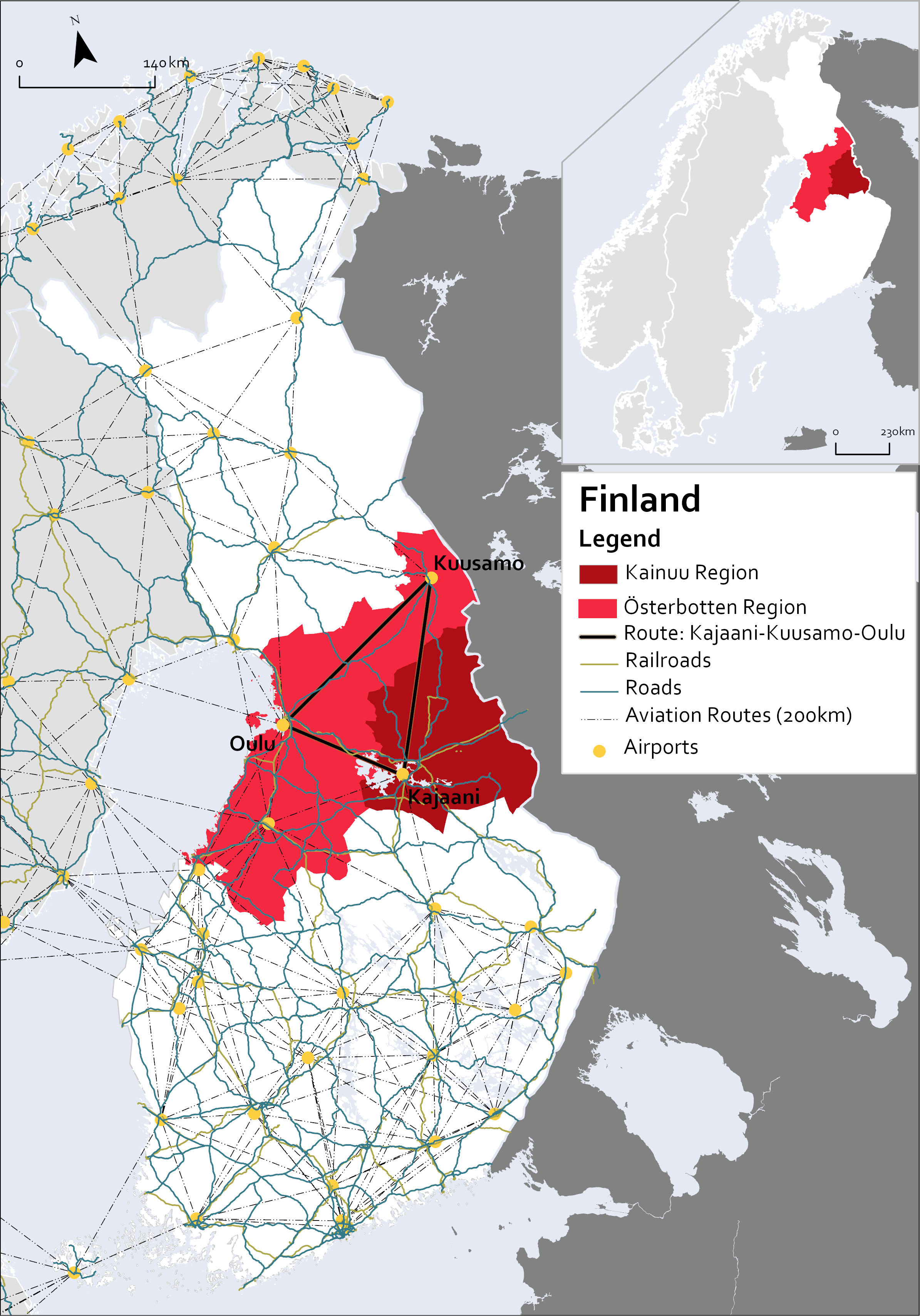
Figure 3: Finnish route and regional transport infrastructure
Source: Nordregio
Source: Nordregio
Accessibility of care facilities, education, work and other public services
Compared to the Oulu region, accessibility has long been one of the core problems of the whole Kainuu region and related problems have also been on the increase. Transport infrastructure is considerably weaker than in southern Finland when it comes to road conditions, service provision (especially regarding railways) and the fragility of air traffic connections. For that reason, the smart specialisation strategy of Kainuu aims for more interregional cooperation and connections to compensate for the lack of people. (Kainuun liitto, 2020).
Energy infrastructure
Finland has a strong main grid and fewer regional bottlenecks than Norway, Denmark or Sweden. The case study regions of Northern Ostrobothnia and the Kainuu region have surplus power production. The Ostrobothnian coast also has a high share of wind power production with several completed wind parks and new ones in development, indicating reasonable potential for electric aviation in the region. The wind energy production area also extends to Kajaani and Kuusamo, making them attractive locations for electric aviation despite their relative proximity (200 km) to Oulu Airport. In addition, they are highly rural and sparsely populated regions. (Nordic Energy Research, 2023).
Ten-year scenario for electric aviation
The focus group
The focus group mainly consisted of regional experts representing the areas around the cities of Oulu and Kuusamo, as well as a representative from the Finnish public company Finavia, which is responsible for maintaining and managing the national airports. There were six participants in total. Oulu, the biggest city of the three, was also represented by the highest number of participants, with experts from Business Oulu (2) and the city of Oulu (1). An expert representing the tourism sector in Kuusamo also participated. Subsequent to the focus group discussion, an individual interview was conducted with an expert representing the council of the Oulu region who was also well informed about the situation in the city of Kajaani. The case study also gathered observations from the Seminar on Sustainable Tourism and the Circular Economy organised by the regional council of Kainuu (in Kajaani), at which this topic was likewise discussed.
Key driving forces for implementing electric aviation on the routes between Oulu, Kajaani and Kuusamo
Political factors
The political factors discussed in the group were sub-grouped under uncertainty over government subsidies, national and EU climate goals, regional development aims and better connections to Helsinki. The group began by pointing out that political support may potentially favour other ways of decreasing transport emissions in the future, such as rail traffic or – in the case of aviation – synthetic low-carbon fuels. In other words, electric aviation is presently not seen as a “silver bullet” to the same extent that it was several years ago. While the possibilities it offers are still worth considering, electric aviation may prove out to be the best available option under certain conditions.
Better connections to Helsinki were deemed an unimportant factor for electric aviation, since it would be difficult to compete with train connections here. Electric aviation could primarily be useful for inter-regional traffic or for feeding passengers from smaller cities into a bigger airplane that would then connect Kajaani and Helsinki, for example. In other words, electric aviation could help create new transport hubs in places where the transport links are rather thin at present. For example, the charter airplanes operating to Kuusamo could also feed passengers to smaller airplanes and bring them to the north or other cities to allow for more diverse options.
Instead of building new types of connections to the capital, other cities in the north were viewed as promising options for electric aviation routes from the three cities. Those could include, for example, routes from Oulu to Luleå in Sweden or Rovaniemi or even further north to destinations in northern-most Finland or Tromsø and other cities in northern Norway. A connection between Oulu and Rovaniemi could open up a wide network of new travel options. Creating a denser and more flexible flight network with lower emissions for the use of the tourism industry was repeatedly mentioned as one of the main possible early benefits of electric aviation. The future possibility to create new types of hubs means that it is sensible to invest a certain amount of money now in maintaining regional airports and airfields, since electric aviation cannot grow a functioning airport.
Furthermore, the discussion addressed the current political goals for cutting emissions. Given that all participants agreed that this factor is the single most important driver (some even went as far as to suggest that it the only significant driver) for electric aviation, there was less debate on this point.
Finally, the focus group discussed drivers – linked to the northern geography and long distances – that are currently perceived as marginal or absent, but that might be worth considering during the ten-year time span. For example, forest fire monitoring or defence requirements resulting from the current unpredictable geopolitical situation might result in new demand for smaller airplanes that are affordable to operate.
Socioeconomic factors
Here a decision was made to combine economic and sociocultural factors into socioeconomic factors, including the need to attract a skilled work force to the area, new industry projects, the potential to link the cities concerned with Skellefteå in Sweden and the role of the cities as nodes for transport, business and education. In addition, tourism was discussed.
While attracting a skilled work force is an important factor, it was not seen as an important driver for electric aviation. Instead, it was thought that businesses would benefit most from having more regular connections, thereby enabling meetings between clients and other stakeholders. The same applies to new industrial projects in the area; while they are important, it was difficult to estimate whether they would feed enough passengers to maintain a regular new transport route. In other words, while the focus groups viewed accessibility as one the main factors for business development in the region, they were unsure whether electric aviation would be the best way to support that.
Instead, tourism could be an important driver because even a relatively small decrease in price (estimated at 30-40 EUR cheaper for one trip) could be sufficient incentive for people to choose a new experience. The focus group discussed opportunities for experience tourism that electric aviation could make more accessible, such as short flights to view the Northern Lights or the summer White Nights. Current trends in travel could also favour electric aviation for reasons beyond those related to low emissions. Tourists are increasingly choosing to stay longer in one region in order to cut back on short-haul flights. Electric aviation connections could help them discover more of the wider region of northern Finland during the same stay.
Kuusamo is an important transport node for tourism, with several charter flights arriving there weekly. It could therefore also act as a significant transport node for electric aviation if charter flights were to feed passengers into smaller electric airplanes that would then serve other destinations. As Oulu is growing as an important node combining different transport modes, the possibility for a combination of train travel and electric aviation in the region might also be a potential future product. For example, there are currently too few trains arriving in Rovaniemi during the season when the leaves change colour in autumn (“ruska”) to transport all potential passengers, so such types of more targeted connections might serve the region well. However, given the current absence of such connections previously, it remains difficult to estimate how much they would be utilised. In short, the group anticipated that while new connections would represent new possibilities, the most important determining factors are price and travel time.
With respect to the connection between Kuusamo and Oulu, the group also noted that in some cases it would make more sense to increase rail traffic between Oulu and Kajaani, where a railroad exists, than to add an electric aviation route there. However, on other routes, the distances are long, so electric aviation could potentially decrease travel time. In other words, new transport routes have considerable potential to make travel links more flexible and smoother, but that fact is not enough to constitute a driver in land travel. That view applies foremost to the current situation, in which the initial investment costs are significant (especially for public actors), i.e. within a ten-year scenario, and such factors may change as the market develops.
Technological factors
Under technological factors, the group evaluated only the growing wind power production in Finland (especially Ostrobothnia) and the resulting surplus electricity. However, while the experts assumed that affordable electricity would be available for electric aviation as well, it was not viewed as a significant driver. Since operating electric aircraft is already less costly than operating conventional airplanes, that type of additional boost is not considered to be needed.
Concluding reflections
The group was more or less consistently sceptical about the future drivers for electric aviation. That was less due to the practical usability of electric airplanes than to several unanswered questions that need to be addressed before more detailed regional visions are possible. Such questions include identifying operators willing to make large investments during the cost-heavy initial phases of development or discovering new business models that would be able to find niches where electric aviation would not be in direct competition with traditional transport models (traditional aviation and railroads). Since so many market factors are currently “up in the air”, a single driving force or operator may rapidly change the overall situation.
New strategic security shifts or cooperation arrangements, slower and broader trends in tourism or regular work travel flows between two cities in the Oulu-Kajaani-Kuusamo triangle, to name just a few examples, could potentially prove to be a driving force that might suddenly become significant. While regional stakeholders are waiting to see whether electric aviation will eventually impact the future development of their region, they can prepare themselves by investigating which new routes have the best prospects for future small-scale travel and by maintaining close cooperation with their colleagues in the broader Barents region. As the field is currently developing very fast, it is essential for the region to maintain openness to embracing potential new opportunities in practical and political terms.