Iceland. Akureyri – Reykjavik
Akureyri – Reykjavík | |
Distance between the airports | 250 km |
Travel time by electric airplane | approx. 50 min |
Table 5: Distance and travel time between the airports.
Introduction
The Akureyri-Reykjavík flight route is the most popular domestic route as it has the highest passenger numbers of all domestic flight routes (Isavia, 2022) and is therefore an interesting case study to examine. The estimated travel time by electric aircraft would be approximately 50 minutes. Flights on this route are currently operated by Icelandair. As highlighted in the report Electric Aviation Outlook in the Nordics (Löfving et al., 2023), Icelandair announced in 2022 that the company will support the development of a 30-seat electric airplane by Heart Aerospace to use for passenger transport in 2028. Electric aviation is therefore likely to be introduced on this domestic route within the next ten years. The route is important for access to services, including health services, and for business travel. Additionally, very few international routes are operated from Akureyri Airport so many people need to fly to Reykjavík in order to travel abroad.
Geography and demography
Akureyri is a town located in the north of Iceland. It has an area of 138 square kilometres and lies just 100 kilometres from the Arctic Circle (Guide to Iceland, n.d.). It is situated about 390 kilometres north of the capital city Reykjavík and it takes about five hours to drive between the two places. There are regular bus services between Reykjavík and Akureyri, with the route taking about six hours (Visit Akureyri, n.d.). The route includes three mountain passes and may be closed in the event of severe weather warnings and snowfall. Over the years, there have been discussions about shortening the route between Akureyri and Reykjavík and there has been support for some initiatives. For instance, a report by the University of Akureyri Research Centre in 2022 (Dagsdóttir, 2022) found that 66% of survey participants thought it was important to shorten the route by 15 kilometres around the town of Blönduós. There is therefore a possibility that the route will be shortened, which could mean increased competition between driving and flying. Furthermore, it has historically been more expensive to drive between the two locations due to the high cost of petrol. However, with the introduction of electric cars and relatively inexpensive electricity prices in Iceland, it has become cheaper to drive than before (if driving an electric car).
Iceland is unique in that, despite having a population density of just four people for each square kilometre (World Bank, n.d.), 63% of the population – which totals just under 400,000 – lives in the greater Reykjavík region (the capital region), corresponding to approximately 243,000 people (Statistics Iceland, 2023). Some 80% of the island’s population lives within the functional urban area of Reykjavík
Within approx. one-hour driving distance.
The average age of the population of Akureyri municipality is 38.5 years. That is only slightly higher than the Reykjavík average age, which is 38.0 years (Byggðastofnun, n.d.). In Akureyri, men account for 50.3% of inhabitants, while women account for 49.7% and other account for 0% (Byggðastofnun, n.d.). The demography of Reykjavík is similar with 51.2% men, 48.7% women and 0.1% non-binary/other. According to data from the Directorate of Labour (n.d.), the unemployment rate in Akureyri was 2.9% in 2022, compared with 4.2% in Reykjavík.
The average wage income in Akureyri was approximately 7% lower than the national figure in 2021 and was approximately 6% lower than in Reykjavík (Statistics Iceland, n.d.).
It is difficult to estimate housing prices in Akureyri in comparison with housing prices in Reykjavík. However, in 2019 Landsbankinn Bank estimated that housing prices in Akureyri were at 75% of the prices in the capital region (Sturludóttir, 2019).
Regional economy
Akureyri is the main service hub for the north of Iceland, so accessibility of the municipality is important. Historically, Akureyri has had a large fishing industry with an important port and some of the biggest Icelandic fishing companies, including Samherji, are based there (Guide to Iceland, n.d.). Strong economic sectors in northeast Iceland, where Akureyri is the most populous town, include primary materials processing, tourism and public sector jobs (SSNE, 2021). Furthermore, higher education has become a fast-growing economic sector, alongside services, in the last few years. Akureyri Hospital (SAk) is also a large employer (Guide to Iceland, n.d.).
Transport infrastructure
Icelandair is currently the only airline to operate flights between Akureyri Airport and Reykjavík Airport. Based on information from Icelandair‘s booking machine, there are currently three to five flights from Akureyri to Reykjavík on weekdays, three flights on Saturdays and four flights on Sundays. The flight time is estimated to be 45 minutes.
As shown in Figure 5, the number of passengers on the Akureyri-Reykjavík flight route in 2022 was 163,586 (Isavia, 2022). The number of passengers was even higher prior to the Covid-19 pandemic at 168,212 in 2019 and 190,621 in 2018 (Isavia, 2022).
Figure 5: The number of passengers on domestic flights in 2022.
Source: Isavia, 2022
Source: Isavia, 2022
One point to consider in this case study, since it covers the next decade, is that discussions around relocating Reykjavík Airport have been ongoing for over six decades. The latest update is that the airport will remain in its current location until the year 2032 or until a new and suitable location has been found. While the City of Reykjavík is emphasising that the airport should be relocated (City of Reykjavík Department of Environment and Planning, 2022), that will not take place until another option is ready and the Minister of Infrastructure has maintained that the airport will not stop operating for some decades. (Kjarnans, 2020). If the airport were to be relocated, that might impact electric aviation as the domestic airport is currently in the centre of the city and is therefore located conveniently close to services such as the national hospital.
Akureyri Airport opened in 1954 and serves both domestic and international flights (Isavia, n.d.). The airport is 2,400 m long (Isavia, 2023). Its facilities have been under construction and, after some delays, it is anticipated that a new terminal will be ready in May 2024 (Ólafsson, 2023).
The Northeast Iceland Development Strategy 2020-2024 highlights inefficient basic services on the national roads as a threat to employment development and innovation in the region. It also points to distorted competitive conditions with regards to transport. Furthermore, the strategy mentions that the uncertainty regarding Reykjavík Airport and domestic flights is a further threat to employment development and innovation (SSNE, 2021).
There is only one currently scheduled direct flight from Akureyri Airport to a destination abroad, namely the Akureyri to London Gatwick route operated by EasyJet, which will be a scheduled service from 31 October through March 2024 (Níelsson, 2023). Previously a local airline, Niceair, had launched in summer 2022 but it filed for bankruptcy in May 2023 (Ásgeirsson, 2023). The main reason given for the bankruptcy was that Niceair lost access to the sole aircraft in its fleet and was therefore unable to continue its operations (Ritstjórn, 2023). The experience of Niceair nevertheless demonstrated that there was a market for regular direct international flights from Akureyri. EasyJet restarting international flights from Akureyri could therefore decrease demand for domestic flights to Reykjavík for people based in northern Iceland travelling abroad from Keflavik Airport. When the Northeast Iceland Development Strategy was formulated, Niceair had not begun operating and the lack of direct flights to destinations abroad from the region was noted among the weaknesses in terms of job development and innovation. An overview of the transport infrastructure in Iceland is illustrated in Figure 6.
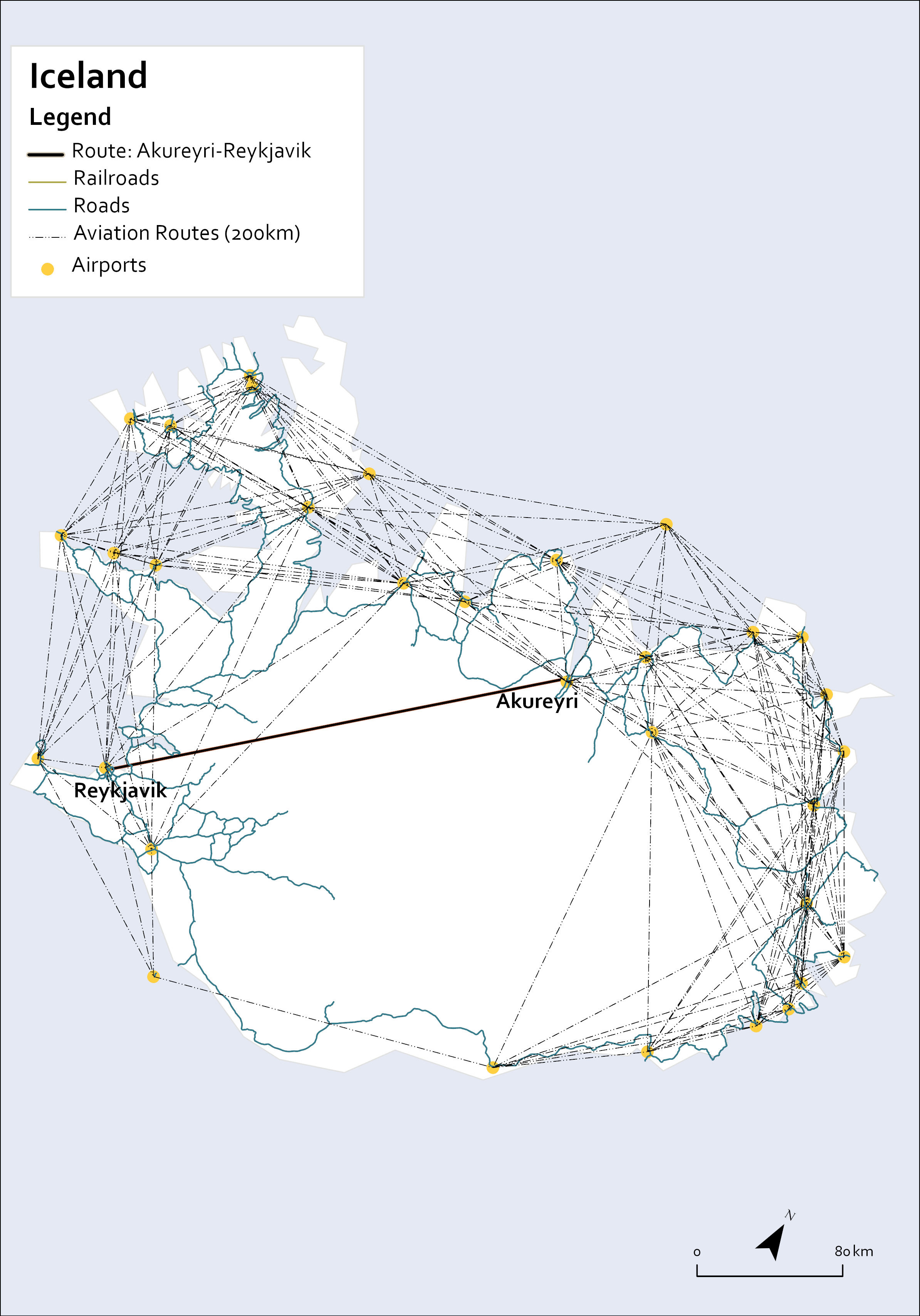
Figure 6: Icelandic route and regional transport infrastructure
Source: Nordregio
Source: Nordregio
Accessibility of care facilities, education, work and other public services
Public services are concentrated in Reykjavík and its service role for all of Iceland has become progressively stronger. Public administration and, accordingly, the majority of government institutions are based in Reykjavík. The Parliament, ministries and most institutes are located there, for instance. Furthermore, all institutes of national interest with regards to culture and recreational services, for example, are located in the capital region (Jóhannesson, 2015). Nevertheless, as Akureyri is the largest town outside the capital region, its inhabitants are more privileged in terms of access to services of general interest than inhabitants in other sparsely populated regions of Iceland (Jóhannesson, 2015).
There main hospitals in the country are located in Reykjavík in Akureyri (Jóhannesson, 2015). Three universities in Iceland are based in Reykjavík, including two of the largest universities, namely the University of Iceland and the University of Reykjavík, as well as the only arts university in the country.
Akureyri is a regional centre in the northeastern area. Its hospital, for instance, has a catchment of roughly 45,000 people and also acts as the primary reserve hospital for the national hospital, Landspítali, in times of health-related crises (Editorial Team & Waller, 2020). The hospital had 960 employees in 2021 (Akureyri Hospital, 2022) and provides general and specialised healthcare. There is an emphasis on emergency services and vital specialist treatments (Ísland.is, n.d.a). In 2021 there were 111 beds at the hospital and 16,019 emergency admissions. A total of 491 children were born at the hospital in 2021 (Akureyri Hospital, 2022).
There is a primary healthcare centre in Akureyri called the Akureyri Health Clinic (Akureyri Municipality, 2023) as well as a number of dentist practices. Access to healthcare facilities in Akureyri is therefore relatively good. If a person living in Akureyri needs to seek health services in Reykjavík on the basis of a doctor’s recommendation, that person can apply for reimbursement from Iceland Health for the domestic travel costs (Ísland.is, n.d.b).
There are several educational facilities in Akureyri. The municipality of Akureyri runs nine kindergartens in 12 locations and also supports one private kindergarten for children under the age of six (Akureyri Municipality, 2022c). There are ten primary schools (Akureyri Municipality, 2022b) and two secondary schools (Menntamálastofnun, n.d.).
Furthermore, Akureyri is home to the largest university outside of the capital region, the University of Akureyri. In additional, many companies have offices in Akureyri.
Nevertheless, the inhabitants of areas outside the capital region need to travel regularly to Reykjavík and its nearby towns to access services, such as specialist doctors and even regular services such as eye doctors etc. The Icelandic government therefore subsidises routes of regional airports for passengers for whom it takes more than 3.5 hours to reach necessary governmental services by public transport and where there is no air transport due to market failure (Althingi, n.d.).
Furthermore, on 1 September 2020 the government introduced a new flight discount on domestic flights, providing inhabitants living at least 270 kilometres from the capital region with a discount of 40 percent on domestic flights. The discount could be applied to up to six flight legs (3 round trips) per year starting on 1 January 2021 (Jóhannsson, 2020).
Regional policies and initiatives relevant to electric aviation
A policy on strengthening Akureyri as a regional urban centre for north and east Iceland has been developed (Ministry of Transport and Local Government, 2021).
Akureyri municipality belongs to the Association of Municipalities in Northeast Iceland, which has set out its objectives and priorities in the Northeast Iceland Development Strategy 2020-2024. The strategy highlights the electrification of domestic flights as an opportunity (SSNE, 2021). Additionally, one of the goals of the strategy is to enhance the region’s infrastructure, including by ensuring provision of the amount and quality of electricity required (SSNE, 2021).
Akureyri municipality has an environmental and climate policy which is in effect from 2022 to 2030. The main objective of the policy is to reduce emissions of greenhouse gases by changing travel habits and increasing the use of domestic energy, as well as by decreasing waste and increasing recycling (Akureyri Municipality, 2022a). Akureyri municipality is one of three municipalities in Iceland that are members of the Global Covenant of Mayors for Climate & Energy (GCoM), which is a joint statement by a number of city and town mayors around the world on reducing greenhouse gas emissions, strengthening resilience to climate change, publishing statistical information on climate performance and setting targets for even better performance. By participating, the municipalities want to demonstrate that local actions can have a significant impact on a global scale. The policy includes an emphasis on the energy transition of cars in the municipality and electrification of the harbour. The municipality is also aiming to increase the use of eco-friendly energy sources produced in the municipality such as methane, biodiesel and electricity (Akureyri Municipality, 2022a).
Energy infrastructure
The Northeast Iceland Development Strategy 2020-2024 notes that the electricity transmission system in the northeast is a weakness for job development. One of the goals under the strategy is to enhance the region’s infrastructure, including by ensuring provision of the amount and quality of electricity required (SSNE, 2021). The main transmission grid in Iceland is being renewed. Access to electricity in Akureyri is very good with two new and upgraded transmission lines set to power stations in northeast and east Iceland. There will be further improvement in the next few years with three new transmission lines between Akureyri and the capital region (Landsnet, 2023).
Ten-year scenario for electric aviation
The focus group
A focus group discussion was conducted in person on 14 September 2023 at Akureyri Airport. It was attended by seven participants, as well as two researchers from the University of Akureyri Research Centre. The participants in the focus group included a high-level expert in healthcare services from the hospital in Akureyri, a high-level representative from Regional Airports Iceland, airport managers from Reykjavik Airport and Akureyri Airport, a project manager for tourism in Akureyri municipality, a high-level expert from the company “Vistorka” and finally an expert in electric aviation.
Key driving forces:
Political factors
The focus group viewed the electrification of domestic flights as an opportunity and believed that there is a high chance overall that it will become reality. According to the focus group, implementation of electric aviation is tied closely to a possible political decision to reduce imports of energy and begin providing the country with domestically generated electricity. However, that requires considerable political support for infrastructure expansion and one participant noted that there is currently no funding for electric aviation in the government’s transport plans for 2024-2038. Strong political support is required as there cannot be an impact without funding.
The goals of achieving carbon neutrality by 2040 and replacing fossil fuels by renewable energy sources by 2050 are perceived as a good driver for the implementation of electric flights on the Akureyri-Reykjavík route, but the group did not believe that international routes would be covered. As part of the efforts to achieve those goals, the collaboration between Icelandair and Heart Aerospace is seen as a positive development. The focus group participants would expect that the airplanes used for pilot training will be the first ones to be used more widely in the country and on the route in question. However, those driving forces all come down to the question of necessary funding, as charging facilities would need to be set up in both airports.
Economic factors
High flight ticket prices in Iceland are a strong driver to implement electric aviation in the country. The focus group recognised that Iceland has good access to reasonably priced electricity, which could result in the electric airplane tickets being more affordable. The focus group noted that the state is a significant purchaser of flight tickets for staff in the public sector, providing an additional incentive. The participants said, for example, that on average two people fly each day on behalf of Akureyri Hospital on the Akureyri-Reykjavík route. In the long run, the costs for the government of transitioning from conventional airplanes to electric aviation could be lower since the ticket prices might fall further down the road. That would also apply to the private sector, as both the government and employees of companies need to be able to travel readily in Iceland.
Even though Iceland is rapidly electrifying cars, which could result in lower road transport costs, the focus group determined that this would not significantly impact the popularity of flying, especially between Reykjavik and Akureyri. That is due to the travel time difference on this route. An aviation expert who was present at the focus group discussion estimated that the flight time would increase by a maximum of ten minutes compared to conventional airplanes operating currently on the route. On a different note, the decision to fly or drive also depends to a great extent on the purpose of the trip, as some people prefer to travel by car to Reykjavík in order to be able to commute within the city. Nevertheless, for most people time is of utmost importance and if ticket prices were to fall due to electrification of the fleet, it would serve as an additional benefit.
There is a general disposition towards the green economy and sustainable ecotourism in Iceland, which is a stimulant for implementing electric aircraft. As mentioned before, cars and also buses are expected to transport commuters. One example includes the bus route from Keflavik Airport to the city centre or the public transport system around the Reykjavik region, which is planned to be electrified in the upcoming decade. By implementing electric aviation, Iceland could become a leading country in terms of electrifying its transport nodes. On the other hand, cruise ships, for example, would still be significant polluters, especially in Akureyri.
Social factors
The main social driving force according to the participants is the increasing need for accessibility of public services in rural areas. The ageing population requires more frequent trips to specialised doctors in the capital region. It is also just as important for such medical or public specialists to be able to have easy access to people living in the north of Iceland. As discussed earlier, a likely fall in ticket prices would result in those public services becoming cheaper both for the state and for the people requiring assistance. More frequent flights could likewise result in a higher level of access to public services.
Regarding public acceptance of electric aviation, the group believed that suitable education and introduction of new technologies could result in a positive view of electric aviation. An accident relating directly to an electrical malfunction could, however, have a negative impact on the perceived safety of the new technologies. Nevertheless, the focus group agreed that since the public authorities place great emphasis on aviation safety, the public is not likely to develop a fear of electric flights.
Technological factors
Under the technological factors, the focus group agreed that availability of the necessary infrastructure for charging batteries is crucial for successful operations. The participants expect there to be overnight charging of batteries, but do not anticipate swappable batteries to be used in electric aircraft. Another key requirement would involve the necessary training of the airport staff. For instance, fire fighters at the airport would have to learn to adapt to different conditions, since the electric airplanes would not be powered by a combustion engine. Additional equipment and inventory would have to be stored at the airport to accommodate the new technologies.
Environmental factors
The focus group acknowledged that there is still little knowledge about the effects of environmental impacts specific to the Icelandic climate, such as cold weather, on the electric airplanes. For example, experiences with electric cars suggest that the range might be lower due to the cold weather. According to the focus group, there will be a generator in the Heart Aerospace aircraft, which is most likely to operate on the route in question. The purpose of that would be to ensure sufficient power to turn the airplane around in the event of an emergency. It is likewise expected that the airplanes will carry fuel for extraordinary situations.
Concluding reflections
The flight route between Akureyri and Reykjavik is currently operated by Icelandair. As the airline intends to cooperate with Heart Aerospace on developing an electric airplane to be used on domestic flights by 2028, the focus group considered that electric aviation is likely to become reality in the region within the next ten years. The results of the focus group discussion indicate that there is strong support for electric aviation, both because of the positive environmental impacts and because the participants believed that it could reduce the price of flying domestically thanks to access to inexpensive electricity in Iceland.